

Go-live is a false finish line. It's a manufactured milestone designed to trigger final payments, not to ensure organizational readiness. Most HRIS projects don't fail because the software is broken. They fail because the structural foundation of the project was built on vendor bias rather than internal capability. To bridge this gap, you need an independent HR technology advisor who prioritizes your architectural integrity over a software salesperson's quota.
You've likely felt the frustration of being held hostage by rigid vendor timelines or watching your budget creep upward without a clear return on investment. It's exhausting to manage a system that feels like it was built for IT instead of your people. This article explains why vendor-neutral advisory is the only way to ensure your HRIS transformation delivers sustainable value long after the system integrator departs. We'll explore how to reclaim ownership of your roadmap and transition from a passive recipient to a disciplined, battle-tested owner of your organizational machinery.
Key Takeaways
- Distinguish between technical delivery and behavioral transformation. Learn why a successful go-live often masks a deeper strategic failure.
- Unmask the conflict of interest in vendor-aligned consulting. Understand how implementation partners are often incentivized to maximize software consumption over system utility.
- Bridge the accountability gap. Discover why an independent HR technology advisor answers to the executive sponsor while system integrators remain focused on their specific contract.
- Audit your advisory partners with a rigorous vetting framework. Verify revenue streams and team seniority to ensure you receive senior-led strategic leadership.
- Secure long-term ownership through the Built Not Bought™ method. Use the Field Library to transfer critical capabilities to your internal team for a sustainable HRIS roadmap.
Beyond Go-Live: Why Implementation Success Isn't Transformation Success
The "Go-Live Fallacy" is the most expensive misunderstanding in the enterprise. It's the belief that a technical launch signifies victory. It doesn't. A technical launch is merely a prerequisite. Real success is measured in months and years, not days. Software delivery is a mechanical event. Transformation is a structural shift that requires a different set of disciplines.
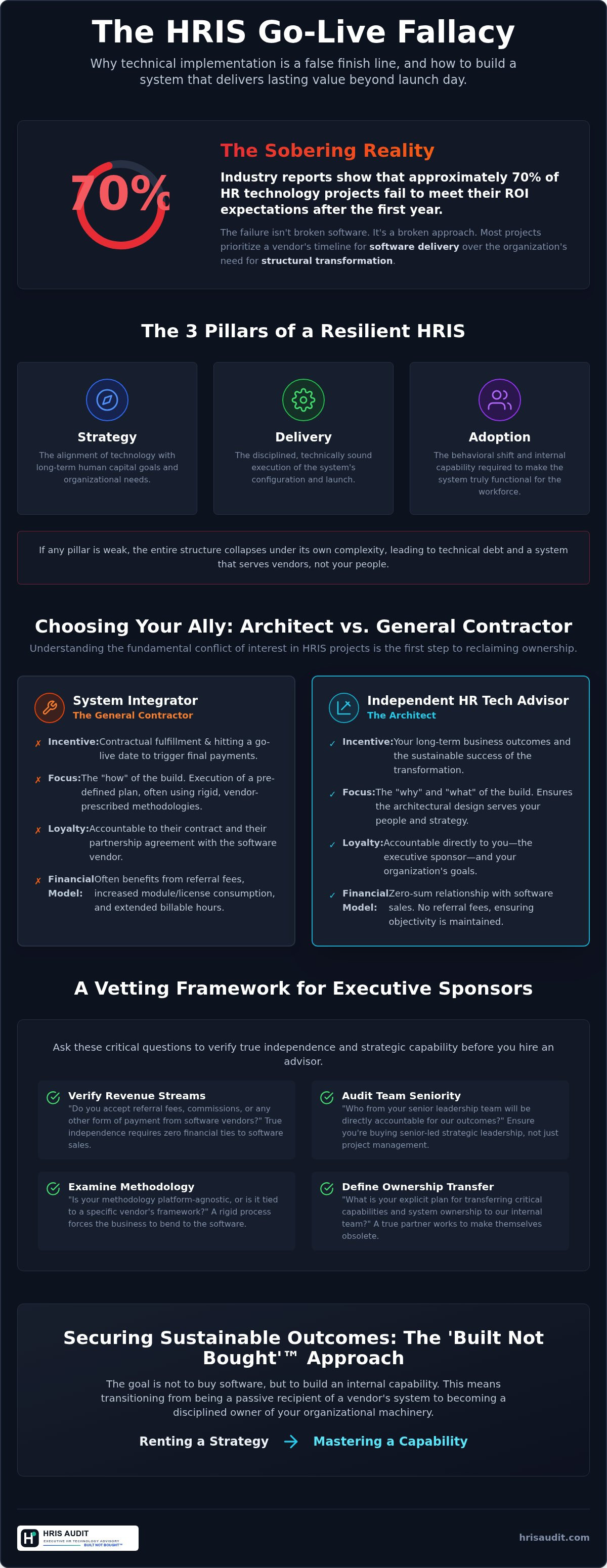
Industry reports consistently show that roughly 70% of HR technology projects fail to meet their ROI expectations after the first year. The reason is simple. The focus remains on software delivery rather than organizational maturity. To survive this, a system must stand on three pillars:
- Strategy: The alignment of technology with long-term human capital goals.
- Delivery: The disciplined execution of technical configuration.
- Adoption: The behavioral shift required to make the system functional for the workforce.
If any pillar is weak, the entire structure collapses under the weight of its own complexity. This is where the expertise of an independent HR technology advisor becomes critical. They ensure that the architectural integrity of the system isn't sacrificed for the sake of a vendor's timeline.
The Project Finish Line vs. The Maturity Start Line
System integrators are incentivized to hit a date and exit. Their success is tied to contractual fulfillment, not your long-term business outcomes. This results in "stabilization" phases that never actually end. You end up in a state of permanent repair. Transformation is the transfer of system ownership to the business. It is the moment the machinery belongs to your team, not the consultant.
The Invisible Gap in Enterprise HRIS
Technical debt accumulates when governance is outsourced. Most organizations settle for "using" a system. They follow vendor paths and accept limitations. Ownership is different. It means controlling the roadmap. It requires an independent HR technology advisor who ensures the system serves the people. Without Client-Side HR Technology Leadership, you are essentially renting your own strategy from the vendor.
Stop treating your HRIS as a project to be finished. Start treating it as a capability to be mastered. When you prioritize structural integrity over a calendar date, you move beyond mere implementation. You achieve a system that works for your organization's unique requirements.
The Independence Myth: Debunking Vendor-Aligned Advisory
Most organizations operate under a dangerous delusion. They believe a consultant recommended by their software vendor is an objective ally. It isn't true. Implementation partners are frequently incentivized to maximize software consumption. Their business model depends on it. They are rewarded for more modules, more licenses, and more billable hours. This is not a partnership; it is a sales extension.
To understand the risk, consider the "Architect vs. General Contractor" metaphor. Your implementation partner is the General Contractor. They focus on the "how" of the build. They want to finish the job according to the blueprints provided. An independent HR technology advisor is your Architect. They design the blueprint based on your specific organizational needs. They ensure the structure is sound, the foundations are deep, and the design serves the inhabitants, not the builder's profit margin. True independence requires a zero-sum financial relationship with software sales. If your advisor accepts referral fees, their objectivity is gone. Period.
Identifying Hidden Biases in Your Advisory Team
Certified partners are often constrained by vendor-prescribed methodologies. These frameworks are designed for speed and repeatability, not nuance. This leads to "cookie-cutter" implementations that ignore your unique organizational culture. When a methodology is rigid, the business is forced to bend to the software. A platform-agnostic perspective is the only way to ensure the technology serves the strategy. Without it, you aren't transforming; you're just installing.
The Value of a Client-Side Guardian
An independent advisor acts as a "BS detector" during technical gate reviews. They possess the pattern recognition to see when a vendor is pushing unnecessary scope or hiding technical debt behind a "standard feature" label. They protect the project sponsor from decisions that favor the vendor's bottom line over the client's ROI. If you suspect your project is drifting or the advice you're receiving feels scripted, a Transformation Pulse Scan can expose these hidden structural risks.
Protecting your investment requires a disciplined approach to governance. For executives who demand uncompromised clarity, engaging with specialized Advisory Services ensures that your interests remain the sole priority throughout the project lifecycle. Don't let your transformation be dictated by those who profit from its complexity.
System Integrator vs. Independent HR Technology Advisor: Choosing Your Ally
The System Integrator (SI) and the advisor are not interchangeable. They occupy different strata of the project hierarchy. An SI is a configuration engine. They ingest requirements and output code. An independent HR technology advisor is a strategic filter. They ensure those requirements actually solve a business problem before they ever reach the configuration stage. One focuses on the "how" of technical setup; the other focuses on the "why" of organizational alignment.
Accountability is the primary differentiator. Integrators are accountable to the Statement of Work (SOW). If the SOW is flawed, the SI will build a flawed system and call it a success because it matches the document. They are rewarded for speed and contractual compliance. An independent HR technology advisor is accountable to the Executive Sponsor. Their success is tied to the realization of the business case. They don't just follow the roadmap; they question whether the roadmap is leading toward a cliff.
Technical Setup vs. Outcome Governance
You cannot allow the team building the system to be the same team auditing the work. This is letting the fox guard the henhouse. Effective governance requires a separate, objective layer of oversight to validate technical milestones against strategic intent. Without this layer, you lose visibility into the structural integrity of your build. For a deeper breakdown of this structural divide, read about the HR Transformation Advisor vs. System Integrator. You need someone to govern the integrator, not just manage the project schedule.
The Capability Gap: Building Internal Muscle
Most implementation models are designed to create dependency. When the SI leaves, they often leave behind a trail of support tickets and an internal team that doesn't understand the logic behind the configuration. Their business model thrives on your inability to self-sustain. An advisor prioritizes capability transfer. The goal is to build internal muscle so your team can operate the machinery without external crutches. You must determine if your team has the skills to own the system post-launch. Use the HR System Capability Evaluation to assess your current internal readiness and identify where your team needs to grow.
Stop settling for a system that requires a permanent external life-support system. Demand a transformation that leaves your organization stronger and more capable than when you started. True ownership isn't bought through a contract; it is built through disciplined governance and intentional capability transfer.
Vetting for Independence: A Framework for Executive Sponsors
Vetting an independent HR technology advisor is not a standard procurement exercise. It is a structural audit of professional integrity. Most firms claim independence while maintaining hidden financial pipelines. You must look past the glossy presentation deck and interrogate the underlying business model. If the advisor's revenue is tied to the software vendor, their advice is compromised from the start.
Follow this five-step framework to verify objectivity:
- Audit revenue streams. Ask directly if they accept referral fees, commissions, or "partnership" kickbacks from software vendors. Any "yes" is an immediate disqualification of their independence.
- Evaluate team seniority. Large consultancies often sell the partner but deliver the junior associate. Your transformation is too complex for a trainee. Demand a battle-tested architect with decades of industry experience.
- Review their methodology. Is it designed for internal ownership or long-term outsourcing? You want a philosophy that prioritizes building your internal capability rather than selling you a pre-packaged, "bought" solution.
- Assess their tools. Do they provide proprietary assets like a Field Library? These workbooks and frameworks are the machinery of capability transfer. They ensure your team isn't starting from a blank page.
- Verify their exit strategy. A true advisor plans for their own obsolescence. If there is no clear plan to transition off the project and leave your team in control, they are building a dependency, not a solution.
Critical Questions for Your Potential Advisor
Surface-level interviews result in surface-level outcomes. You must force transparency. Ask how they challenge a software vendor when a roadmap conflicts with your strategic needs. Demand to see the specific artifacts your team will own after the engagement ends. Inquire about their process for handling decision support for the project sponsor. If the answers feel scripted or vague, the advisor lacks the necessary edge to protect your interests.
Decision Support: The Sponsor's Secret Weapon
Executive sponsors are often buried in technical jargon and vendor-supplied optimism. They need a private advisor to translate complex system issues into tangible business risks. This role acts as a strategic buffer. It allows the sponsor to master the gate review process with objective data. Engaging an independent HR technology advisor ensures the sponsor has an advocate who isn't afraid to call out technical debt or scope creep. For a deeper dive into this role, consult the Executive Guide to Sponsor Support.
Secure your transformation with specialized Advisory Services
The 'Built Not Bought' Approach: Securing Sustainable Outcomes
The Built Not Bought™ philosophy is a structural mandate. Most organizations try to buy transformation. They buy licenses. They buy integrators. They expect a finished product. This is a category error. Transformation is engineered, not purchased. Designing for internal governance ensures the system serves the organization, not the vendor's bottom line. It requires a shift from system-centricity to people-centricity. The machinery only works if the operators are capable.
This is where the independent HR technology advisor adds the most value. They don't just deliver a configured environment; they deliver a capable team. By using the Field Library workbooks, internal teams lead the design phase rather than observing it. They become the architects of their own workflows. The Transformation Studio acts as the bridge. It aligns high-level executive vision with the practical, mechanical reality of execution. It prevents the strategic drift that occurs when IT and HR speak different languages. It ensures every configuration choice is rooted in a specific business outcome.
Designing for Ownership from Day One
Ownership isn't a post-launch activity. It begins at the first requirement session. You must move from passive participation to active accountability. If your team cannot explain why a configuration exists, they don't own it. They are merely renting it. Use diagnostics to detect project rot before it becomes terminal. A disciplined approach identifies weak foundations early. For those seeking the foundational logic of this method, the Built Not Bought Book provides the necessary blueprints for structural integrity.
The Future of HRIS Leadership
The next generation of HR leaders will reject vendor-led narratives. they will demand an independent HR technology advisor to guard their interests. They understand that platform-agnostic maturity is the only defense against technical obsolescence. The goal is a system that remains agile as the organization evolves. Order, discipline, and ownership are the only paths to a sustainable HRIS roadmap. Stop allowing vendors to dictate your organizational structure. Reclaim your roadmap. For a sober assessment of your current transformation and its long-term viability, contact HRIS Audit.
Reclaiming Your HRIS Roadmap
Software delivery is a mechanical event. True transformation is a structural shift in organizational maturity. You've seen how the go-live fallacy erodes long-term ROI and why vendor-aligned interests compromise your strategic foundation. Securing a sustainable future requires more than just a configuration partner. It requires a platform-agnostic strategy and a disciplined commitment to internal ownership from the first requirement session.
Engaging an independent HR technology advisor ensures your interests remain the sole priority throughout the project lifecycle. With 30+ years of battle-tested industry experience and the proprietary Built Not Bought™ methodology, HRIS Audit provides the client-side leadership necessary to move from passive participation to total system mastery. As the author of the definitive guide to HR transformation, we provide the frameworks needed to bridge the gap between technical launch and enduring value.
Request a Transformation Pulse Scan to detect risk in your HRIS program
Your HRIS should be a strategic asset you own, not a technical liability you rent. Take the first step toward building a system that finally works for your people and your business. You have the vision; now secure the structural integrity to realize it.
Frequently Asked Questions
What is an independent HR technology advisor?
An independent HR technology advisor is a platform-agnostic consultant who provides client-side leadership without financial ties to software vendors. They focus on structural integrity and business outcomes rather than technical configuration. Their primary role is to protect the executive sponsor's interests and ensure the system architecture aligns with long-term strategic goals. They act as the architect, not the builder.
How does an independent advisor differ from a system integrator?
System integrators are configuration engines focused on technical delivery and contractual fulfillment. They are incentivized to hit a date and exit. In contrast, an independent HR technology advisor acts as a strategic filter, governing the integrator's work to ensure quality. While integrators are accountable to a Statement of Work, an advisor is accountable to the Sponsor's business case.
When is the best time to hire an independent HRIS consultant?
The optimal time is during the pre-selection phase, before any vendor contracts are signed. Engaging an advisor early allows you to define a neutral roadmap and establish governance structures. This prevents the vendor-led design traps that lead to technical debt. Waiting until implementation has started often means you're already inheriting a flawed foundation that requires expensive remediation.
Can an independent advisor help with a failing HR implementation?
Yes. They act as a specialized diagnostic resource to identify the root causes of project drift or technical debt. By conducting a structural audit, they realign the project roadmap and reset vendor expectations. It's about moving from permanent repair to sustainable ownership. They provide the "tough love" expertise needed to salvage the investment and establish proper governance.
Does hiring an advisor increase the total cost of the project?
Actually, it typically reduces the total cost of ownership by eliminating unnecessary scope and preventing post-go-live rework. While there is an upfront investment in advisory services, the long-term savings from avoiding vendor bias and technical debt are substantial. It is a strategic insurance policy against the high failure rates common in enterprise HCM transformations.
What should I look for in an HR technology advisor's methodology?
Look for a framework that prioritizes capability transfer and internal ownership, such as the Built Not Bought™ method. The methodology should provide tangible artifacts, like a Field Library of workbooks, that empower your team to lead. If the methodology relies on permanent external dependency or lacks proprietary tools, it is a staffing model, not an advisory framework.
Why is vendor neutrality so important in HRIS selection?
Vendor neutrality ensures your technology choices are driven by business requirements, not salesperson quotas or referral fees. When an independent HR technology advisor is truly neutral, they can objectively evaluate which platform fits your organizational maturity. This eliminates hidden biases that lead to cookie-cutter implementations. Without neutrality, you are essentially renting your strategy from someone with a conflict of interest.
How do independent advisors handle capability transfer to internal teams?
Capability transfer is achieved through disciplined governance and the use of proprietary tools that force internal teams to engage with the system design. Instead of just delivering a configured environment, the advisor coaches the team through the build process. This ensures that when the engagement ends, your people possess the knowledge to operate the machinery independently without relying on external support tickets.


