

Most HR transformations fail because the design was never truly yours. Is your implementation partner's template the foundation of your future, or is it a structural weakness waiting to buckle? You've felt the frustration of being led by a vendor's script, watching internal capabilities erode while decision paralysis stalls your executive sponsors. It's a common trap. Relying on generic SI playbooks creates a system you don't own and cannot sustain.
We're changing the motion. By utilizing specialized HR transformation facilitation guides, you can master the architectural design process and ensure your technology is Built Not Bought™. This article outlines a disciplined method to lead your internal teams, provides tools for systemic design, and clarifies the gate reviews necessary for long-term integrity. You don't need another software manual. You need a blueprint for ownership. We'll explore how to move from passive participation to strategic authority, ensuring your 2026 transformation is a pillar of organizational maturity rather than a costly renovation.
Key Takeaways
- Transition from administrative coordination to strategic leadership by using HR transformation facilitation guides to navigate complex architectural motions.
- Implement the Built Not Bought™ method to ensure your internal team owns the design process rather than defaulting to generic vendor templates.
- Utilize decision support frameworks and gate reviews to identify structural weaknesses before they become permanent configuration errors.
- Leverage the Field Library to scale internal expertise, reducing reliance on external system integrators while increasing organizational maturity.
- Bridge the gap between high-level executive vision and the practical machinery of software implementation through disciplined, client-led facilitation.
What is an HR Transformation Facilitation Guide?
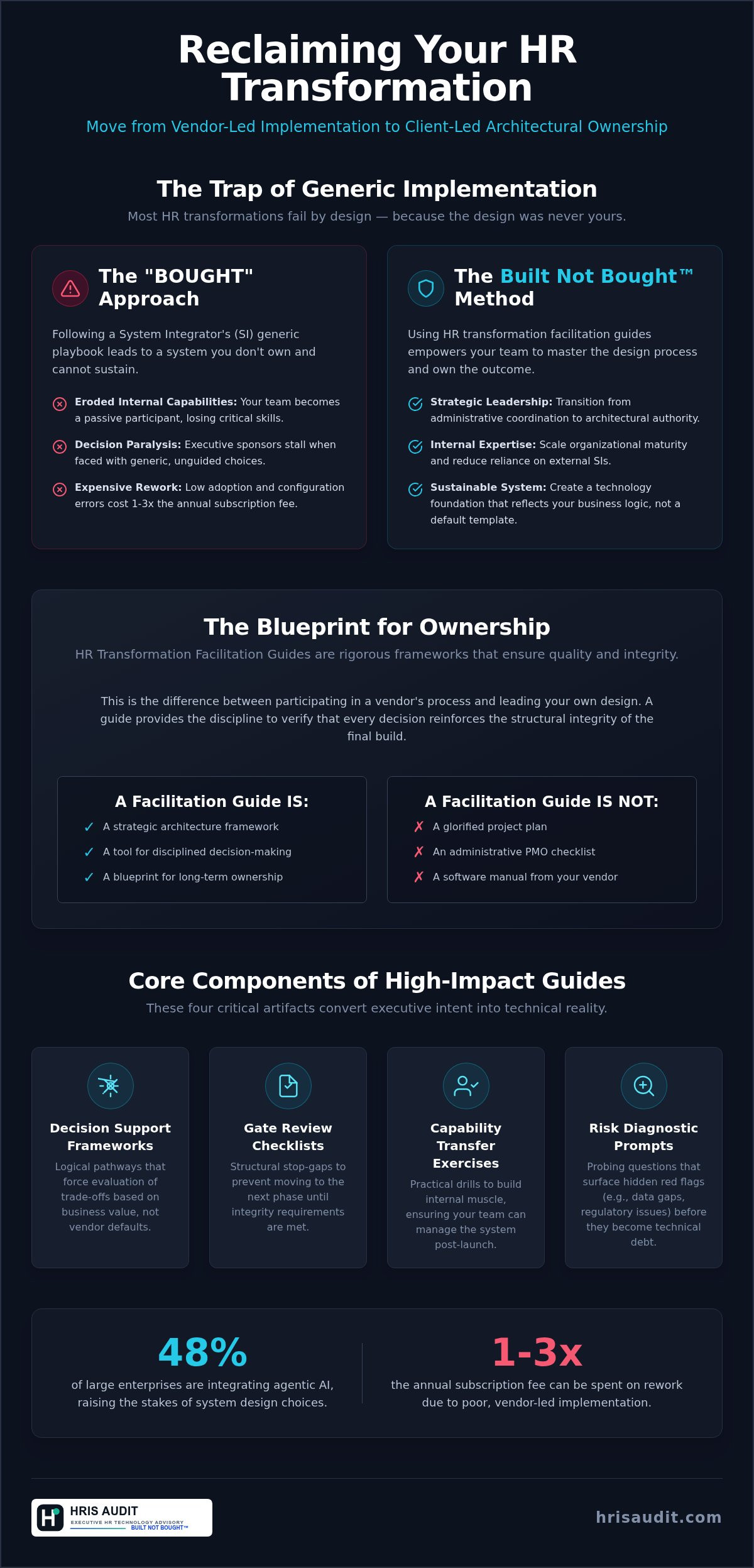
An HR transformation facilitation guide is not a glorified project plan. It is a rigorous, structured framework designed to navigate executive sponsors and project teams through the high-stakes decision-making motions of a technology shift. While a PMO checklist tracks completion, a facilitation guide ensures quality. It moves beyond administrative coordination into the realm of strategic architecture. In the complex environment of 2026, where 48% of large enterprises are already integrating agentic AI and navigating new state-specific AI discrimination laws, the stakes of these decisions have never been higher. Without a guide, you aren't leading a transformation. You're simply reacting to a vendor's timeline.
Facilitation vs. Implementation
Your System Integrator (SI) has a guide. It's designed for their efficiency, not your ownership. They want a "Go-Live" that meets their contract milestones. You need a system that survives the next decade. This is the distinction between participating in a vendor's process and leading your own design. Passive participation is the primary cause of technical debt. When you follow an SI's template blindly, you inherit their shortcuts. Effective change management requires a client-led approach where the internal team owns every configuration choice. Poor facilitation results in a system that's "bought" rather than "built," leading to low adoption and expensive rework that can cost one to three times the annual subscription fee.
The Architecture of a Decision
Every design choice is a structural commitment. HR transformation facilitation guides map complex human processes to specific system capabilities without losing strategic intent. These tools ensure every decision aligns with your long-term HR technology governance framework. They force a necessary shift from "how we do it today" to "how we must operate tomorrow." This isn't about building consensus. It's about alignment with organizational maturity. We treat these choices as integrated components of a larger machine. If one gear is misaligned, the entire system fails. A facilitation guide provides the discipline to verify that every "motion" reinforces the structural integrity of the final build. This disciplined approach prevents the decision paralysis that often plagues executive sponsors when faced with thousands of configuration options. Using HR transformation facilitation guides ensures that the final product is a reflection of your business logic, not just a software default.
Core Components of High-Impact Facilitation Guides
High-impact HR transformation facilitation guides are not passive documents. They are active machinery. These guides convert executive intent into technical reality through four critical artifacts: decision support frameworks, gate review checklists, capability transfer exercises, and risk diagnostic prompts. Each component serves as a structural pillar. Without them, the project is merely a series of expensive meetings. A robust guide ensures that every design session produces a tangible, documented outcome that reinforces the overall architecture of the system.
- Decision Support Frameworks: Logical pathways that force sponsors to evaluate configuration trade-offs based on business value rather than vendor defaults.
- Gate Review Checklists: Structural stop-gaps that prevent the project from moving to the next phase until specific integrity requirements are met.
- Capability Transfer Exercises: Practical drills designed to build internal muscle, ensuring your team can manage the system long after the consultants leave.
- Risk Diagnostic Prompts: Probing questions that surface hidden implementation red flags, such as misaligned data structures or regulatory gaps, before they manifest as technical debt.
Governance and Decision Support
Decision fatigue is a virus in multi-year programs. Sponsors often start with high energy but eventually begin making easy choices instead of hard ones. Facilitation guides counteract this by mandating binding, strategic decisions at every turn. You shouldn't be asking what the software can do. You should be asking what your operating model demands. Using HR transformation tools and frameworks allows you to visualize future-state outcomes before they are hard-coded. This is the sober truth of governance: if a decision isn't documented and tested against the blueprint, it isn't a decision. It's a guess.
Design and Capability Transfer
True transformation happens when the internal team stops watching and starts doing. Effective HR transformation facilitation guides integrate editable workbooks directly into the design session flow. Documentation isn't a post-meeting chore. It's the output of the design motion itself. This ensures the resulting HR system design framework is something your team actually understands and can defend. While you can find a comprehensive guide to HR transformation to understand the theory, the practical machinery is found in the Studio. Hands-on capability building requires "Studio" style workshops where the team manipulates the architecture themselves. This is the only way to ensure the system is Built Not Bought™. For those ready to audit their current trajectory, our Field Library frameworks provide the specific gate reviews needed to protect structural integrity.
Built Not Bought: The Facilitation Philosophy
The core philosophy is simple: you cannot buy a transformation. You can only build one. A "Bought" implementation is a passive surrender to vendor-standard templates and system integrator timelines. It is a surface-level installation that ignores the unique structural requirements of your business. Conversely, a "Built" transformation is an active, client-led exercise in strategic HR leadership. It requires HR transformation facilitation guides that act as a bridge between rigid software capabilities and your organizational reality. This shift in perspective moves your team from being "users" of a system to becoming its "architects."
Objectivity is the foundation of this approach. Facilitation must remain platform-agnostic. If your facilitation is tied to a specific software vendor’s methodology, you’ve already lost your independence. The goal is to design a system that reflects your business logic, regardless of which tool sits in the background. We treat technology as the servant of the strategy, not its master.
The Vendor Conflict of Interest
System Integrators (SIs) are incentivized for speed. Their business model relies on moving resources from your project to the next as quickly as possible. This creates a natural conflict with your need for long-term sustainability. They want a "standard" configuration because it's faster to implement, even if it creates technical debt for you later. Independent HR transformation facilitation guides allow you to have "Tough Love" conversations with your partners. They provide the evidence needed to push back on shortcuts. You aren't paying for a "Go-Live" date; you are paying for a functioning organizational machine.
Achieving Sustainable Outcomes
A successful transformation isn't measured on the day the software turns on. It’s measured six months later when the implementation team is gone. A Built Not Bought HR strategy focuses on this "Day 2" reality. It ensures the system doesn't collapse once the external support is removed. By using a Field Library to maintain design discipline, you ensure that every configuration choice is documented, understood, and manageable by your internal team. We don't facilitate for the celebration. We facilitate for the structural integrity of the system in 2026 and beyond. This disciplined approach prevents the post-launch erosion of value that plagues most enterprise projects.
Deploying Facilitation Guides Across the Lifecycle
Deployment is not a flat library of templates. It is a chronological blueprint. It demands a sequence of four distinct, non-negotiable motions that ensure the system evolves from a concept into a pillar of organizational strength. Strategic HR transformation facilitation guides provide the structure for these phases, preventing the project from devolving into a series of disconnected tasks. Each step is a gate. Each gate requires proof.
- Step 1: Discovery and Strategy Alignment. Facilitating the "Why." We align high-level executive vision with the practical machinery of the business.
- Step 2: Design and Configuration. Facilitating the "How." This is where we map complex business logic to the software architecture.
- Step 3: Testing and Readiness. Facilitating the "Proof." We verify that the build meets the structural requirements defined in the blueprint.
- Step 4: Adoption and Optimization. Facilitating the "Value." We ensure the system produces the intended outcomes and scales with the organization.
Early-Stage Alignment
Alignment begins with a diagnostic. Using a HR transformation pulse scan allows you to set a precise facilitation agenda from day one. It identifies design risks before they are hard-coded into the environment. If the initial designs begin to drift from the core strategy, the guide provides the framework for a Program Reset. This is a disciplined pause, not a failure. It's a necessary correction to protect the long-term integrity of the system. During this phase, you must establish the governance motions that will endure for years. These aren't temporary project rules. They are the foundations of your future operating model.
Pre-Go-Live Readiness
The final push to launch is the most dangerous period of the lifecycle. Vendors often claim readiness based on technical milestones and "green" project plans. You must verify readiness based on actual organizational capability. Facilitating rigorous gate reviews allows you to challenge vendor claims objectively. You aren't checking boxes; you're auditing structural integrity. Has the capability transfer actually occurred? Can your internal team manage the system on Day 2? We manage the emotional landscape of this phase by replacing desperation with data. Discipline replaces anxiety. The goal isn't just to turn the software on. The goal is to ensure the organization is ready to own it.
Schedule your Pulse Scan diagnostic today
Scaling Internal Capability with the Field Library
Scaling is the ultimate test of organizational maturity. You cannot rely on a single heroic leader or an external consultant to maintain the integrity of a multi-year program. You need a system that replicates expertise across the entire enterprise. This is where HR transformation facilitation guides evolve from project artifacts into a permanent Field Library. A licensed model allows you to move from one-off facilitation to a repeatable, disciplined motion. It ensures that every architect in your organization uses the same precision tools. Expertise becomes an asset you own, not a service you rent.
Large, decentralized organizations face a unique risk: design drift. Without a unified method, one workstream might build a skyscraper while another builds a cottage. A licensed Field Library provides the professional-grade workbooks and diagnostics required to enforce a single standard of structural integrity. It standardizes the design language across Payroll, Talent, and Benefits. This integration is further strengthened when guides are used alongside Transformation Studio sessions. The Studio provides the high-intensity practice; the Field Library provides the permanent blueprint. Together, they create a culture of ownership that survives long after the initial implementation is complete.
The Field Library Advantage
Accessing a licensed library of diagnostics and workbooks changes the power dynamic of your transformation. You no longer need to wait for a consultant to bring their "proprietary" templates to the table. You already own the framework. This independence significantly reduces reliance on expensive external consulting. By transferring capability to your internal teams, you ensure that the people managing the system on Day 2 are the same people who designed it. It is a shift from renting knowledge to building institutional muscle. Consistency, discipline, and ownership are the primary returns on this investment.
Next Steps for HR Leaders
Evaluate your current facilitation capability with cold objectivity. Is your team leading the vendor, or is the vendor leading your team? If you don't have a structured method to lead internal design, you're at risk of a "Bought" implementation. The first step toward structural authority is introducing the Built Not Bought™ method to your steering committee. This foundational guide ensures every project member understands the stakes of systemic design. It sets the philosophical stage for everything that follows.
Once the mindset is established, you must identify your specific facilitation gaps. Request a Transformation Pulse Scan to audit your project's health. This diagnostic provides the sober truth about your current trajectory and identifies exactly where your facilitation is failing. Stop guessing at your readiness. Start using the architectural motions that ensure your system is built for the long-term. The integrity of your 2026 transformation depends on the discipline you apply today.
Securing Structural Integrity for 2026
Transformation is not an event. It's an architectural commitment. Relying on vendor scripts guarantees technical debt and systemic weakness. True ownership requires the discipline of HR transformation facilitation guides to bridge the gap between software defaults and organizational strategy. You've seen the pattern: systems that look acceptable at launch but collapse under the weight of "Day 2" reality because the internal team lacks the capability to manage the build.
We provide the machinery to prevent that erosion. With 30+ years of battle-tested experience, our focus remains on the structural integrity of your build. The Built Not Bought™ methodology isn't just a philosophy. It's a rigorous, disciplined framework used by global enterprises to reclaim their design authority and ensure long-term stability. Stop renting expertise. Start building muscle. Your internal team must be the architects of your future, not just the users of a vendor's product.
Explore the HRIS Audit Field Library and Facilitation Guides
Reclaiming your design authority is the only path to a sustainable HR ecosystem. Build it right the first time.
Frequently Asked Questions
What is the difference between a project plan and a facilitation guide?
A project plan is a schedule of tasks; an HR transformation facilitation guides is a blueprint for decision-making. While the plan tracks milestones like Go-Live, the guide ensures the structural integrity of the configuration itself. It provides the motions your team needs to lead design sessions rather than just attending them. These guides shift the focus from administrative completion to strategic ownership. Without this architectural layer, you're simply following a vendor's timeline.
Do we need a facilitation guide if we have a Big 4 consulting firm?
Yes, because Big 4 firms often prioritize their own templates and delivery efficiency over your long-term sustainability. They are implementers; you need to be the architect. Even with a major partner, you need independent facilitation to protect your interests. Their goal is a successful project exit; your goal is a functioning organizational machine. A facilitation guide empowers your team to challenge vendor defaults and ensure the system is Built Not Bought™.
How do facilitation guides help with system adoption?
Adoption is the natural result of a system that works for the business. Facilitation guides ensure the design process captures your unique operating model rather than forcing you into a software-standard box. When users see their own logic reflected in the tool, resistance disappears. High-impact facilitation moves the conversation from technical features to business outcomes. This ensures the system is a pillar of support rather than a source of friction for the workforce.
Can these guides be used for any HRIS platform like Workday or Oracle?
These guides are platform-agnostic because business logic transcends software features. Whether you are deploying Workday, Oracle, or SAP, the fundamental motions of governance and systemic design remain constant. The software is merely the engine; the facilitation guide is the steering mechanism. By focusing on your organizational requirements first, you ensure that the technology serves the strategy. This prevents you from becoming a hostage to the specific limitations or defaults of any one platform.
Who should be the primary facilitator for an HR transformation?
The primary facilitator should be a senior internal leader or an independent strategic advisor who has no financial stake in the software sale. This role requires the battle-tested authority to push back on executive sponsors and implementation partners alike. They must act as a bridge between the high-level vision and the practical machinery of the project. Effective facilitation demands objectivity. If the facilitator is also the one selling the software, the conflict of interest is unavoidable.
How often should we update our facilitation frameworks?
Frameworks should be reviewed at every major gate and updated when external pressures shift. For instance, the new 2026 AI discrimination laws in states like Illinois and Texas require immediate adjustments to your talent acquisition facilitation. However, the core architectural principles of the Built Not Bought™ method remain stable. You don't change the blueprint's foundation, but you must adjust the motions to account for shifting regulatory landscapes and increasing organizational maturity levels.
What happens if our implementation partner resists our facilitation guides?
Resistance from an implementation partner is a significant red flag that often indicates a priority on their profit margins over your system's integrity. If they resist your HR transformation facilitation guides, it's usually because your disciplined approach interferes with their shortcuts. You must use your governance authority to enforce these guides. Remember, you are the architect. The partner is the builder. They don't get to decide how your house is designed.
How do I measure the success of my facilitation efforts?
Measure success by the level of internal capability on Day 2. If your team can manage configuration changes, troubleshoot data errors, and lead governance reviews without external help, your facilitation was successful. Other metrics include the percentage of design decisions that align with your initial Pulse Scan and the absence of technical debt post-launch. Success isn't a Green project status. It's a system that maintains its structural integrity six months after the consultants leave.


