
Most HR workshops are expensive talk shops designed to generate consensus rather than construction. You've likely experienced the cycle. Post-it notes on the walls. High-level visions that evaporate the moment the system integrator hands over the keys. With 82 percent of HR professionals now expected to blend their roles with IT and analytics, these old models are insufficient. You know that a successful HR transformation studio workshop requires more than just showing up. It requires structural ownership. The goal isn't participation; it's precision.
This is where the paradigm shifts. You can move from passive facilitation to active structural design by utilizing the Built Not Bought™ method. We'll explore how this approach replaces generic templates with rigorous internal capability transfer. You'll learn to establish clear governance and decision support systems that ensure your technology reflects your specific organizational logic. We're moving beyond the meeting room. We're building a system for long-term sustainability. It's time to stop buying someone else's solution and start building your own.
Key Takeaways
- Distinguish between the high-energy "workshop trap" and the disciplined environment of a Studio where structural blueprints are actually drafted.
- Apply the Built Not Bought™ methodology to shift from purchasing vendor-driven solutions to designing systems that reflect your unique organizational logic.
- Leverage the Transformation Pulse Scan and the Field Library to establish rigorous architectural standards before the design phase begins.
- Execute a high-impact HR transformation studio workshop to bridge the gap between executive vision and the mechanical reality of system implementation.
- Secure long-term sustainability by integrating studio outcomes into a robust enterprise governance framework that survives far beyond the go-live date.
The Fallacy of the Facilitated Event: Why HR Transformations Need Studios, Not Just Workshops
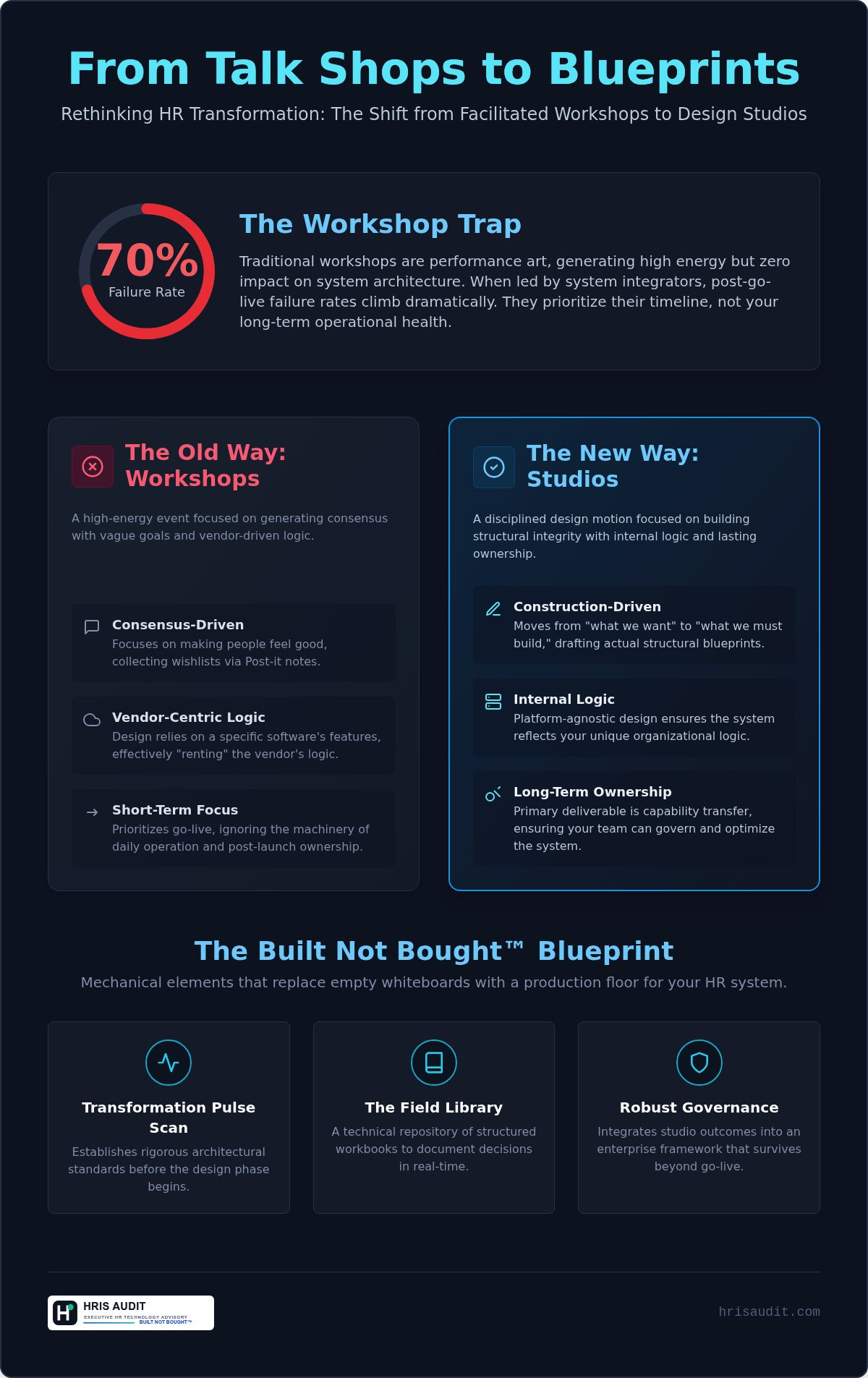
Traditional workshops are performance art. They generate heat but no light. You've seen the result: a room full of stakeholders agreeing on vague goals while the actual system design remains a black box. This is the Workshop Trap. High energy during the session leads to zero impact on system architecture. When these sessions are led by system integrators, the failure rate post-go-live climbs to 70 percent. Vendors prioritize their implementation timeline. They don't prioritize your long-term operational health.
An effective HR transformation studio workshop is not a facilitated event. It's a design motion. It moves the conversation from the public consensus of "what we want" to the private structural integrity of "what we must build." We replace the whiteboard with a blueprint. We move from talking about change to executing the mechanical shifts required for success. This requires a departure from standard change management principles that often focus on sentiment rather than system logic. The goal isn't to make people feel better about the software. It's to build a system that actually works.
Moving from Consensus to Construction
Stop asking your team what they want. It invites a wishlist of features that your organization cannot sustain. Instead, ask how the team will own the system. The Studio forces hard design decisions early. It demands a platform-agnostic perspective. If your design relies solely on a specific software's features, you aren't building a system; you're renting a vendor's logic. True transformation requires the Built Not Bought™ philosophy to ensure the foundation remains yours. We focus on the mechanical necessity of making these hard choices before the first line of code is configured.
Addressing the Post-Go-Live Ownership Gap
Most workshops ignore the reality of Day 2. They focus on the ribbon-cutting of go-live and ignore the machinery of daily operation. A Studio environment prepares your team for client-side HR technology leadership. It's about capability transfer. We design for sustainability. We ensure your internal team has the knowledge to govern, optimize, and pivot the system without a permanent reliance on outside integrators. Ownership isn't a post-script. It's the primary deliverable. If the team can't run the system on day two, the transformation failed on day one.
Inside the Built Not Bought™ Blueprint: Mechanical Elements of the Studio
The Studio environment is not a brainstorming session. It is a production floor. Where traditional workshops rely on "agendas" that list topics for discussion, the Studio utilizes "motions." A motion is a disciplined, repeatable action designed to produce a specific architectural artifact. This shift is fundamental. We move away from the high-level abstractions of vendor presentations and toward the sober reality of system construction. At its core, the Built Not Bought™ philosophy dictates that if you don't design the logic, you don't own the outcome. Ownership is the objective. Blueprints are the means.
Strategic decision-making in this environment requires stripping away marketing hyperbole. We treat HR processes as integrated mechanical systems rather than isolated administrative tasks. While many leaders seek a comprehensive guide to HR transformation to understand the broader industry shifts, the Studio provides the practical machinery to execute those shifts internally. It's the difference between studying a map and actually grading the road.
Leveraging the Field Library for Structural Design
Blank pages are the primary enemy of progress. The Field Library serves as the Studio’s technical repository, replacing empty whiteboards with structured, editable workbooks. These tools force teams to document governance and design decisions in real-time. By adhering to a rigorous HR system design framework, organizations can identify structural flaws before they are hard-coded into a platform. Proprietary diagnostics within the library act as stress tests. They reveal where existing technical debt or process fragmentation will likely cause system failure. For those ready to audit their current trajectory, the Transformation Pulse Scan provides the necessary baseline data to begin this design motion.
From Vision to Executable Governance
Governance is a design activity, not an administrative burden. In an HR transformation studio workshop, the primary task is translating executive intent into technical requirements that a system can actually execute. We establish Gate Review criteria. These are mechanical checkpoints that ensure every configuration decision remains aligned with the original blueprint. If a proposed process doesn't pass the gate, it doesn't move to the implementation phase. This discipline prevents the "scope creep" that typically plagues vendor-led projects. We ensure that the final system reflects the organization's unique business logic rather than the default settings of a software package. Governance becomes the guardian of your structural integrity.
Strategic Comparison: Studio Workshops vs. Traditional HR Consulting
Traditional HR consulting is a market defined by misaligned incentives. Most enterprise projects are led by System Integrators (SIs) who operate under a fundamental conflict of interest. Their revenue is tied to configuration hours, software licenses, and vendor partnerships. This bias prioritizes the platform's capabilities over the organization's strategic needs. In contrast, an HR transformation studio workshop acts as an independent design motion. It is platform-agnostic. It prioritizes the human and strategic elements of technology over the specific tools themselves. We don't build software. We build the internal capability to lead it.
The difference is one of perspective. The SI sees a project; the Studio sees a system. The SI delivers a go-live; the Studio delivers a legacy. Before entering these high-stakes comparisons, organizations often benefit from a Transformation Pulse Scan to establish their baseline maturity. This diagnostic ensures that the subsequent design motion is rooted in data rather than assumptions.
Client-Side Leadership vs. System Integration Bias
The SI wants to configure the tool; the Studio helps you architect the business process. This distinction is critical. Most organizations enter vendor negotiations without a clear blueprint, effectively allowing the vendor to dictate the business logic. Client-side leadership is the guardian of your interests. It provides the necessary friction to challenge vendor assumptions. We maintain objectivity in a platform-heavy market. We ensure that the system serves the strategy, not the other way around. This requires a shift in focus. We move from "how does the software work" to "how does the business operate."
The "Built Not Bought" Differentiator
Buying a "best practice" configuration is an admission of defeat. It is a generic solution applied to a specific problem. A Built Not Bought™ approach, as detailed in our foundational methodology, rejects these templates. We provide "tough love" expertise. We challenge your internal teams to look past surface-level solutions toward deeper structural foundations. Our pattern recognition, earned through 30+ years of industry experience, allows us to identify design flaws before they become technical debt. We don't offer a "talk shop." We offer a construction zone. The result is a system built for sustainability. It is a system your team understands, operates, and owns. Ownership is the only path to a successful post-go-live reality.
Operationalizing the Studio: How to Execute the Design Motion
Execution requires more than an agenda. It demands a rigorous diagnostic baseline. You don't enter an HR transformation studio workshop hoping for the best. You enter with a survey of the damage. We begin with the Transformation Pulse Scan. This diagnostic reveals the technical debt and process fragmentation that generic workshops ignore. It sets the stage for architectural standards. These standards must be locked before the first session begins. They define the rules of the road for configuration, data migration, and integration. Without them, you're just having a meeting. You aren't designing a system. You're simply reacting to vendor suggestions.
Participant selection is a mechanical choice, not a political one. We distinguish between governance leads and subject matter experts (SMEs). Governance leads possess the authority to make binding design decisions. SMEs provide the localized data required to inform those decisions. Mixing these roles without clear boundaries creates organizational gridlock. It leads to design by committee, which is the antithesis of structural integrity. Maintaining this discipline throughout the HR transformation studio workshop ensures that the resulting governance model is robust enough to survive the implementation phase. It forces sponsors to own the tough love decisions that define the system's future.
The Diagnostic Phase: Detecting Risk
Risk detection is the first motion. By utilizing the HR transformation pulse scan, we identify Red Zones in program health. These are the critical areas where the current trajectory is likely to result in post-go-live failure. We establish a baseline of structural integrity that allows the project team to see where the foundation is crumbling. This data-driven approach ensures the Studio agenda is focused on remediation and construction rather than abstract visioning. We stop guessing and start grading the architectural reality of the project.
Facilitating the Decision Motion
Gridlock is the natural state of large organizations. Breaking through it requires specific facilitation guides designed for structural design. These guides drive specific design outputs, moving the team from vague agreement to documented technical requirements. Every major system decision must be documented with its underlying "Why." This creates a trail of logic that survives personnel changes, budget cuts, and vendor rotations. It transforms a subjective preference into a documented architectural standard that the organization can actually operate.
Execute the Transformation Pulse Scan
Securing the Foundation: From Studio Insights to Sustainable Delivery
The Studio is not an isolated event. It is the first stage of the Delivery Motion. Most projects treat the workshop as the finish line of strategy. This is a fatal error. The outputs of an HR transformation studio workshop are the functional blueprints for the build phase. This transition requires a shift from theoretical design to mechanical execution. We don't archive these insights. We integrate them directly into an HR technology governance framework. This ensures that every configuration choice made during implementation is anchored in the original structural logic. Design is only valuable if it dictates delivery.
Scaling these outcomes across a global enterprise requires more than just documentation. It requires a disciplined application of standards. Continuous advisory serves as the guardian of this structural integrity. It provides the necessary objectivity to challenge internal compromises. Without this ongoing oversight, global projects often fragment into localized workarounds that erode the system's value. We maintain the integrity of the whole by governing the parts. This is where the pattern recognition of a seasoned advisor becomes essential. We identify common failure points in global rollouts before they manifest as technical debt.
Continuous Governance and Gate Reviews
The Studio Blueprint is not a suggestion. It is the law of the project. Regular gate reviews act as mechanical checkpoints. They prevent the scope drift that occurs when technical teams prioritize platform features over business requirements. By maintaining the discipline of the Built Not Bought™ method, we ensure the system remains a reflection of your organizational needs. We don't allow the software to dictate the process. We force the process to govern the software. This level of rigor is what separates a successful transformation from an expensive software implementation.
Achieving Sustainable People-Centric Outcomes
Success is not measured by the go-live date. It is measured by adoption, optimization, and long-term ownership. The final motion of the HR transformation studio workshop is the transition from project team to operational owners. This is the moment of capability transfer. We ensure your internal team possesses the intellectual authority to operate the system without a permanent reliance on outside advisors. We build for sustainability. We design for the reality of Day 2 and beyond. The system must be resilient enough to handle the evolving needs of the workforce without requiring a complete redesign every three years.
Ready to build? Contact HRIS Audit to schedule your Transformation Studio.
Architecting the Future of HR Technology Ownership
HR transformation is a mechanical challenge that requires a structural response. You've learned that a successful HR transformation studio workshop is not an exercise in consensus; it's a motion of construction. By replacing generic vendor templates with the Built Not Bought™ method, you secure the internal capability required to lead your own system. We've moved beyond the meeting room to define the blueprints of sustainable delivery. Governance is no longer a burden. It's the guardian of your architectural integrity.
Success depends on your ability to transition from a passive participant to a client-side leader. With over 30 years of enterprise experience, we provide the platform-agnostic advisory needed to navigate high-stakes design decisions. Don't leave your organizational logic in the hands of a system integrator. Build a foundation that lasts.
Design your system for sustainability with a Transformation Studio Workshop
The machinery of your future organization is waiting to be built. Start the design motion today and take command of your transformation journey.
Frequently Asked Questions
What is the difference between an HR transformation workshop and a Studio session?
A Studio session is a design motion focused on construction, whereas a traditional workshop is a facilitated event focused on consensus. While workshops often result in vague goals and Post-it notes, the HR transformation studio workshop produces actionable structural blueprints. It shifts the focus from what you want to how you'll own the system. This environment prioritizes the mechanical reality of implementation over the high-level abstractions of vendor presentations.
How long does a typical HR Transformation Studio workshop take to complete?
A typical engagement duration varies based on organizational complexity, but the core design motion often spans two to three days of intensive architectural work. This is preceded by a diagnostic phase using the Transformation Pulse Scan to set the agenda. The objective isn't to fill a calendar but to execute specific motions that result in documented governance. Speed is never prioritized over the structural integrity of the final design.
Does our system integrator (SI) need to be present during the Studio workshop?
No, the system integrator shouldn't be present during the Studio design phase. The Studio exists to establish client-side leadership and independent business logic before the SI begins configuration. Including the vendor early often introduces a conflict of interest, as their priority is implementation speed rather than your long-term operational sustainability. We ensure your team owns the blueprint before the contractor starts the build.
What specific outcomes should we expect from a Built Not Bought™ Studio?
You should expect documented technical requirements, a robust governance framework, and a clear path for internal capability transfer. The Built Not Bought™ method ensures that the final output is a system designed for your specific organizational logic rather than a generic vendor template. These outcomes act as the architectural standards that govern the implementation phase. You gain the intellectual authority to operate the system long after the project team departs.
Can a Transformation Studio workshop help rescue a failing HRIS implementation?
Yes, the Studio is an ideal mechanism for a program reset when an implementation is veering toward failure. By utilizing the Transformation Pulse Scan, we identify the specific red zones and technical debt causing the friction. The Studio then provides the controlled environment needed to strip away failing processes and redesign the structural foundation. It's a strategic intervention designed to recover ownership and ensure a sustainable post-go-live reality.
What roles from our organization should participate in the Studio?
Participation is limited to governance leads with decision-making authority and subject matter experts (SMEs) who provide localized data. We avoid the design by committee trap by clearly defining these roles before the first session. Governance leads focus on the architectural integrity of the system, while SMEs ensure the design reflects operational needs. This disciplined selection prevents organizational gridlock and ensures that every motion results in a binding design decision.
How does the Field Library support the workshop process?
The Field Library provides the technical machinery for the Studio, replacing blank whiteboards with licensed, editable workbooks and diagnostics. It ensures that the team follows a disciplined HR transformation studio workshop structure rather than reacting to subjective preferences. These proprietary tools act as the scaffolding for your design. They force the documentation of the why behind every major decision, creating a trail of logic that survives the lifecycle of the project.
Is the Studio approach applicable to all HCM platforms like Workday, Oracle, or SAP?
The Studio methodology is entirely platform-agnostic and applies to Workday, Oracle, SAP, or any other enterprise HCM system. Our focus remains on the strategic and human elements of technology rather than the specific software features. By designing your business logic independently of the tool, you ensure that the technology serves the strategy. This approach prevents vendor lock-in and allows your organization to maintain structural integrity regardless of the underlying platform choice.


