

Your system integrator isn't your architect; they're your builder. If you rely on them to design your long-term stability, you've already lost control. Most organizations treat implementation as a finish line. In reality, it's just the moment the structural load shifts to your internal team. Without a rigorous HR technology governance framework, your global decision-making fragments. Adoption collapses. The technology becomes a liability rather than an asset. You've likely felt this friction before. It's the gap between the promise of the software and the reality of its daily operation.
It's frustrating to watch a multimillion-dollar investment erode because of poor structural integrity. You need a system that works as well in year three as it did on day one. This guide provides the architectural blueprints to ensure your systems remain sustainable long after the external consultants leave. We'll examine the mechanics of strategic alignment, define clear accountability for technology ownership, and establish the repeatable motions required for high-performance system maintenance. It's time to stop reacting to failures and start governing for growth.
Key Takeaways
- Establish a robust HR technology governance framework to transform passive documentation into active structural machinery for your organization.
- Replace standard status reports with disciplined gate reviews that force executive decision-making at every critical checkpoint.
- Protect your investment by mandating a formal capability transfer process to eliminate over-reliance on external system integrators.
- Align every technical configuration with tangible business outcomes using the four pillars of strategic program governance.
- Adopt the Built Not Bought™ methodology to ensure your systems remain sustainable and high-performing long after implementation ends.
What is an HR Technology Governance Framework?
Most leadership teams treat their software implementation like a house renovation. They hire a contractor, pick the finishes, and wait for the keys. This is a fundamental mistake. In an enterprise environment, your software is not a static object; it is a living, breathing mechanical system that requires constant calibration. An HR technology governance framework is the operational backbone that keeps this system from seizing up. It is the set of rules that dictates who makes decisions, how those decisions are funded, and who is held accountable when the results don't match the vision.
Beyond the technical configurations, governance defines the "motions" of the organization. It is not a stack of documents gathering dust on a SharePoint site. It is the active machinery of risk mitigation. While a foundational governance framework provides a general structure for corporate oversight, the HR version must be more surgical. It must bridge the gap between high-level human strategy and the cold logic of technical delivery. Without it, you aren't leading a transformation; you're just paying for a very expensive upgrade.
The Distinction Between Project and Program Governance
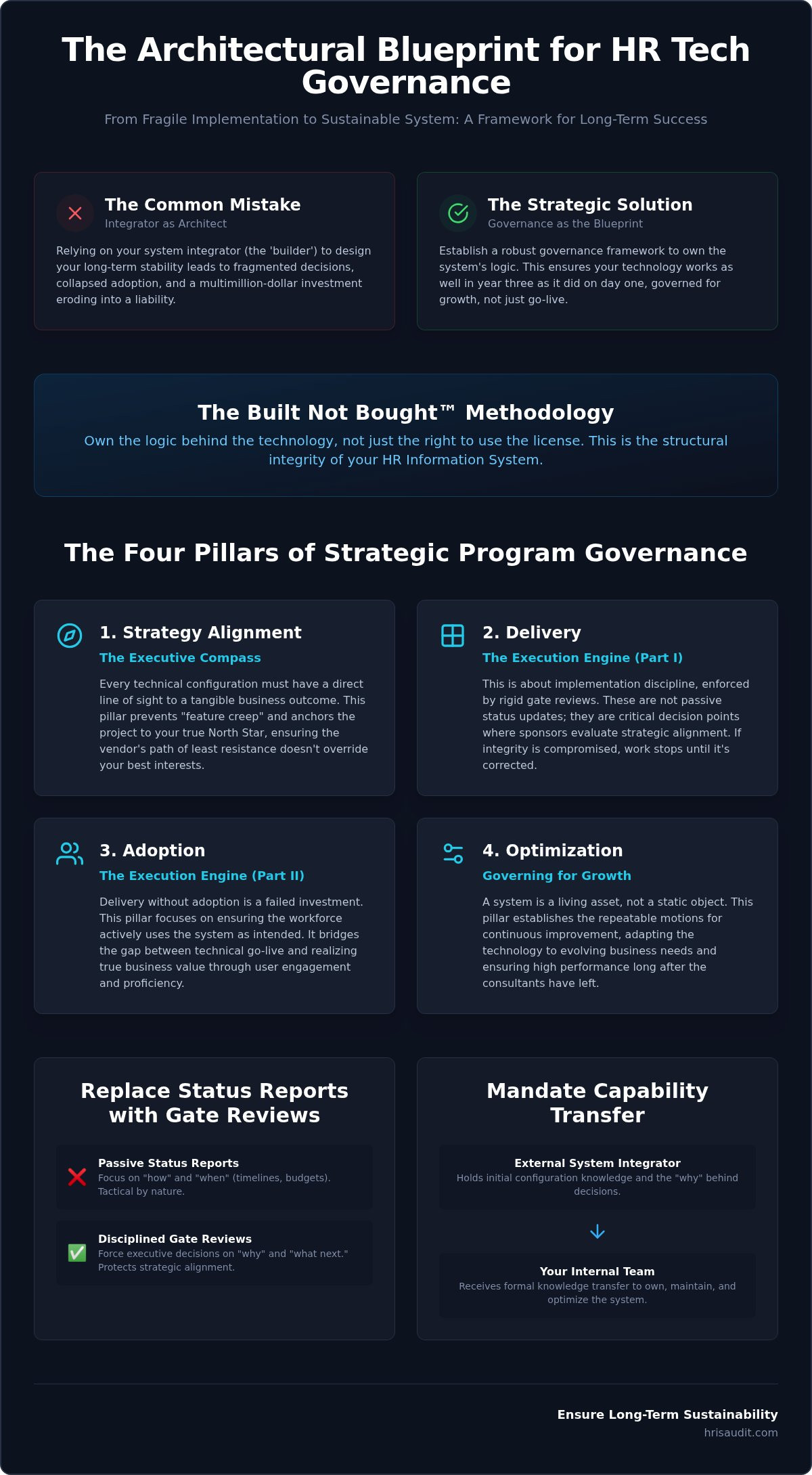
Many executives confuse their Project Management Office (PMO) with governance. They are not the same. A PMO is focused on the "how" and the "when." It tracks timelines, manages budgets, and checks boxes. It is tactical by nature. Governance, specifically at the program level, focuses on the "why" and the "what next." It prioritizes long-term sustainability over short-term milestones. If your focus is purely on the go-live date, you're building for a collapse. Real HR technology governance framework design ensures that once the integrator leaves, the internal team has the structural authority to maintain the system. Project governance gets you to the finish line; program governance ensures you stay there.
The "Built Not Bought" Perspective on Governance
Systems are never truly "installed." They are architected, refined, and eventually adopted by the workforce. The Built Not Bought™ philosophy demands that the organization owns the logic behind the technology, not just the right to use the license. This prevents the "Integrator Trap," where external vendors make critical design decisions that favor their own delivery speed over your long-term operational health. Governance acts as the shield against this convenience-led design. It mandates a formal process for capability transfer, ensuring your team understands the "why" behind every configuration. Governance is the structural integrity of HRIS.
The Four Pillars of Strategic Program Governance
A high-performing HR technology governance framework isn't built on consensus. It's built on discipline. Most organizations fail because they treat governance as a series of administrative meetings rather than a set of load-bearing structures. To maintain structural integrity, you must anchor your program in four distinct pillars: Strategy, Delivery, Adoption, and Optimization. These aren't isolated departments. They are integrated motions that ensure your technology serves the business, not the other way around. Understanding The Four Pillars of Strategic Program Governance allows leadership to move from passive oversight to active steering.
Strategy Alignment: The Executive Compass
Strategy serves as the executive compass. Every technical configuration needs a direct line of sight to a business outcome. If a feature doesn't solve a specific organizational pain point, it's noise. This level of Client-Side HR Technology Leadership is what prevents "feature creep" from bloating your budget and complicating your user experience. Define your North Star early. Use it to veto distractions that don't contribute to your long-term architectural goals. Without this anchor, the project will drift toward the path of least resistance for the vendor, not the best outcome for the client.
Delivery and Adoption: The Execution Engine
Delivery and Adoption form the execution engine. Delivery is about more than hitting dates. It's about implementation discipline. This requires rigid gate reviews. These are not status updates; they are decision points where sponsors evaluate if the project remains aligned with the strategy. If the structural integrity is compromised, the work stops until it's corrected. This discipline prevents the project from drifting into a vendor-led implementation that ignores your specific internal requirements.
However, delivery without adoption is a sunk cost. A system that works perfectly on paper but remains ignored by the workforce is a failure. Governance must track "Adoption Readiness" as a core metric. This requires a formal capability transfer process. Your internal team must learn the mechanics of the system while it's being built, not after the integrator has left. If you aren't measuring how the system is actually used, you're just guessing at its value. For those looking to audit their current structure, exploring our governance frameworks can provide the necessary clarity for your next move.
The Pillar of Optimization
The final pillar is Optimization. Go-live isn't the end. It's the beginning of the system's lifecycle. A robust framework accounts for the continuous motion of improvement. It anticipates that business needs will evolve. It ensures the technology is flexible enough to follow suit. Without an optimization plan, your system begins to decay the moment the integrator logs off. Sustainable performance requires a governance model that prioritizes ownership over mere participation.
The Gate Review Process: Controlling the Transformation
A status update is a performance. A gate review is an audit. In a disciplined HR technology governance framework, gate reviews serve as the primary mechanism for control. These are the load-bearing checkpoints where program sponsors evaluate the structural integrity of the build. If the foundation is weak, the project doesn't move forward. This isn't about checking boxes on a timeline. It's about ensuring that every technical decision made by the system integrator aligns with the long-term operational needs of the enterprise. You don't ask if the work is done; you ask if the work is right.
Transitioning from "status reporting" to "decision support" requires a cultural shift. Executives often feel pressured to keep the project moving to meet arbitrary deadlines. This is how adoption collapses. A strategic gate review forces a sober assessment of five critical questions: Does this configuration serve the business outcome? Is the technical debt manageable? Is the data architecture sound? Is the internal team ready to own this function? And finally, has the integrator fulfilled their transfer obligations? If the answer to any of these is "no," the gate remains closed. Handling a "red" gate is not a failure of management. It's a success of governance.
Sponsor Decision Support
The sponsor’s role is to provide direction, not just sign checks. To do this effectively, they need more than a vendor's slide deck. They need ground-level truth. Equipping leaders with independent data allows them to challenge the system integrator's assumptions. We use Pulse Scans to detect hidden risks and friction points before they reach a formal gate. This diagnostic approach removes the emotion from the room. It replaces "I think" with "the data shows." When sponsors have this level of clarity, they can make go/no-go decisions with absolute confidence.
Anatomy of a Strategic Gate Review
A successful gate review begins long before the meeting starts. It requires the validation of artifacts from your Field Library. These are the blueprints and design documents that prove the system is being built to specification. During the session, the atmosphere must be one of rigorous inquiry. You aren't there to applaud progress. You're there to identify cracks. Once the session concludes, every decision must be documented with surgical precision. This prevents "decision circling," where the same configuration issues are debated repeatedly. Governance is about finality. It's about moving from one stable state to the next with total accountability.
Designing for Ownership: The Capability Transfer Model
The "Integrator Trap" is a quiet failure of leadership. It occurs when a system integrator builds your platform in a vacuum, keeping the structural logic to themselves. They profit from your dependency. They hold the keys to the configuration while your internal team stands by as spectators. To avoid this, your HR technology governance framework must mandate a formal capability transfer process from day one. You aren't just buying a system; you're building an internal competency. If your team cannot explain the "why" behind a specific workflow, you don't own the system. You're just renting it.
Readiness is not a technical checklist. It's an internal state of mastery. True readiness means your team can troubleshoot, recalibrate, and optimize the system without external intervention. This requires the construction of an internal Field Library during the project. This library isn't just a collection of user manuals. It is a repository of architectural decisions, design blueprints, and logic maps. It captures the "tribal knowledge" that usually disappears when the consultants log off for the last time. Without this knowledge transfer, your structural integrity is an illusion.
Transitioning from Project to Operations
Day 2 is where the real work begins. The moment the project team dissolves, the operational burden shifts. Who owns the system now? You must establish a permanent governance body to oversee continuous optimization. This group ensures that the technology evolves alongside the business. Part of this transition involves creating a rigorous HRIS Audit of internal skills. You need to know exactly where your capability gaps lie before the safety net of the integrator is pulled away. Ownership is not a title; it is a demonstrated ability to maintain the machinery you've built.
The Role of Internal Experts
Your internal experts must move from passive participants to active architects. They should be the ones challenging the integrator’s design choices, not just approving them. Governance must facilitate this shift by giving these experts the authority to veto configurations that compromise long-term sustainability. Capability transfer is a non-negotiable governance requirement, not a post-project afterthought. Vendor-led governance is a surrender of organizational sovereignty. It places the vendor's delivery speed above your operational health. You must lead the design if you intend to lead the results.
Access our strategic governance frameworks today.
Implementing the Built Not Bought™ Governance Framework
The year 2026 marks a deadline for organizational maturity. The era of simply "buying" a cloud solution and hoping for the best is over. Enterprise leaders now face a choice: continue reacting to system failures or build a permanent internal capability. Implementing a robust HR technology governance framework requires more than just a change in software. It requires a fundamental shift in how you view your PMO. You must move from tracking milestones to governing for structural integrity. This means integrating the Built Not Bought™ method into your existing project structures to ensure that every technical decision is anchored in long-term ownership.
Assessing your current governance maturity is the first step toward this transition. Most organizations operate in a state of "accidental governance," where decisions are made by whoever is loudest in the room. This leads to fragmented global processes and a total reliance on external integrators. An independent, client-side advisor acts as the architect who designs the machinery of your oversight. They provide the objective distance needed to challenge the status quo. They don't just help you go live; they ensure you are built to last.
Leveraging the Field Library
Speed is essential, but precision is non-negotiable. You don't need to reinvent the wheel for every decision point. Leveraging The Field Library License allows your team to use pre-built workbooks and diagnostic tools that have been battle-tested in the field. These resources standardize decision-making across global enterprise teams, ensuring that a configuration choice made in London aligns with the strategy set in New York. It creates a common language for your architects. When everyone uses the same blueprints, the structural integrity of the entire system remains intact.
Starting with a Pulse Scan
You cannot fix what you haven't diagnosed. A governance structure that looks good on an organizational chart might be failing in practice. Identifying "blind spots" in sponsor decision support is critical before you commit to further technical changes. A diagnostic approach allows you to evaluate the health of your current motions and identify where the load is too heavy for your internal team to carry. If your sponsors are just signing checks instead of providing direction, your transformation is at risk. It's time to stop guessing at your program's health and start measuring it with surgical accuracy.
Request a Pulse Scan to evaluate your program health and secure your system's future.
Governing for Architectural Longevity
The success of your digital transformation depends on the structural integrity of your oversight. You've seen how a robust HR technology governance framework replaces vendor dependency with internal mastery. It's the difference between a system that erodes post-go-live and one that scales with the enterprise. By prioritizing disciplined gate reviews and formal capability transfer, you protect the high-stakes investment you've made.
This approach isn't about adding bureaucracy. It's about installing the mechanical controls required for long-term sustainability. We bring over 30 years of enterprise transformation leadership to this challenge. Our independent advisory provides a perspective free from vendor conflicts of interest. Combined with our battle-tested Field Library of diagnostic tools, we ensure you own the logic of your technology. It's time to move past passive participation.
Download the Built Not Bought™ Framework for Sustainable HR Tech
The path to ownership is a deliberate architectural choice. You have the blueprints. Now, start building a foundation that lasts.
Frequently Asked Questions
What is the primary purpose of an HR technology governance framework?
The primary purpose is to ensure the structural integrity and long-term sustainability of your digital investments. It acts as the operational machinery that moves an organization from passive software consumption to active system ownership. By establishing clear rules for decision-making and accountability, the HR technology governance framework prevents the system from decaying once the initial implementation team departs. It aligns technical delivery with the overarching human strategy of the enterprise.
How does program governance differ from standard project management?
Project management is tactical and focuses on the "how" and "when" of delivery. It tracks budgets, timelines, and task completion. Program governance is strategic; it focuses on the "why" and the "what next." While a project manager ensures the house is built on time, governance ensures the house is architecturally sound and maintainable for the next decade. Failing to distinguish these two leads to a system that works at go-live but collapses under operational pressure.
What are the most common signs of a failing governance structure?
Decision circling is the most obvious symptom of structural failure. When the same configuration issues are debated for months without resolution, your framework is broken. Other signs include fragmented global processes, a total reliance on external system integrators, and a post-go-live adoption collapse. If your executive sponsors are signing checks but cannot explain the logic of the system, your governance is a performance rather than a control mechanism.
Who should lead the HR technology governance committee?
The committee must be led by an executive sponsor with cross-functional authority, typically the CHRO or a dedicated Head of Transformation. This leader must have the political capital to veto technical configurations that don't align with the business's North Star. They act as the chief architect. Their role is to provide direction and enforce discipline, ensuring that IT, HR, and Finance remain aligned on the long-term architectural goals of the program.
How often should gate reviews occur during an HCM implementation?
Gate reviews should occur at every critical transition point, typically every four to six weeks. These are not calendar-based status updates; they are load-bearing checkpoints. A gate review must happen at the end of design, before the start of testing, and prior to go-live. If the criteria for structural integrity aren't met, the gate remains closed. This discipline prevents technical debt from accumulating and ensures the project remains on its intended path.
Can we use a governance framework for a system that is already live?
A HR technology governance framework is arguably more critical for live systems than for those in flight. Post-go-live governance manages the continuous motion of optimization and technical debt mitigation. It ensures that as business requirements evolve, the technology follows suit without breaking. Without a permanent governance body, live systems begin to decay the moment the integrator leaves. Governance provides the steady-state maintenance required for high-performance system longevity.
What role does a system integrator play in the governance framework?
The system integrator is the builder, not the architect. They provide technical expertise, status reports, and implementation labor. However, they do not set the strategy or own the logic. Governance ensures the integrator remains a vendor rather than a shadow decision-maker. It mandates that they fulfill their capability transfer obligations. Their role within the framework is to provide data that supports the internal team's ability to make informed, sovereign decisions.
How do we measure the success of our governance model?
Success is measured by the speed of internal decision-making and the degree of organizational self-sufficiency. You've succeeded when your internal team can troubleshoot and optimize the system without calling an external consultant. Other metrics include high data integrity, consistent global adoption, and a measurable reduction in technical debt. Ultimately, a successful governance model is one where the system remains stable, flexible, and fully aligned with the business's strategic outcomes over time.


