

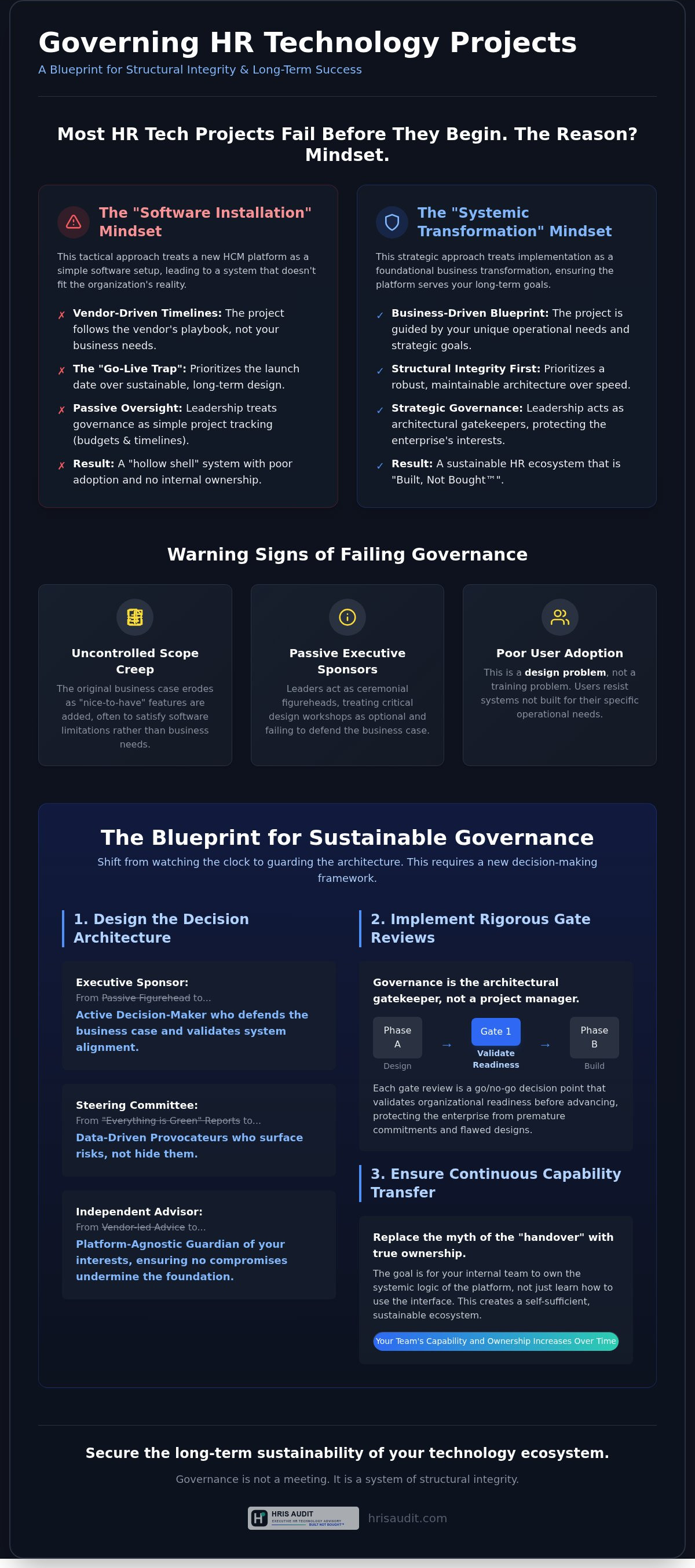
Most HR technology projects fail long before the first line of code is configured. They fail because leadership treats implementation as a software installation rather than a structural transformation. If your project feels like it's being driven by a vendor's timeline rather than your organization's needs, you've already lost control. Learning how to govern HR technology projects isn't about attending more steering committee meetings. It's about establishing the architectural gates that ensure your HCM platform serves the business, not the other way around.
You've likely felt the weight of decision-making paralysis at the executive level. You've seen systems that were bought but never truly built for your specific operational reality. It's a common pattern. Without internal ownership, you're left with a hollow shell of a system. We'll show you how to move beyond tactical implementation. You'll master the disciplined governance motions required to build a sustainable HR technology ecosystem. This framework provides a blueprint for structural integrity. It ensures your platform remains compliant with evolving regulations like the EU AI Act while maintaining its long-term health and strategic purpose.
Key Takeaways
- Shift from tactical project tracking to a system of structural integrity that treats implementation as a foundational transformation rather than a software installation.
- Master how to govern HR technology projects by implementing rigorous gate reviews that validate organizational readiness before advancing to subsequent phases.
- Redefine the executive sponsor role from a passive figurehead to an active decision-maker within a disciplined, data-driven steering committee.
- Replace the myth of the "handover" with continuous capability transfer, ensuring your internal team owns the systemic logic behind the HCM platform.
- Adopt the Built Not Bought™ blueprint to move beyond the "Go-Live Trap" and secure the long-term sustainability of your technology ecosystem.
Why Traditional HR Technology Governance Models Fail
Governance is not a meeting. It is a system of structural integrity. Most organizations fail because they mistake administrative project tracking for strategic oversight. They focus on timelines, budgets, and status reports while the underlying architecture of the system begins to crumble. Understanding how to govern HR technology projects requires a shift from a "software installation" mindset to a "systemic transformation" perspective. If you are following a vendor's playbook, you are likely building their ideal system, not yours.
The conflict of interest is inherent. A system integrator is incentivized by deployment speed and resource utilization. Your organization is incentivized by long-term sustainability and operational fit. When governance is led by the vendor, the "Go-Live Trap" becomes inevitable. This trap prioritizes the launch date over sustainable design. It celebrates a successful "cut-over" while ignoring the fact that the internal team lacks the capability to maintain the platform. Real governance follows established Technology Governance Principles to protect the enterprise from these misaligned incentives. It ensures that the system is Built Not Bought™, placing ownership in the hands of the client from day one.
Project Management vs. Strategic Governance
Project management is the hammer; governance is the blueprint. A Project Management Office (PMO) is designed to track tasks and burn rates. It ensures that milestones are met. However, a PMO is often insufficient for managing complex HCM program resets because it lacks the authority to challenge design decisions that compromise structural integrity. Strategic governance protects the enterprise's long-term interests. It acts as the architectural gatekeeper. It asks whether a specific configuration choice solves a business problem or merely satisfies a software limitation. Without this distinction, you aren't governing; you're just watching the clock.
The Symptoms of Poor Governance
Weak governance manifests in predictable patterns. You see it in uncontrolled scope creep where the original business case is slowly eroded by "nice-to-have" features. You see it in the silence of executive sponsors who treat critical design workshops as optional. The most damaging symptom appears post-implementation. Adoption issues aren't usually a training problem. They are a design problem. When a system isn't built for the organization's specific mechanical needs, users will naturally resist it. These failures are rooted in the design phase, where a lack of rigorous oversight allowed the system to drift away from its intended purpose.
Designing the Decision Architecture: Roles and Responsibilities
Governance isn't a democracy. It is a hierarchy of accountability. To master how to govern HR technology projects, you must first design a decision architecture that functions under pressure. Most projects fail because the lines of authority are blurred. When the integrator asks for a design pivot, who has the final word? If the answer is "the committee," you've already introduced structural weakness. High-stakes transformations require a clear chain of command that prioritizes organizational health over vendor convenience.
The Executive Sponsor must move from a ceremonial figurehead to an active decision-maker. This isn't about micro-management. It's about defending the business case. A sober sponsor understands the mechanical trade-offs of every configuration choice. They don't just sign off on milestones; they validate that the system still aligns with the original blueprint. Similarly, the Steering Committee must abandon the "everything is green" status report. These reviews should be data-driven and provocative. They exist to surface risks, not to hide them behind polished slide decks.
The Role of the Independent Advisor
Independence is the prerequisite for objective HCM program advisory. A vendor-led project is inherently biased toward the vendor's profit margins and deployment speed. You need a "battle-tested" architect who is platform-agnostic. An independent advisor acts as a guardian of your interests, providing critical sponsor decision support during high-stakes project pivots. They ensure that technical compromises don't undermine the foundation of your ecosystem. For a deeper look at this role, see our Client-Side HR Technology Leadership Pillar. This approach mirrors a framework for merit-based modernization, where clear ownership and objective evaluation drive long-term success.
Defining Accountability in the Transformation Studio
Accountability cannot be vague. It must be mapped with precision across HR, IT, and Finance functions. We use Studio workshops to align these stakeholders early in the transformation lifecycle. These sessions strip away departmental silos and force a consensus on systemic design. They create a single source of truth for governance documentation that remains accessible throughout the project. When everyone understands their specific "motions" for escalation, decision-making paralysis disappears. If your leadership team is struggling to align on these roles, a strategic Advisory Service can help stabilize your structural foundation before the first configuration begins.
Implementing Rigorous Gate Reviews and Decision Support
Gate reviews are the pressure tests of transformation. They are the moments where the blueprint meets the reality of the build. If you want to master how to govern HR technology projects effectively, you must treat these reviews as non-negotiable quality gates rather than administrative hurdles. A project that glides through every milestone without friction isn't necessarily a success. It might just be a project where no one is looking at the foundation. Real governance requires looking past the surface.
Most status reports are works of fiction. They use "green" indicators to mask design compromises and technical debt. A rigorous governance model demands more. It requires the courage to execute a "Stop/Pivot" motion when structural integrity is at risk. If the data migration is incomplete or the business processes are fragmented, you don't proceed. You pause. You fix the foundation. You only advance when the criteria for success are met with objective evidence. This is the difference between project tracking and enterprise protection.
The Anatomy of an HR System Gate Review
A Gate Review is a non-negotiable quality checkpoint designed to validate systemic integrity before the project advances. Technical readiness is often the primary focus, yet it's only half the equation. You must also measure organizational readiness. Is the human machinery prepared to operate the new system? Governance must balance these two forces. If the software is configured correctly but the internal team hasn't mastered the logic behind it, you're building a system that will fail post-launch. Every gate must ensure that design decisions still align with the long-term HR technology strategy.
Using Pulse Scans for Real-Time Risk Detection
Anecdotal feedback is the enemy of disciplined governance. You need objective data to detect hidden risks before they become go-live blockers. A Transformation Pulse Scan identifies governance gaps by stripping away the noise of polished status reports. It provides a real-time diagnostic of project health. By utilizing a proprietary "field library" of standardized diagnostic tools, leadership can move from gut feelings to data-backed risk assessments. This moves the conversation from "I think we're ready" to "The data proves we're ready." It's about finding the cracks in the foundation while you still have the time to fill them.
Capability Transfer: Governing for Post-Go-Live Ownership
The "handover" is a dangerous fiction. It suggests that a complex human system can be gift-wrapped and delivered on a specific date like a retail purchase. It can't. If your internal team hasn't been part of the architectural heavy lifting, they won't own the result. They'll just be caretakers of a system they don't understand. Learning how to govern HR technology projects requires shifting ownership from the integrator to the client long before the launch date. You must build capability, not just software.
Effective leaders know how to govern HR technology projects by treating the go-live as a beginning, not an end. Designing for ownership means ensuring the team understands the systemic logic behind every workflow. Why was this specific payroll rule configured this way? What are the downstream impacts of this data field? Without this knowledge, the internal team is flying blind. Governance during the "Hypercare" phase should focus on stabilizing the system's long-term health, not just clearing a ticket queue. We measure success by adoption and continuous optimization. System uptime is a baseline requirement. It is not an achievement.
Evaluating Internal HR System Capability
Waiting until go-live to assess your team's readiness is a recipe for failure. You must conduct a capability evaluation during the build phase. This identifies skill gaps in the HRIS team before they transform into post-launch liabilities. Our "Built Not Bought" philosophy demands that internal stakeholders are the primary architects of their own solutions. Empowerment isn't a training session. It's the result of disciplined participation in the design process. If your team doesn't understand the "why" behind the configuration, they will never truly own the "how".
Sustaining the Governance Framework Post-Launch
Governance doesn't evaporate once the project code is frozen. It must transition from "Project Governance" to "Business-as-Usual" (BAU) Governance. This involves establishing a permanent center of excellence dedicated to HR technology optimization. Systems naturally decay. Processes drift. Regular "health checks" are necessary to prevent systemic atrophy. A disciplined framework ensures the platform evolves with the organization rather than becoming a legacy burden. Success should be measured by the following metrics:
- User adoption rates across core business modules.
- Speed of internal issue resolution without vendor intervention.
- Realization of the original business case objectives.
Evaluate your internal capability with our strategic frameworks.
The Built Not Bought™ Blueprint for Sustainable Governance
Passive participation is a liability. It creates a vacuum that vendors are happy to fill with their own incentives. To truly master how to govern HR technology projects, you must reclaim the architect’s chair. This shift from "buying" to "building" isn't just semantic. It is a fundamental change in how your organization interacts with its own machinery. Ownership starts with the first design session and never ends. If you aren't defining the logic, you're just paying for someone else's assumptions.
The Built Not Bought book serves as the definitive roadmap for this transition. It provides the strategic logic required to move beyond tactical implementation and toward systemic excellence. To operationalize this logic, leaders utilize licensed Field Library workbooks. These tools standardize governance motions across the enterprise. They ensure that every gate review, every design pivot, and every configuration choice is measured against a single standard of structural integrity. You don't need more meetings. You need more discipline.
Taking the First Step: The Pulse Scan
Clarity is the first requirement of leadership. Most sponsors operate in a fog of polished status reports and anecdotal feedback. You can't fix what you haven't diagnosed. Benchmarking your current project health provides the objective data needed to stabilize a failing transformation. A diagnostic scan offers immediate visibility into hidden risks and governance gaps. It allows you to see the cracks in the foundation before the weight of the full system is applied. If your project feels unstable, a strategic consultation can provide the necessary course correction before the damage becomes permanent.
Aligning Strategy with Structural Integrity
Governance is the bridge between executive vision and technical execution. Without it, the vision becomes a hallucination. The Enterprise HR Technology Governance Framework provides the necessary guardrails for this alignment. It ensures that your technology ecosystem remains a strategic asset rather than a legacy burden. Understanding how to govern HR technology projects means accepting that disciplined leadership is the only path to a sustainable HR system. It requires the courage to prioritize long-term health over short-term milestones. Don't just buy a system. Build a capability. Design for outcomes, not just outputs.
Building for Structural Integrity
Structural integrity isn't an accidental byproduct of a software purchase. It is the hard-earned result of disciplined leadership. You now understand how to govern HR technology projects by shifting from passive project tracking to active architectural oversight. Success requires a rigorous decision architecture, non-negotiable gate reviews, and a relentless focus on building internal capability rather than settling for a fragile vendor handover. Governance is the guardian of your original business case.
We bring over 30 years of HR transformation leadership to every engagement. Our platform-agnostic strategic advisory and proprietary Pulse Scan diagnostic tools are designed to expose hidden risks and stabilize your structural foundation. Don't let your transformation become another industry failure statistic. Build a system that works for your organization's specific mechanical needs. It is time to move beyond the go-live trap and toward a sustainable ecosystem.
Secure your project's future. Explore the Built Not Bought™ Field Library today.
Your organization deserves a technology ecosystem that empowers its people and scales with your vision. Take ownership of your blueprint today and build a legacy of operational excellence.
Frequently Asked Questions
What is the difference between project management and HR technology governance?
Project management focuses on the tactical execution of tasks and timelines. Governance is the architectural blueprint that protects the organization's long-term interests. While a PMO tracks the "when" of a project, governance investigates the "why" and "how well." It ensures the system's structural integrity remains intact during the build. Without this strategic layer, you're simply managing a schedule toward a potentially flawed outcome.
Why do most HRIS implementation governance models fail?
Failure usually stems from the "Go-Live Trap." Most models prioritize launch dates and budgets over sustainable system design. When governance is vendor-led, the integrator's incentive for speed often overrides the client's need for operational fit. This creates a conflict of interest where the foundation is sacrificed for a ceremonial milestone. Real governance requires an independent guardian to challenge these misaligned motivations.
What are the core roles required for effective HR technology project governance?
Effective governance requires an active Executive Sponsor, a data-driven Steering Committee, and an Independent Advisor. The sponsor defends the business case. The committee provides sober, objective reviews of project health. The advisor acts as a battle-tested architect to counter vendor bias. These roles create a hierarchy of accountability that ensures the system is built for your organization's specific mechanical needs, not generic software limitations.
How often should HR technology gate reviews be conducted?
Gate reviews must occur at every critical architectural transition point. They aren't calendar-based meetings; they're non-negotiable quality gates. You conduct them before moving from Design to Build, or Build to Test. The frequency depends on the project's complexity and risk profile. To master how to govern HR technology projects, you must ensure these reviews validate technical and organizational readiness before the project advances.
Can we use our existing IT governance for an HR technology transformation?
Standard IT governance is rarely sufficient for complex HR transformations. While IT focuses on security and infrastructure, HR technology requires deep alignment with complex business logic and human workflows. A generic framework lacks the pattern recognition to identify HR-specific design flaws. You need a specialized framework that treats HR processes as integrated systems. This ensures the technology serves the strategic workforce vision.
What is 'capability transfer' in the context of HRIS governance?
Capability transfer is the continuous process of building internal expertise during the implementation. It isn't a "handover" that occurs at go-live. True governance ensures the internal team participates in the architectural heavy lifting from day one. This allows them to understand the systemic logic behind every configuration choice. When the team owns the "why," they're prepared to sustain and optimize the platform post-launch.
How do I know if my HR technology project needs a governance reset?
Signs of a necessary reset include decision-making paralysis, uncontrolled scope creep, and a lack of executive engagement. If your status reports are perpetually "green" but the internal team feels disconnected from the build, your governance has failed. Another red flag is vendor-driven design. If the integrator is making critical architectural choices without independent oversight, you need a diagnostic Pulse Scan to stabilize the foundation.
What is the 'Built Not Bought' approach to governance?
The Built Not Bought™ approach is a methodology centered on internal ownership and systemic design. It rejects the passive "software installation" mindset. Instead, it provides a blueprint for how to govern HR technology projects by empowering the client to act as the primary architect. By utilizing proprietary tools and disciplined motions, this approach ensures the final system is a reflection of your organization’s specific operational requirements.


