

Your System Integrator is not responsible for your long-term ROI. That responsibility sits squarely with you. It's a hard truth, and one many organizations realize only after the final invoice is paid. You've likely felt the creeping anxiety of a project timeline dictated entirely by external vendors. You see technical boxes being checked, yet you know your team lacks the internal expertise to challenge critical design decisions. This isn't just a project risk; it's a structural failure. Establishing robust client-side HR technology leadership is the only way to convert a high-cost software purchase into a resilient, high-performing HR ecosystem.
True leadership in this space requires a shift from passive participation to active architectural governance. You don't need more consultants; you need a blueprint for ownership. In this article, you'll learn how to design for the day after go-live. We'll explore a framework that reduces external dependency, eliminates the fear of organizational rejection, and aligns your technology with actual business outcomes. It's time to stop being a passenger in your own transformation. Let's build for maturity, not just momentum.
Key Takeaways
- Distinguish between tactical project management and the strategic governance required to drive long-term systemic ROI.
- Implement the Built Not Bought™ framework to ensure your HRIS architecture supports future growth rather than just a technical deadline.
- Establish strong client-side HR technology leadership to effectively challenge vendor decisions and maintain control over the transformation lifecycle.
- Prioritize internal capability transfer to transition from high-cost consultant dependency to total organizational ownership of the system.
- Leverage independent advisory as a strategic safeguard to align technical implementation with your specific people-centric business outcomes.
The Invisible Gap: Why Client-Side HR Technology Leadership is Not Project Management
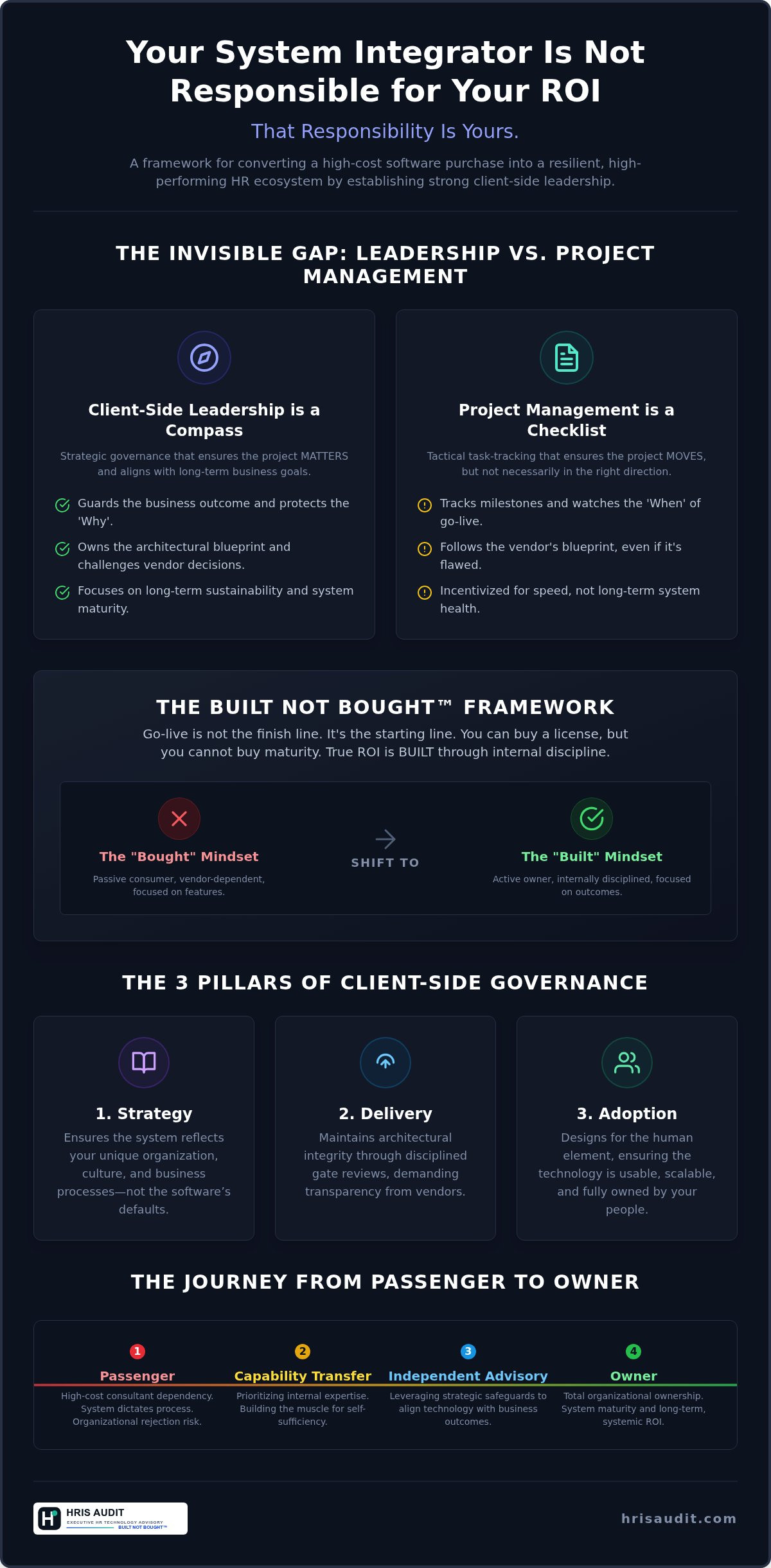
Project management is a checklist. Leadership is a compass. Most organizations fail because they confuse the two. They hire a project manager to track milestones but leave the steering wheel empty. This creates a dangerous vacuum. Tactical task-tracking ensures the project moves. Strategic decision governance ensures the project matters. You don't just need someone to watch the clock; you need someone to guard the outcome.
Effective client-side HR technology leadership is the strategic oversight of the entire transformation lifecycle. It's the refusal to let the software dictate the business process. It is not about the "when" of go-live. It is about the "why" of the investment and the "how" of long-term survival. You are re-engineering the machinery of your people operations. A project manager tracks the timeline. A leader protects the business case. They act as the internal architect who ensures the finished product actually solves the problems you set out to fix.
Your System Integrator (SI) cannot lead you. They are builders. They follow a blueprint. If your blueprint is flawed, they will build a flawed structure and bill you for the labor. They are your contractor, not your architect. They lack the organizational context to make trade-offs that favor your culture over their delivery schedule. They are experts in the tool, but they are strangers to your strategy.
The Conflict of Interest in Vendor-Led Programs
Implementation partners are incentivized for speed. Their business model relies on moving consultants to the next project as quickly as possible. Sustainability is your problem. Without an independent voice at the steering committee level, you risk a "black box" implementation. This is where technical complexity hides organizational debt. You lose control of the design. You inherit a system that is technically functional but strategically hollow. A client-side leader prevents this by forcing transparency and demanding that every configuration choice serves the long-term ROI.
The Anatomy of True Client-Side Governance
Effective governance rests on three pillars: Strategy, Delivery, and Adoption. Leadership ensures the system reflects your organization, not the software’s defaults. It requires a disciplined approach to gate reviews and sponsor decision support. By focusing on the technology adoption lifecycle, leaders move beyond technical deployment. They design for the human element. They ensure the machinery is usable, scalable, and owned by the people who run it. This is the difference between a software purchase and a systemic transformation. It is the shift from being a passenger to being the owner of your digital future.
The Built Not Bought™ Framework: Establishing Architectural Integrity
Software is not a trophy. It is an engine. Many executives believe that signing a multi-million dollar contract for a tier-one HRIS is the solution to their organizational friction. It isn't. You can buy a license, but you cannot buy maturity. The Built Not Bought™ philosophy rejects the passive "consumer" mindset that plagues modern HR departments. Systems are grown through internal discipline, not just installed by external parties. True client-side HR technology leadership treats the system as a living organism that requires a strong architectural foundation to survive.
Architectural integrity is the alignment of technology with human workflow. Without this alignment, you are simply digitizing chaos. If the foundation is brittle, the system will crack under the weight of the first major organizational change. Leadership must ensure that the design choices made during implementation support future scalability rather than just meeting a punch-list of technical requirements. You must shift your perspective. Go-live is not the finish line. It's the starting line. It is the moment the training wheels come off and your team must prove they can actually operate the machinery you've built.
Designing for Sustainability
Sustainability is a choice. It requires moving beyond "out-of-the-box" features that promise a quick fix but deliver a generic experience. In global HR transformations, systemic design is non-negotiable. You need a standardized approach to configuration that respects local nuances while maintaining global integrity. This is where a licensed Field Library becomes essential. It acts as the blueprint for your internal team, providing the tools and frameworks needed to maintain the system long after the consultants have left the building. For those looking to master this shift, the Built Not Bought Book provides the definitive guide to establishing this level of ownership.
The Cost of the "Bought" Mindset
The "bought" mindset is expensive. Industry research suggests that approximately 70% of enterprise technology projects fail to deliver their promised ROI. This failure rarely stems from technical glitches. It stems from organizational rejection. When a system is "bought" and forced upon a workforce without architectural integrity, users find workarounds. This creates the "shadow IT" effect. Employees return to spreadsheets and manual processes because the official system feels like a burden rather than a tool. You end up paying for a platform that no one uses correctly. A leader’s job is to ensure the system is built into the fabric of the business, making it impossible to ignore and essential to success. Ownership is the only path to a sustainable, high-performing HR ecosystem.
Strategic Advisory vs. System Integration: Navigating the Transformation
The System Integrator (SI) is a construction crew. They possess the tools, the labor, and the technical knowledge of the platform. But they aren't the architects of your business strategy. Client-side HR technology leadership provides the architectural oversight necessary to ensure the SI builds what you actually need, not just what's easiest for them to configure. Without this separation of powers, you're effectively letting the contractor design the house while they're building it. The result is often a structure that's technically sound but functionally uninhabitable.
Managing an SI contract requires more than just approving timesheets and tracking milestones. It requires a rigorous evaluation of deliverables against the original business case. Are the configurations solving your specific organizational friction? Or are they creating technical debt for the sake of hitting an arbitrary go-live date? Leadership means having the technical gravitas to say "no" when a vendor recommendation compromises long-term integrity. It involves acting as the bridge between executive vision and the practical machinery of the implementation.
Removing Vendor Bias from Decision Making
Vendors have built-in biases. Their recommendations often favor their own internal methodologies or profit margins. To counter this, leaders must employ objective diagnostics. A Transformation Pulse Scan allows you to look under the hood of the implementation plan. It identifies hidden risks before they become catastrophic failures. This diagnostic provides your internal team with the evidence needed to challenge the "Vendor-Side" experts. It replaces subjective vendor "confidence scores" with objective data. You need a perspective that's platform-agnostic and fiercely protective of your interests.
Mastering the Gate Review Process
Traditional status reports are often "watermelon" projects: green on the outside, red on the inside. Sponsors need better data to make high-stakes decisions. Effective gate reviews move past the binary of "on time and on budget." They ask deeper questions. Is the internal capability being transferred? Is the design sustainable? By using standardized diagnostics from a Field Library, you can move from subjective opinions to objective project health. Sponsors shouldn't ask if the project is on track. They should ask if the project is still worth doing. Leadership ensures they have the clarity to answer that question with confidence at every major milestone.
Capability Transfer: Transitioning from Project Delivery to System Maturity
Consultants are a temporary scaffolding. If they remain after the building is finished, the project has failed. True client-side HR technology leadership aims for its own obsolescence. You aren't just delivering a system; you're harvesting capability. Success is not defined by a functional dashboard on day one. It's defined by an internal team that possesses the mastery to maintain, evolve, and optimize that dashboard on day five hundred. You must move from renting expertise to owning it.
Capability transfer is the deliberate handover of intellectual property from advisor to client. It's the shift from knowing "how" to click buttons to understanding "why" the architecture exists. When your internal team only understands the technical steps, they are merely operators. When they understand the architectural logic, they become architects. This depth of understanding is what prevents system decay. It's the difference between a system that survives the first major software update and one that requires a total rebuild within three years because no one knows how to fix the broken configurations.
Ownership Beyond the Go-Live
The transition from implementation mode to optimization mode is where most organizations stumble. They treat go-live as a finish line and disband the project team. This is a strategic error. You need a permanent structure for post-launch governance. We advocate for establishing an internal Transformation Studio. It's a dedicated environment for continuous refinement and systemic health. Using Field Library workbooks ensures that internal knowledge isn't trapped in the heads of a few individuals. It creates a centralized, documented logic for every configuration choice made during the build. This documentation becomes the manual for your internal machinery.
The People-Centric Transformation
Technical uptime is a baseline, not a victory. Success must be measured through adoption metrics and business impact. If your employees find the system cumbersome, they'll bypass it. You must align your technical capability with actual employee experience outcomes. This requires a disciplined focus on how the machinery serves the human workflow. Leaders must look past the technical specs to see if the technology is actually reducing friction for the workforce. If you're ready to stop relying on external support and start building internal expertise, explore our Transformation Studio to accelerate your team's maturity.
Independent Advisory: The Guardian of Enterprise Transformation
Objectivity is the rarest commodity in enterprise software. Most implementation partners are tethered to software vendors through alliances, referral fees, or resale agreements. They cannot be objective because their revenue depends on the platform's footprint, not your organizational health. Independent client-side HR technology leadership provides the necessary friction to these vendor-led narratives. It ensures that every decision serves the business case rather than the vendor's bottom line. You need an advocate whose only metric for success is your long-term maturity.
A boutique, independent advisor offers a level of precision that the Big 4 cannot match. Large firms often prioritize the relationship over the result. They are incentivized to keep the peace and keep the consultants billed. We prioritize the architecture. This "Tough Love" approach means telling sponsors what they need to hear, not what they want to hear. If your timeline is a fantasy, we say so. If your internal team lacks the necessary skills, we provide the path to build them. We don't offer surface-level encouragement; we offer structural truth.
Why Independence Matters
Independence is about structural integrity. It is the ability to look a vendor in the eye and challenge a configuration that serves their delivery schedule but sabotages your future reporting. At HRIS Audit, we bring thirty years of pattern recognition to the table. We've seen the same failures repeat across different platforms and industries. We know where the technical debt is buried in the standard SI contract. Engaging a specialist in client-side HR technology leadership before the SI contract is signed is the most critical move a sponsor can make. It ensures the rules of engagement are written in your favor.
Getting Started with HRIS Audit
We act as battle-tested architects for your transformation program. Our Transformation Studio provides the workshops necessary to align executive vision with the practical machinery of the implementation. We don't just advise; we equip. By accessing our Field Library, your team gains enterprise-grade tools and blueprints for long-term ownership. You move from being a passenger to being the owner of your digital future.
The first motion is diagnostic. You cannot fix what you haven't measured. If you sense project risk but can't name it, you need an objective assessment. It is time to stop hoping for a successful go-live and start designing for one. Assess your program health with a Transformation Pulse Scan to detect hidden risks before they become terminal failures.
Reclaiming the Architecture of Your HR Transformation
Your HRIS is an asset that must be mastered, not a product that can simply be consumed. We've explored why the distinction between tactical project tracking and strategic architectural governance is the difference between failure and a sustainable ecosystem. True transformation requires a shift in mindset. You must move from being a passenger to becoming the architect of your own digital future. Establishing disciplined client-side HR technology leadership ensures that your internal team possesses the capability to own the machinery long after the builders depart.
With over 30 years of enterprise experience, we provide the platform-agnostic, independent perspective needed to navigate these high-stakes shifts. Our Built Not Bought™ methodology is designed to transfer intellectual property back to you, removing the conflict of interest inherent in vendor-led programs. It's time to stop managing milestones and start designing for ownership. The complexity of your organization demands a foundation that is as resilient as your vision.
Secure your transformation with client-side leadership advisory. You have the vision. We have the blueprint to help you realize it.
Frequently Asked Questions
What is the difference between an implementation partner and a client-side advisor?
An implementation partner focuses on technical configuration and software delivery. A client-side advisor focuses on your long-term ROI and organizational maturity. While the partner builds the engine, the advisor ensures the engine actually fits your vehicle. Effective client-side HR technology leadership acts as the independent guardian of your business case. It provides the architectural oversight that a vendor, incentivized by speed, cannot offer.
Why do most enterprise HRIS transformations fail after go-live?
Most failures stem from a lack of internal ownership. Organizations treat go-live as a finish line. They fail to build the necessary internal machinery to operate the system once consultants depart. Technical uptime is irrelevant if your workforce rejects the workflow. Without a deliberate focus on capability transfer, the system begins to decay the moment the project team disbands. Ownership is the only path to sustainability.
What is the "Built Not Bought" methodology?
The Built Not Bought™ methodology is our proprietary framework for enterprise transformation. It posits that sustainable systems are grown through internal discipline, not merely purchased through software licenses. The focus is on architectural integrity and capability transfer. It provides the rigorous structure needed to move from being a passive consumer of technology to an active owner of a high-performing HR ecosystem.
How does a client-side leader manage a Big 4 implementation team?
Management requires independent technical gravitas. Big 4 teams are often driven by internal firm metrics and standardized delivery models. A client-side leader provides the friction necessary to challenge these models. They enforce rigorous gate reviews and demand transparency in decision-making. You need an advocate who prioritizes your specific people-centric outcomes over the vendor's generic implementation methodology. We act as the bridge between executive vision and technical delivery.
When is the best time to engage a client-side HR technology leader?
The optimal time is during the pre-contract phase. Engaging client-side HR technology leadership before signing an SI agreement allows you to bake governance and ownership into the contract itself. It prevents the vendor from dictating terms that favor their delivery speed over your long-term sustainability. Early intervention is the most effective way to eliminate technical debt before it is even created. Don't wait for the first red status report.
What is included in the HRIS Audit Field Library?
The Field Library is a proprietary suite of enterprise-grade tools and frameworks. It includes workbooks, standardized diagnostics, and governance blueprints. Think of it as the manual for your internal transformation machinery. It equips your team with the specific knowledge needed to maintain system health and manage vendors without constant external reliance. It is the architectural foundation for your internal Transformation Studio.
How does a Transformation Pulse Scan help a failing project?
The Transformation Pulse Scan is a diagnostic intervention. It strips away the subjective "green" status reports to reveal the actual health of the program. By identifying misaligned configurations and governance gaps, it provides sponsors with the objective data needed to course-correct. It turns a failing project into a manageable system by exposing the structural risks before they become terminal. It replaces vendor confidence with architectural truth.
Can HRIS Audit help if our project has already started?
Intervention is possible at any stage of the transformation lifecycle. We begin with a Transformation Pulse Scan to baseline your current project health and identify immediate risks. From there, we establish the governance and capability transfer mechanisms needed to salvage the business case. It's never too late to move from a "bought" mindset to a "built" reality, provided you are willing to apply the necessary discipline to the process.


