

A cloud HCM platform can make a weak HR model more visible, but it cannot make that model more effective. An HR technology target operating model defines how HR roles, processes, governance, technology, and service delivery work together to support the organization. The system matters, but its role in that design matters more.
It’s understandable to focus first on the platform: it’s tangible, complex, and often central to transformation. But software can’t decide who owns a service, how employees get help, or when an issue requires specialist judgment. Those are operating-model decisions.
This article explains what an HR target operating model is and how its core parts fit together. You’ll see how HR business partners, centers of excellence, shared services, and cloud HCM contribute to service delivery, and why designing employee interactions before selecting supporting technology creates a stronger foundation. The goal isn’t a prettier system map. It’s an operating structure with clear ownership and a practical connection between HR’s work and business needs.
Key Takeaways
- Define how HR roles, processes, governance, and technology work together before treating a new platform as the solution.
- Clarify how HR business partners and centers of excellence share responsibility for business relationships and specialist expertise.
- Map employee interactions and simplify high-friction processes before deciding where cloud HCM and automation fit.
- Compare functional HR models by how well they align ownership and service delivery with organizational needs.
- Design the target interaction model first so the operating structure and supporting technology reflect how employees and the business need HR services to work.
HR business partner and center of excellence interfaces
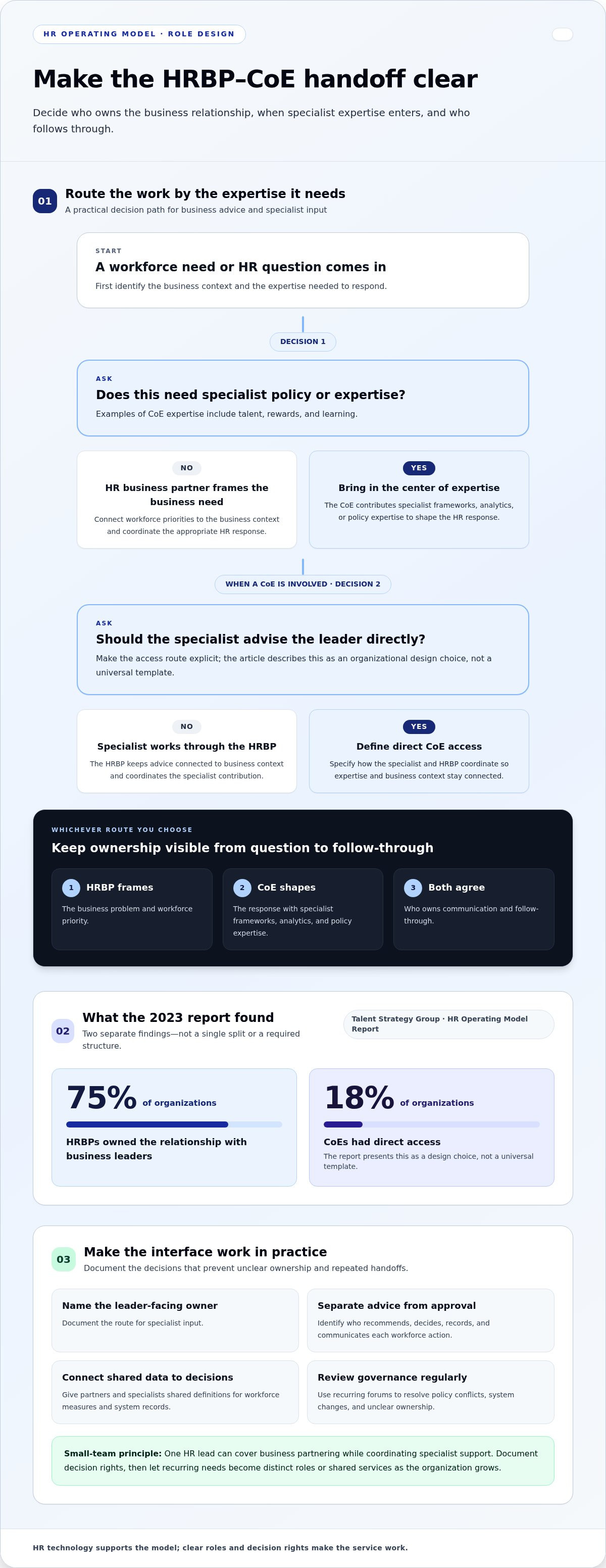
An HR technology operating model assigns accountability for business advice, specialist policy, and employee services. HR business partners connect business leaders with HR priorities; centers of excellence develop expertise in areas such as talent, rewards, and learning. Shared governance defines who makes decisions, who advises, and how work moves between roles. That clarity helps prevent employees and managers from being passed between teams without an owner.
Talent Strategy Group’s 2023 HR Operating Model Report found that HR business partners owned the relationship with business leaders in 75 % of organizations. The same report found that centers of excellence had direct access in 18 % of organizations. These figures highlight a design choice, not a universal template: organizations must specify whether specialists advise leaders directly or work through the business partner. A clear interface preserves specialist depth while keeping advice connected to business context.
Strategic HR business partners translate workforce priorities into decisions leaders can act on. For example, if a business unit plans to expand a service, the partner can bring hiring, capability, and retention needs into workforce planning. The center of excellence then contributes frameworks, analytics, and policy expertise. Define the handoff clearly: the partner frames the business problem, the specialist shapes the HR response, and both agree who owns communication and follow-through.
Small businesses can use the same role logic without copying a large-company org chart. One HR lead may handle business partnering and coordinate specialist support, while documented decision rights clarify ownership. As the organization grows, recurring needs can become distinct roles or shared services. Keep the model scalable by documenting process owners, data stewards, escalation routes, and the systems each role uses. This also helps connect cloud HCM workflows with human decision-making.
- Set the business interface: name the leader-facing owner and the route for specialist input.
- Separate advice from approval: identify who recommends, decides, records, and communicates each workforce action.
- Connect data to decisions: give partners and specialists shared definitions for workforce measures and system records.
- Review governance: use recurring forums to resolve policy conflicts, system changes, and unclear ownership.
These interfaces make HR’s strategic role tangible: business strategy sets workforce priorities, and HR assigns accountable roles to address them. A growth plan, for instance, should connect capability requirements with talent decisions, specialist guidance, and employee processes in the HCM system. The operating model should also distinguish local choices from enterprise-wide standards. That balance lets organizations adapt HR support to business conditions without fragmenting governance, data, or employee experience.
What Is an HR Target Operating Model?
An HR target operating model describes how people, processes, governance, and technology deliver HR services. Since the 1990s, HR departments have largely focused on efficient, low-cost service delivery. A modern design also connects administrative work to talent needs and business value. It defines ownership, decision rights, service pathways, and the information systems supporting each process. Without those connections, automation can accelerate a flawed process instead of improving it.
Simplify processes before automating them. Map a process such as onboarding, identify duplicate approvals and unclear handoffs, then remove unnecessary steps before configuring workflows. HR teams can automate repetitive tasks, including payroll queries, approvals, onboarding steps, and case routing. This can reduce manual handling, but every process still needs an accountable owner. For payroll, define who maintains employee data, resolves exceptions, and approves corrections before adding automated calculations or notifications.
AI increases the need for explicit governance. Ninety percent of chief human resources officers expect AI integration in HR to become more prevalent, and 83% expect AI’s role in HR functions to increase. Those expectations make decision boundaries a design requirement. Specify which decisions technology can make, inform, or leave to people, especially for hiring, pay, performance, and employee relations. For example, automation can route an employee relations case, while trained HR experts assess context, credibility, and risk.
In the United States, build privacy, security, and compliance controls into each process. Assign data access by role, limit collection to business needs, define retention and deletion practices, and keep audit records for sensitive actions. For example, a payroll workflow should identify authorized users, approval points, and escalation ownership. Governance should also cover vendors, integrations, and AI use so responsibility remains clear when employee information moves between systems.
No single cost or staffing benchmark fits every HR technology operating model. Requirements depend on process scope, workforce complexity, data quality, integration demands, service hours, and the support model. A transformation addressing fragmented payroll processes needs different capabilities from one focused on simplifying case routing. Estimate effort by mapping required ownership, specialist skills, system administration, and ongoing governance. Then compare those needs with existing capacity and the workload the redesigned processes will retain.
Common implementation risks include automating inconsistent processes, unclear accountability, weak data governance, and treating the platform as the operating model. Each can lead to avoidable rework or erode employee trust. Establish decision ownership before configuration, test a high-friction process with employees, and compare experience and efficiency before scaling automation. HRIS Audit’s Transformation Pulse Scan can help identify structural issues to address before a wider transformation moves forward.
Cloud HCM and service-delivery technology
Cloud HCM works best when its architecture follows how employees access HR services, not just how the platform stores data. Four design choices connect service channels, integrations, governance, and performance measures.
Tiered and Front-Back Service Delivery
Tiered delivery routes employee requests from self-service to shared services and specialist expertise. In the three-legged-stool model, Tier 0 supports employees and managers through technology-enabled self-service; Tier 1 handles cases through HR shared services; Tier 2 addresses complex issues through centers of excellence.
A front-back model separates the visible service interface from specialist work behind it. For example, a shared services team can receive a benefits case, resolve routine questions, and route policy exceptions to benefits specialists. This structure clarifies ownership and helps leaders design consistent service for a global workforce without hiding complex decisions behind a single portal.
Self-Service and HR Service Delivery
Self-service lets employees complete straightforward HR tasks through a digital channel, such as updating personal details or finding a policy. The experience must be designed around employee needs, not merely the features available in cloud HCM. Mercer reports that 1 in 3 employees say straightforward HR tasks take more than an hour to complete.
That makes task simplicity a useful design test. Map a common request, remove confusing steps, and make guidance available at the point of action. Keep a clear route to human support when an employee can’t complete the task or needs judgment. This balance can create an employee experience that fits the organization’s culture while keeping effective HR service accessible.
Systems, Integrations, Data, and Architecture
A cloud HCM architecture defines which system owns each data element, how integrations move information, and who governs changes. For example, workforce records should have a designated source of truth, while payroll, time, and benefits connections use agreed definitions and controlled interfaces.
A clear architecture prevents local fixes from turning into enterprise-wide complexity. The U.S. General Accounting Office warns that modernizing operations and systems without an architecture can create duplication, poor integration, and unnecessary expense. Document system ownership, data standards, integration dependencies, and access roles before expanding workflows. This discipline helps HR leaders assess how a change in one process affects employee records and downstream services.
Performance and Service-Level Measures
Performance measures show whether HR technology delivers timely, usable service and supports the intended employee experience. Track request volumes, resolution times, rework, escalation patterns, and completion rates by service channel. Segment results by request type so a fast password reset doesn’t hide delays in complex benefits or employee relations cases.
Use those measures in recurring service reviews. If a portal has high usage but repeated case escalations, examine its guidance and routing rather than treating login volume as success. After reorganizing around a Target Interaction Model, HR can free up about 30% of its administrative workload. Measure whether that capacity shifts toward higher-value work, and adjust service levels when employee needs or business conditions change.
Functional HR model
A functional HR model organizes the HR function around its work, capabilities, and decision rights. The design may group expertise by specialty, such as talent acquisition, rewards, or employee relations, while assigning clear ownership for shared processes. Dave Ulrich pioneered the centralized HR operating model in the late 1990s. Its enduring lesson is structural: roles need defined interfaces, not just new titles.
There is no single functional structure that suits every organization. Gartner reported that 89% of HR functions had recently restructured, were restructuring, or planned to do so. Talent Strategy Group reported that two-thirds of companies had recently changed their HR operating model. These figures point to continued redesign, but restructuring alone does not establish whether the function meets business needs. The test is whether responsibilities, skills, and services align with the organization’s priorities.
Common archetypes provide useful comparisons, not templates. McKinsey research cited by CIPD found that 48% of HR leaders adopt the Ulrich+ archetype, while 47% adopt the employee experience-driven archetype. The first emphasizes distinct HR roles and specialist contributions; the second foregrounds employee needs across services. A functional model can combine elements, provided leaders define who owns decisions and how expertise reaches the business.
Performance exposes gaps that an organization chart can hide. Gartner found that only 9% of HR functions are both highly efficient and highly aligned to organizational needs. Mercer reports that 4% of HR teams believe they deliver an exemplary employee experience. Read these measures together: an HR team may process work efficiently yet still fail to deliver services employees value. A maturity assessment should examine both operational capability and business alignment.
Assess the current function across four practical dimensions: role clarity, process ownership, workforce skills, and technology governance. For each, compare documented practice with the work actually being done. For example, check whether the team responsible for talent acquisition owns the process from request through reporting, or only manages selected steps. Then identify dependencies, such as HR data definitions shared by recruiting and workforce planning. This makes the assessment specific enough to guide design decisions.
Use findings to distinguish capability gaps from structural ones. If specialists have the required skills but lack timely access to business decisions, the interface may need redesign. If repeated corrections stem from unclear data ownership, clarify governance before adding another role. Peabody refined its three-pillar structure following its 2022 merger with Catalyst, illustrating how organizational change can prompt model refinement. The practical sequence is to assess, identify the constraint, and adjust roles or processes against a defined business need.
A useful maturity review ends with explicit priorities, not a generic rating. Record which capabilities the HR function needs to strengthen, which responsibilities should move, and how success will be observed. For example, connect a skills-development priority to an accountable owner and a workforce-planning process. This turns assessment into an operating decision and gives leaders a basis for aligning the functional model with business strategy.
HR target operating model design
An HR technology target operating model should connect process ownership, workforce skills, data, automation, and service delivery. HR leaders should assign decision rights to clearly defined roles, then align technology choices with those accountabilities.
Operating Model Capabilities
An HR operating model’s capabilities are the repeatable abilities that turn workforce priorities into reliable services. They include process design, HR data stewardship, technology governance, service management, analytics, and change leadership. Each capability needs an accountable owner and a clear connection to business outcomes.
Design the target interaction model before the wider operating model. This makes employee and business needs the basis for service pathways, role design, and technology. For example, map how a manager requests workforce planning support, who provides analysis, and where the resulting decision is recorded. Gartner found that adapting the HR operating model to AI has a predicted impact of 29% on AI productivity gains.
The impact depends on more than automation itself. HR leaders need the skills to assess whether a process is suitable for automation, maintain data quality, and manage exceptions. A useful design links each capability to a defined process, system, role, and measure. If an automated workflow can’t identify who owns an exception, the capability is incomplete.
Governance and Decision Rights
Governance defines who sets standards, approves changes, and resolves conflicts across HR processes and technology. Separate enterprise-wide decisions, such as shared data definitions, from local choices that need to reflect business conditions. Record who recommends, approves, executes, and monitors each decision.
For example, HR process owners can define policy intent, while technology owners assess configuration and integration impacts. A governance forum can resolve conflicts between those responsibilities and document the decision. U.S. General Accounting Office guidance warns that modernizing operations and systems without an architecture can lead to duplication, poor integration, and unnecessary expense.
Make governance operational through decision logs, change thresholds, and named escalation routes. When a team proposes automating an approval, it should identify the process owner, affected data, control implications, and exception path. Explain how HR employees will be supported as roles change. This turns governance into action, rather than a committee reviewing changes after design decisions are already embedded.
Use Built Not Bought Book to explore a disciplined approach to HR technology transformation.
Before finalizing the wider design, map the target interaction model so service delivery and technology reflect employee and business needs. The resulting HR target operating model provides a strategic framework for continually aligning people, processes, and technology with organizational value creation.
Use the model to decide whether HR strategy is set centrally by corporate headquarters or by local teams; the centralized HR operating model is the most popular and best-known HR operating model. If roles shift, define compelling roles in the new model and explain how HR employees will be supported in moving into those roles.
HRIS Audit: Advisory Services
HRIS Audit’s Advisory Services help leaders assess whether HR roles, governance, processes, and technology form a coherent operating model. Turn to this client-side advisory when a transformation involves competing design decisions, unclear ownership, or a platform plan without an operating architecture. The work focuses on establishing what the organization needs, aligning decisions with that design, and grounding transformation choices in business priorities.
The Built Not Bought Book offers a further perspective on designing and governing HR systems beyond go-live. For organizations that need structured guidance across transformation work, Advisory Services provide a practical next step.
Contact HRIS Audit about Advisory Services.
Turn the Operating Model Into a Governed Decision
The next step is to make the design actionable. Choose a business priority, name the executive sponsor, and identify the decisions that must change for HR to support it. Then test whether roles, governance, data, and technology reinforce that priority. A sound HR technology target operating model isn’t a static blueprint. It gives leaders a basis for consistent choices as business needs shift.
HRIS Audit’s Advisory Services support organizations as they make HR technology transformation decisions. The Field Library License provides structured reference materials, while the Built Not Bought Book presents an approach to designing and governing HR systems. Choose the format that fits the work ahead, whether you need advisory support or a resource for internal discussions.
Bring a defined challenge and a clear view of the decisions your organization needs to make.
Build the next stage with purpose, clear ownership, and a design grounded in how your organization works.
Frequently Asked Questions
What is an HR technology target operating model?
An HR technology target operating model sets out how an organization will govern and use HR systems to deliver its intended services. It connects business ownership with technology decisions so each system has a defined purpose and accountable decision-makers. For example, HR can own policy design while IT manages technical controls, with a shared process for approving changes that affect employee records or payroll outputs.
Which HR technology operating model works best: centralized, decentralized, or federated?
No structure is best for every organization. A centralized model suits organizations that need common standards and concentrated expertise. A decentralized model gives business units more local control, which is useful when their operating needs differ substantially. A federated model combines enterprise-wide rules with local execution. For example, an organization could govern workforce data centrally while allowing business units to shape service pathways for distinct employee groups.
What are typical costs and staffing benchmarks for an HR technology operating model?
There is no single cost or staffing benchmark. Requirements depend on process scope, workforce complexity, data quality, integration demands, service hours, and the support model. Estimate needs by mapping ownership, specialist skills, system administration, and ongoing governance, then compare them with existing capacity.


