

An HRIS project steering committee should include an executive sponsor, HR process owners, IT leadership, finance, and leaders accountable for workforce data and adoption. A useful HRIS project steering committee charter defines what the committee can decide, what remains with the project team, and how decisions, actions, migration risks, and adoption risks are recorded. Without clear boundaries, senior participation can amount to oversight in name only.
It’s natural to focus first on who should attend. But a roster alone won’t create effective governance. The committee also needs a clear purpose, defined authority, and a reliable way to escalate issues.
This guide explains whom to involve, how to define the charter’s scope and exclusions, and how to set decision rights, meeting records, and risk tracking. It also connects oversight to practical project work, including migration readiness, user preparation, and follow-through on decisions.
Key Takeaways
- Turn prior-meeting actions into owned tasks with a status, next step, and escalation path.
- Define the charter around measurable outcomes, decision boundaries, and explicit exclusions.
- Track migration and adoption risks separately so data readiness and user readiness each have clear owners.
- Set decision rights and escalation rules before disagreements reach the steering committee.
- Use meeting records to connect decisions to actions, risks, and project direction.
Prior-meeting action items and status
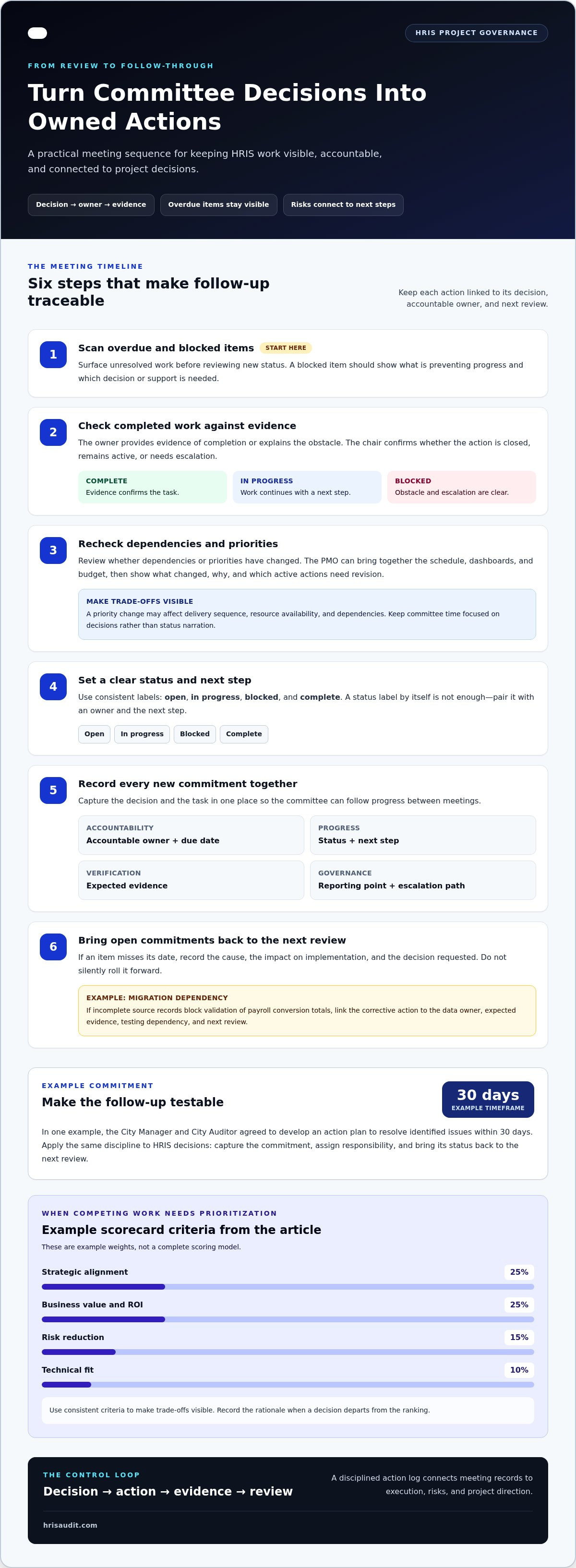
A meeting action item is a specific task assigned to an owner after a committee decision. Record the decision, accountable owner, due date, status, and next step together. This links governance to execution and keeps unresolved issues visible between meetings. At the next review, the owner provides evidence of completion or explains the obstacle. The chair confirms whether the action is closed, remains active, or needs escalation.
An action status summarizes progress against the agreed task and due date. Use clear labels such as open, in progress, blocked, and complete. For example, “validate payroll conversion totals” should identify the data owner, expected evidence, and any testing dependencies. If incomplete source records block validation, the log should show the corrective action and decision required. A status label without an owner or next step provides little control.
A recorded commitment gives the committee a testable follow-up point. In one example, the City Manager and City Auditor agreed to develop an action plan to resolve identified issues within 30 days. Apply the same discipline to HRIS decisions: capture the commitment, assign responsibility, and bring its status back to the next review. If an item misses its date, document the cause, impact on implementation, and requested decision. Do not silently roll it forward.
A PMO defines project-management processes, governance practices, and change-management approaches. For an HR reorganization program, it can help assess priorities by considering the schedule, dashboards, and budget together. A priority change may affect delivery sequence, resource availability, and dependencies. At each review, the PMO should show what changed, why, and which active actions need revision. Keep the committee focused on decisions rather than status narration.
An investment prioritization scorecard is a consistent method for comparing proposed work against agreed criteria. One example weights strategic alignment at 25%, business value and ROI at 25%, risk reduction at 15%, and technical fit at 10%. These criteria make trade-offs visible, rather than disguising preference as urgency. Apply the same scoring logic to competing HRIS work, then record the rationale for any decision that departs from the ranking. The listed weights are examples, not a complete scoring model.
Use a short meeting sequence to turn review into action. First, scan overdue and blocked items. Then confirm completed work against evidence and decide whether dependencies or priorities have changed. Close by recording each new action with an owner, due date, and reporting point. For example, a delayed data-cleanup task may affect a migration test; the minutes should link the risk to its owner and next review. A disciplined log makes decisions traceable from meeting to meeting.
Charter purpose, scope, and exclusions
An HRIS charter sets the project’s mandate, boundaries, and oversight rules. It should state the budget baseline and approval authority, scope and exclusions, timeline milestones, and measurable success criteria.
Charter Purpose and Exclusions
The charter’s purpose explains the business problem the HRIS project must solve; its exclusions identify work outside that mandate. For example, a modern HRIS project aims to provide one robust system for daily HR and position-budgeting needs. Other aims include improving user communication and workflows while reducing duplicated tasks across legacy systems. Stating the purpose and exclusions helps stakeholders distinguish required outcomes from adjacent requests.
Use the charter to set functional boundaries. A comprehensive enterprise project aims to include reliable, timely workforce data and what-if projections for leadership at all organizational levels. Managers should be able to access and track employee information. The project also aims to control data access, maintain data integrity, and support enterprise-wide changes when needed. State clearly what is inside the project and what remains outside it.
Budget, Scope, Timeline, and Success Measures
These charter elements define the resources, work, schedule, and evidence used to govern delivery. Record the approved budget baseline, the spending decisions the committee controls, and how proposed changes affect funding. Define scope through named processes, users, data, and deliverables. For the timeline, identify stages, dependencies, milestone dates, and who can approve changes. Tie success measures to outcomes, not activity counts.
An enterprise HRIS project aims to streamline and standardize electronic processing of key processes while minimizing paper-based HR work. It also aims to provide an easy-to-use, on-demand, real-time analytics reporting tool. Translate these aims into acceptance measures. For example, assess whether a defined workflow is electronic and whether users can access the required report. The project team should specify the evidence and owner for each measure.
Separate goals from objectives before the committee approves the charter. Goals describe broad outcomes; objectives state operational, measurable accomplishments. A strong foundational document ensures the HRIS Steering Committee adopts its project vision, goals, and objectives early in the planning phase. Use that distinction to prevent broad aspirations from becoming untestable sign-off criteria. Identify three to five measurable outcomes the organization expects its HRIS to deliver.
Build a change-control rule into the charter. A request to add work should identify the affected process, users, data, budget, and milestone. The committee can then approve, defer, or reject it against the agreed mandate. Record exclusions just as clearly, such as an adjacent process the project will not redesign. This keeps implementation boundaries visible as stakeholder requests arise.
For a broader design perspective, the Built Not Bought Book connects HR technology decisions to organizational ownership.
Data migration and user adoption risks
A data migration risk is any threat to moving accurate, usable HR information into the new system. The steering committee should treat migration readiness as a strategic control, not merely a technical status update. Nearly one in four organizations reported that their HR technology implementations failed to meet expectations. A migration plan should identify source systems, data owners, quality rules, reconciliation steps, and approval evidence. For example, a mismatch between employee records and payroll totals needs an owner and resolution path before conversion sign-off.
A migration checkpoint is a defined review of whether data meets agreed objectives. Set checkpoints for profiling, cleansing, trial conversion, reconciliation, and final approval. At each gate, report exceptions by type, business impact, accountable owner, and required decision. If a record fails a validation rule, determine whether the source data needs correction or the rule needs review. Keep unresolved exceptions visible. A green status without reconciliation evidence hides risk instead of controlling it.
A user adoption risk is a threat that prevents employees or managers from using the new system effectively. Schedule training so HR managers and other affected people can learn the new tools. The charter should name the audiences, training owner, learning materials, and readiness evidence. For example, managers who approve employee changes need practice with the new workflow before taking on that responsibility in production. Attendance alone does not show whether users can complete the task.
Change readiness requires executive sponsors to understand their role in guiding the people side of implementation. In one reported finding, 52% of executive sponsors did not adequately understand that role. The committee can address this by assigning sponsors visible actions: explain why processes are changing, resolve cross-functional barriers, and reinforce expectations with business leaders. Track each action through observable evidence, such as completed manager briefings or resolved ownership questions. Sponsorship must be active, not ceremonial.
- Before conversion: confirm data ownership, quality rules, and exception handling.
- Before launch: test critical workflows with affected roles and document readiness gaps.
- After launch: monitor support issues, recurring errors, and user feedback.
A support phase is a planned period for helping users learn the new tool and sustain its use. Include support ownership, issue routing, and escalation criteria in the governance plan. Evaluate implementation outcomes six and twelve months after go-live. Also identify who will own the HRIS 90 days after the implementation partner leaves. These checkpoints expose whether migration controls held, users adopted key workflows, and ongoing responsibilities have a clear home.
HR project governance and decision-making
An HRIS steering committee can meet quarterly for full governance reviews, with monthly project reviews between them. An example model uses 2-3 hours for quarterly committee meetings and 1-2 hours for monthly project reviews. Agendas should cover decisions, scope or schedule changes, budget, dependencies, risks, and overdue escalations.
HR project governance defines how authority, accountability, and information flow are assigned. Clear roles help decisions stay consistent across HR, IT, finance, and project operations. A steering committee is usually central to this structure. It resolves cross-functional trade-offs and keeps project direction aligned with approved outcomes. The project manager manages delivery; the committee governs decisions beyond the manager’s authority.
Decision rights define who may approve, recommend, or escalate each type of change. An example charter delegates medium-project decisions in the $50K-$250K range to the CIO. Another example gives the IT steering committee final approval authority over major capital investments above $250K and vendor contracts above $100K per year. Treat these as example thresholds, not universal rules. Set local limits around your organization’s approval structure.
A quorum is the minimum attendance required for valid committee decisions. In one example, quorum requires 50% of voting members plus the Chair or Vice Chair. The charter should also state who votes, how conflicts are recorded, and what happens when quorum is absent. For example, the committee can defer a material scope decision rather than treating silence as approval.
Project management is the disciplined planning and execution of a specific objective. The HRIS project manager develops a charter that clarifies the project approach, desired outcomes, decision governance, and risk and decision records for each phase. A PMO defines project-management processes, governance practices, and change-management approaches. Together, these roles connect day-to-day execution with committee oversight.
Use monitoring points to identify when project direction, scope, or requirements need committee attention. For example, changing approval routing could affect HR operations, testing, training, and the schedule. Present the change, its dependencies, available options, and a recommended decision. Weak project control is a recognized HRIS development issue; structured escalation makes emerging problems visible before they become embedded.
- Before the meeting: circulate decision papers and identify required approvers.
- During the meeting: distinguish decisions from updates, then capture rationale and conditions.
- After the meeting: publish the decision record and assign resulting work.
This rhythm gives the committee a clear operating role. Monthly reviews can address delivery progress, while quarterly sessions examine strategic alignment and major investment choices. The HRIS project manager should bring forward only matters requiring governance, with enough evidence for members to decide. Routine execution stays with the project team; material changes follow the authority and escalation paths set out in the charter.
Steering committee and project charter
A steering committee directs major project decisions and resolves escalated trade-offs. A project charter records its mandate, authority, membership, and operating rules. Together, they connect executive oversight with implementation. An HRIS project needs both: the committee integrates decisions across business functions, while the charter makes its authority clear and usable.
Choose members for decision ownership, not seniority alone. Include leaders representing HR, IT, finance, and affected business units. Add people accountable for workforce data, operations, and adoption when their decisions affect delivery. Each representative should understand their authority and bring input from their area. The example charter uses two-year rotating terms for business-unit representatives, helping preserve continuity while refreshing participation.
Quorum and meeting rules determine when the committee can act. One example requires 50% of voting members plus the Chair or Vice Chair for quorum. Set agenda and recordkeeping rules too: the example charter distributes meeting materials five business days before meetings and minutes within three business days afterward. Those intervals give members time to prepare and create a timely decision trail.
Operating cadence should separate strategic oversight from detailed project review. One example holds full committee meetings quarterly, lasting 2-3 hours, and monthly project review meetings lasting 1-2 hours. Use the quarterly session for strategic alignment, major changes, and unresolved decisions. Use monthly reviews to examine progress, emerging risks, dependencies, and decisions needing escalation. The project team handles routine execution between meetings.
The charter should make decision rights specific enough to guide real choices. An example committee has final approval authority over major capital investments above $250K and vendor contracts above $100K per year. These are sample thresholds, not universal limits. Define your own approval categories, delegated authority, escalation route, and required decision evidence. State whether the committee approves, recommends, or receives updates on each matter.
Anchor oversight in outcomes. The Oregon HRIS Project Team foundational document states that the HRIS Steering Committee adopted the project vision, goals, and objectives on April 28, 2016. It defines goals as broad, qualitative statements and objectives as specific, operational, measurable statements. Use that distinction to set three to five measurable outcomes, then link progress reports and decisions to those outcomes.
- Membership: name each role, representative, and decision responsibility.
- Authority: define approval limits, delegation, and escalation paths.
- Operating rules: document quorum, cadence, preparation, and minutes.
- Outcomes: connect committee decisions to measurable objectives.
A charter is useful when it governs real decisions, not just committee meetings. Review its rules when project scope, leadership, or integration dependencies change. Keep the approved version accessible to committee members and project leads. This keeps the mandate clear even as participants or delivery conditions shift.
Explore HRIS governance frameworks
HRIS Audit: Advisory Services
HRIS Audit’s Advisory Services help leaders strengthen governance across enterprise HR technology transformation. Turn to this support when committee authority is unclear, decisions stall between functions, or migration and adoption risks lack accountable owners. The focus is the operating structure around the system: decision rights, project oversight, and the capabilities needed to sustain the work beyond go-live.
For leaders building that structure, the Built Not Bought Book offers a complementary perspective on designing and governing HR systems for lasting effectiveness. Start with a focused discussion of your governance challenges and transformation priorities.
Contact HRIS Audit about your transformation
Make Governance a Living Discipline
The next test is whether your governance structure still works under pressure. A steering committee charter shouldn’t sit untouched after approval. Treat it as an operating agreement and revisit it when leadership changes, priorities shift, or unresolved decisions expose gaps in authority. The aim isn’t more process. It’s a structure that helps the right people make clear decisions and own the consequences.
If your team needs an independent perspective, HRIS Audit’s Advisory Services can support governance decisions. The Field Library License and Built Not Bought Book offer additional resources for leaders strengthening their approach to HR technology transformation. Choose the support that fits the work ahead, then put the next decision on the agenda. A well-designed HRIS project steering committee charter can help your organization move from participation to accountable leadership.
Build the governance your transformation needs and give your team a stronger foundation for what comes next.
Frequently Asked Questions
Steering and governance of an HR project: which profiles should be involved?
Involve people who own HR processes, technology, funding, workforce data, and business outcomes. For example, an HR operations lead can explain process impacts, while an IT leader assesses architecture and dependencies. Finance should understand funding trade-offs, and a business representative can highlight operational consequences. Include subject-matter experts when a decision needs their input, but limit decision-making membership to people with clear accountability.
What is an HRIS project steering committee charter?
An HRIS project steering committee charter is the written agreement defining how the committee governs the project. It clarifies the group’s purpose, membership, authority, escalation route, and meeting practices. Unlike a project plan, it doesn’t detail every task or delivery dependency. Instead, it establishes how leaders make decisions when those details change, conflict, or require executive direction.
What roles and stakeholders should be on an HRIS steering committee?
Include an executive sponsor, senior HR and IT representatives, finance, and business-unit voices affected by the system. Assign a chair to lead decisions and a secretary or PMO representative to maintain the official record. Data, security, payroll, or change leaders may participate when their decisions are material. Distinguish voting members from invited specialists so their expertise informs decisions without blurring accountability.
What are the steering committee's responsibilities and decision-making authority?
The committee sets direction, resolves cross-functional conflicts, and approves decisions beyond delegated project authority. Its charter should distinguish approvals from recommendations and status updates. For example, the project manager may resolve a routine sequencing issue, while a change affecting approved scope or funding goes to the committee. Record the decision, rationale, conditions, and accountable owner so others can understand how it was reached.
What should an HRIS project charter include?
An effective charter identifies the business case, intended outcomes, executive sponsor, project manager, governance structure, and delivery boundaries. It should also describe assumptions, dependencies, major risks, change control, and how success will be assessed. For example, if employee self-service is an objective, specify which user tasks demonstrate success. Keep detailed work assignments in the project plan, where teams can maintain them as execution evolves.
What HRIS project decisions require steering committee approval?
Escalate decisions that change the approved mandate or have material cross-functional consequences. Examples include adding a major process to scope, changing a milestone that affects dependent teams, accepting significant data-quality exposure, or reallocating funds beyond delegated authority. The committee should also resolve conflicts between business priorities. Routine configuration choices and task sequencing belong with delivery leads unless they trigger an agreed escalation threshold.
How should HRIS project risks, issues, and escalations be governed?
Use one governed process, but distinguish a risk from an active issue. A risk describes a possible future event; an issue is already affecting delivery. Each record should identify its cause, impact, owner, mitigation or resolution, and any decision needed. Escalate when the owner lacks authority, a dependency threatens another workstream, or the response changes approved commitments. Keep evidence and the rationale for closure with the record.
What HRIS project governance models and steering committee structures are commonly used?
A practical structure pairs an executive steering committee with a PMO or project office, a project manager, and functional workstream leads. The committee governs direction and escalations; the PMO maintains delivery methods and reporting; workstreams manage detailed execution. Organizations may add design, data, or change forums when decisions need specialist review. Choose a structure that fits decision complexity, dependencies, and how authority already operates.


