

What if your HR technology project looks ready on the dashboard, but the evidence says otherwise? Independent validation for HR tech projects tests whether key decisions, readiness signals, and delivery claims hold up under scrutiny. A positive status report does not prove that requirements are sound, data is fit, or people are prepared to use the system.
That does not mean adding another layer of control or second-guessing the implementation team. It means giving leaders an objective way to challenge assumptions while delivery continues. The platform and integrator bring essential expertise. Independent judgment helps the client own decisions, understand risk, and proceed with clear evidence.
This guide explains what validation should examine, how to connect review questions to project decisions and readiness gates, and where evidence can reveal adoption or ownership gaps before go-live. You will learn how to distinguish reported confidence from verifiable readiness and strengthen governance without taking delivery out of the hands of the people responsible for it.
Key Takeaways
- Use independent validation for HR tech projects to test whether evidence supports the decision at each project gate, not just whether status reports look positive.
- Trace readiness across Vision, Design, Deliver, Adopt, and Optimize, linking each decision to evidence, accountable ownership, and a clear readiness signal.
- Separate independent validation from implementation, vendor review, internal assurance, and technical testing so each activity has a defined purpose and decision owner.
- Run a focused gate review: define the decision, set evidence expectations, inspect the evidence, test assumptions, and record actions without relying on one-size-fits-all thresholds.
- See how Built Not Bought™ structures transformation through 5 motions, 10 frameworks, and 1 client-owned operating system, while working alongside platforms and integrators.
Why Independent Validation for HR Tech Projects Matters Before Go-Live
A project can be marked green while the organization still lacks proof that it is ready to proceed. A status report may summarize completed tasks and open issues, but it does not necessarily show whether critical assumptions have been tested, decisions have accountable owners, or employees and operational teams are prepared for the change. The gap may not be visible in the dashboard. It sits beneath the headline status.
Independent validation for HR tech projects is an objective review of the evidence, assumptions, readiness, and consequential decisions shaping a transformation. Its purpose is not to take over delivery or duplicate the implementation team’s work. It gives client leaders a disciplined way to assess whether the evidence supports the next decision. The distinction matters: the platform and delivery partners contribute expertise, while the organization remains responsible for the outcomes and decisions it owns.
What does independent validation mean in an HR technology project?
Validation examines whether the reasoning behind a project decision is sound and whether the evidence supports it. It is client-side judgment informed by the platform and delivery approach, but not dependent on either. The broader discipline of Verification and validation (V&V) distinguishes checking that a system meets specified requirements from assessing whether it is suitable for its intended purpose.
For example, a team may report that a business process is ready for launch. An independent review would examine the agreed process, test evidence, unresolved exceptions, and named operational ownership behind that claim. It does not execute the team’s testing or make the readiness decision for the client. It clarifies what the evidence supports, what remains uncertain, and who must decide what happens next.
Why can a project look green without being ready?
Summary status compresses complexity. An issue may be labeled “in progress” even though a decision has no accountable owner, or an assumption about how a process will work may remain untested. A completed task is not proof that the resulting capability is usable, supported, or understood by the people who will operate it.
Executive confidence should therefore be calibrated against observable evidence. Before accepting a readiness claim, leaders can ask:
- What decision does this evidence support, and what does it not prove?
- Which assumptions or exceptions remain unresolved?
- Who owns the decision, the follow-up action, and the process after go-live?
These questions do not accuse a vendor or imply that software causes failure. They reveal whether governance, ownership, and decision-making are keeping pace with delivery. A client-side leadership approach keeps the organization accountable for shaping the transformation and sustaining the capability, rather than treating go-live as the finish line.
Validation surfaces risk while there is still an opportunity to address it. It cannot guarantee a risk-free implementation, and it should not claim to. Its value is sharper visibility: leaders can proceed, pause, or assign action based on evidence instead of confidence alone.
What Independent Validation Should Examine Across the HR Tech Lifecycle
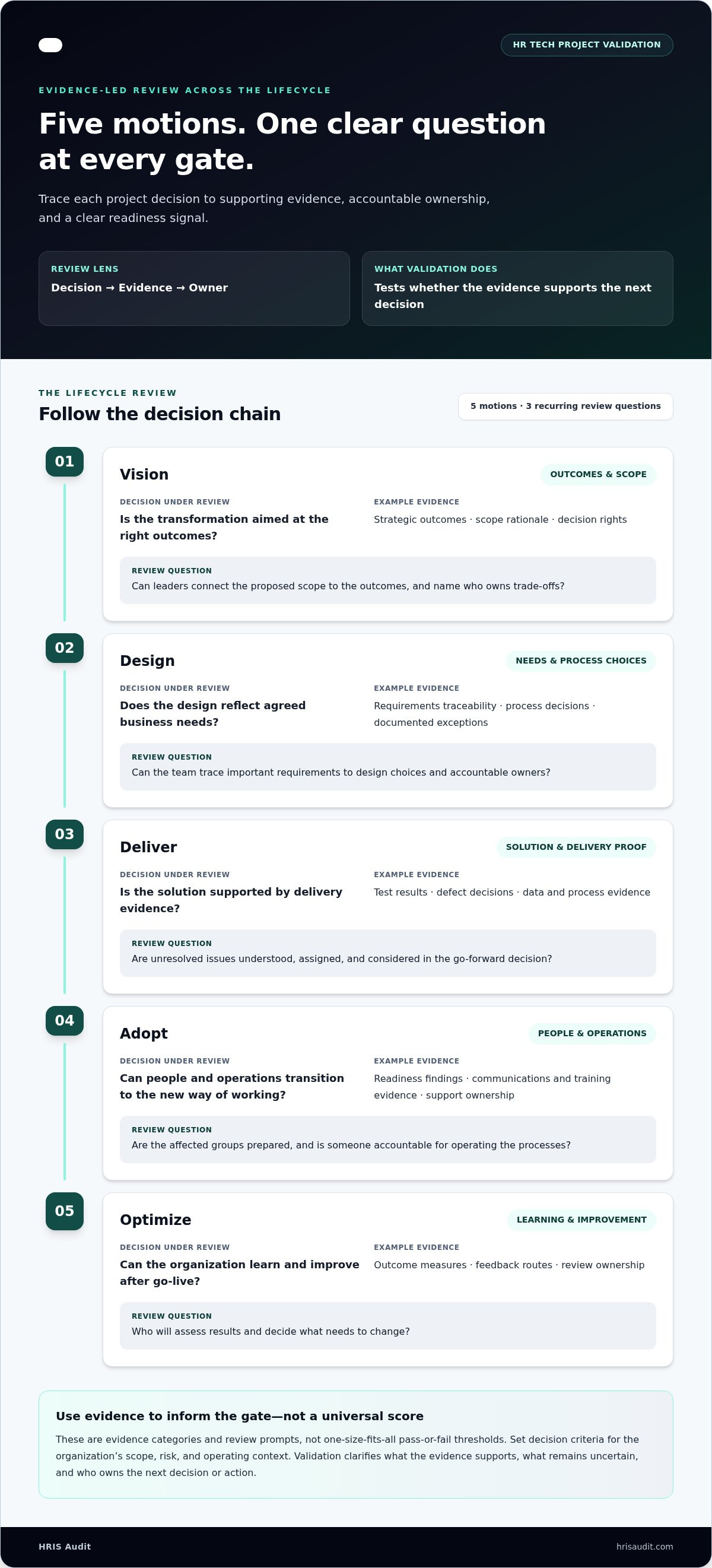
Validation is not a final inspection bolted onto the project before deployment. It follows the decision chain from the reason for change through design, delivery, adoption, and ongoing improvement. At each motion, leaders can ask the same three questions: What decision is being made? What evidence supports it? Who owns the decision and the next action?
The evidence changes as the program advances, but the discipline of review should remain consistent. The table below offers a practical map for independent validation for HR tech projects. It identifies evidence categories and review prompts, not universal pass-or-fail thresholds. Each organization should set decision criteria suited to its scope, risk, and operating context.
| Motion | Decision under review | Example evidence | Review question |
|---|---|---|---|
| Vision | Is the transformation aimed at the right outcomes? | Strategic outcomes, scope rationale, decision rights | Can leaders connect the proposed scope to the outcomes, and name who owns trade-offs? |
| Design | Does the design reflect agreed business needs? | Requirements traceability, process decisions, documented exceptions | Can the team trace important requirements to design choices and accountable owners? |
| Deliver | Is the solution supported by delivery evidence? | Test results, defect decisions, data and process evidence | Are unresolved issues understood, assigned, and considered in the go-forward decision? |
| Adopt | Can people and operations transition to the new way of working? | Readiness findings, communications and training evidence, support ownership | Are the affected groups prepared, and is someone accountable for operating the processes? |
| Optimize | Can the organization learn and improve after go-live? | Outcome measures, feedback routes, review ownership | Who will assess results and decide what needs to change? |
What evidence should leaders review at each project motion?
At Vision, inspect the logic connecting business outcomes to scope, including who can approve changes. In Design and Deliver, trace requirements into design decisions and delivery evidence. A requirement marked complete is less useful than a record showing how it was addressed and who accepted any exception. At Adopt and Optimize, focus on people, processes, and ownership: readiness activities, support responsibilities, feedback mechanisms, and the ability to act on what the organization learns.
How do readiness signals connect evidence to a decision?
A readiness signal summarizes what the evidence means for a specific decision. It might indicate that evidence supports proceeding, that a gap needs resolution, or that an assumption should be revisited. The signal does not replace judgment. It makes the basis for judgment visible. Quality gates create a defined moment to surface unresolved issues before deployment, assign ownership, and record whether leaders proceed or take another action.
Governance gives those decisions a structure: authority, evidence expectations, escalation paths, and follow-through. That structure is central to an effective HR technology governance framework. Leaders shaping their review model can also explore HRIS Audit’s transformation frameworks as a practical reference for connecting decisions to ownership and evidence.
Independent Validation vs. Implementation, Vendor Review, and Testing
These activities may examine the same project from different angles, but they do not serve the same purpose. Confusing them can leave gaps: delivery teams may be expected to provide independent challenge, or a technical test result may be treated as proof of organizational readiness. Clear boundaries let each role contribute without creating a parallel delivery structure.
| Activity | Purpose | Typical question | Decision owner |
|---|---|---|---|
| Implementation delivery | Configure, build, migrate, and deliver the agreed solution | Have the planned delivery activities and outputs been completed? | Implementation and platform leads for delivery decisions |
| Vendor review | Assess providers or products against selection needs | Which provider or platform best fits the organization’s needs? | Client sponsors and selection authorities |
| Technical testing | Check system behavior against defined requirements | Does this configuration or process behave as specified? | Testing leads and designated business or technical approvers |
| Internal assurance | Review selected controls, risks, or processes within a defined scope | Are the agreed control or assurance objectives being met? | Internal assurance leadership, with scope-dependent reporting |
| Independent validation | Assess project evidence, readiness, governance, and consequential decisions | Does the available evidence support the client’s next decision? | Client leaders retain the decision; the validator provides independent judgment |
What does independent validation cover that implementation teams do not?
Implementation teams and platform specialists own their delivery and technical responsibilities. Independent validation adds a client-side view across the wider system: whether decisions are supported, readiness claims are evidenced, governance is functioning, and the organization is building the capability to operate what is delivered. It does not presume that delivery partners lack integrity or competence. It gives client leaders a separate perspective on whether project information is sufficient for decisions they remain accountable for.
That distinction makes validation complementary. A test team may show that a configured workflow passes its test cases. A validator may then examine whether the relevant business owner accepted the workflow, whether exceptions have an agreed path, and whether the client is prepared to manage it. Each review informs the next without transferring delivery work or technical authority.
How is project validation different from software testing or an audit?
Technical testing asks whether a system behaves according to defined requirements. Validation asks whether broader claims about the project, its readiness, and its decisions are adequately supported. These questions intersect, but one result cannot stand in for the other. A passed test can be useful evidence without proving that ownership, adoption, or operational arrangements are ready.
“Audit” and “assurance” also cover different scopes depending on the organization and mandate. There is no single boundary that applies to every review. To avoid duplicated effort, define the validation remit before work begins: specify which decisions it will examine, which existing evidence it will use, who owns delivery actions, and who has authority to accept risk or proceed. Validation can then test decision quality without repeating tasks another team is already performing.
How to Run an Evidence-Led Validation Review Before a Project Gate
A gate review should resolve a decision, not generate another status report. Keep the scope narrow: identify what leaders must decide, examine the evidence relevant to that decision, and record what follows. This sequence makes independent validation for HR tech projects practical within existing governance, without inventing universal scores or thresholds.
- Define the decision. State precisely what the gate authorizes, such as moving a process into deployment preparation or accepting a design. Name the decision-maker and clarify which outcomes are in scope. If the decision cannot be stated plainly, the review is not ready to begin.
- Set evidence expectations. Agree what observable records would support the decision and who owns their accuracy. Depending on the gate, evidence might include approved requirements, test results, decisions on exceptions, or assigned operational responsibilities. These are evidence categories, not a universal checklist or fixed pass mark.
- Inspect the evidence. Trace claims to their supporting artifacts. A missing artifact is an evidence gap; it does not by itself prove that delivery failed. If the artifact exists but shows an unresolved defect or incomplete work, that points to a delivery issue. If the evidence depends on a decision no one has made, the gap is organizational.
- Test assumptions. Ask what must be true for the decision to hold. Which assumptions remain open, and what depends on each? What adoption or operational capability must exist before the next gate? A readiness claim about a new process, for example, should connect to evidence of preparation and a clear owner for operating that process.
- Record the action. Summarize the evidence reviewed, gaps found, implications for the decision, accountable owners, and follow-up. Make clear whether leaders will proceed, remediate a gap, pause, or revisit scope. Assigning an action does not transfer the delivery team’s responsibility or the executive’s authority.
Which questions expose weak evidence or false confidence?
Ask: What observable artifact supports this status claim? Who is responsible for its accuracy? Which assumptions remain open, and which decision depends on each? What must employees, managers, or operational teams be able to do before the next gate? These questions move discussion from reassurance to evidence. They also show whether a concern belongs with delivery, a business decision-maker, or an operational owner.
How should leaders record findings and act on them?
A useful record distinguishes evidence from interpretation. Note what was reviewed, what it supports, what remains uncertain, who owns the response, and when the decision returns to governance. Route technical findings to the delivery or testing leads, organizational decisions to their accountable owners, and material proceed-or-pause choices to the designated authority. This keeps the review visible without creating competing delivery instructions.
Licensed HR transformation frameworks can provide practical structure for consistent review questions and decision ownership. A framework should sharpen judgment, not replace it. Gate criteria still need to reflect the specific decision and the evidence available.
HRIS Audit’s advisory services bring independent judgment, readiness calibration, gate reviews, governance, recovery support, and executive decision support to HR technology transformations.
How HRIS Audit Applies Independent Validation to HR Tech Projects
Independent validation has value when it strengthens the client’s ability to lead, not when it creates another delivery authority. HRIS Audit applies this principle through Built Not Bought™, an executive system for leading HR technology transformation. It is not software or an implementation service. Its structure is exact: 5 motions, 10 frameworks, and 1 client-owned operating system.
The method connects strategic intent to the practical work of transformation. Vision establishes outcomes and ownership. Design and Deliver turn decisions into requirements and delivery evidence. Adopt and Optimize focus on organizational readiness, ongoing capability, and learning after deployment. The sequence gives leaders a way to examine whether evidence supports decisions across the lifecycle, rather than relying on a final checkpoint alone.
What makes the Built Not Bought™ approach relevant to validation?
Validation is not a separate verdict imposed on the program. It is a disciplined client-side perspective that works alongside platforms, integrators, and internal teams. Advisory capabilities include independent judgment, readiness calibration, gates, governance, recovery, and support for executive decisions. They help leaders challenge assumptions and make ownership explicit without taking delivery responsibilities away from the teams doing the work.
The operating principle is evidence before confidence, and capability before dependency. A quality gate can make an unresolved readiness issue visible; governance can direct it to the person with authority to act. These practices can surface risk, but they cannot eliminate every risk or guarantee a particular outcome. The platform remains part of the system, while the organization’s decisions, ownership, and ability to operate the change matter too.
What can leaders expect from an initial readiness conversation?
A readiness discussion should begin with the organization’s current decisions and evidence, not a predetermined conclusion. Leaders can consider what is known, which assumptions remain open, who owns critical choices, and where readiness needs closer attention. The purpose is to frame useful questions and clarify where further examination may be warranted, not to promise specific findings or outcomes.
That focus keeps the review grounded in the organization’s own context. Which decision is approaching? What evidence supports it? Who owns action if a gap needs attention? Independent validation for HR tech projects should help leaders answer those questions while preserving their authority and the delivery team’s role.
HRIS Audit’s Transformation Pulse Scan provides a starting point for examining current readiness questions and areas that need attention.
Make the Next Gate a Decision You Can Own
The next project gate is an opportunity to turn uncertainty into a clear leadership choice. Before approving the next step, decide what evidence would give your team a sound basis to proceed, what gaps require action, and who owns each decision. That discipline keeps accountability with the organization while allowing implementation teams to focus on delivery.
Independent validation for HR tech projects is not about adding scrutiny for its own sake. It is about building the judgment and ownership to act on what the evidence shows. HRIS Audit brings 30 years of experience in HR technology transformation to this work, helping leaders examine readiness and strengthen decision-making without taking ownership away from the client.
Start with the question that matters now: where does your organization need a clearer view of readiness?
Frequently Asked Questions
What is independent validation for an HR tech project?
It is an impartial review of whether the evidence supports important project decisions. For example, before approving a change to payroll processing, leaders might review documented requirements, test outcomes, exception handling, and business-owner approval. The reviewer assesses whether the decision is supported, while the people accountable for delivery and operations retain their roles. The focus is not simply whether tasks are complete, but whether the available evidence is sufficient for the decision being made.
When should an HR technology project be independently validated?
Use validation at consequential decision points, not only in the final weeks before launch. Early review can test whether scope and expected outcomes are clear; later reviews can examine design choices, data readiness, adoption preparation, or operational ownership. For example, validate a major process decision before it becomes a configuration assumption carried into testing. Timing should follow the project’s risk and governance needs, with reviews aligned to decisions leaders can still influence.
How is independent validation different from an HRIS audit?
The terms can overlap, but an HRIS audit often refers to a review of defined systems, processes, controls, or records, while project validation focuses on whether evidence supports transformation decisions and readiness claims. The actual boundary depends on the review’s purpose and scope. If leaders need to know whether access controls operate as intended, that may call for an audit or control review. If they need to decide whether a process change is ready to launch, validation can assess the decision evidence.
Can an implementation partner validate its own HR technology project?
An implementation partner can review its own work, perform quality checks, and report delivery evidence. Those activities are valuable, but they are not independent client-side validation because the partner is part of the delivery arrangement being assessed. The client can use partner evidence as an input while retaining a separate perspective on decision quality, readiness, and organizational ownership. Independence is about the reviewer’s relationship to the work and decision, not an accusation about a partner’s competence.
What evidence should leaders review before an HR tech go-live?
Review evidence tied to the organization’s actual go-live decisions: approved process designs, test outcomes and unresolved defects, data reconciliation results, role and access decisions, support ownership, and adoption preparation. For a benefits enrollment process, for example, leaders may need to understand how exceptions are handled and who resolves them after launch. Do not treat a large evidence pack as proof by itself. Check that each item is current, relevant to the decision, and connected to an accountable owner.
Does independent validation replace HR technology testing or implementation support?
No. Testing checks whether configured technology behaves according to defined requirements; implementation teams build, configure, and deliver the solution. Validation considers whether evidence from those activities, alongside business and operational information, supports the client’s decisions. For example, successful testing may establish that a workflow operates as designed, while leaders still need to determine whether the design reflects an accepted business process. Validation uses delivery evidence; it does not replace the teams that produce it.


