

An HRIS project can be on schedule and still be losing control of the decisions that determine whether it works. A vendor’s status report shows delivery progress, but it cannot prove the organization has agreed on its processes, data responsibilities, or ownership after go-live. The role of client-side project manager HRIS transformation demands is to protect business decisions, not just delivery milestones.
It’s reasonable to expect the implementation partner to manage its delivery work. But HR, IT, executives, and the vendor each hold different pieces of the operating model, and the vendor cannot make the organization’s choices for it. This article explains what the client-side project manager should own, what belongs with the implementation partner, and how clear boundaries keep accountability from dissolving between teams. It also covers how client-side oversight connects governance, system design, adoption, and post-launch capability, with practical steps for keeping decisions visible and assigned. The distinction matters: a project can complete its tasks while leaving the business unprepared to run the system.
Key Takeaways
- The role of client-side project manager HRIS is to connect business outcomes, internal decisions, delivery oversight, readiness, and lasting ownership.
- Make decision rights explicit: track what needs a decision, who holds authority, and what evidence will support it.
- Separate client and implementation partner responsibilities across delivery, risk, readiness, and post-go-live support, guided by the contract and governance model.
- Use a steady management rhythm to establish authority, review evidence, resolve exceptions, and transfer ownership, with clear outputs from each step.
- Stalled decisions, repeated scope disputes, or weak readiness evidence can signal the need for experienced advisory support.
Role of a Client-Side PM in HRIS Transformation
Client-side leadership represents the adopting organization’s interests throughout HRIS change. The project manager connects business objectives to internal decisions, oversees delivery from the client’s perspective, and tests whether people and processes are ready to operate the system. This goes beyond maintaining a schedule. The manager helps ensure the system being delivered supports the organization’s intended way of working.
A plan can show completed milestones while critical questions remain open: Who approves a changed process? Which team owns employee data quality? What needs to be resolved before a workflow is accepted? Schedule and scope control make activity visible, but they don’t establish whether the organization understands the choices it has made or can take responsibility for the system after launch.
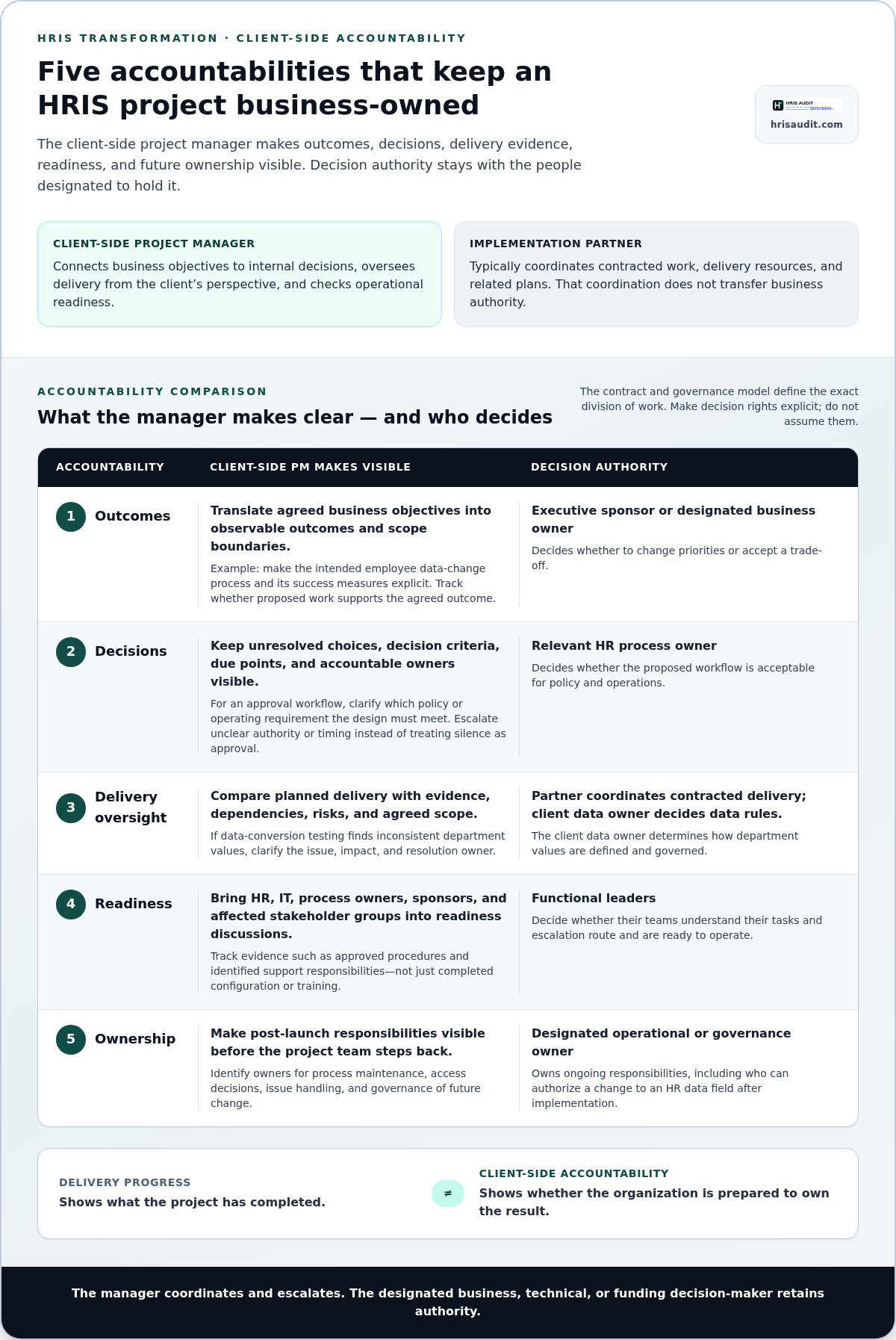
Delivery progress shows what the project has completed; client-side accountability shows whether the organization is prepared to own the result. That distinction is central to the role of a client-side project manager in HRIS transformation.
How is the client-side role different from a vendor project manager?
The client-side manager is accountable to the adopting organization and its priorities. They bring the right internal decision-makers into the process, surface trade-offs, and make sure decisions reflect business needs rather than simply the easiest route through delivery.
The implementation partner’s project manager typically coordinates the contracted work, delivery resources, and related plans. The two roles work closely, but coordination doesn’t transfer business authority. For example, a partner can explain the implications of configuring an approval workflow, while the client’s authorized business owner decides whether that workflow fits policy and operations. The contract and governance model shape the exact division of work, so decision rights should be explicit rather than assumed.
Why does the role matter beyond go-live?
Implementation choices become operating conditions. Decisions about process design, data responsibilities, support routes, and system administration shape what internal teams must manage after launch. If those responsibilities remain vague during the project, inconsistent adoption, avoidable support requests, or uncertainty about who can change a process may follow.
The client-side manager connects delivery decisions to future ownership. That includes identifying who will maintain processes, handle exceptions, guide users, and govern change once the implementation team’s work is complete. It also means treating readiness as evidence: named owners, agreed procedures, and clear escalation paths, not simply a completed training session.
This ownership-focused approach aligns with governance and ownership frameworks, which help organizations consider how HR technology can remain effective beyond launch. The broader test is straightforward: can the organization explain why key decisions were made and who is responsible for carrying them forward?
Five accountabilities a client-side HRIS project manager must hold
The role of client-side project manager HRIS transformation requires more than task tracking. The manager makes five things visible: expected outcomes, decisions needed to achieve them, delivery evidence, operational readiness, and ownership after launch. The manager coordinates and escalates, while authority stays with the people designated to make each business, technical, or funding decision.
- Outcomes. Translate agreed business objectives into observable outcomes and scope boundaries. If the goal is to simplify employee data changes, for example, make the intended process and measures of success explicit. The manager tracks whether proposed work supports that outcome; the executive sponsor or designated business owner decides whether to change priorities or accept a trade-off.
- Decisions. Maintain a visible record of unresolved choices, decision criteria, due points, and accountable owners. For an HRIS approval workflow, clarify which policy or operating requirement the design must meet. The relevant HR process owner decides whether the workflow is acceptable. If authority or timing is unclear, the manager escalates instead of letting silence become approval.
- Delivery oversight. Compare planned delivery with evidence, dependencies, risks, and agreed scope. If a data-conversion test reveals inconsistent department values, make the issue, impact, and resolution owner clear. The implementation partner may coordinate contracted delivery work; the client’s data owner decides how the organization will define and govern those values.
- Readiness. Bring HR, IT, process owners, sponsors, and affected stakeholder groups into readiness discussions. A new employee-change process needs more than a finished configuration: teams need to understand their tasks and escalation route. The manager tracks evidence such as approved procedures and identified support responsibilities; functional leaders decide whether their teams are ready to operate.
- Ownership. Make post-launch responsibilities visible, including process maintenance, access decisions, issue handling, and governance of future change. Identify who will authorize a change to an HR data field after the project team steps back. The designated operational or governance owner accepts that responsibility; the project manager records gaps and drives their resolution before handover.
Accountability becomes real when every outcome has an owner, every decision has an authority, and every commitment has follow-through. The project manager doesn’t make every decision. They make it difficult for a decision to disappear between teams.
Keep governance connected to day-to-day work
Governance isn’t a separate layer of ceremony. It defines who can decide, how exceptions move, and which responsibilities persist after delivery. Align project decision routes with the organization’s HR technology governance framework so design choices, risk escalation, and operational ownership reinforce one another without turning every issue into an executive agenda item.
When decision rights, accountability, or follow-through need strengthening, client-side HRIS advisory can help clarify governance and reinforce business ownership alongside delivery.
Client-side project manager vs. implementation partner: who owns what?
Having two project managers doesn’t automatically mean duplicated effort. The roles are useful when their accountabilities differ. The client-side manager protects the organization’s priorities and decision rights. The implementation partner’s manager coordinates delivery responsibilities set out in the contract and project plan. The client-side manager’s role is not to mirror vendor reporting, but to connect delivery activity to client requirements and decisions.
The division isn’t universal. Contracts, governance arrangements, and organizational design determine who coordinates each workstream, manages specific risks, or leads readiness activity. Use the table as a starting point, then assign named owners and decision-makers for your program.
| Area | Client-side project manager | Implementation partner project manager |
|---|---|---|
| Business decisions | Structures decisions around business priorities, process ownership, and acceptable trade-offs. Escalates to the sponsor or accountable process owner, who decides. | Explains delivery implications and coordinates agreed actions. Doesn’t assume authority to set the client’s policies or business priorities. |
| Delivery coordination | Coordinates internal contributors and tests progress against client requirements, dependencies, and approved decisions. | Coordinates contracted delivery tasks, resources, milestones, and workstream dependencies as agreed. |
| Risks | Makes organizational impacts, unresolved choices, and accountable owners visible; escalates risks to the appropriate client authority. | Manages delivery risks within its assigned scope and reports issues that could affect contracted work. |
| Readiness | Brings internal leaders and affected teams into readiness discussions; confirms client-side owners assess operational preparedness. | Provides delivery information and performs readiness activities assigned through the plan or contract. |
| Post-go-live ownership | Coordinates transition to the client’s designated process, support, and governance owners. | Supports any post-launch responsibilities defined in the engagement. |
Which decisions must stay with the client organization?
Business priorities, process ownership, acceptable trade-offs, and readiness choices belong with the organization’s authorized leaders. The project manager makes these decisions answerable by clarifying the options, impacts, deadline, and decision owner. They don’t substitute for the sponsor’s authority or a process owner’s judgment. For example, the manager can frame the impact of changing an HR approval route, but the accountable business owner decides whether the change fits the organization’s operating needs.
Where should delivery responsibilities be coordinated?
Workstream coordination, milestones, dependencies, and issue handling should follow agreed delivery responsibilities. The client-side manager reviews status against requirements and recorded decisions, not just activity reported as complete. If a configuration task is marked done, the client still needs to assess whether it reflects the approved process. The partner is responsible for its assigned delivery work; the organization retains responsibility for its internal ownership and business outcomes.
How to make client-side HRIS project management work in practice
Strong client-side management depends on a repeatable rhythm, not a crowded status deck. Each review should move from authority to evidence, then from exceptions to ownership. The role of client-side project manager HRIS teams need is to make that rhythm useful: decisions reach the right people, unresolved issues are escalated, and delivery closes with operational responsibilities assigned.
- Establish authority. Confirm the sponsor, decision-makers, process owners, and escalation route. A governance map or project charter can record who approves business priorities, who owns a process, and who resolves conflicts between workstreams. The useful output is a shared understanding of who can decide, not simply a list of meeting attendees.
- Set decision rules. Agree how decisions are raised, what information supports them, and when unresolved items escalate. A decision log can capture the question, options, impact, owner, and due point. If a process change affects several teams, for example, the log should show which process owner recommends an option and who has authority to approve it.
- Review evidence. Examine completed work against requirements and approved decisions. Workstream updates, test results, dependency records, and readiness evidence can show whether progress is verified or merely reported. Separate a completed configuration task from confirmation that the business process works as agreed. This prevents assumptions from being mistaken for accepted outcomes.
- Resolve exceptions. Identify what is blocked, who can unblock it, and what decision or action is needed. Record the issue, its impact, the accountable owner, and the escalation route in an exception log or review note. Keep escalations concise, and don’t let an unresolved choice disappear inside a general status of “on track.”
- Transfer ownership. Before project closure, identify operational owners for processes, data, ongoing decisions, and system stewardship. A transition record or capability-transfer session can capture responsibilities, open items, and governance routines that continue after implementation closes. Treat transfer as work throughout delivery, not a final handoff event.
What should a client-side project review examine?
A useful review is a decision forum, not merely a progress meeting. Examine decisions due, accountable owners, dependencies, risks, and evidence of readiness. Distinguish completed activity from verified outcomes, and surface assumptions that still need a decision. HRIS Audit’s Transformation Pulse Scan provides a diagnostic resource for surfacing program signals that warrant discussion and action.
How can the team preserve ownership after go-live?
Build future operating responsibilities into delivery conversations. Name the people who will maintain processes, steward data, make ongoing decisions, and oversee system changes. Connect those responsibilities to governance routines that will continue after the project closes. Capability transfer should give owners a clear view of decisions made, unresolved work, and how to manage the system in practice.
When client-side HRIS project leadership needs experienced advisory support
Additional leadership can help when the project’s structure no longer turns activity into clear decisions and accountable action. Warning signs are often visible before a major milestone slips: decisions stall without an escalation path, teams disagree about who owns a process, scope disputes recur because requirements or decision rights remain unsettled, or readiness reports describe activity without evidence that the organization can operate what is being delivered.
- Stalled decisions: the same issue returns to meetings without an authorized decision-maker or a clear path to resolution.
- Unclear ownership: HR, IT, sponsors, and partners assume another group will own a process, data decision, or operating responsibility.
- Repeated scope disputes: teams revisit what was agreed because priorities, boundaries, or approval authority aren’t clear.
- Weak readiness evidence: training or configuration is reported as complete, but business owners can’t show that roles, procedures, or support responsibilities are ready.
These conditions call for independent client-side leadership focused on decisions and business ownership. An advisor can help the organization clarify what it must decide, strengthen governance, and keep attention on business ownership alongside implementation activity. The role of client-side project manager HRIS programs require is not to make every decision for executives. It is to make decisions visible, prepare leaders to act, and ensure the resulting direction is carried through.
What can client-side advisory contribute?
Advisory can support a program reset when governance or direction has lost coherence, provide gate reviews to test whether evidence supports progression, and give sponsors structured decision support when trade-offs need leadership attention. Capability transfer helps internal teams build the knowledge and practices needed to steward the system beyond project close. Each contribution should fit the program’s needs and authority structure.
HRIS Audit’s Built Not Bought™ method guides organizations in designing, governing, and delivering HR systems intended to remain effective after go-live. It connects decisions made during transformation with the operating capabilities needed afterward. With more than 30 years of HR transformation experience, HRIS Audit provides client-side leadership and advisory throughout enterprise HR technology transformation. The advisory complements implementation delivery by keeping attention on the organization’s decisions and ownership. Experience can sharpen the questions leaders ask; it doesn’t remove their responsibility to decide.
What is the next step for a leadership team?
Take a clear-eyed snapshot of the program. Can leaders identify who owns open decisions? Are material risks visible with accountable owners? Does readiness evidence show operational capability, rather than completed activity alone? Are post-go-live responsibilities assigned to people with the authority and capacity to carry them? Gaps in these areas point to where leadership attention should go next.
Strengthen the decision structure before ambiguity hardens into accepted practice. Explore client-side HRIS advisory for leadership and decision support throughout your transformation.
Put client-side ownership into motion
Test whether your project’s decision structure works under pressure. Pick one unresolved issue. Can the team identify who owns it, who has authority to decide, and what evidence will support the choice? If not, the gap is not a reporting problem. It’s a leadership issue to address before it becomes embedded in the design or operating model.
The role of client-side project manager HRIS transformation depends on should evolve with the work. As implementation moves toward launch, shift the focus from coordinating activity to building the organization’s ability to govern and improve its system. That means making ownership durable, not dependent on one project lead or a temporary delivery team. Start with the decision or handoff that feels least clear, then give it a named owner and a practical next action.
Clear ownership is built through deliberate choices. HRIS Audit’s client-side advisory can help your leadership team make the next one with confidence.
Frequently Asked Questions
What is a client-side project manager in an HRIS implementation?
A client-side project manager represents the organization, coordinating internal decisions and checking delivery against agreed business needs. They connect sponsors, HR, IT, process owners, and implementation teams so questions reach the right people. For example, they can coordinate a decision about which employee group a new process applies to. They don’t simply administer meetings, make executive decisions, or replace the sponsor’s leadership.
Is a client-side HRIS project manager different from a vendor project manager?
Yes. The client-side manager represents the adopting organization, while the vendor project manager coordinates the implementation partner’s assigned delivery work. Shared plans and escalation routes connect their work, but the roles aren’t interchangeable. If a proposed design changes an internal approval practice, the partner can explain delivery implications, while the client’s authorized owner decides whether the practice should change. Exact task boundaries depend on governance and delivery agreements.
Does every HRIS implementation need a client-side project manager?
Not every project needs a dedicated person with that title, but every project needs clear client-side accountability. A contained change with few stakeholders may be coordinated by an existing leader, provided decision and risk ownership remain clear. A transformation spanning HR, payroll, IT, and multiple business groups carries a heavier coordination and decision load. Assess complexity, stakeholder reach, dependencies, and available internal capacity before choosing a staffing model.
Who should a client-side HRIS project manager report to?
There’s no single reporting line that suits every organization. The arrangement should give the manager access to accountable sponsors and a credible route to raise issues across HR, IT, and business functions. For instance, a reporting line that limits visibility of a cross-functional data decision can slow escalation. Define the manager’s access and escalation authority in program governance, while assigning approval rights to the appropriate executives and process owners.
When should a client-side project manager join an HRIS transformation?
Bring client-side leadership in while objectives, governance, and delivery responsibilities are being shaped. Early involvement helps the organization establish who will approve scope, resolve competing requirements, and represent affected teams. If implementation has already started, the manager can still create a current view of open decisions, dependencies, and readiness gaps. Begin with the program’s present state; don’t assume earlier work needs to be discarded before it’s assessed.
What skills matter most for a client-side HRIS project manager?
The role calls for disciplined project leadership, stakeholder coordination, clear communication, risk awareness, and judgment about when to escalate. HRIS knowledge helps the manager understand how a decision may affect processes and delivery, but software expertise alone isn’t enough. When a requirement conflicts with an operating practice, for example, the manager must clarify the trade-off and guide it to the right owner, not make the business choice by default.


