

HRIS implementation mistakes are often governance failures disguised as delivery problems. The common HRIS implementation mistakes to avoid rarely begin with a software defect. They begin when leaders approve a system before requirements, decision rights, data ownership, and measures of success are clear. By the time testing exposes the gaps, teams are already absorbing rework and operational risk.
It’s reasonable to focus on configuration, migration, integrations, and training. Those are visible workstreams, but they can’t compensate for weak foundations or unclear accountability. The real question is whether your organization can make timely decisions, validate what matters, and own the system after go-live.
This guide shows how to spot early warning signs and apply practical controls across strategy, design, execution, and post-go-live operations. You’ll see how governance, data discipline, testing, adoption, and sustainable ownership fit together, and where an independent client-side perspective can strengthen decisions before risks become expensive.
Key Takeaways
- Define business outcomes before discussing features, then establish who owns key decisions and scope.
- Distinguish platform constraints from design choices, data controls, and integration ownership before assigning blame.
- The common HRIS implementation mistakes to avoid often stem from weak governance, not isolated delivery errors.
- Treat go-live as a transition point by separating communications, role-based learning, operational support, and ongoing governance.
- Use a disciplined path to diagnose risks, assign owners, review decisions, and transfer capability for sustainable system ownership.
Common HRIS Implementation Mistakes: Why They Start Before Go-Live
Leaders face a genuine tension: deliver a live HR system on schedule while protecting employees, payroll processes, and day-to-day operations. That pressure is real. But moving quickly through unresolved questions doesn’t remove them. It pushes the consequences into later stages, where changes affect more workstreams and become harder to contain.
An implementation mistake isn’t simply a task that was late or a configuration that needed correction. It’s a decision or control failure: a choice made without the right owner, evidence, or agreement about its consequences. A missed task may be visible on a project plan. A weak control is more dangerous because it can let the same kind of error pass through multiple stages.
Look for patterns rather than isolated slips. The common HRIS implementation mistakes to avoid often announce themselves through friction: teams repeatedly reopening decisions, different groups describing success in incompatible terms, or manual workarounds appearing before the system is live. These are signals to investigate, not proof that the software is at fault.
What early warning signs reveal an HRIS project is off track?
Recurring scope changes, unresolved decisions, and conflicting success measures can point to a project without a stable decision framework. Other warning signs include process workarounds, inconsistent ownership between functions, and issues reaching sponsors only after delivery teams have tried to resolve them themselves. Ask what each signal connects to: a symptom identifies where work is struggling; the structural cause explains why the organization can’t resolve it consistently.
- A requirement changes repeatedly because the decision-maker or decision criteria remain unclear.
- Teams use different definitions of “ready” because success measures haven’t been aligned.
- Escalations arrive late because ownership or authority is divided across functions.
Track signals by owner, decision, and operational consequence. A pattern across teams deserves leadership attention even if each individual issue looks manageable. For example, repeated changes to the same requirement may indicate that decision rights or the underlying business need have not been settled.
Why do familiar HRIS mistakes repeat across organizations?
Schedule pressure makes foundational decisions feel deferrable. Teams may keep moving while questions about process ownership, priorities, or acceptable exceptions remain open. Functional silos compound the problem: HR, payroll, IT, and business leaders may each document their own requirements while nobody owns the end-to-end outcome. The project appears active, but its assumptions are disconnected.
Implementation risk is the accumulated weight of unresolved decisions that teams continue to carry forward.
Software capability can support a sound operating model; it can’t decide who owns a process, reconcile competing priorities, or establish which assumptions are acceptable. A feature demonstration may show what a platform can do. It can’t substitute for agreement on what the organization needs, who has authority to decide, and how the result will work in practice. Before treating a warning sign as a technical defect, trace it back through ownership, decision history, and agreed operating assumptions.
Prevent Strategic HRIS Mistakes by Defining Outcomes, Scope, and Ownership
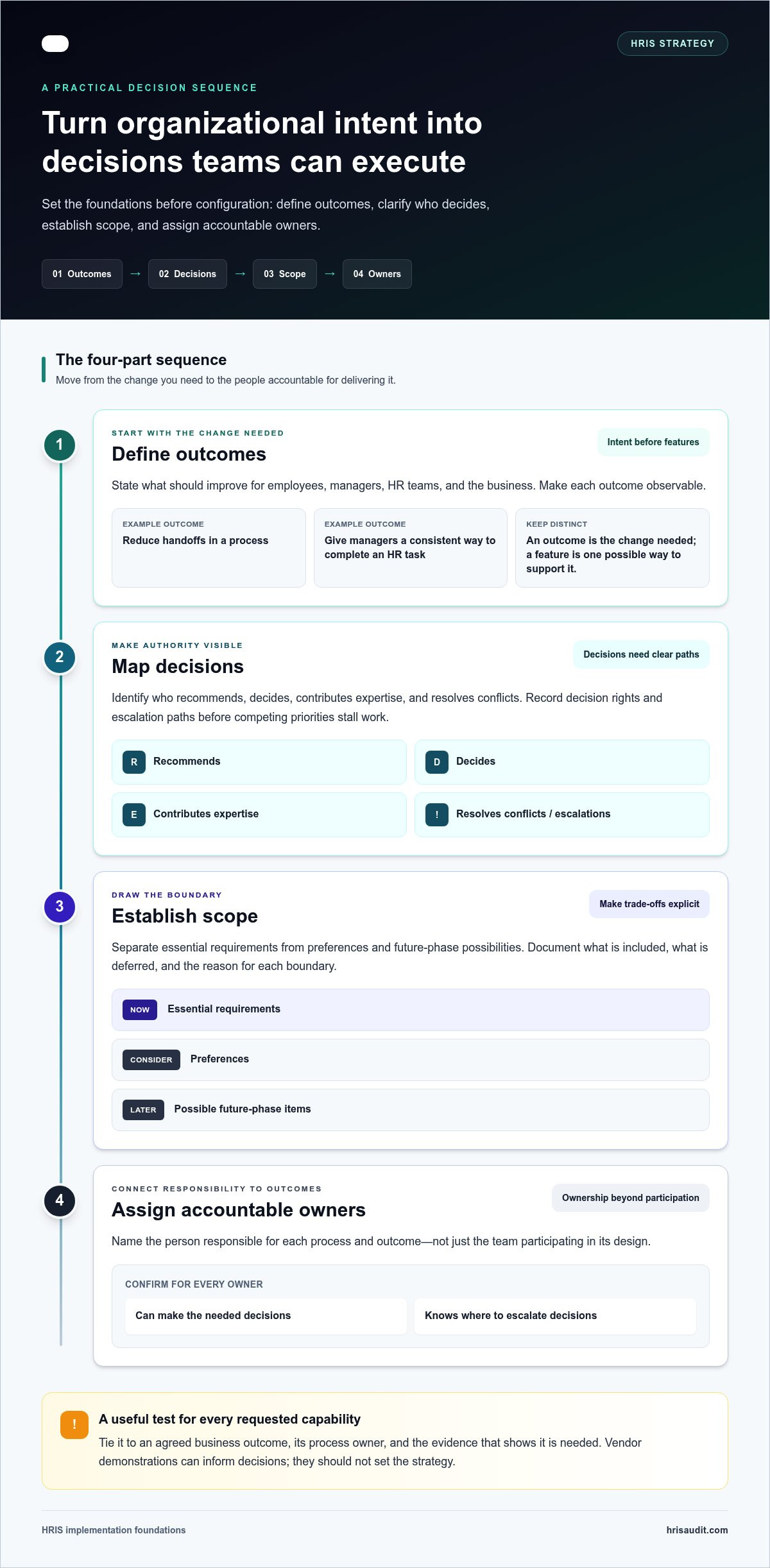
Strategic discipline starts before configuration. Leaders need a sequence that turns organizational intent into decisions teams can execute. Skip a step, and preferences can masquerade as requirements, while unresolved trade-offs return later as scope changes or operational gaps. Use this four-part sequence:
- Define outcomes. State what should improve for employees, managers, HR teams, and the business. Make each outcome observable, such as reducing handoffs in a process or giving managers a consistent way to complete an HR task.
- Map decisions. Identify who recommends, decides, contributes expertise, and resolves conflicts. Record decision rights and escalation paths before competing priorities stall work.
- Establish scope. Separate essential requirements from preferences and future-phase possibilities. Document what is in scope, what is deferred, and the reason for each boundary.
- Assign accountable owners. Name the person responsible for each process and outcome, not just the team participating in its design. Confirm that owners can make decisions or know where to escalate them.
How should leaders define HRIS outcomes before selecting or configuring a system?
Translate organizational needs into workforce, process, and service outcomes before reviewing features. For example, define the employee or manager task that should become clearer, more consistent, or easier to complete. Then classify each requirement as essential now, a preference, or a possible later phase. A business outcome describes the change the organization needs; a feature list describes one possible way to support it.
Vendor demonstrations can help teams understand system capabilities, but they shouldn’t set the strategy. A polished feature is not automatically a priority. Tie each requested capability to an agreed outcome, its process owner, and the evidence that would show it is needed. This keeps demonstrations in their proper role: informing decisions, not making them.
Who owns scope, decisions, and cross-functional trade-offs?
Ownership must cover the full operating chain. Sponsors set priorities and resolve material trade-offs. Process owners define how work should function. HR and payroll leaders clarify service and transaction needs; IT contributes architecture and technical considerations; business leaders represent operational requirements. These roles may overlap, but decision authority should not be assumed.
Document who decides, which issues require escalation, and what assumptions underpin each decision. An assumption that stays invisible can become a design constraint nobody knowingly approved. The Enterprise HR Technology Governance Framework offers a structure for clarifying decision rights and escalation. This discipline also supports client-side HR technology leadership, where independent attention can help keep organizational priorities at the center of transformation decisions.
Unresolved priorities create predictable strain: repeated scope negotiations, complexity added to satisfy competing preferences, or a design that lacks a clear operational owner. The common HRIS implementation mistakes to avoid are less likely when leaders make trade-offs explicit early, document the rationale, and revisit decisions through a defined governance path.
If priorities or ownership remain unclear, HRIS Audit’s Transformation Pulse Scan can help leaders assess program risks and identify where decision discipline needs attention.
Are HRIS Implementation Mistakes Really Software Problems?
A failed transaction or mismatched record can look like a platform defect. Sometimes it is. But a technical symptom doesn’t establish the root cause. The issue may sit in a design choice, inaccurate source data, an undocumented interface dependency, or a test that checked only whether information moved, not whether it was correct or usable.
Separate these causes before authorizing a fix. Otherwise, teams may alter configuration to compensate for bad data, or patch an interface while leaving the process that produces errors untouched. Use this comparison to direct investigation:
Area
What to investigate
Example signal
Platform constraint
Whether the system supports the required capability or has a documented limitation.
A needed rule cannot be represented as designed.
Design decision
Whether configuration reflects an agreed process and approved exceptions.
Two groups expect different approval paths.
Data control
Whether a named business owner defines, cleans, and validates the information.
A transferred code has no consistent business meaning.
Integration ownership
Whether each interface has an accountable owner and documented dependencies.
A downstream process receives incomplete or stale records.
How do data and integration mistakes become operational failures?
Trace each important data flow from source to use. Establish who owns the source, which definitions apply, what cleansing is required, and how migrated records will be reconciled. Then document where data travels, what each interface expects, and how exceptions are handled. If a field means different things to HR and payroll, a technically successful transfer can still produce an operational error.
Weak source data, unclear interface rules, and thin testing can compound. An incorrect value moves downstream, passes a basic transfer check, then disrupts a process that depends on it. Business owners must validate meaning and expected use, not just confirm that a file or record arrived.
What does testing need to prove before go-live?
Test complete business scenarios across connected HR, payroll, and downstream processes. For example, follow a workforce change from its initiation through the relevant approvals, updates, and resulting outputs. Include normal cases, exceptions, and corrections. A successful interface test does not prove that the business process works.
Keep three forms of evidence distinct: technical validation shows that systems exchange information as designed; business acceptance confirms that results match approved rules; operational readiness confirms that people can manage routine work, exceptions, and support responsibilities. The common HRIS implementation mistakes to avoid include treating one type of evidence as proof of all three. Before go-live, require named owners to review outcomes and unresolved defects against their real operational impact.
Avoid Adoption and Post-Go-Live Mistakes With Clear Operating Controls
Go-live marks a change in operating conditions, not proof that people have adopted the system or that the organization is realizing its intended value. Employees may still rely on familiar workarounds. Managers may be uncertain about new responsibilities. HR teams may lack a clear route for resolving issues that fall between process and technical ownership.
Build post-go-live controls before launch, with distinct workstreams for communication, learning, support, and governance. They solve different problems. A message can explain what is changing, but it can’t teach a manager how to complete a new task. Training can build task knowledge, but it can’t replace an operating team with authority to resolve recurring issues.
How should change and training be designed for different user groups?
Start by mapping affected roles, changed decisions, and new responsibilities. Then tailor communication and learning to the work each group must perform. Employees need guidance for their own transactions; managers need practice with approvals and team changes; HR and administrators need deeper process and system knowledge. Use questions, readiness reviews, and practice scenarios to surface barriers before launch, not after old habits return.
Keep these activities connected but distinct. Communications create awareness and explain why work is changing. Role-based learning builds practical capability. Operational support provides a clear route for questions and defects. Feedback from each group should inform readiness decisions and reveal where instructions, process design, or support arrangements need attention.
What must remain governed after the HRIS goes live?
Assign enduring owners for data definitions, process changes, access, issue resolution, and enhancements. Establish a review rhythm for use, process performance, data quality, open issues, and unresolved risks. Measures should prompt action: a rise in incomplete records, for example, should lead to an owner, a cause investigation, and a follow-up decision, not simply another status report.
Define escalation routes as carefully as routine responsibilities. Which issues can an operational owner resolve? Which require sponsor attention because they affect priorities, resources, or control? Keep decisions and assumptions visible so teams can distinguish a one-time defect from a recurring operating weakness. This is how governance continues after the project structure winds down.
Sustainable ownership is the principle behind the Built Not Bought HR strategy: organizations need the capability to govern and improve the system, not just receive a configured solution. Practical HR transformation tools and frameworks can help shape that operating discipline. The common HRIS implementation mistakes to avoid include treating adoption as a launch activity or governance as a temporary project task. Both must become part of how the organization works.
Assess transformation risks with a Transformation Pulse Scan.
A Practical HRIS Mistake-Prevention Path From Diagnosis to Sustainable Ownership
Risk control is not a final project phase. It’s a management discipline that connects weak signals to decisions, accountable owners, and follow-through. Leaders can use a straightforward sequence to decide what needs attention now, what can wait, and whether the program’s current structure is still fit for purpose.
- Diagnose. Gather evidence across unresolved decisions, dependencies, ownership gaps, adoption readiness, and post-go-live controls. Look for connections between issues. A data concern, for instance, may affect testing, payroll processes, and operational readiness at once.
- Prioritize. Rank risks by business impact and dependency, not by who escalates most forcefully. A blocked decision that holds up several workstreams may need attention before a visible but isolated defect.
- Assign ownership. Give each priority a named accountable owner, a decision date, and a review point. An issue without those elements is a concern, not yet a managed action.
- Review decisions. Revisit assumptions, scope choices, and unresolved trade-offs against current evidence. Record what changed, who approved it, and which downstream work is affected.
- Transfer capability. Prepare internal leaders and teams to own decisions, measures, processes, and improvement after project or advisory support reduces. Sustainable ownership is an outcome to design, not a handover document.
How can leaders prioritize risks before they become program resets?
Assess where uncertainty is concentrated and what depends on it. Compare each issue’s operational impact, affected workstreams, and time sensitivity. Then identify the decision or control that would reduce exposure. For example, an unclear process owner may create more risk than a delayed task if multiple teams depend on that process. Track priorities in a concise register with an owner, decision date, and scheduled review.
A program reset may be appropriate when the existing plan no longer reflects the real state of decisions, scope, ownership, or delivery dependencies. An independent gate review can help test whether evidence supports moving to the next stage, expose unresolved conditions, and restore decision discipline. Neither should be treated as ceremony. The purpose is to make the next decision clearer and more accountable.
How can client-side advisory strengthen implementation discipline?
Independent client-side leadership and advisory keeps the organization’s interests in view as delivery choices are made. Sponsor decision support helps leaders resolve consequential trade-offs; gate reviews bring evidence and readiness into key transitions. Capability transfer builds the internal understanding needed to govern the system after go-live, rather than leaving the organization dependent on project momentum.
HRIS Audit provides client-side leadership and advisory for enterprise HR technology transformation, with a focus on governance and sustainable organizational ownership. The common HRIS implementation mistakes to avoid are less likely to persist when risks have owners, decisions have a clear route, and internal teams are prepared to sustain the operating model.
Make Sustainable Ownership the Next Milestone
The next step isn’t simply to move the plan forward. It’s to identify where decision discipline or accountability needs strengthening, then act while leaders still have room to shape the path. The common HRIS implementation mistakes to avoid become harder to correct when unresolved risks are allowed to pass from one project stage to the next.
For more than 30 years, HR transformation experience has informed HRIS Audit’s client-side advisory approach. The focus is governance, delivery, adoption, and sustainable organizational ownership, not the technology alone. A clear-eyed view of program health can help leaders decide where attention is needed and what to address first.
Build the conditions for your organization to own and improve its HR technology with confidence. Progress begins with a decision you can stand behind.
Frequently Asked Questions
How long does an HRIS implementation take?
There’s no reliable universal timeline. Duration depends on scope, data readiness, integrations, decision speed, and organizational complexity. A program with several connected processes and inconsistent records has different planning needs from a narrower change with stable data. Build the schedule around actual work, including validation and business decisions. Treat unresolved dependencies and delayed decisions as planning variables with owners and consequences, not as small tasks to squeeze in later.
Is a phased HRIS rollout better than a single go-live?
Neither approach is inherently safer. A phased rollout can contain the transition and let teams apply lessons before expanding. A single go-live may suit tightly connected processes that need coordinated change, such as linked employee and payroll workflows. Choose based on dependencies, operational risk, readiness, and the organization’s capacity to support users. Map what each phase would leave running in parallel, and account for the additional coordination that arrangement requires.
How can an organization measure HRIS implementation success beyond go-live?
Measure whether the system supports the business outcomes it was meant to enable. Select indicators for process performance, data quality, adoption, service experience, and ownership of ongoing work. Establish a baseline and name an owner for each measure before launch. For example, track whether a key process is completed accurately and within its intended workflow. A deployment milestone confirms delivery progress, not that the organization has achieved the intended operating results.
How much internal time should HR leaders reserve for an HRIS implementation?
There’s no fixed staffing level that fits every program. Internal effort depends on scope, organizational complexity, data condition, and the decisions required. Plan for focused time on process design, record validation, change preparation, and post-launch responsibilities, not just project meetings. Name owners for critical work and protect their decision-making capacity. If key contributors can participate only between competing priorities, surface that constraint early and account for its effect on delivery.
What is the difference between HRIS configuration and customization?
Configuration means setting options the system supports to reflect approved requirements. Customization changes or extends standard behavior. The boundary depends on the platform and proposed design, so examine what a change means in practice rather than relying on its label. Consider ongoing maintenance, the effect on future changes, and whether the design supports a documented business outcome. A preference alone is weak justification for adding complexity the organization must continue to own.
What should an HRIS implementation decision log include?
A useful decision log records the decision, accountable decision-maker, options considered, rationale, affected processes, assumptions, dependencies, and date. Note open conditions and when the decision should be reviewed again. For example, if a process choice depends on a data cleanup, record that dependency and what evidence will close it. The log keeps teams aligned and makes later changes traceable; it supports formal governance rather than replacing it.
What should leaders do when an HRIS implementation deadline is at risk?
First assess the cause, business impact, dependencies, readiness, and unresolved decisions. Then present sponsors with explicit options, trade-offs, and an accountable decision-maker. A delayed dependency may call for a sequence change; a readiness gap may require a revised date or scope. Don’t recover time by bypassing testing or adoption preparation. The objective is a decision that protects operational integrity and gives teams a credible basis for their next actions.


