

The implementation quote is rarely the full cost of an HRIS transformation. The hidden costs of HRIS implementation build up in the work around the system: decisions without clear owners, internal teams pulled from operational responsibilities, data that needs preparation, and adoption that requires sustained attention.
It makes sense to start with visible vendor fees and delivery line items. They’re easier to compare and put in a budget. But a decision-ready estimate also accounts for the people, governance, and ongoing work required to make the system effective after go-live. What gets missed when those responsibilities have no clear owner?
This article maps cost exposure across the transformation lifecycle, from planning and data readiness through training, adoption, and post-go-live ownership. You’ll learn how to build a more complete estimate, surface assumptions before commitments, and assess how internal capability affects long-term value. No unsupported averages, just the cost categories leaders need to examine before the budget is locked.
Key Takeaways
- The hidden costs of HRIS implementation extend beyond vendor fees to internal effort, decision-making, and ongoing system ownership.
- Map costs across discovery, design, configuration, testing, deployment, and stabilization to see where work and capacity are required.
- Budget for adoption and process ownership after launch. Go-live doesn’t mean the organization is ready to sustain the system.
- Build a more complete estimate by workstream, timing, accountable owner, and whether the effort is internal or external.
- Test assumptions and clarify ownership before commitments so cost discipline is built into the transformation, not added as a late-stage fix.
Hidden Costs of HRIS Implementation Start with a Narrow Definition of Cost
The hidden costs of HRIS implementation are necessary effort and expenditure missing from the visible initial estimate. “Hidden” doesn’t necessarily mean unexpected or deliberately concealed. Often, the estimate draws a boundary around software and contracted delivery, leaving client-side work, operational disruption, or post-launch responsibilities outside the frame.
A quoted project price answers a limited question: what is covered by that quote, under its stated assumptions? It doesn’t automatically describe the full cost of establishing and sustaining the HR system. An implementation budget funds the transformation work; total cost of ownership includes the capacity and operating commitments required to keep the system effective.
What belongs in the full HRIS cost picture?
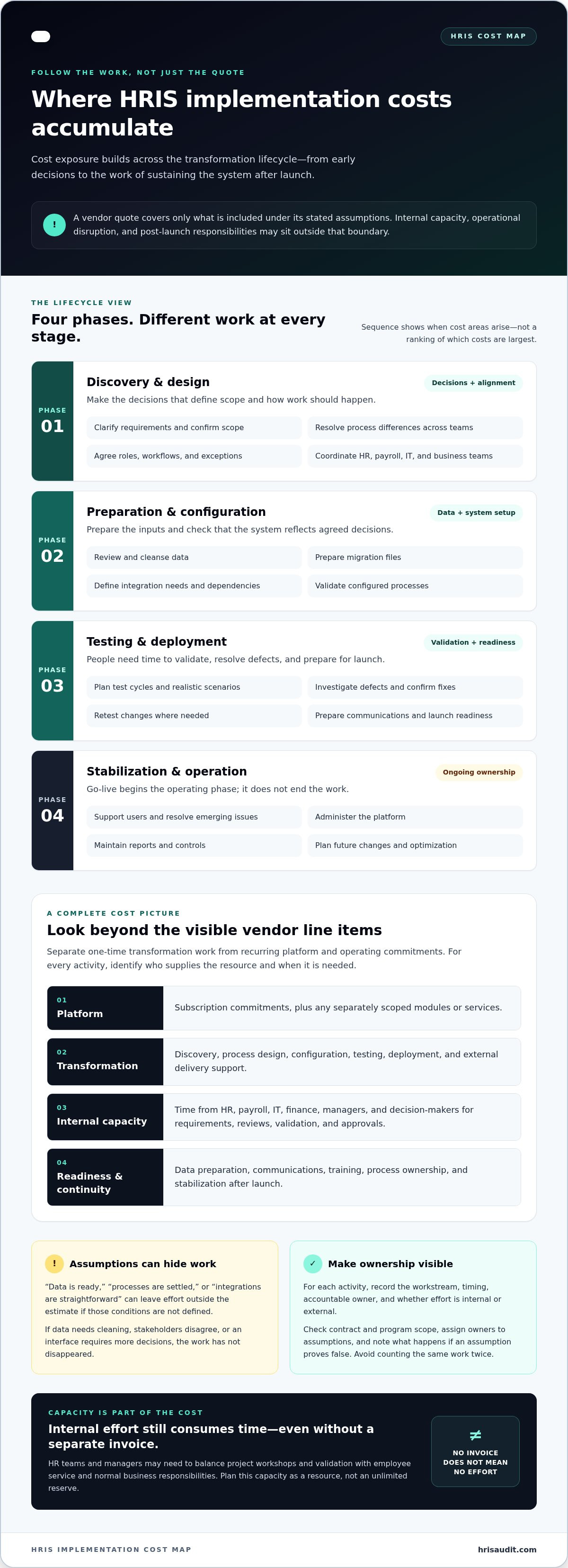
Separate one-time transformation work from recurring platform and operating commitments. For every activity, identify who supplies the resource and when it is needed. Contract boundaries vary, so an activity may sit within a vendor’s scope in one program but be assigned to internal teams or treated as additional work in another.
- Platform: Subscription commitments and any separately scoped modules or services.
- Transformation: Discovery, process design, configuration, testing, deployment, and external delivery support.
- Internal capacity: Time from HR, payroll, IT, finance, managers, and decision-makers for requirements, reviews, validation, and approvals.
- Readiness and continuity: Data preparation, communications, training, process ownership, and stabilization after launch.
Use these categories as a working map, not a universal cost template. Check the contract and program scope to place each activity, and avoid counting the same work twice.
Why the initial estimate can look deceptively complete
Visible vendor line items are easy to identify and compare. Internal effort is less visible because it may be absorbed into existing roles rather than recorded as a project expense. But assigning a subject-matter expert to validate employee records or resolve policy questions still consumes capacity, even if no new invoice appears.
Assumptions can conceal additional work. A plan may treat data as ready, processes as settled, or integrations as straightforward without defining what those conditions mean. If records need cleaning, stakeholders disagree on a process, or an interface requires more decisions, the work hasn’t disappeared. It has moved outside the estimate.
For example, a budget that includes configuration but assumes approved requirements may omit the time needed to agree on roles, workflows, and exceptions. Exposure depends on scope, operating model, integration needs, data condition, and readiness. Not every project has the same cost categories or level of effort. Make assumptions explicit, assign an owner to each, and record what happens if an assumption proves false.
Where HRIS Implementation Costs Accumulate Across the Lifecycle
HRIS costs don’t arrive in one clean block. They accumulate as the program moves from decisions to design, delivery, and sustained operation. A lifecycle view makes the work visible before it gets buried in separate contracts, internal calendars, or post-launch backlogs.
For each phase, distinguish external partner fees from the capacity the organization must provide. A partner may facilitate requirements or configure a system, but internal leaders and subject-matter experts still need to make decisions, validate outputs, manage dependencies, and keep the program moving. That effort has a cost, even when it doesn’t appear as a separate invoice.
- Discovery and design: Clarifying requirements, making process decisions, confirming scope, and resolving differences across HR, payroll, IT, and business teams.
- Preparation and configuration: Cleansing data, preparing migration files, defining integration needs, and reviewing whether configured processes reflect agreed decisions.
- Testing and deployment: Planning test cycles, investigating defects, retesting changes, preparing communications, and involving business users in validation and launch readiness.
- Stabilization and operation: Supporting users after launch, resolving emerging issues, administering the platform, maintaining reports and controls, and planning future changes.
These phases also use time that would otherwise support normal operations. HR teams may need to balance project workshops with employee service, while managers validate workflows alongside their business responsibilities. Plan this capacity as a resource rather than treating it as an unlimited reserve.
What can surface before and during go-live?
Requirements work can expose unresolved process choices. Data review can reveal inconsistencies that need remediation before migration. Integration design can surface dependencies on other systems and teams. During testing, business users need time to check realistic scenarios, log defects, confirm fixes, and repeat tests where needed. The contract and program scope determine whether each activity is included in partner fees, funded separately, or carried by internal teams.
Which costs continue after launch?
Launch begins a new operating phase. Budget for the agreed stabilization approach, recurring subscriptions, ongoing support, and planned optimization. Assign capacity for routine administration, reporting, control reviews, user questions, and future system changes. Give these responsibilities named owners, not just a handover date. HRIS Audit’s Built Not Bought framework connects system design with the ownership needed to sustain it.
Project delivery costs fund the change; ongoing operating costs fund the system’s continued use, control, and improvement. Keep both visible in the budget. Combining them can obscure whether the organization has resourced implementation work and the operating model that follows.
The Biggest HRIS Cost Misconception: Go-Live Is Not the Finish Line
A system can launch as planned and still leave the organization with work it isn’t ready to own. Technical deployment confirms that the system is available. It doesn’t prove employees know how to use it, processes are working as intended, decisions have been resolved, or the right people can support it.
A launch-centered budget treats the project as a delivery event. A lifecycle budget asks whether the organization can operate and improve what was delivered. The distinction matters because reducing visible project effort can shift work rather than remove it. For example, limiting preparation or capability transfer may leave internal teams to manage unclear processes, recurring support requests, or manual workarounds after launch. The level of exposure depends on the program, not a universal cost pattern.
How adoption and operational readiness affect cost
Adoption depends on practical readiness: people understand their roles, training reflects their work, and processes are clear enough to use in the system. If those elements are weak, employees may need repeated help or revert to workarounds, creating follow-up effort for HR, managers, and support teams. This isn’t a predictable cost multiplier. It’s a risk to assess against the organization’s actual roles, processes, and readiness.
Before launch, leaders can test readiness with specific questions:
- Can each user group complete the tasks it owns?
- Are process exceptions and escalation paths understood?
- Is support prepared to resolve common questions and route unfamiliar issues?
The answers show where more preparation may be needed. They also help distinguish a training gap from an unresolved process decision or a system issue, so teams can address the cause rather than repeatedly treating the symptom.
Why post-go-live ownership must be planned early
Someone must own routine administration, data quality, reporting, and decisions about changes. Someone must also know when an issue can be resolved within the business and when it needs escalation. If these responsibilities are undefined, work can stall, circulate among teams, or fall back to external support by default.
Define operating roles before launch, then plan how knowledge will transfer to the people who will carry them. Capability transfer is more than a handover document: internal owners need to perform their responsibilities, understand decision paths, and maintain the system as business needs evolve. HRIS Audit’s HR technology governance resources explore how decision rights support sustained ownership.
The hidden costs of HRIS implementation often become visible when project delivery ends but ownership hasn’t been designed. A lifecycle view treats readiness and operating responsibility as part of the transformation, not optional work after it. HRIS Audit’s client-side advisory helps leaders clarify decisions and responsibilities as they shape that model.
How to Build a More Complete HRIS Implementation Cost Estimate
A useful estimate isn’t a single figure presented with false precision. It’s a structured view of work, timing, ownership, and assumptions that leaders can challenge before commitments are made. Use this five-step process to expose gaps without relying on generic industry prices.
- Define the scope. Record the business outcomes, processes, user groups, systems, and deliverables included. Separate approved scope from open decisions and possible change requests. If an integration or process choice is unresolved, show that uncertainty instead of silently treating it as settled.
- Map the work by workstream. Break the program into activities such as process design, data preparation, migration, integrations, configuration, testing, communications, training, deployment, and stabilization. Add ongoing platform operation and planned improvements to the lifecycle view.
- Assign an accountable owner. For each activity, name the person or role responsible for decisions and completion. Record whether the effort is internal or external, when it is needed, and which teams must contribute. Internal time is a real capacity commitment, even if it doesn’t generate a supplier invoice.
- Test the assumptions. Document dependencies, including data condition, integration complexity, decision timing, and subject-matter expert availability. Use ranges only when they reflect project-specific assumptions. Explain what would move the estimate toward the low or high end instead of applying an unsupported contingency.
- Review lifecycle coverage. Check that the estimate accounts for delivery and the operating responsibilities that follow. Confirm owners for administration, user support, data quality, reporting, decision escalation, and future change. Identify any activity that has no budget, no owner, or no agreed treatment.
Create a cost inventory leaders can challenge
Make the estimate reviewable. For each workstream, capture the deliverable, timing, accountable owner, internal or external effort, and basis for the estimate. Mark what is committed, what depends on an unresolved decision, and what could become a change request. This turns a headline figure into an auditable set of assumptions and makes internal capacity visible alongside contracted work.
HRIS Audit’s free Transformation Pulse Scan can help leaders examine transformation risks and readiness while assessing the basis of an estimate.
Stress-test the estimate before approval
Challenge exclusions and dependencies. What changes if data needs more remediation, an integration requires additional design, a decision arrives late, or a key expert has limited availability? Review the rationale for contingency and confirm post-launch responsibilities aren’t left outside the plan. HRIS Audit’s Field Library provides tools and frameworks to structure planning and decision discussions.
The point isn’t to predict every change. It’s to show which assumptions support the estimate, who owns them, and how the plan responds if they shift. That discipline gives executives a clearer basis for approval and a better way to govern cost exposure as the program moves forward.
For client-side HR transformation advisory, connect with HRIS Audit.
Control HRIS Implementation Cost by Designing for Ownership
Cost discipline isn’t achieved by trimming visible project effort alone. It comes from controlling scope, making decisions at the right time, assigning accountability, and building the capability to operate the system after launch. Without those foundations, an apparent saving can become unresolved work that consumes internal capacity or requires further support.
Ownership is a design responsibility. Define who can approve process decisions, manage exceptions, maintain data, and prioritize system changes before those duties become urgent. Then connect those roles to the program’s scope and delivery plan. Clear ownership helps leaders see whether a proposed change belongs in the current transformation, should be deferred, or requires a deliberate change to the estimate.
What client-side advisory contributes to cost control
Client-side advisory gives sponsors and program leaders a disciplined way to scrutinize assumptions, scope boundaries, decisions, and readiness from the organization’s perspective. It can support decision-making, gate reviews, and program resets, helping leaders identify where unresolved issues may affect delivery or future operations. HRIS Audit provides this advisory leadership alongside the technical work of an HR technology transformation.
HRIS Audit’s Built Not Bought™ method centers on designing, governing, and delivering systems the organization can continue to own. That means examining whether design choices fit the organization’s operating model and whether internal teams can carry the responsibilities that follow. A system’s long-term sustainability depends on more than its technical setup.
Choose the next step based on the risk you need to resolve
Start with the uncertainty that matters most. If leaders can’t see where exposure sits, HRIS Audit’s free Transformation Pulse Scan can help clarify lifecycle questions and assumptions that need attention. If the program is losing alignment or key decisions remain unresolved, a program reset can refocus scope, ownership, and priorities. If a decision is blocking progress, a focused review can help sponsors examine options and implications.
Keep the intervention proportionate to the risk. The goal isn’t to add another layer of process. It’s to strengthen the decisions and ownership needed to manage the transformation responsibly.
The hidden costs of HRIS implementation are easier to control when accountability extends beyond delivery. Before approving a change or closing a project phase, ask: who will own the outcome, what capacity will that require, and how will unresolved work be handled? Those answers connect today’s budget decisions to the system’s future operation.
Explore HR transformation frameworks for a structured approach to sustainable system ownership, or connect with HRIS Audit about client-side advisory for your transformation.
Make Ownership Part of the Investment Decision
The next budget conversation should lead to a decision, not just a revised number. Ask whether the organization has the authority, capacity, and capability to own the system once delivery support recedes. The answer will shape which risks deserve attention now and which responsibilities need to be built into the operating model.
The hidden costs of HRIS implementation are easier to govern when leaders can see the full transformation and make informed choices about ownership. HRIS Audit brings over 30 years of HR transformation experience and applies its Built Not Bought™ method to sustainable system ownership. Its client-side advisory can support sponsor decisions, gate reviews, program resets, and capability transfer, strengthening the client team throughout the transformation.
Start with the lifecycle question your organization needs to resolve. A clearer view of ownership today gives the system a stronger foundation for tomorrow.
Design your transformation for lasting ownership from the outset.
Frequently Asked Questions
How much should an organization budget for hidden HRIS implementation costs?
There’s no reliable universal figure for the hidden costs of HRIS implementation without understanding the scope, system landscape, data condition, operating model, and contract assumptions. Build an estimate by workstream instead. For each activity, record what external fees cover and what internal capacity is required. For example, distinguish contracted data migration work from employee time spent preparing and validating records. This makes the estimate specific to the organization rather than dependent on a generic benchmark.
What is usually excluded from an HRIS implementation quote?
There’s no universal list of exclusions; contract terms and project scope determine what a quote covers. Treat potential gaps as questions for review, not assumptions about what a vendor has omitted. Check how the estimate handles client-side labor, data preparation, change activity, integrations, business-user testing, and post-launch support. A responsibility matrix can clarify the boundary by showing which party owns each activity and whether it is included, separately funded, or internal.
Can internal employee time be included in the total cost of an HRIS implementation?
Yes. Internal effort consumes capacity even when it doesn’t appear as an external invoice. Subject-matter experts may validate workflows, decision-makers may resolve policy questions, program leaders may coordinate dependencies, and business users may test real scenarios. Record the expected effort by role or workstream, then note which operational responsibilities may need coverage while people contribute. Organizations calculate that opportunity cost differently, so document the method used rather than assuming one standard salary-based formula.
What happens if an HRIS implementation budget does not account for post-go-live work?
Post-launch responsibilities still need people and time. If the budget doesn’t make room for stabilization, user support, adoption, system ownership, and optimization, those demands may compete with existing work or remain unresolved. That doesn’t mean the project will fail, but it can make accountability harder to maintain. Before launch, identify who handles incoming issues, which decisions need escalation, and how ongoing responsibilities fit into the organization’s operating model.
Are data migration and integration costs always included in an HRIS implementation?
No. Whether migration or integration work is included depends on the agreement, solution scope, systems involved, and condition of the data. A named deliverable may cover a defined transfer or connection, while client teams still need to prepare records, validate results, provide system knowledge, or participate in testing. Map each assumption and responsibility in the estimate. This helps distinguish the contracted output from the organizational effort required to make it usable.
How can leaders identify hidden HRIS costs before approving a project?
Map workstreams, accountable owners, dependencies, contract inclusions, internal effort, and post-launch obligations before approval. Document unresolved decisions and test assumptions about data condition, integration needs, and stakeholder availability. For instance, identify what changes if a subject-matter expert can’t participate when planned. Avoid generic cost benchmarks. A useful estimate shows how its assumptions support the plan, where uncertainty remains, and what information would allow leaders to refine it.
Does going live mean an HRIS implementation is complete?
No. Go-live marks technical availability, not necessarily sustained operational ownership. People may still need support using the system, teams must maintain data quality and administration, and the organization may need to refine processes as experience accumulates. The precise work depends on the system and operating model. Treat launch as a transition point: confirm who receives responsibility, how issues are escalated, and how ongoing improvement decisions will be made.


