

What if the biggest risk in an HRIS deal isn’t the subscription price, but the operating assumptions buried around it? Negotiating HRIS software contracts means looking beyond the headline figure. Exposure can sit in implementation responsibilities, fees for future changes, renewal mechanics, data access, and decisions your team may not control after signing.
The pressure to close can make a vendor proposal feel like a complete plan. It isn’t. A contract can promise outcomes without making clear who owns the work, how decisions get made, or what happens when workforce needs change. Those gaps can weaken the business case long after the initial price is approved.
This article lays out a negotiation plan tied to how your organization needs to operate. You’ll learn how to prioritize commercial terms, define delivery responsibilities and decision rights, protect usable data, and preserve flexibility at renewal and exit. The aim isn’t to negotiate every clause equally. It’s to secure the terms that keep costs visible, accountability clear, and the system sustainable after go-live.
Key Takeaways
- Compare contract proposals by total cost, scope, flexibility, accountability, data control, and exit terms, not subscription price alone.
- For each important commitment, define who owns it, how success is measured, when it is due, and what happens if it isn’t met.
- Prepare for negotiating HRIS software contracts by ranking must-haves, tradeable terms, walk-away conditions, and approval authority before discussions begin.
- Separate legal review, client-side leadership, vendor delivery, and long-term system ownership so responsibilities don’t disappear between teams.
- Treat contract governance as an ongoing discipline that supports delivery, adoption, optimization, and renewal, not a task that ends at signature.
Why negotiating an HRIS software contract is more than securing a discount
A lower subscription fee can look like a clear win, but price is only one part of the deal. An HRIS must support defined work, serve the people who use it, and remain operable as the organization changes. Negotiating HRIS software contracts is about aligning commercial terms with operational commitments before signature, so the agreement supports the system your organization intends to run.
That distinction matters. A vendor may describe a smooth migration, responsive support, or flexible configuration during sales discussions. A contractual obligation is different: it specifies what will be delivered, by whom, when, and what happens if the commitment is missed. An assumption is different again. If your team expects to provide clean data or make decisions by a certain date, that responsibility needs an internal owner, even if it isn’t a vendor obligation.
Contract value depends on commitments that are enforceable and meaningful in the way your organization operates. A discount cannot resolve vague scope, unclear decision rights, or an outcome your team can’t use.
What does an HRIS software contract actually govern?
The agreement may comprise several documents. A master agreement sets general terms; an order form may define products, subscription quantities, and fees; and a statement of work may describe services, deliverables, milestones, and responsibilities. These documents work as a system, not as independent promises. Their hierarchy, definitions, and cross-references can determine which language controls if provisions conflict. Legal counsel should review that structure and its implications.
Separate the commitments by function. Software access is not the same as implementation services. Support, data handling, and change requests may be governed by distinct terms or documents. For example, a subscription might include access to a module, while configuration work or later changes are scoped separately. Make those boundaries clear in the contract. A foundational overview of Human Resources Information Systems (HRIS) helps frame the range of functions a system may support, but your agreement must specify the services and outcomes actually in scope.
Why signing is the beginning of contract governance
Unresolved assumptions don’t vanish at signature. They surface as delivery disputes, schedule slippage, or work nobody planned to fund. If a vendor expects the client to validate migrated data while HR assumes the vendor owns validation, the gap becomes operational before anyone can resolve it in a meeting.
Prevent that gap with clear client-side ownership. Executive sponsors set direction; procurement manages the commercial process; HR defines business needs; IT assesses technical dependencies; finance tracks exposure; and legal counsel reviews the agreement. These roles need a shared decision path, not a collection of separate approvals. Client-side HR technology leadership connects the contract to the operating model, keeping vendor commitments, internal responsibilities, and decision rights aligned through delivery and beyond go-live.
Which HRIS contract terms protect cost, delivery, data, and continuity?
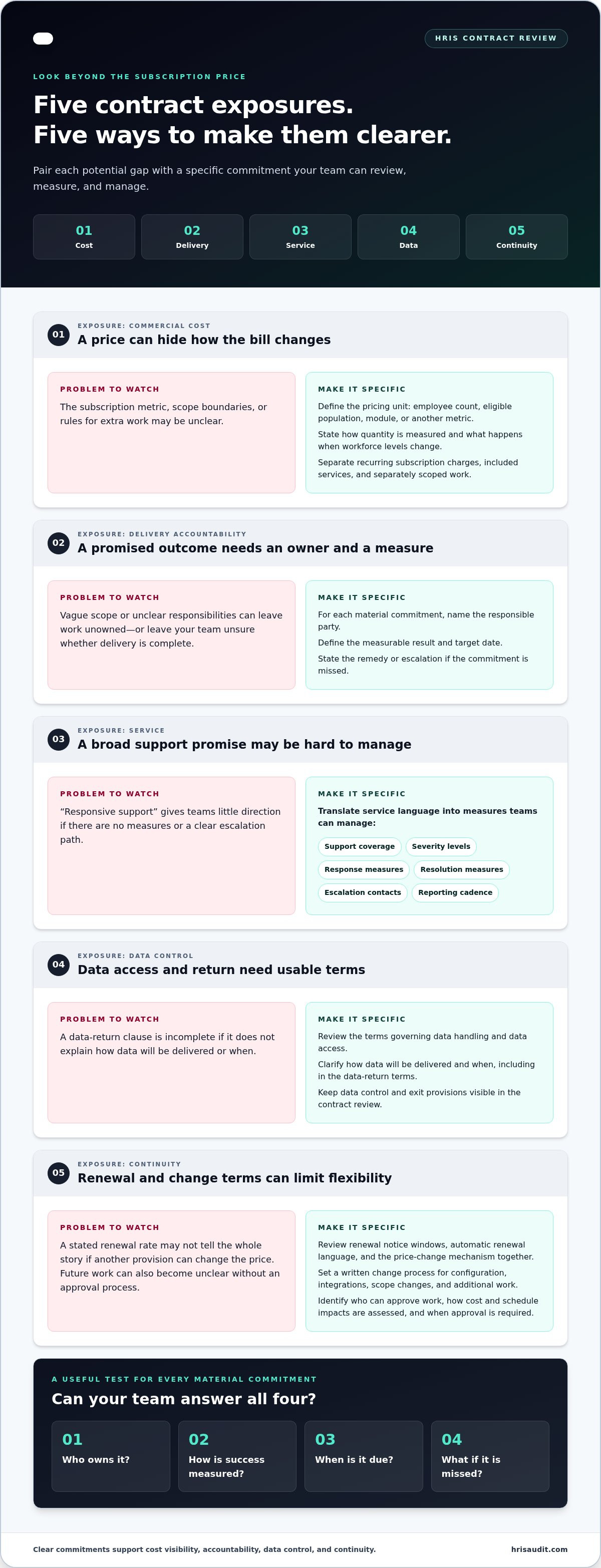
Build the review around five exposures: commercial cost, delivery accountability, data control, service, and exit. A clause matters when it protects a business outcome, not simply because it appears on a standard checklist. For each material commitment, identify the responsible party, the measurable result, the timing, and an appropriate remedy if performance falls short. Align proposed terms with your operating model and risk tolerance, and have qualified legal counsel review them.
This structure also makes trade-offs visible. A broad service promise is weak if it has no response measure or escalation path. A data-return clause is incomplete if it doesn’t explain how the data will be delivered or when. For a wider view of commercial negotiation mechanics, Software Negotiation: A Complete Guide for Enterprise Buyers offers a useful complement to HRIS-specific operating questions.
Commercial terms: pricing, scope, renewal, and change
Start with the unit that drives the subscription: employee count, eligible population, module, or another metric. Define how the quantity is measured and what happens when workforce levels change. Map payment timing against the contract term, and distinguish recurring subscription charges from included services and separately scoped work.
Then examine renewal notice windows, automatic renewal language, and the mechanism for price changes. Don’t treat a stated renewal rate as fixed if another provision can alter it. Clarify how the parties authorize configuration, integrations, scope changes, and additional work. A practical control is a written change process that identifies who can approve work, how cost and schedule impacts are assessed, and when approval is required. General software negotiation guidance can help frame commercial questions, but HRIS terms must reflect the organization’s delivery dependencies.
Operational protections: service, security, data, and exit
Translate service language into measures teams can manage. Define support coverage, severity levels, response and resolution measures, escalation contacts, and reporting cadence. For delivery commitments, state the accountable owner, acceptance measure, target date, and remedy or escalation if the commitment is missed. Tie each measure to a business need, such as payroll continuity or timely resolution of a workforce-impacting issue.
Data portability is the organization’s ability to retrieve its data in a usable format, within a defined timeframe, so it can continue operating or transition to another system. Address ownership, permitted use, export scope and format, delivery timing, and transition assistance. Consider whether the export includes only records or also the structure and documentation needed to interpret them. Define retention and deletion expectations as well.
Security, privacy, incident notification, and subcontractor terms need careful review with qualified counsel, informed by the organization’s data and risk profile. Don’t assume a vendor’s general policy answers every operational question. Likewise, an exit right has limited value if the organization cannot retrieve usable data, maintain continuity during transition, or understand which services end and when. Client-side governance frameworks can help connect these provisions to delivery ownership and ongoing system operation.
Use the HRIS transformation frameworks to consider how contract decisions connect to the operating model your teams must sustain.
Comparing HRIS Contracts Beyond Just Price
A contract comparison should show how each proposal works in practice, not just what it costs on day one. Use the same categories for every option, and label each commitment as included, conditional, excluded, or dependent on a later agreement. That last category matters: an attractive proposal can leave essential work unresolved until after signature.
Comparison area | What to compare
Total cost: Recurring subscription, services, optional modules, and potential change work. Separate firm commitments from estimates and assumptions.
Scope: Included functionality and services; conditions or limits; exclusions; and items requiring a future statement of work or separate agreement.
Flexibility: How subscription measures respond to workforce growth or contraction, module changes, and shifting business needs. Note any minimum commitments or constraints.
Accountability: Named owners, dependencies, milestones, acceptance criteria, reporting, and remedies. Identify obligations that depend on your team or third parties.
Data: Ownership, permitted use, export format and timing, retention, and support for transition.
Exit: Termination conditions, notice requirements, transition assistance, and whether the organization can maintain continuity and retrieve usable data.
Compare the whole commercial model, not a headline rate
Separate recurring subscriptions from services, optional modules, and work that may arise through configuration, integrations, or later scope changes. Then model relevant workforce scenarios using the contract’s pricing measures. For example, consider how obligations change if the covered population grows, contracts, or shifts between employee groups. Record assumptions beside each scenario. Don’t present estimates as guaranteed savings or treat an undefined future charge as zero. Negotiating HRIS software contracts means comparing what the same operating need costs under each proposal, including the conditions attached to the price.
Compare commitments against delivery realities
A promised milestone has limited value if it depends on timely client decisions, clean data, or third-party work that the agreement doesn’t govern. Map each vendor obligation to its dependencies, acceptance criteria, and internal owner. Check whether support and exit terms still work if your workforce structure, priorities, or system ownership changes. Make decision rights explicit: who approves changes, accepts deliverables, and resolves competing priorities? A clear HR technology governance framework connects those authorities to delivery responsibilities.
Longer commitments may come with commercial concessions, but they can also narrow the room to adjust scope or leave. Compare the trade, not just the concession. Ask whether the term aligns with your organization’s planning horizon, capacity to operate the system, and confidence in the delivery model. If switching constraints make exit difficult, reflect that exposure in the comparison instead of treating it as a distant possibility.
Use the completed matrix to identify the proposal with the strongest fit across cost, delivery, and continuity. A lower rate may still be the weaker choice if it depends on unpriced work or leaves critical obligations unresolved.
How to prepare and run an HRIS contract negotiation
Good negotiations start before the vendor meeting. The buyer needs a mandate, decision-makers, and a clear account of what the organization can accept. Without those controls, discussions can drift toward whichever terms are easiest to settle rather than the ones that protect delivery and long-term ownership.
Set the negotiation mandate before vendor meetings
Assign roles across HR, finance, procurement, IT, security, executive sponsorship, and legal. Name who leads commercial discussions, who makes business decisions, who reviews risk, and who has authority to approve exceptions. Rank proposed terms by impact, likelihood, reversibility, and the organization’s risk tolerance. Keep decisions, unresolved issues, assumptions, and approval thresholds in one controlled log so teams work from the same version.
- Establish outcomes. Define what the HRIS must enable and what successful delivery and ongoing operation require. Tie contract priorities to these outcomes, not to a generic wish list.
- Assemble owners. Bring together the people accountable for commercial, operational, technical, security, and legal decisions. Confirm decision rights and escalation routes before discussions begin.
- Rank terms. Separate must-haves from tradeable terms. Set walk-away conditions and approval limits in advance, including who can accept a change to a critical protection.
- Negotiate with evidence. Bring documented requirements, proposal comparisons, delivery dependencies, and credible alternatives. State the basis for each request. Don’t bluff about competing offers or manufacture deadlines; unsupported leverage can damage trust without improving the agreement.
- Approve and operationalize. Route final language through the right approvers, resolve open issues, and assign owners to track commitments after signature.
This sequence gives the team discipline without pretending every term has equal value. For example, a flexible commercial term may be tradeable if service continuity and data access remain protected. Record any concession with its consequence, approver, and rationale. That is the practical work of negotiating HRIS software contracts: making deliberate choices, not improvising under pressure.
Turn negotiated language into operating discipline
Signature is a handoff point, not the end of the process. Convert each material obligation into an owner, milestone, evidence of completion, and escalation path. If an agreed vendor deliverable depends on a client decision or third-party input, record that dependency too. This keeps accountability visible on both sides and makes slippage easier to diagnose.
Set a governance calendar that includes service reviews, change control, renewal preparation, and exit readiness. Use it to revisit assumptions as workforce needs and internal capabilities evolve. A structured risk assessment can also help surface transformation risks before key decisions are made. The Transformation Pulse Scan can help bring those risks into view.
Keep legal counsel responsible for legal review, while business and technology leaders own operating decisions. This separation matters. Contract language can allocate obligations, but active governance keeps those obligations connected to how the organization runs its system.
Make the HRIS contract a foundation for lasting system ownership
A contract should support more than the purchase and launch. Its commitments shape how the organization makes design decisions, delivers the transformation, prepares people to use the system, improves it over time, and manages renewal. If ownership ends at signature, the agreement can become disconnected from the way the system is actually run.
That’s why negotiating HRIS software contracts must include a view of the organization’s future operating capability. The vendor may deliver contracted services, but the organization still needs people who understand its processes, govern change, make decisions, and maintain the system’s business value. Build that capability into delivery expectations rather than treating it as a post-launch aspiration.
Keep decision rights and organizational capability inside the business
Make authority explicit. Executives set priorities and resolve material trade-offs. Process owners define business requirements and confirm whether outcomes meet those needs. Technical teams assess architecture, access, and support implications. Vendor teams deliver the work assigned to them in the agreement. Connect these roles through clear approval paths rather than relying on assumed overlap.
Knowledge transfer and usable documentation are part of that design. Specify what the organization needs to operate and maintain after vendor-led work ends, such as process decisions, configuration records, operating procedures, and training materials where relevant. The Built Not Bought approach reflects this principle: lasting system value depends on organizational ownership, not simply acquiring technology.
Choose the right support for contract-to-transformation alignment
Legal counsel reviews legal language and advises on legal risk. Business leaders own operating decisions: which outcomes matter, what responsibilities the organization can sustain, and which trade-offs it will accept. Client-side HR technology leadership connects those decisions to program priorities and governance, so commercial terms and delivery expectations reinforce the same operating model. Advisory can provide decision support for that alignment; it is distinct from legal representation and software implementation.
Keep that alignment active through design, delivery, adoption, optimization, and renewal. At each stage, revisit whether decision rights remain clear, internal owners have the knowledge they need, and the contract still supports workforce and operating requirements. A renewal should not be the first time leaders examine whether the system remains fit for purpose. It is one checkpoint in a longer cycle of ownership.
HRIS Audit’s Built Not Bought™ method centers on designing, governing, and delivering systems that remain effective after go-live. For leaders who need client-side support connecting contract choices to transformation priorities and governance, explore client-side HR transformation advisory.
Make the Next Contract Decision Deliberate
The contract sets boundaries, but your organization determines what happens within them. Before the next negotiation, bring business and technology leaders together around one question: what capability must remain inside the organization for this system to keep serving the business as needs change? The answer can guide decisions about commitments, internal ownership, and where advisory support would strengthen the process.
Negotiating HRIS software contracts is a chance to build a stronger foundation for the transformation, not just close a deal. HRIS Audit brings more than 30 years of HR transformation experience and client-side advisory grounded in the Built Not Bought™ method. The focus is on helping leaders connect contract decisions to the governance and organizational capability needed beyond go-live, while legal counsel remains responsible for legal review.
Make the agreement serve the system your people and organization need to operate. With clear ownership and deliberate decisions, you can move forward with greater confidence.
Frequently Asked Questions
When should an organization begin negotiating an HRIS contract?
Begin before commercial pressure narrows your options, ideally while requirements and delivery assumptions are still being shaped. That gives HR, IT, finance, and procurement time to identify dependencies and assess how proposals map to actual needs. For renewals, start at least 90 days before the deadline. Set internal review dates before the vendor’s decision deadline so there is time to evaluate terms and secure approvals.
What is the difference between an HRIS master agreement, order form, and statement of work?
A master agreement typically sets the general terms governing the relationship. An order form usually records the subscription, selected products or services, quantities, and commercial details. A statement of work commonly describes specific professional services, deliverables, timing, and responsibilities. The exact structure varies. Check how the documents fit together, whether one takes precedence over another, and whether later documents can change terms already agreed.
Should an HRIS contract include an exit and data-export plan?
Yes. An exit plan is more useful when it answers practical questions before a transition becomes urgent. Specify which data can be exported, the format and delivery process, applicable timing, and how the organization can continue its work during the transition. Consider whether supporting materials, such as configuration records or data definitions, are needed to interpret the export. Legal and technical teams can assess how these provisions fit the organization’s requirements.
How can an organization negotiate HRIS renewal terms?
Review renewal terms well before the notice deadline. Confirm the renewal date, notice method, price-change mechanism, subscription measures, and any changes to scope or service. Compare the renewal proposal with current usage and anticipated workforce needs, then identify which terms must change and which can remain. Starting at least 90 days in advance gives teams time to assess options and secure internal approvals.
Can HRIS implementation responsibilities be negotiated in the software contract?
Yes. The contract documents and related statements of work can allocate responsibilities, dependencies, deliverables, acceptance conditions, and change-control processes. For instance, clarify who prepares source data, who reviews mapped fields, and how a delayed client decision affects a milestone. Make sure vendor responsibilities align with the organization’s available people and decision capacity. Don’t assume that a general promise to support implementation defines who performs each task.
Does negotiating an HRIS contract require a lawyer?
Legal counsel should review the agreement, especially provisions involving liability, data, confidentiality, termination, and document precedence. Counsel can explain legal implications, but shouldn’t be expected to decide which HR processes or delivery outcomes the organization needs. Business and technology leaders must define those requirements and trade-offs. A useful review combines legal analysis with operational input, so the negotiated language reflects both acceptable risk and the organization’s ability to meet its responsibilities.
What should an organization do after signing an HRIS contract?
Turn the signed agreement into a working control document. Assign an internal owner to each major commitment, record key dates and dependencies, and make the relevant contract language available to delivery leads. Set reminders for renewal notices, scheduled reviews, and approval checkpoints. When scope or assumptions change, route the change through an authorized process and retain the decision record. This helps the organization manage obligations instead of relying on memory or informal handoffs.


