

Two polished HRIS demos can make fundamentally different operating models look comparable. A well-built HRIS vendor evaluation scorecard changes the test: it measures how each system would support your organization’s work, not how convincingly it performs on screen.
The usual approach feels straightforward: list the features, watch the demonstrations, compare the scores. But feature checklists rarely expose harder risks, such as whether workflows fit, data can be governed, integrations can be sustained, and employees will adopt the system. When stakeholders disagree on priorities and weightings, a neat total can hide an unexamined decision.
This guide provides a practical framework for building a reusable scorecard tied to your business and workforce needs. You’ll learn how to define criteria, test vendors against consistent evidence, weigh tradeoffs, and record risks and ownership. The result is more than a ranking. It’s a defensible decision your organization can explain, govern, and operate after the demo ends.
Key Takeaways
- Build an HRIS vendor evaluation scorecard around organizational needs, not feature counts alone.
- Include process fit, data, integrations, security, usability, support, adoption, and long-term ownership in your criteria.
- Give every shortlisted vendor the same evidence requests and scenarios so comparisons are consistent.
- Look beyond total scores to identify mandatory gaps, weak evidence, and operational risks.
- Turn evaluation findings into clear decision conditions, accountable owners, and follow-up actions.
Why an HRIS vendor evaluation scorecard must measure more than features
A feature list can tell you whether a platform claims to offer a capability. It can’t tell you whether that capability fits your workforce, supports the process you intend to run, or can be governed by the people who will own it.
An HRIS vendor evaluation scorecard is a structured way to compare vendor evidence against the needs your organization has agreed matter. Its purpose isn’t to manufacture a winner with arithmetic. It’s to make assumptions visible, keep comparisons consistent, and give executives a sound basis for judgment.
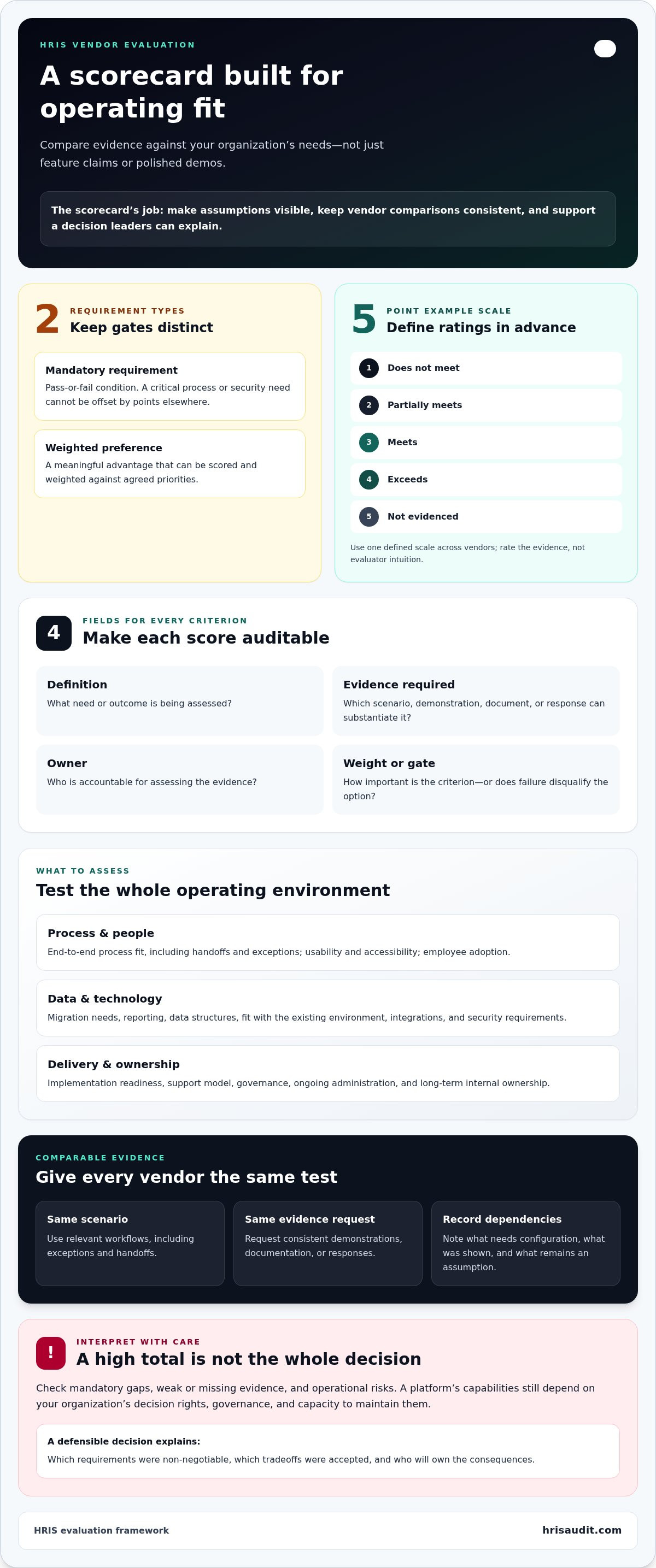
Before demonstrations begin, separate mandatory requirements from weighted preferences. A mandatory requirement is a pass-or-fail condition, such as supporting a critical workforce process. A preference is a meaningful advantage that can be scored and weighted. If these categories blur, a vendor can accumulate points for desirable features while still missing a condition the organization cannot compromise.
What decisions should an HRIS scorecard support?
Start with the decisions the system must enable. Which workforce processes need to work differently? What strategic outcomes should the system support? Who has authority to set policy, approve design choices, and accept operational risk? Executives should settle these questions before assigning scores, or the scorecard will quietly encode unresolved disagreements.
Then distinguish platform capability from organizational readiness. A system may support configurable workflows, but your organization still needs decision rights, governance, and internal capacity to maintain them. Score both sides of that equation. Client-side HR technology leadership can help keep evaluation criteria anchored in organizational needs rather than vendor framing.
Why feature checklists create a false sense of comparability
Labels can match while the operating experience differs. “Employee self-service” might mean a simple profile update in one platform and a broader set of transactions in another. A workflow may be available but require configuration, depend on other modules, or feel difficult for employees and managers to use.
A polished demonstration is a presentation, not proof of operating fit. Ask each vendor to show the same relevant scenario, including exceptions and handoffs. Record what was demonstrated, what depended on configuration, and what remains an assumption. Then evaluate evidence quality alongside capability. This is the difference between scoring what a product appears to do and understanding what your organization would need to design, govern, and own.
Scores are inputs to executive judgment, not substitutes for it. The strongest decision is one leaders can explain: which requirements were non-negotiable, what tradeoffs they accepted, and who will own the consequences.
Build HRIS vendor evaluation criteria around fit, evidence, and ownership
A useful scorecard turns organizational needs into criteria that can be tested. Keep it broad enough to reflect the operating model, but specific enough that evaluators know what evidence to look for. The HRIS vendor evaluation scorecard should assess more than whether a capability exists. It should reveal how well the system fits your processes and what your organization must do to make it work.
Which HRIS evaluation dimensions belong on the scorecard?
Assess the full operating environment, not a collection of isolated features. For process fit, test an end-to-end workflow, including handoffs and exceptions. For data and architecture, evaluate migration needs, reporting, data structures, and how the system fits your existing environment. Define integration criteria around your actual systems and information flows. Include security requirements, usability and accessibility, the support model, and the capacity for ongoing administration.
Then score the conditions that determine whether the system can be sustained: implementation readiness, governance, adoption, and long-term internal ownership. A platform may meet a technical requirement while leaving unresolved questions about who approves changes, supports users, or maintains process rules. Those are evaluation findings, not details to defer until later.
How should you weight HRIS vendor criteria?
Set weights before vendor scoring, with input from business, HR, IT, security, and employee stakeholders. Weighting is a governance choice: it shows which outcomes matter most and whose needs shape the decision. Document the rationale, and use an enterprise HR technology governance framework to connect evaluation priorities to decision rights and ongoing oversight.
Keep mandatory pass-or-fail gates separate from weighted criteria. A critical security or process requirement shouldn’t be offset by a high score for a preferred feature. For the remaining criteria, use one defined scale across vendors. For example, a five-point scale could distinguish “does not meet,” “partially meets,” “meets,” “exceeds,” and “not evidenced.” Define each rating in advance so evaluators score evidence, not intuition.
A compact matrix makes the method usable. For each criterion, record:
- Definition: The need or outcome being assessed.
- Evidence required: The scenario, demonstration, documentation, or response that can substantiate it.
- Owner: The stakeholder accountable for assessing the evidence.
- Weight or gate: The agreed importance, or whether failure disqualifies the option.
This structure exposes disagreement early. If stakeholders can’t agree on a criterion’s meaning, evidence, or weight, the scorecard has surfaced a decision that needs resolution before vendor scores can be trusted.
Score HRIS vendors consistently using comparable evidence
A consistent scoring process prevents the strongest presentation from becoming the default favorite. Use the same sequence for every shortlisted vendor: define the criterion, request evidence, test a shared scenario, score independently, then reconcile differences. Keep the prompts, time available, and acceptance conditions equivalent. If one vendor gets to demonstrate a polished workflow while another is assessed from a brief answer, the comparison is already compromised.
A score is only as reliable as the evidence behind it. Record not just the rating, but what supports it and how confidently the organization can rely on that evidence.
What evidence should vendors provide for each score?
Use evidence that matches the claim. For a process requirement, ask the vendor to demonstrate a realistic workflow with defined acceptance conditions, including relevant handoffs or exceptions. For architecture, data, or security criteria, request written responses and supporting documentation. For ongoing support, review the stated support model and commitments. Customer references can add context, but they shouldn’t replace evidence about your own requirements.
Classify each finding clearly:
- Demonstrated: Shown against the agreed scenario.
- Documented: Supported by written materials or a formal response.
- Roadmap: Described as planned, not available capability.
- Assumption: Inferred or not yet substantiated.
Beside each rating, capture the evidence source, date reviewed, confidence level, and unresolved questions. That record matters when a confident verbal answer later proves less complete than the team understood.
How can stakeholders score demonstrations without bias?
Have evaluators score independently before discussing results. HR, IT, security, and business stakeholders may observe different risks in the same scenario. Preserve those first judgments; they reveal where priorities or interpretations differ. Use the same rating definitions and prompts for every vendor, and ask evaluators to cite evidence rather than impressions.
During reconciliation, don’t average away material disagreement. If one evaluator rates a workflow highly and another flags a governance or usability risk, capture the difference as a decision topic. Clarify what each person observed, identify any evidence still needed, and assign an owner to resolve the question.
A disciplined HRIS vendor evaluation scorecard makes those distinctions visible. It separates demonstrated capability from promises and assumptions, so decision-makers can compare vendors on a common basis without pretending every uncertainty has been settled.
Interpret scorecard results without mistaking a high score for the right choice
A weighted total is a summary, not a verdict. Strong ratings in usability or reporting can lift a vendor’s overall score while masking a failed mandatory requirement, uncertain evidence, or a dependency your organization can’t support. Read the results by criterion before comparing totals.
For each vendor, consider four things together: criterion-level performance, confidence in the evidence, operational impact, and implementation exposure. A small numerical gap may have little meaning if both options meet the needs that matter most. A larger difference in a critical process, data requirement, or ownership capacity may matter far more than the final totals suggest.
Use the HRIS vendor evaluation scorecard to make tradeoffs explicit. The decision record should capture key assumptions, unresolved risks, evidence gaps, accepted tradeoffs, and the owner responsible for each follow-up. Note why a risk is acceptable, what action will address it, and when that action must be completed. This gives leaders a defensible rationale, not just a ranking.
How should teams handle conflicting HRIS vendor scores?
Trace each disagreement to its source. Evaluators may be working from different assumptions, interpreting evidence differently, or assessing the criterion from distinct responsibilities. Clarify the basis for each rating, then identify whether more evidence can resolve the gap.
If the conflict affects a material requirement or risk, escalate it to the accountable decision-maker with the options and consequences. Don’t force consensus or average away opposing judgments. A documented executive decision is more useful than agreement that hides unresolved concerns.
When should a scorecard result trigger a decision gate?
Define gates before results are in. Set thresholds for security, data, integrations, critical processes, and organizational readiness. A mandatory requirement that isn’t met should be recorded as a disqualifier or an explicit risk requiring an authorized decision, not softened into a low weighted score. Use a clear HR technology gate review process to establish who reviews exceptions and what evidence supports approval.
A close score is not automatically a close decision. Compare how each option fits the organization’s operating model, what risks it leaves behind, and whether those risks have accountable owners. That is where executive judgment belongs.
Explore the HR technology governance framework
Turn the HRIS vendor scorecard into a decision and ownership plan
Selection is not the finish line. The scorecard should become the bridge between the decision and the work of designing, governing, delivering, adopting, and optimizing the system. Translate each material strength, gap, and accepted tradeoff into a condition, an accountable owner, and a follow-up action. If a rating depended on an assumption, name how and when that assumption will be validated.
Keep requirements and acceptance criteria under client ownership. Vendor selection shouldn’t transfer responsibility for deciding how the organization will operate its processes or govern the system. Carry those decisions forward into delivery gates, adoption planning, and capability transfer so internal teams can sustain the model after go-live. Designing for system ownership means planning for that responsibility from the outset, not treating it as a later handoff.
What should the decision record capture after vendor scoring?
Make the record useful to people who weren’t in the demonstrations and to teams who will deliver the decision. Capture the criteria and weights, evidence sources, ratings, exceptions, known risks, and accountable decision-makers. State why material tradeoffs were accepted, which assumptions still need validation, and who owns each next action.
For example, if a selection depends on a workflow being configured to meet a business requirement, record the requirement, the decision condition, and the owner who will verify it during design. That creates a traceable line from evaluation evidence to delivery and governance. The HRIS vendor evaluation scorecard becomes a working decision record, not a spreadsheet filed away after selection.
How can client-side advisory preserve evaluation integrity?
Client-side advisory helps leaders keep organizational requirements, evidence standards, and acceptance criteria in the client’s hands. HRIS Audit provides client-side leadership and advisory for enterprise HR technology transformation, helping leaders connect evaluation choices to governance, adoption, and sustainable ownership.
Use HR transformation frameworks and workbooks to support structured evaluation and decision-making. HRIS Audit’s Built Not Bought™ method guides organizations through designing, governing, and delivering HR systems that remain effective after go-live. Carry agreed conditions into delivery reviews and capability transfer so internal teams can sustain the operating model. The discipline is simple: preserve the rationale, assign ownership, and revisit unresolved assumptions at the right decision points.
Make the decision one your organization can own
A defensible HRIS decision depends on more than a vendor’s total score. The HRIS vendor evaluation scorecard should test operating fit, compare evidence on equal terms, and make risks and tradeoffs visible. Then carry the decision forward: assign owners, validate assumptions, and connect selection criteria to governance, adoption, and long-term system ownership.
The scorecard is a tool for disciplined judgment, not a substitute for it. Its value lies in helping leaders explain why a vendor was selected, what conditions still need attention, and who is accountable for the next steps.
HRIS Audit brings more than 30 years of HR transformation experience and client-side advisory spanning strategy, delivery, adoption, and optimization. That perspective helps organizations keep their requirements and decisions grounded in their own operating needs.
Explore HRIS Audit’s client-side advisory to connect your vendor evaluation decisions with transformation governance, adoption, and lasting system ownership.
Frequently Asked Questions
What is an HRIS vendor evaluation scorecard?
An HRIS vendor evaluation scorecard is a structured tool for comparing vendors against requirements your organization has agreed in advance. It records criteria, definitions, weights, evidence sources, and decision owners. For example, a workflow criterion should specify what process is being assessed and what evidence demonstrates fit. The scorecard makes tradeoffs visible, but it shouldn’t reduce a complex selection to one number or replace executive accountability.
How do you create an HRIS vendor evaluation scorecard?
Start by defining business outcomes and mandatory requirements. Group criteria around process fit, data, integrations, security, usability, support, implementation readiness, and ownership. Agree on weights and rating definitions before demonstrations begin. Then request the same evidence from each shortlisted vendor, test equivalent workflows, and have stakeholders score independently. Reconcile material differences and document risks, assumptions, and decisions. Keep each criterion tied to real workforce processes, not a generic feature checklist.
What should be included in an HRIS vendor scorecard?
Include criteria for workforce processes, data and reporting, integrations, security, usability, support, and your organization’s capacity to operate the system. Separate mandatory pass-or-fail requirements from weighted preferences. For each criterion, record its definition, evidence needed, weight or gate, and evaluation owner. Capture assumptions and risks beside ratings. The right categories and priorities depend on your operating needs, so copying another organization’s weights can produce a misleading comparison.
How do you weight criteria in an HRIS evaluation?
Agree on weights before reviewing vendor scores, with input from stakeholders responsible for business outcomes, HR, technology, security, and operations. Treat mandatory requirements as pass-or-fail gates, not weighted items that other strengths can offset. Define what each rating means and document why each weight matters. As a useful check, test whether modest changes to the weights would change the preferred vendor. If they do, examine the underlying priorities and tradeoffs.
Can an HRIS vendor evaluation scorecard prevent a bad implementation?
No scorecard can eliminate implementation risk. It can expose weak evidence, untested assumptions, process gaps, and unclear ownership before selection. Its findings need to carry into governance, design decisions, delivery gates, adoption planning, and post-go-live operations. For example, if a critical workflow depends on configuration, record who will validate that requirement and when. The scorecard supports disciplined client-side leadership, but it can’t replace organizational readiness or accountable execution.
Is the highest-scoring HRIS vendor always the best choice?
No. A high total can conceal an unmet mandatory requirement, uncertain evidence, or an operational dependency the organization can’t sustain. Compare vendors by criterion, evidence confidence, and business impact, then consider the risks and tradeoffs attached to each option. A small difference in totals may not represent a meaningful difference in fit. Choose based on the organization’s actual needs and ability to govern and own the system.


