

What if go-live succeeded, but the system still isn’t working as intended? Employees may rely on workarounds, HR teams may struggle to complete routine processes, and leaders may lack evidence that expected outcomes were achieved. An HRIS post-implementation review looks beyond the launch milestone to test whether the organization can operate and improve the system.
A new HRIS is often expected to improve efficiency, data quality, and the employee experience. But a successful launch doesn’t prove those outcomes have taken hold. The review isn’t a blame exercise. It’s a structured way to find where the system, processes, data, or operating model are falling short, then decide what should change.
This article explains how to assess performance, adoption, process fit, data quality, and governance using evidence rather than assumptions. You’ll learn to distinguish technical defects from capability or ownership gaps, then turn findings into a prioritized improvement plan with accountable owners and review checkpoints. The goal is not simply to fix what’s broken. It’s to establish the conditions for the HRIS to keep delivering value after go-live.
Key Takeaways
- An HRIS post-implementation review tests whether the system delivers intended outcomes in practice, not just whether deployment was completed.
- Compare agreed goals with evidence from system performance, process results, user activity, and stakeholder feedback.
- Use multiple evidence sources to identify patterns and validate causes without turning findings into a blame exercise.
- Prioritize improvements by impact, risk, urgency, dependencies, and confidence in the evidence.
- Assign each action an owner and review checkpoint so fixes, process changes, and capability gaps don’t disappear after the assessment.
What Is an HRIS Post-Implementation Review, and What Should It Prove?
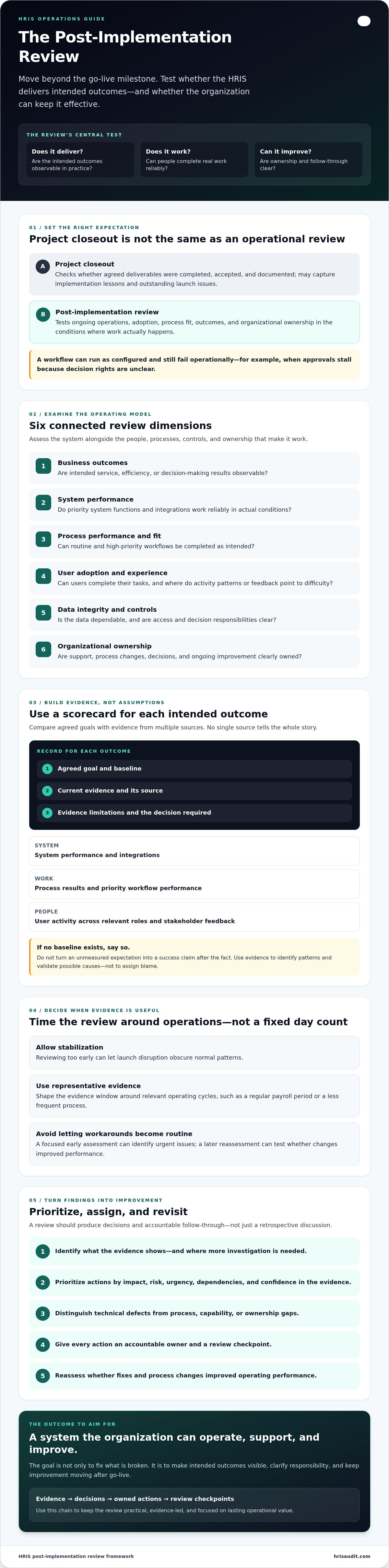
Deployment completion records a milestone. A review tests whether the system works in practice. An HRIS post-implementation review is a structured assessment of outcomes, operating performance, adoption, and organizational ownership after go-live. It asks whether the system supports the work it was designed to support and whether the organization can manage and improve it.
A Human Resource Information System (HRIS) supports core people-management activities through technology. Reviewing the technology alone, however, gives an incomplete picture. The review must also examine the operating environment: processes, roles, decision rights, support arrangements, data practices, and user experience. Vendor claims and individual feedback can inform the assessment, but neither is sufficient evidence on its own.
The test is not whether a system can perform a function in theory. It is whether that function works reliably in the organization’s actual conditions and whether responsibility for keeping it effective is clear. The review should produce decisions, assigned actions, and checkpoints. A retrospective with no accountable follow-through records a discussion, but does not improve operations.
How does a post-implementation review differ from project closeout?
Project closeout asks whether agreed deliverables were completed, accepted, and documented. It may capture implementation lessons and resolve outstanding launch issues. A post-implementation review asks a different question: are ongoing operations and user experience matching the intended design? Closing project governance doesn’t automatically transfer ownership. Someone must be accountable for decisions, support, process changes, and ongoing system improvement after the project team steps back.
That distinction matters. Fixing an access issue or correcting a configuration error addresses an immediate problem. It doesn’t establish whether the operating model is functioning. For example, a workflow may run as configured while approvals routinely stall because decision rights are unclear. The system may be technically sound, while the organization’s process is not.
When should an organization conduct the review?
Choose timing based on stabilization, usable evidence, and the organization’s operating cycles, rather than a universal day count. Review too early, and launch disruption may obscure normal patterns. Wait too long, and workarounds can become routine. Consider a focused early assessment to identify urgent issues, followed by a later reassessment when enough operating evidence exists to test whether changes improved performance.
Use relevant cycles to shape the assessment. A process that runs during a regular payroll period may need to be observed in that context. A less frequent process may require a different evidence window. The question isn’t “How many days since go-live?” It’s “Do we have enough representative evidence to make sound decisions?”
What Should an HRIS Post-Implementation Review Examine?
An HRIS post-implementation review needs a scorecard, not a collection of impressions. For each intended outcome, record the agreed baseline, current evidence, evidence source, limitations, and decision required. If no baseline exists, state that clearly. Don’t turn an unmeasured expectation into a success claim after the fact.
The core dimensions of an HRIS review are business outcomes, system and process performance, user adoption, data integrity, controls, and organizational ownership. Assess them as connected parts of one operating model. A breakdown in one area can distort results elsewhere. Inaccurate data can weaken reporting, for example, while unclear process ownership can make a functioning workflow appear unreliable.
- Outcomes: Are the intended service, efficiency, or decision-making results observable?
- Operations: Do priority workflows, integrations, and reports work as needed?
- People and control: Can users complete tasks, and are access and decision responsibilities clear?
There is no universal benchmark that proves an HRIS is working. Set measures against the organization’s goals, context, and available evidence. Make the scorecard useful to decision-makers by showing where evidence supports action, where measurement is incomplete, and what needs further investigation.
How can leaders evaluate adoption and business outcomes?
Compare evidence across relevant roles, user groups, and high-priority workflows. Usage records may show whether people access a feature, but a login doesn’t prove they completed a task or achieved the intended result. Pair available system data with process records, support trends, and stakeholder feedback. For each claimed business outcome, test whether it is observable, whether the system or a changed process plausibly contributed to it, and whether a valid baseline exists. Flag measurement gaps instead of filling them with assumptions.
Which operational risks belong in the review?
Inspect data quality, process exceptions, integration reliability, reporting, access controls, and evidence that operational responsibilities are being carried out. Repeated support requests or manual workarounds are signals to investigate, not automatic proof of a software defect. Trace each pattern to its cause. Classify findings as confirmed defects, configuration questions, capability gaps, or governance decisions. This helps separate technical corrections from changes to training, process design, or ownership.
Use that classification to direct action to the right accountable role. For a broader view of the structures that help sustain HR technology, explore HR transformation frameworks.
How Do You Gather Evidence Without Turning the Review into a Blame Exercise?
A credible HRIS post-implementation review follows a method. Start with the questions the review must answer, then identify evidence sources before interviews or analysis begin. Collect records, test patterns, validate likely causes with affected users and process owners, and document decisions. This sequence reduces the risk of letting one strong opinion, a sponsor’s preferred conclusion, or a single incident define the findings.
Triangulate evidence rather than treating any one source as definitive. System measures may show where a workflow stops, while process records explain what happened next. Support trends can reveal recurring friction, and user feedback can explain how people work around it. Governance documents help establish who had authority to decide or act. For a broader view of relevant HR measures, see AIHR’s guidance on how to measure HR effectiveness.
How should the review team test findings?
Define the review question, evidence source, and selection approach before gathering input. For a critical workflow, compare the intended steps with actual execution, including exceptions and handoffs. Sample records across relevant roles or situations instead of relying on a single example. Take emerging patterns back to affected users and accountable process owners. Confirm what the evidence shows, ask what may explain it, and note where accounts differ.
How can the review remain objective and useful?
Apply consistent criteria across functions. Record what was directly observed separately from stakeholder interpretation and hypotheses that still need testing. For each finding, document the evidence, operational impact, confidence level, and unanswered questions. That discipline doesn’t remove judgment. It makes judgment visible and open to challenge.
Keep the focus on conditions and decisions, not personal fault. A recurring workaround may indicate unclear instructions, a process that doesn’t fit operational needs, or a design issue. Don’t assume which cause applies until evidence supports it. If accounts conflict, record the conflict rather than forcing agreement.
Governance makes the next step clear. An HR technology governance framework can help define decision rights, escalation paths, and ownership when a finding crosses HR, IT, and business operations. The review team identifies and substantiates the issue. Accountable leaders decide what changes and who owns the response.
How Do You Turn HRIS Review Findings into a Prioritized Improvement Plan?
A finding matters only when it leads to a decision and an owned action. Convert the HRIS post-implementation review into a prioritized improvement plan by weighing each issue against business impact, risk, urgency, dependencies, and confidence in the evidence. Don’t force these factors into a universal scoring formula. Calibrate priorities to the organization’s operating context, risk tolerance, and governance responsibilities.
Keep the remedy aligned with the cause. A confirmed system defect may need correction. A process that no longer fits may require redesign. Other findings may call for a policy decision, targeted training, or a change in ownership. Treating every gap as a technical fix can leave the underlying operating problem intact.
How should leaders rank and assign findings?
Use a decision-ready action register. For each finding, capture:
- Finding and evidence: What was observed, and how confident is the team in the evidence?
- Impact and priority: What business outcome, risk, or operation is affected, and how urgent is action?
- Owner and authority: Who is accountable for the response, and who can approve the required decision?
- Next action and dependencies: What must happen, and what other decisions or work must come first?
- Checkpoint: When will progress or effectiveness be reviewed, based on risk and operational cadence?
Confirm dependencies and decision authority before marking work ready to proceed. A configuration change may depend on a policy decision, while a process redesign may require agreement across HR and IT. Escalate material risks and unresolved trade-offs through established governance. Informal workarounds are not substitutes for accountable decisions.
How should the organization track remediation?
Keep the register visible and current. Track status, evidence that an action is complete, unresolved constraints, and any decision still required. “Done” should mean the intended change has been made and its effect checked, not simply that an activity was closed. Set checkpoints that fit the risk and the relevant operating cycle. No standard deadline fits every finding.
Sustained progress depends on internal capability, not just an action list. Clear client-side HR technology leadership helps preserve decision rights and organizational ownership as improvements move from review into ongoing operations. HRIS Audit’s client-side HR technology leadership can support organizations considering how to maintain that ownership.
Use the findings to assess your HR transformation priorities.
How Can an Organization Keep Its HRIS Effective After the Review?
A review should change how the organization manages the system, not become a one-time verdict on the project. The HRIS post-implementation review is most useful when its findings feed into recurring governance, operational decisions, and capability building. Without that connection, the same issues can return under a different label.
What should become part of the ongoing operating model?
Make ownership explicit. Assign accountable roles for system performance, process decisions, data stewardship, controls, and user support. These responsibilities may sit with different teams, but they need clear boundaries and a route for resolving issues that cross them. If everyone is consulted but no one owns the decision, the operating model has a gap.
Where practical, bring outcome measures and risk signals into existing governance forums. Leaders can review whether intended outcomes remain visible, whether recurring exceptions are increasing, and whether agreed improvements are working. Use those discussions to decide what needs attention, not to create reporting for its own sake.
Capture lessons in a form teams can use. Document process changes, decision rationale, and capability gaps so the organization can operate and improve the HRIS without depending on project-era knowledge. Revisit responsibilities when processes or organizational needs change. The system’s operating model must evolve with them.
When is outside advisory useful after go-live?
Independent challenge can help when evidence is disputed, ownership is fragmented, or findings cut across program boundaries. An external perspective can test assumptions and help leaders see whether a problem sits in system conditions, governance, process design, or organizational capability. The purpose is to strengthen client-side decisions and ownership, not to replace them.
Advisory is not software implementation or system integration. The organization remains responsible for its decisions and for sustaining the operating model. Outside perspective can clarify the issue, but lasting effectiveness depends on internal owners who can act on it.
If you want a structured starting point for considering transformation priorities, explore the Transformation Pulse Scan. It can help frame where further discussion may be useful, without presuming what the review will find.
Make the Review the Start of Better System Ownership
A go-live milestone doesn’t prove an HRIS is delivering its intended value. A disciplined HRIS post-implementation review tests outcomes against evidence, examines how the system fits real operations, and distinguishes technical defects from process, capability, or governance gaps.
The work only matters if it leads to action. Prioritize findings according to impact, risk, urgency, and evidence. Assign accountable owners, make dependencies visible, and set checkpoints that fit the organization’s operating needs. Then carry the lessons into ongoing governance so the system can be managed and improved, not simply maintained.
When evidence is contested or ownership is unclear, independent perspective can help leaders challenge assumptions and strengthen client-side decisions. HRIS Audit brings more than 30 years of HR transformation experience, with advisory focused on decision support, governance, and organizational capability.
The goal isn’t a perfect review document. It’s an organization equipped to act on what it learns and keep its HRIS effective over time.
Frequently Asked Questions
What is an HRIS post-implementation review?
An HRIS post-implementation review is a structured assessment of how well the system and its operating environment perform after go-live. It tests intended outcomes against evidence from processes, users, system records, data, and governance. Unlike project closeout, it examines whether the organization can operate and improve the HRIS in practice. Its value lies in decisions and owned actions, not simply documenting what happened.
When should you conduct an HRIS post-implementation review?
Conduct the review when the system has stabilized enough to produce useful evidence and relevant operating cycles have occurred. There’s no universal number of days or months that fits every organization. A focused early assessment may surface urgent issues, while a later reassessment can test whether changes worked. Choose each review point based on the questions to answer and whether the evidence is representative enough to support decisions.
What should an HRIS post-implementation review include?
Include intended business outcomes, workflow performance, user adoption, data quality, integrations, reporting, access controls, support patterns, and operational ownership. Compare current evidence with agreed goals and baselines, and state clearly when a baseline or reliable measure is missing. Review workarounds and recurring exceptions as signals to investigate. The scope should cover the system and the processes, decisions, and capabilities that determine how it functions day to day.
How do you measure whether an HRIS implementation was successful?
Measure success against the outcomes defined for the transformation, using evidence that shows whether those outcomes are observable and sustained. Depending on the goals, this may involve process completion, data accuracy, service performance, user task completion, or reporting usefulness. Compare results with a valid baseline where one exists. Don’t rely on logins or delivery acceptance alone, and don’t claim attribution when other changes may have influenced the result.
Who should lead an HRIS post-implementation review?
A review should be led by someone able to assess evidence objectively and bring the relevant business, HR, technology, and process owners together. The accountable sponsor or governance body should authorize the scope and act on material decisions. Include people who understand daily operations, but don’t make the review depend solely on the project team or vendor. Independent challenge can be useful when findings are contested or ownership is unclear.
How do you review HRIS adoption after go-live?
Assess whether relevant user groups can complete priority tasks, not just whether they access the system. Compare available usage data with task completion, support requests, process exceptions, workarounds, and feedback from employees and managers. Look for differences across roles and workflows. A high login count can coexist with poor task completion or manual workarounds, so interpret system measures in context and note gaps in the available evidence.
What happens if an HRIS review finds major system or process gaps?
Document the evidence, impact, confidence, and unresolved questions for each gap, then determine its cause before choosing a remedy. Separate confirmed defects from process redesign, policy decisions, training needs, and ownership changes. Prioritize actions according to business impact, risk, urgency, and dependencies. Assign an accountable owner, route material risks through governance, and track completion with evidence and checkpoints suited to the organization’s operating needs.


