

What if pausing your failing HRIS program is the move that protects your investment? A disciplined HRIS program reset isn’t an admission of defeat. It’s a considered intervention before weak processes, low adoption, and unclear ownership become harder to address.
The sunk cost is real. So is the pressure to keep moving, even when users work around the system, the vendor and integrator aren’t aligned with business needs, or your team can’t confidently own the platform. Spending more to preserve a flawed plan won’t make it sound. The answer isn’t necessarily to start over. First establish what’s broken, what remains valuable, and what your organization must be able to own after go-live.
This guide lays out a disciplined path to pause, assess, and restart the transformation, with decision points for governance, process design, data, adoption, and internal capability. It also explains why an independent diagnostic should come before another vendor-led fix. HRIS Audit’s Transformation Pulse Scan can help identify risks at the outset. The goal is a system that works beyond launch and supports your people strategy, not just a project that reaches go-live.
Key Takeaways
- Spot structural stress early by examining sponsor engagement, workarounds, and gaps between promised and actual system capability.
- Use an HRIS program reset as a controlled intervention that moves your team from passive participation to active system ownership.
- Start with a diagnostic, such as the Transformation Pulse Scan, then align stakeholders around clear success measures.
- Set governance guardrails and gate reviews to identify unresolved risks before they become systemic.
- Independent client-side leadership can challenge assumptions and keep recovery decisions anchored to business needs.
Recognizing Structural Stress: When to Trigger an HRIS Program Reset
A delayed milestone is not, by itself, evidence that an HRIS transformation is structurally unsound. The more important question is whether the system’s design, operating model, and business needs still align. An HRIS supports core people processes, as outlined in this overview of the Human resource management system (HRMS). If the architecture can’t support the work people need to do, accelerating toward go-live only moves the problem downstream.
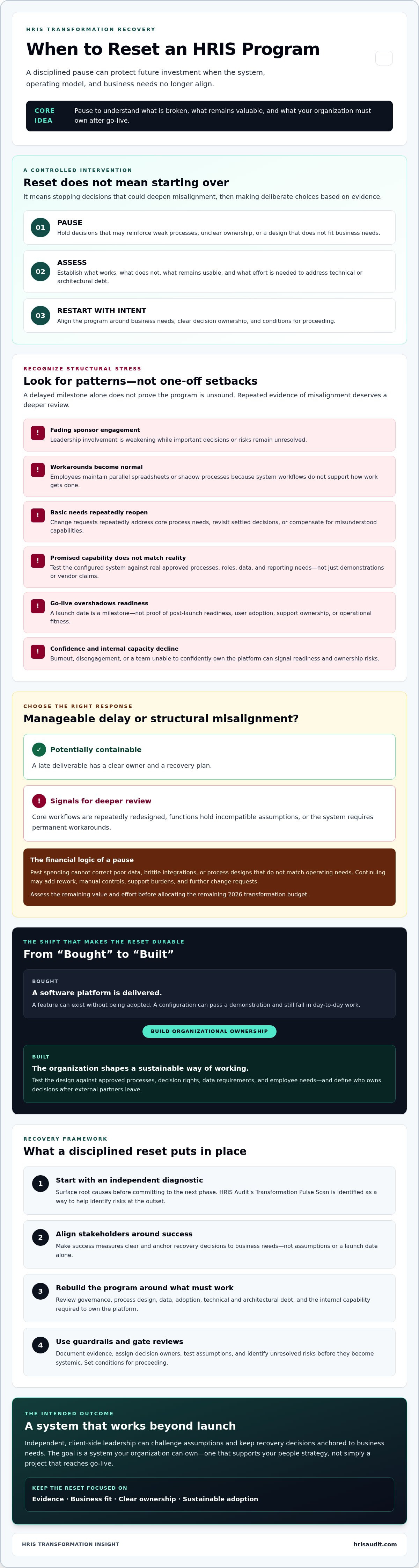
Look for patterns, not one-off setbacks. Sponsor engagement is fading. Employees maintain parallel spreadsheets because workflows in the new system don’t work for them. Teams repeatedly explain gaps that were assumed to be covered by the vendor’s product or the project design. These workarounds are operational evidence. They show where the formal system and the way people actually work have separated.
The Red Flags of HRIS Transformation Failure
Escalating change requests can be legitimate as requirements evolve. But when they repeatedly address basic process needs, reopen settled decisions, or compensate for misunderstood capabilities, they may expose weak discovery or design. Test vendor claims against real scenarios: can the configured system support the organization’s approved processes, roles, data, and reporting needs?
Pay attention to what the program rewards. If the integrator’s plan treats go-live as the primary measure of success, ask how it accounts for post-launch readiness, support ownership, user adoption, and unresolved defects. A launch date is a milestone, not proof of operational fitness. Internal burnout and declining confidence in the solution are also material risks. When experienced team members disengage or users rely on shadow processes, the issue is no longer just morale. It is a warning about readiness and ownership.
Separate manageable delays from structural misalignment. A late deliverable with a clear owner and recovery plan may be containable. Repeated redesign of core workflows, incompatible assumptions between functions, or a system that requires permanent workarounds calls for a deeper review. An HRIS Transformation Pulse Scan can help surface root causes before leaders commit to the next phase.
The Financial Logic of a Strategic Pause
The sunk-cost trap turns prior spending into an argument for continuing, even when the remaining plan is unsound. But past expenditure can’t correct poor data, brittle integrations, or process designs that don’t match operating needs. Continuing may add rework, manual controls, support burdens, and further change requests. These costs are often distributed across teams, making them easy to overlook.
A strategic pause isn’t a blank cheque or an automatic restart. It’s a way to assess what remains usable, estimate the effort required to address technical and architectural debt, and decide how to allocate the remaining 2026 transformation budget. Move from firefighting to governance: document the evidence, assign decision owners, test assumptions, and set conditions for proceeding. The right HRIS program reset protects future investment by requiring the design to work in practice, not just on a project plan.
The Anatomy of a Successful Reset: Moving from Bought to Built
A reset is not a project shutdown followed by an improvised restart. It’s a controlled intervention: pause decisions that could deepen misalignment, establish what is working, identify what is not, then rebuild the program’s direction around business needs. The objective isn’t to defend the original plan or discard everything. It’s to make deliberate choices about the system, processes, governance, and capabilities the organization must sustain.
This is the shift from “bought” to “built.” Buying software provides a platform. Building a durable HRIS program requires the organization to define how that platform should support its people processes and who will own decisions after external partners leave. A feature can exist without being adopted. A configuration can pass a demonstration and still fail to support day-to-day work.
The Built Not Bought™ Methodology
Built Not Bought™ distinguishes software delivery from organizational adoption. Instead of treating the vendor’s feature set as the blueprint, leaders test whether the design fits approved processes, decision rights, data requirements, and employee needs. Structural integrity comes first. Features matter when they support a coherent operating model and can be maintained by the organization.
Explore the Built Not Bought strategy for a deeper look at designing sustainable HR transformation.
A platform-agnostic assessment applies the same questions regardless of software: Does the system support the required work? Are integrations and data flows understood? Can internal teams govern changes and resolve issues? This keeps recovery focused on fit and ownership, not on defending a particular product or accumulating more features.
Reclaiming Client-Side Leadership
The system integrator can explain configuration choices and delivery constraints, but shouldn’t be the sole authority deciding whether the program’s design is sound. The integrator is accountable for its contracted work. Client leaders are accountable for business outcomes and must independently assess whether the solution meets organizational needs. Independent advisory can provide that client-side perspective, challenge assumptions, and help separate delivery progress from readiness to operate.
The sponsor’s role is to restore direction. Set the outcomes the reset must achieve, name decision owners, and require evidence before the program moves forward. Then shift from vendor management, tracking tasks and escalations, to program stewardship: aligning HR, technology, and business leaders around decisions the organization will own.
That ownership must extend beyond go-live. Identify who will maintain process decisions, oversee data quality, manage system changes, support users, and evaluate whether the platform continues to serve the strategy. HRIS Audit’s Built Not Bought frameworks offer a starting point for leaders structuring that ownership. A successful HRIS program reset doesn’t simply put a project back on schedule. It gives the organization the capability to sustain what it builds.
A Step-by-Step Framework for HRIS Program Recovery
A recovery plan needs more than a revised timeline. It needs an evidence-based sequence that identifies the cause of failure, resets decisions, and prevents the same weaknesses from carrying into the next phase. Treat the HRIS program reset as a governed effort, with a clear owner and an output for every stage.
Stage 1: Diagnose the Root Causes
Begin with a Transformation Pulse Scan to surface risks and misalignment across the program. Pair the diagnostic with interviews of the “engine room”: HR, payroll, IT, managers, and employees who use the tools. Trace specific breakdowns to their source. A system defect needs a different remedy than an unclear approval process or a policy that was never translated into system requirements. Record each issue alongside its evidence, likely cause, owner, and next decision so the review leads to action.
Stage 2: Realign Stakeholders
Bring sponsors and functional leaders back to a shared definition of success. Replace broad goals such as “modernize HR” with observable outcomes: which processes must work, who approves them, and what evidence will show they’re ready? Record disagreements and name decision owners. Alignment means accountable decisions, not just meeting attendance.
Stage 3: Audit the Architecture
Review the current design against approved requirements. Examine process flows, roles, data definitions, integrations, configuration decisions, and unresolved assumptions. Use the organization’s Field Library of design artifacts as evidence: where do documented decisions match actual use, and where have workarounds become the operating model? Separate essential repairs from preferences for additional features. For each gap, note whether it belongs to process, configuration, data, integration, governance, or adoption, then assign the appropriate owner.
Stage 4: Correct the Motion
Rebuild the roadmap around capacity and dependencies, not optimism. Rank needs as must-haves for safe, reliable operations or enhancements that can wait. Review each milestone with the system integrator against the work remaining, internal availability, and decision dependencies. A credible plan makes trade-offs visible and assigns owners; it doesn’t conceal risk behind a new date.
Stage 5: Re-establish Governance
Set gate reviews before the next phase proceeds. At each gate, require evidence that agreed requirements are met, critical issues have owners, and internal teams can support the work ahead. Define who can approve exceptions and how unresolved risks are escalated. These controls turn recovery findings into operating discipline.
Reset the Roadmap and Rebuild Trust
Communicate what has changed, why the plan is being reset, what remains undecided, and how employees can raise practical concerns. Don’t promise a frictionless relaunch. Show how decisions will be made and how progress will be assessed. For a structured diagnostic starting point, review the Transformation Pulse Scan. A sound recovery effort creates a roadmap the organization can deliver and sustain.
Establishing Governance Guardrails: Designing for Post-Reset Sustainability
A reset only holds if governance changes with it. Without clear decision rights, evidence standards, and ownership, the program can reproduce the same conditions that caused the failure. An Enterprise HR Technology Governance Framework gives leaders a practical structure for decisions across design, delivery, and ongoing system stewardship. Read the guide on HR technology governance for a deeper look at building that structure.
Governance should distinguish responsibilities rather than blur them. System integrators are responsible for their contracted delivery work and technical recommendations. Sponsors and client-side leaders retain accountability for business priorities, decisions, risk acceptance, and whether the organization is prepared to operate the system. Independent strategic advisory can support that client-side perspective; it doesn’t replace internal accountability or the integrator’s delivery role.
The Role of Gate Reviews in Program Health
A gate review is a decision point, not a progress presentation. Before a phase advances, sponsors should examine evidence against agreed criteria. Depending on the phase, that evidence might include approved process designs, tested integrations, resolved critical defects, validated data, named operational owners, and user readiness. Set the criteria before the review so teams know what “ready” means and exceptions are visible.
Don’t rely on vendor status reports alone. Compare them with issue logs, test results, decision records, and feedback from the teams expected to use the system. If the evidence doesn’t meet the gate, hold the decision, assign corrective actions, and set conditions for reassessment. Go-live is a milestone. The destination is a system the organization can operate and improve.
Capability Transfer: Training for Ownership
Post-reset sustainability depends on internal capability, not just documentation. Assign people to own process decisions, data stewardship, access, change evaluation, and user support. Confirm they understand how to handle routine requests and where unresolved issues must go. A useful test is whether the team can explain the decision behind a configuration, not merely where to click.
Field Library frameworks can help standardize internal knowledge and give teams a consistent reference for program decisions. Use that foundation to review changes, capture lessons, and revisit whether the system still supports business needs. This makes optimization a governed practice rather than a series of urgent fixes. A successful HRIS program reset leaves the organization better equipped to make and sustain its own decisions.
Client-side advisory can help leaders review program evidence, challenge assumptions, and clarify ownership while keeping decisions with the organization.
Navigating the Reset Motion with Client-Side Leadership
A failing program needs more than another delivery plan. It needs someone accountable to the organization’s interests, able to test whether proposed fixes address root causes or simply protect the current approach. That perspective can be missing when recovery is led by a party whose work, contract, or preferred solution is itself under review.
System integrators have an important role in technical delivery. But they shouldn’t be the only party judging whether the program’s design serves the business. An independent advisor can challenge assumptions, surface trade-offs, and help executives connect strategic goals to practical decisions without taking over internal accountability. HRIS Audit provides client-side leadership grounded in more than 30 years of HR transformation experience.
Finding an Independent HR Technology Advisor
Be cautious of recovery proposals that begin with more configuration, added scope, or a new delivery commitment before diagnosing the underlying problem. Ask an advisor to show how they distinguish a software limitation from a process, governance, data, or ownership failure. Their assessment should be platform-agnostic and grounded in evidence, not in defending a specific vendor or blaming users for workarounds.
Pattern recognition matters because recurring symptoms can have different causes. A missed decision may look like a technical delay. Repeated change requests may point to unclear requirements. Strong advisors make those distinctions explicit, explain the evidence behind their conclusions, and identify who must act next. Learn more about client-side HR technology leadership.
Reaching Structural Integrity
The measure of recovery isn’t whether outside support can keep the project moving. It’s whether the organization can govern and sustain the system after that support ends. Leaders should be able to name who owns process decisions, data quality, change evaluation, user needs, and ongoing system stewardship. If those responsibilities remain unclear, the structure is unfinished.
The Built Not Bought™ approach reinforces that ownership is built into daily decisions. Use its principles to connect executive intent to practical program choices: define the outcome, assign an accountable owner, evaluate evidence, and capture the decision so the organization can maintain it. The Built Not Bought book offers a resource for applying those principles to transformation work.
A disciplined HRIS program reset moves the organization out of crisis management and toward sustainable transformation. The next step is an honest assessment of where the program stands, what must change, and who needs to own the recovery.
Make the Reset the Start of Stronger Ownership
A failing transformation doesn’t have to define the outcome. The right HRIS program reset begins with evidence, not sunk-cost thinking: identify structural risks, realign stakeholders, and correct the roadmap before misalignment becomes harder to unwind.
Then make the recovery durable. Clear governance, objective gate reviews, and internal capability help keep the system useful beyond go-live. The goal isn’t simply to get a project moving again. It’s to build an HR technology foundation your organization can own and improve.
HRIS Audit offers client-side advisory, a proprietary Field Library of transformation tools, and a Transformation Pulse Scan to help leaders understand program risks and decisions. Start by clarifying where the program stands and which issues need attention.
A disciplined reset can turn a stalled transformation into a clearer path forward, with stronger ownership and a system built to serve your people strategy.
Request a free Transformation Pulse Scan from HRIS Audit to assess your program’s risks and identify where to focus next.
Frequently Asked Questions
What is an HRIS program reset?
An HRIS program reset is a controlled review and correction of a transformation that is at risk or no longer aligned with business needs. It doesn’t automatically mean abandoning the system or starting over. Leaders assess what remains viable, identify root causes, reset priorities and decision rights, then establish conditions for moving forward. The goal is to protect useful work while correcting design, governance, adoption, or ownership gaps.
How do I know if my HRIS implementation is actually failing?
Look for persistent patterns, not one missed milestone. Warning signs include declining sponsor involvement, repeated changes to core requirements, employees maintaining workarounds, recurring unresolved issues, and teams losing confidence in the solution. Test these signals against evidence: user feedback, defect and decision logs, process tests, and readiness for ongoing support. A delay with an owner and recovery plan may be manageable; recurring structural gaps need deeper diagnosis.
Will a program reset void my contract with the system integrator?
Not necessarily. A reset doesn’t automatically cancel or change a contract, but the effect depends on its terms and the actions your organization takes. Review provisions for scope changes, milestones, acceptance, pause rights, fees, termination, and dispute resolution with qualified legal and procurement advisors. Before directing a pause, document the issue, clarify decision authority, and discuss options with the integrator. Don’t assume that changing the project plan changes contractual obligations.
How long does a typical HRIS program reset take?
There’s no reliable standard duration. The assessment and planning effort depends on the program’s scope, number of unresolved design decisions, quality of available evidence, stakeholder availability, and complexity of data and integrations. A focused diagnostic can define the work ahead, but remediation and delivery planning take longer when root causes are extensive. Set timing after assessing the actual conditions, then tie milestones to evidence and decision readiness rather than an arbitrary target date.
How much does an HRIS program reset cost compared to continuing as-is?
There isn’t enough information to give a dependable figure or claim that a reset will always cost less. Compare both paths using the same assumptions: remaining program work, rework, internal staff time, manual workarounds, support needs, and risks of proceeding with unresolved gaps. Separate sunk costs from future costs. Then document the assumptions and uncertainties behind each scenario. This gives executives a more useful decision than comparing a reset estimate with an unchanged project budget.
Can we perform an HRIS reset internally without outside help?
Yes, if your organization has the capacity and independence to assess the program honestly, challenge vendor assumptions, and make cross-functional decisions. Internal leaders should be able to examine design, processes, data, adoption, and delivery evidence without relying on one project partner’s account. Outside advisory may be useful when internal teams lack time, expertise, or objective distance. The key question is whether someone can lead the review in the organization’s interest.
What happens to our data during a program reset?
A reset should begin by establishing what data exists, where it resides, who controls access, and which migration or conversion activities have occurred. Don’t assume that pausing work deletes, changes, or preserves data automatically. Coordinate with your internal data, security, and technology owners and review relevant vendor and integrator procedures. Record the current state, protect approved records, and verify any planned changes before resuming data work or modifying environments.
How do I explain a project pause to the Board of Directors?
Frame the pause as a governance decision to assess risk and protect the organization’s intended outcomes, not as an attempt to conceal delay. Present the evidence behind the decision, the exposure of continuing unchanged, what the review will determine, who owns it, and when the Board will receive an update. Distinguish confirmed facts from open questions. A clear decision path demonstrates control and gives directors a basis for oversight.


