

Enterprise software doesn't fail in the cloud; it fails on the ground long before deployment. Software handles transactions, but client-side architecture determines transformation survival. If you're asking whether your organization is actually prepared for this shift, you need an objective lens, not a vendor pitch deck. Executing a disciplined HRIS readiness assessment checklist is the only reliable way to audit structural maturity before committing enterprise capital.
You already know that polished sales demos routinely mask fractured workflows, legacy data debt, and missing operational guardrails. Counting on a systems integrator to police your internal readiness is an expensive gamble. Sustainable systems aren't bought from a software catalog; they're built through client-side ownership and internal capability.
This guide delivers an uncompromised evaluation framework to stress-test your people, processes, governance models, and data structures before you sign a contract. Ahead, you'll establish clear go/no-go criteria to protect operational continuity, eliminate blind spots, and govern your architecture sustainably long after launch.
Key Takeaways
- Operational readiness must precede technical deployment; purchasing software never resolves underlying process fragmentation or organizational friction.
- Rigorous pre-implementation audits surface structural failure modes and governance voids before binding vendor contracts lock your timeline in place.
- Deploying an enterprise HRIS readiness assessment checklist across five core domains provides the objective criteria required for definitive go/no-go decisions.
- Diagnostic evaluations must remain strictly client-side to counter vendor sales bias and protect your architectural integrity.
- Long-term transformation success requires building permanent internal capability, ensuring your enterprise governs the platform rather than depending on external integrators.
What Is an HRIS Readiness Assessment and Why Does It Matter?
Enterprise leaders often confuse software selection with transformation readiness. Signing a vendor agreement doesn't mean your enterprise can absorb the shock of a new operational baseline. An independent HRIS readiness assessment checklist evaluates organizational maturity before you commit capital to enterprise technology. Most transformations stumble because executives mistake procuring a digital tool for preparing the operational machinery that surrounds it.
A modern Human Resources Information System (HRIS) coordinates complex workflows across payroll, benefits, talent, and compliance. Software alone cannot repair broken operating models. Vendor-provided checklists rarely solve this problem; they function as sales acceleration tools designed to expedite contract signing rather than uncover operational vulnerabilities. An independent diagnostic establishes whether your processes, data governance, and internal teams can withstand technical disruption.
The Distinction Between Technical Fit and Organizational Maturity
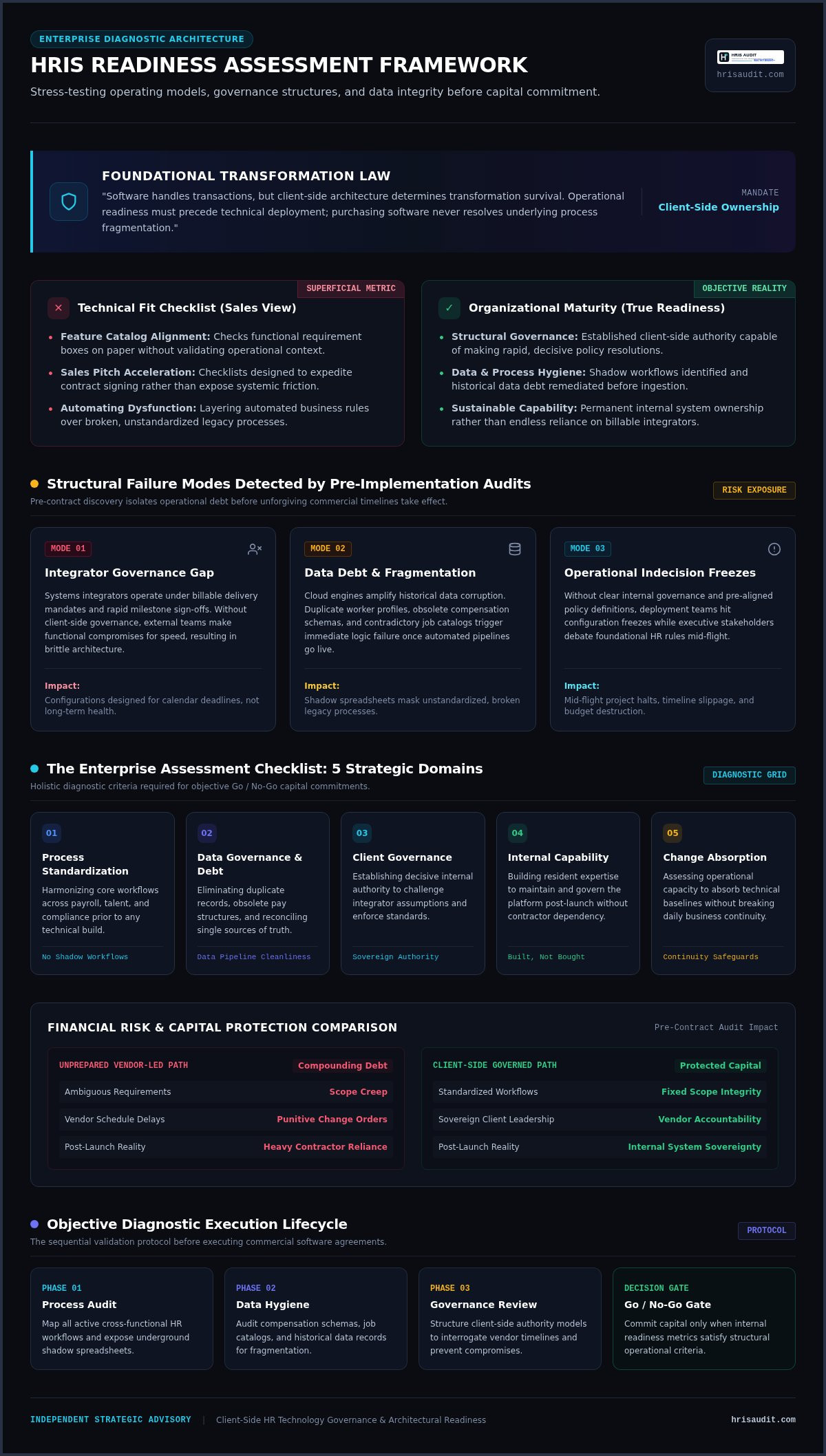
Feature checklists deceive. A platform might check every functional requirement on paper, but if your internal operating model is fractured, the deployment will fail. You cannot configure clean workflows over unstandardized processes. Automating dysfunction only produces faster chaos.
True readiness requires decisive internal governance. Without streamlined decision-making structures, project teams enter prolonged configuration freezes while stakeholders debate foundational policies mid-flight. Software capabilities are easily rented; institutional system ownership must be built internally.
The True Financial Stakes of Unprepared Implementation
Skipping client-side preparation guarantees compounding financial losses. Ambiguous requirements inevitably create scope creep, schedule overruns, and punitive change orders from systems integrators. The most damaging costs emerge post-go-live, when unprepared internal teams cannot maintain the system, forcing leadership to rely on expensive external contractors just to keep basic transactions running. Establishing rigorous client-side HR technology leadership protects capital by auditing operational integrity before project kickoff. A comprehensive HRIS readiness assessment checklist ensures you commit funds based on proven capability, not wishful vendor projections.
Core Failure Modes Detected by Pre-Implementation Audits
Pre-implementation audits expose structural stress fractures before commercial agreements lock teams into unforgiving timelines. Peer-reviewed research evaluating enterprise readiness for HRIS implementation confirms that technical feasibility means little without organizational maturity. When programs fail, they don't break on technical specifications. They collapse under unaddressed operational debt. Executing a rigorous HRIS readiness assessment checklist surfaces three foundational failure modes before you commit capital.
Left unchecked, these failure points compound exponentially once deployment cycles begin. Auditing them early is the only way to establish architectural control.
The Systems Integrator Governance Gap
Integrators operate under billable delivery mandates. Their business model incentivizes rapid milestone sign-offs, not long-term operational health. When internal governance operates in a vacuum, external consultants make functional compromises to hit calendar dates. The enterprise inherits brittle configurations designed for speed rather than sustainability. Executing a proven built not bought HR strategy requires establishing sovereign client-side authority to interrogate vendor timelines, challenge configuration assumptions, and protect institutional interests.
Data Debt and Process Fragmentation
Modern cloud architectures amplify underlying data corruption. If historical records contain duplicate worker profiles, obsolete compensation models, or contradictory job catalogs, automated business logic will break immediately. Shadow spreadsheets and offline manual workarounds reveal exactly where legacy processes failed years ago. A disciplined audit maps these underground habits and enforces strict data ownership rules before data pipelines ever stage records for migration.
Sponsor Disengagement and Capability Deficits
Executive absence guarantees transformation friction. When sponsors treat modernization as a routine IT utility upgrade, cross-functional accountability dissolves. Project teams need decisive executive backing to resolve functional gridlock and clear operational capacity to absorb knowledge. Without intentional capability transfer, internal staff never develop the fluency required to manage the system. The enterprise becomes trapped in permanent vendor reliance. Auditing these friction points against proven transformation governance frameworks ensures your teams hold true architectural stewardship long before contracts are signed.
The Enterprise HRIS Readiness Assessment Checklist: 5 Strategic Domains
Isolated functional checklists create a false sense of security. Evaluating software modules without reviewing organizational mechanics produces operational blind spots. A robust HRIS readiness assessment checklist audits five interdependent domains to establish whether your enterprise can absorb and sustain transformation: strategic alignment, target operating model, process maturity, data hygiene, and governance architecture.
Every domain functions as a structural pillar. If one pillar yields under implementation stress, the entire technical deployment fractures.
Strategic Alignment and Operating Model Discipline
Enterprise technology must serve explicit, documented business targets rather than vague modernization goals. Executive leadership across human resources, finance, and information technology must establish consensus on measurable outcomes before committing resources. Verify that your target operating model defines unambiguous service boundaries between shared services, centers of excellence, and frontline business partners. Ground these expectations directly in an enterprise HR technology governance framework to prevent delivery priorities from drifting during configuration.
Process Standardization and Enterprise Data Integrity
Configuration teams cannot build effective workflows on fragmented operating practices. Every global baseline process, from foundational hire-to-retire paths to complex compensation cycles, requires standardization before tenant build-out begins. Evaluate operational hygiene using this targeted audit checklist:
- Process Standardization: Map and rationalize all regional variations across core talent, payroll, and benefits workflows to establish unified global baselines.
- Job Catalog Architecture: Standardize enterprise job profiles, family structures, and compensation grades, eliminating arbitrary legacy titles.
- Master Data Sources: Identify and document the definitive source of truth for all employee, organizational, and position entities.
- Data Hygiene Protocols: Profile historical records, resolve orphan profiles, and execute mandatory data cleanup routines before staging extraction pipelines.
Governance Rigor, Team Capacity, and Change Architecture
Transformation velocity stalls without decisive internal leadership. Formal gate reviews must govern milestone progression, ensuring phase completions require strict technical and functional acceptance before teams proceed. Securing subject matter expertise demands deliberate operational planning; you must actively backfill daily transactional duties so core practitioners can dedicate real bandwidth to design decisions. Pair this capacity with structured change impact assessments across business units. Modernization succeeds only when operating units can absorb new workflows without business disruption.
How to Execute an Objective Readiness Diagnostic
Executing a readiness evaluation requires strict detachment from sales quotas and implementation revenue. When vendors or integrators lead pre-project discovery, the exercise routinely turns into a billable scoping session. An objective evaluation demands an insulated client-side perimeter. By following a structured five-step diagnostic cadence, leadership isolates structural liabilities before capital is deployed.
Rigorous diagnostics don't seek consensus; they hunt for operational friction. Applying an objective HRIS readiness assessment checklist gives executives an unvarnished audit of organizational health across five discrete steps.
Step 1 & 2: Define Independent Governance and Gather System Evidence
Begin by drafting an independent audit charter that isolates your discovery process from third-party software influence. Once governed, catalog the physical reality of your operating environment. Document every custom integration, core database, shadow spreadsheet, and third-party vendor interface across HR, IT, and Finance. Collect documented standard operating procedures alongside operational SLAs. If workflows exist only in the heads of key operators, your baseline documentation is incomplete.
Step 3 & 4: Stress-Test Capabilities and Model Transformation Scenarios
Structured stakeholder interviews must probe beyond surface satisfaction. Evaluate operational maturity across functional silos by testing how teams manage exception handling, policy discrepancies, and cross-departmental handoffs. Next, simulate active transformation pressure. Test how functional leads handle disputed design deadlocks, scope boundaries, and compressed turnaround schedules. Pinpoint operational single points of failure, particularly within payroll compliance, benefits calculations, and data pipeline maintenance.
Step 5: Synthesize Findings into a Strategic Go/No-Go Decision Gate
Diagnostic evidence must culminate in an executive readiness scorecard rather than an academic report. Grade organizational maturity across each domain, identifying non-negotiable gaps that mandate remediation prior to issuing requests for proposals. Conclude the exercise with a formal stage-gate review. Executive sponsors must hold the authority to halt technology procurement until underlying operational fractures are repaired.
Evaluate your operational risks with the free Transformation Pulse Scan
Beyond the Checklist: Building Sustainable Internal Capability
A diagnostic checklist provides a snapshot in time; it does not run your business. Passing an audit confirms your enterprise is prepared to begin, but real transformation survival depends on what happens next. Organizations must transition from passive software consumers into disciplined system architects. Software vendors routinely push generic best-practice templates to compress deployment cycles, yet these off-the-shelf configurations rarely support nuanced operating structures. True stability requires internal teams capable of defending architectural integrity under pressure.
Completing your HRIS readiness assessment checklist is merely the opening motion. Sustained performance demands permanent internal capability, deliberate knowledge transfer, and relentless operational oversight.
The Built Not Bought Philosophy in Practice
Purchasing modern cloud subscriptions never produces operational fluency. Systems integrators ultimately roll off the project, taking their contextual understanding with them. If your internal teams have not spent the implementation cycle mastering configuration logic, testing protocols, and business rule design, your organization falls into perpetual third-party reliance. The core methodology detailed in the Built Not Bought Book shows how deliberate capability transfer throughout the transformation lifecycle turns internal staff into permanent system stewards rather than dependent software users.
Diagnostic Tools for Ongoing Health Monitoring
Operational drift begins the moment hypercare ends. Process exceptions creep back into daily habits, custom interfaces fail silently, and ungoverned configuration changes erode core reporting. Periodic structural audits are essential to identify these vulnerabilities before they disrupt operations. Organizations can maintain systemic alignment by deploying diagnostic frameworks from the HRIS Audit Frameworks Library. To benchmark operational gaps and stress-test governance health before making major platform decisions, run the HRIS Transformation Pulse Scan.
Securing Independent Client-Side Transformation Advisory
Protecting enterprise capital requires advice uncompromised by vendor software sales quotas or implementation change orders. A true client-side partner provides the governance discipline needed to interrogate third-party milestones, resolve design deadlocks, and protect your long-term operating roadmap. Equipping executive sponsors with seasoned decision support ensures enterprise goals remain front and center from procurement through multi-year optimization. To evaluate your organization's transformation roadmap alongside veteran advisors, connect with HRIS Audit Strategic Advisory.
Architecting Transformation Health Before Deployment
Enterprise technology doesn't fix fractured organizations. Sustainable transformation requires standardized operational baselines, rigorous data hygiene, and uncompromised internal governance. Executing an objective HRIS readiness assessment checklist gives your executive leadership the sovereign clarity needed to establish true readiness before committing multi-year capital.
Long-term operational resilience is built through internal capability transfer, not perpetual contractor billing. Backed by over 30 years of enterprise transformation experience and the proprietary Built Not Bought methodology, our advisory remains 100% independent. We sell no software, take no implementation kickbacks, and hold a single focus: protecting client-side operational health.
Benchmark your transformation risk with the free Transformation Pulse Scan
Take command of your operational architecture before vendors dictate terms. When your enterprise approaches modernization with internal ownership and structural discipline, you build a foundation that endures long after deployment.
Frequently Asked Questions
What is the primary difference between a vendor readiness checklist and an independent audit?
A vendor checklist is engineered to accelerate contract execution, whereas an independent audit evaluates operational survival. Vendor templates focus primarily on feature prerequisites and technical compatibility. They rarely question whether your internal operating model or governance structures can sustain the platform. An independent HRIS readiness assessment checklist interrogates operational liabilities, internal friction, and capability deficits without commercial software sales quotas.
How far in advance of software selection should an enterprise conduct an HRIS readiness assessment?
Organizations should execute an assessment six to twelve months before issuing a formal RFP or signing vendor contracts. Remediating process fragmentation, resolving legacy data debt, and establishing governance models takes deliberate runway. If you evaluate readiness during active procurement, technical sales momentum will outpace your internal decision-making cycles, forcing your teams into costly compromises under rigid calendar deadlines.
Can an organization complete an HRIS readiness assessment while relying on internal staff alone?
Internal teams can document baseline workflows, but evaluating readiness strictly from within often creates structural blind spots. Internal staff frequently normalize legacy workarounds and departmental compromises, mistaking established habits for standardized processes. Independent oversight challenges institutional bias, applying cross-industry pattern recognition to expose latent vulnerabilities. A rigorous HRIS readiness assessment checklist requires client-side advisory unburdened by internal corporate politics.
What are the most common red flags uncovered during an HRIS readiness review?
The most critical red flags are ungoverned data debt, fractured job architectures, and passive executive sponsorship. Diagnostics routinely unearth conflicting compensation structures, unmapped shadow spreadsheets, and functional leads who lack backfilled capacity. When an enterprise cannot identify definitive owners for master employee records or reach consensus on core workflows, launching technical configuration guarantees immediate project distress.
How does data readiness impact overall enterprise HRIS transformation project timelines?
Corrupted data is the single most common cause of implementation schedule overruns. If legacy records contain duplicate worker profiles, obsolete compensation tiers, or broken reporting lines, automated extraction pipelines fail repeatedly. Cleansing, standardizing, and reconciling enterprise records mid-flight freezes configuration workstreams. Resolving data hygiene before procurement ensures data migration proceeds methodically without derailing testing cycles or go-live targets.
What role should executive sponsors play during the pre-implementation readiness stage?
Executive sponsors must operate as decisive architects rather than passive figureheads. During pre-implementation, sponsors enforce cross-functional alignment across HR, IT, and Finance leadership. They authorize operational backfill resources so internal experts can dedicate focused bandwidth to architectural design. Most importantly, sponsors protect enterprise capital by upholding rigorous gate reviews, halting procurement until operational readiness is verified.


