

Your next HCM implementation is likely to fail. It's a harsh reality, but the industry data supports it. Most organizations treat HR transformation as a procurement exercise rather than a structural design challenge. They buy a platform, hire an integrator, and hope for the best. This reliance on external vendors creates a fragile ecosystem. To survive, you must pivot to a built not bought HR strategy that prioritizes internal capability over vendor promises. You've likely felt the frustration of a strategy-to-execution gap that never seems to close.
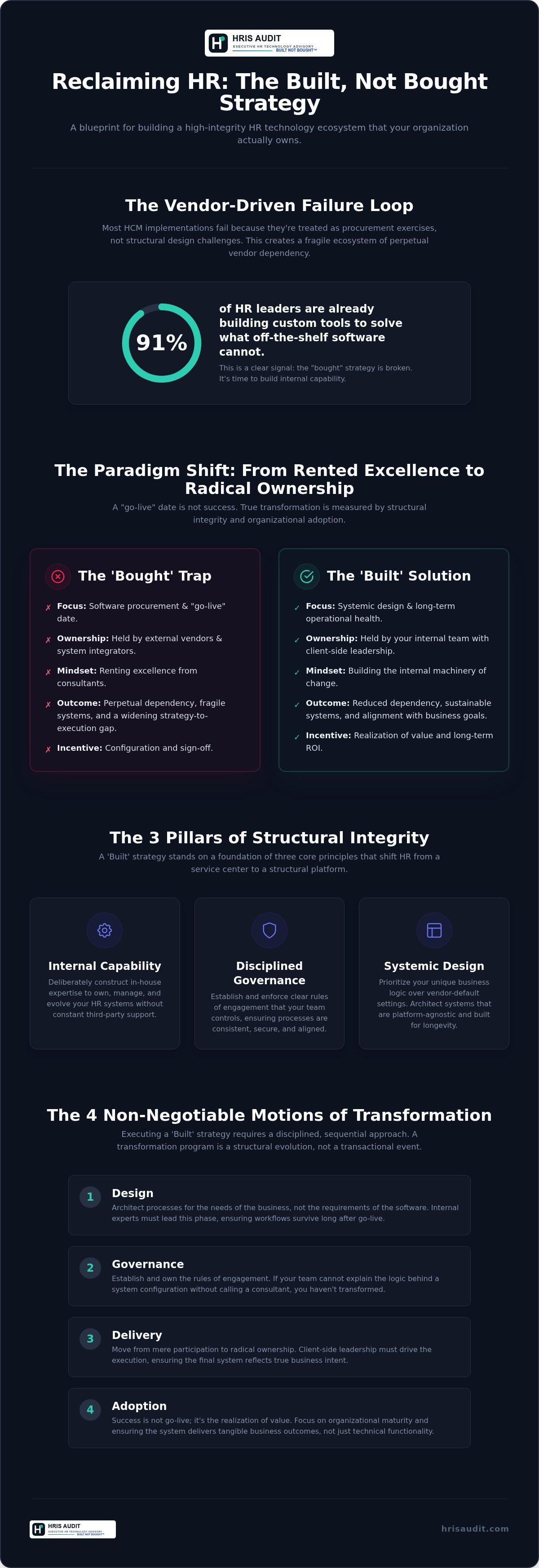
It's time to stop renting your excellence. Recent data shows that 91% of HR leaders are already building custom tools to solve what off-the-shelf software cannot. This guide teaches you how to move beyond vendor-driven implementations to build a high-integrity HR technology strategy your organization actually owns. We'll examine the three pillars of structural integrity: internal capability, disciplined governance, and platform-agnostic design. You'll gain a blueprint for reduced consulting dependency and systems that finally align with your actual business outcomes.
Key Takeaways
- Shift your focus from software procurement to systemic design. True transformation requires a foundation that outlasts any single vendor contract.
- Implement a built not bought HR strategy to reclaim ownership of your technology ecosystem. This method prioritizes internal capability over the cycle of perpetual consulting dependency.
- Distinguish between a "go-live" date and long-term operational health. Success is measured by structural integrity and organizational adoption, not just system configuration.
- Master the five essential motions of transformation to bridge the gap between executive vision and technical execution. These disciplined steps ensure your HRIS ecosystem remains agile.
- Learn how to execute a structural reset when a current project is failing. Transitioning from a "bought" mindset to a "built" program requires securing high-level sponsorship for a fundamental shift in approach.
Beyond the Talent Debate: Why Your HR Strategy Needs Structural Integrity
The traditional "Build vs. Buy" framework is broken. Most HR leaders apply it only to talent acquisition: do we hire the expert or train the junior? This perspective is dangerously narrow. It ignores the structural machinery that manages those people. A high-integrity built not bought HR strategy isn't about where your people come from; it's about who owns the architecture of your organizational systems. Buying the most expensive software on the market often leads to the worst outcomes because organizations buy a solution before they've built the internal capability to sustain it. You don't need a new vendor. You need a new foundation.
The Flaw in Vendor-Led Transformations
System integrators are not your partners in longevity. They are incentivized for the "go-live" event, a single point in time that rarely correlates with long-term success. Their goal is configuration. Your goal is sustainability. This misalignment creates the "bought" strategy trap: a state of perpetual dependency on external consultants to maintain a system your team doesn't truly understand. The hidden cost of this dependency is a widening strategy-to-execution gap. When the consultants leave, the structural integrity of your HRIS begins to erode. You're left with a high-maintenance ecosystem and no internal map to navigate it. You've purchased a product, but you haven't solved the problem.
HR as an Architectural System
Stop treating HR as a service center. Start treating it as a structural platform. In this context, business processes aren't isolated events; they're integrated systems. If your HRIS foundation is weak, the entire organizational structure risks collapse during periods of rapid growth or market volatility. The Built Not Bought™ philosophy demands a shift from mere participation to radical ownership. It's about building the internal machinery of change. This requires a disciplined approach to three core areas:
- Systemic Design: Prioritizing your unique business logic over vendor-default settings.
- Internal Governance: Establishing the rules of engagement that your team actually controls.
- Organizational Maturity: Moving from reactive firefighting to proactive architectural management.
Before you commit to another vendor-led cycle, assess your current state. Tools like the Transformation Pulse Scan can help detect structural risks before they become catastrophic failures. True transformation isn't a product you purchase. It's a capability you build through disciplined leadership and structural governance. Don't just implement. Architect.
What is the Built Not Bought™ HR Strategy?
The Built Not Bought™ method is a rejection of the "rented" transformation model. It's a disciplined approach to organizational maturity. At its core, a built not bought HR strategy is defined by the deliberate construction of internal capability. It's the difference between being a passenger in a vendor's process and being the architect of your own ecosystem. You don't "buy" a strategy from a consultancy. You build it through four non-negotiable pillars: Design, Governance, Delivery, and Adoption.
"Built" refers to the structural integrity of your internal logic. It's the mechanical foundation of your HRIS ecosystem. A software project is a transactional event. A transformation program is a structural evolution. One ends at the sign-off. The other begins at the realization of value. If your team cannot explain the logic behind your system configuration without calling a third-party integrator, you haven't transformed. You've simply outsourced your intelligence. Ownership is the only path to long-term ROI. It is the difference between a system that merely functions and one that actually delivers business value.
Designing for Ownership, Not Just Go-Live
Go-live is the starting line. It's not the finish. Most implementations fail because they design for the requirements of the software, not the requirements of the business. You must design processes that survive the first update. This requires client-side leadership. Your internal experts must lead the design phase, not just attend it. They must understand the mechanical dependencies of every workflow. Why? Because when the system breaks on a Friday afternoon, you shouldn't be waiting for a consultant's ticket response. You should own the solution. For a deeper dive into this architectural approach, the Built Not Bought book serves as a definitive guide for this shift.
The Governance Framework
Governance isn't a committee. It's a mechanism for structural integrity. You need gate reviews that actually hold weight. A "green" status report is often a lie. It measures task completion, not organizational readiness. Real governance provides decision support for sponsors. It forces them to look at the machinery, not just the dashboard. You must evaluate the Enterprise HR Technology Governance Framework to understand how to design for this level of stability. This framework moves past surface-level metrics toward deep structural foundations. It creates a system of checks and balances that ensures the strategy outlasts the implementation team. Does your current governance model actually stop bad decisions, or does it just document them?
Buying a System vs. Building a Sustainable Program
Buying a system is a transaction. Building a program is a transformation. The "bought" mindset prioritizes procurement speed and vendor roadmaps. It treats HR technology as a black box. The "built" mindset, however, views technology as a structural component of a larger organizational machine. Executing a built not bought HR strategy requires a fundamental shift in risk management. You trade the illusion of vendor-guaranteed success for the reality of internal mastery. Ownership isn't optional. It's the foundation of structural integrity.
Short-term speed is a trap. Most organizations rush to go-live only to find they've inherited a system they cannot maintain. Long-term agility is the actual prize. This requires a battle-tested perspective that recognizes patterns of failure before they manifest. Program failure isn't usually technical. It's structural. It's the result of prioritizing the "buy" over the "build." Vendor lock-in is the inevitable result of a "bought" mindset. You become a hostage to their roadmap and their price increases because you lack the internal mastery to pivot. You don't just need a platform. You need a program.
The System Integrator (SI) Trap
System integrators operate on a specific business model: high utilization and billable hours. Their success metric is a successful configuration, not your long-term operational health. They don't live with the system after the check clears. You do. This creates a structural gap between what's implemented and what's sustainable. If the configuration reflects the SI's template rather than your business logic, the system will eventually fail.
You need a client-side advisor to bridge this gap. This advisor acts as a guardian of your interests, ensuring the SI builds for your specific needs, not just their implementation methodology. Understanding the distinction between Strategic Advisory vs. System Integration is critical. One focuses on the tool. The other focuses on the capability. Without this bridge, your strategy remains a document rather than a functional reality.
Capability Transfer: The Ultimate Metric
Success isn't defined by a go-live date. It's defined by the moment your team can run the system without external support. If you're still calling a consultant for basic configuration changes six months after launch, you've failed. Capability transfer is the only metric that matters for ROI. It's a measure of organizational maturity. It requires a disciplined approach to training, documentation, and internal governance.
How do you measure readiness? Look at your team's ability to troubleshoot the mechanical dependencies of your workflows. To accelerate this maturity, many organizations utilize a licensed Field Library. These tools provide the frameworks and documentation needed to move from dependency to autonomy. They provide the architectural blueprints your team needs to maintain structural integrity. Don't just participate in the project. Own the program. This is the core of a sustainable built not bought HR strategy.
Executing the Strategy: The Motions of Transformation
Execution is where philosophy meets the machinery. A built not bought HR strategy requires more than intent; it requires disciplined repetition. We call these the "motions" of transformation. They are the repeatable actions that ensure structural integrity. Without them, your strategy remains a static document. With them, it becomes a functional reality. Ownership isn't a destination. It's a continuous state of operational readiness.
Transformation is a mechanical process. It involves five essential motions: Diagnostic Alignment, Architectural Design, Governance Rigor, Capability Injection, and Operational Transition. These aren't optional steps. They're the gears that drive ownership. If one gear fails, the entire system stalls. This disciplined approach ensures that your plan is platform-agnostic. Your strategy must be independent of your software vendor. If your plan only works for one specific tool, you isn't building a strategy. You're following a user manual. True transformation prioritizes business logic over technical constraints.
The Role of the Pulse Scan
Most failures are silent until it's too late. They hide in "green" status reports and optimistic timelines. A Transformation Pulse Scan acts as a diagnostic sensor for your program. It detects structural risk before it reaches the go-live phase. Use it to reset a failing project or to validate the health of a new one. Data provides the clarity needed for executive decision support. It strips away the marketing hyperbole and reveals the raw state of your implementation. It forces you to look at the machinery, not just the dashboard.
Leveraging the Field Library
The "blank page" problem is a major risk in HRIS configuration. Starting from scratch leads to inconsistency and structural weakness. A licensed Field Library provides the blueprints. These proven workbooks standardize system design across global footprints. They ensure that your configuration is based on industry patterns, not individual whims. This isn't about copying. It's about building on a foundation of structural integrity. You'll reduce the time to value while increasing the reliability of the output. Consistency is the hallmark of a mature system.
Explore the Transformation Field Library
The Path Forward: Transitioning to a Built Strategy
Transitioning from a failing, vendor-led project to a sustainable built not bought HR strategy requires a structural reset. It's a pivot from procurement to architecture. Most organizations wait until a project is in crisis before attempting this shift. Don't wait. Audit your roadmap now. If your current trajectory relies on external system integrators for long-term survival, your foundation is compromised. Securing executive sponsorship for this reset isn't about asking for more budget. It's about presenting a plan for ownership. Executives value ROI. ROI requires structural integrity.
The Built Not Bought Book
The Built Not Bought book provides the definitive blueprint for this transition. It distills 30 years of transformation leadership into actionable frameworks. You'll learn the specific patterns that lead to failure and the disciplined motions required for success. This isn't theoretical advice. It's a field guide for the "battle-tested" leader who values independence over dependency. Building a community of practice within your HR team starts with a shared language. The book establishes that language. It moves your team from being consumers of technology to being architects of value.
Next Steps for HR Leaders
Start with an internal honesty check. If your team cannot explain the logic behind your system configuration without calling a third-party integrator, your foundation is compromised. Moving forward requires a disciplined sequence of actions to reclaim control. Engaging independent advisory is the next logical step to remove vendor bias from your decision-making process. You must focus on three core motions:
- Conduct a structural audit: Evaluate your current roadmap against actual business outcomes rather than vendor milestones.
- Engage independent advisory: Gain an objective view of your internal capability from a platform-agnostic perspective.
- Inject internal capability: Shift your budget from recurring consulting fees to the development of internal system mastery.
Your HRIS ecosystem is the machinery of your business. Treat it with the respect it deserves. A built not bought HR strategy ensures that you aren't just renting excellence. You're institutionalizing it. The transition is difficult. The reset is demanding. But the alternative is a cycle of expensive, recurring failures. Choose ownership. Choose structural integrity. Build your future.
Reclaim Your Organizational Architecture
Transformation is not a product. It's a capability. You've seen the high failure rates of vendor-driven implementations. You understand the cost of long-term dependency. Adopting a built not bought HR strategy is the only way to ensure your systems align with business outcomes. It requires a shift from passive participation to active, structural ownership. Ownership isn't just about the software. It's about the internal logic that drives it. It's about the machinery of your business.
We bring 30 years of enterprise HRIS leadership to your most complex challenges. Our platform-agnostic advisory provides the objectivity your internal teams need. These battle-tested frameworks are used by global organizations to secure their structural integrity. You've spent enough time following vendor roadmaps. It's time to build your own. Reclaim your authority. Secure your future.
Secure your copy of the Built Not Bought book and start your transformation blueprint.
Frequently Asked Questions
What is the difference between 'building' and 'buying' an HR strategy?
Buying is a procurement exercise. It treats strategy as something you can purchase off a shelf. Building is a design challenge. It treats strategy as a structural capability. A built not bought HR strategy prioritizes your unique business logic over software defaults. It ensures you own the architecture rather than renting a vendor's vision. Ownership is the critical differentiator between a project that merely finishes and a program that actually delivers.
Why do 70% of HR technology projects fail after go-live?
Failure stems from a lack of structural integrity. Most projects focus on the go-live date as the finish line. They ignore post-launch operational readiness and internal governance. When the system integrator leaves, the organization lacks the mastery to maintain the complex ecosystem. The system eventually erodes under the weight of software updates and changing business needs. Success requires a focus on long-term sustainability, not just a successful configuration event.
How can I tell if my current HRIS implementation is at risk?
Risk is often silent. Signs include a heavy reliance on external consultants for basic configuration and status reports that only track tasks. If your team cannot explain the system logic without vendor assistance, your project is at risk. A Transformation Pulse Scan provides the diagnostic data needed to detect these structural weaknesses early. It allows you to move from optimistic reporting to objective, data-driven decision support for your sponsors.
What is a client-side HR technology advisor?
This advisor acts as a guardian of your interests. Unlike a system integrator who focuses on software configuration, a client-side advisor focuses on your organizational maturity. They bridge the gap between executive vision and technical execution. They ensure the implementation serves your business logic, not the vendor's methodology. They are battle-tested architects who prioritize your internal capability. Their goal is to make your team self-sufficient rather than perpetually dependent on external support.
Does the Built Not Bought method work with any software vendor?
Yes. The method is platform-agnostic. A built not bought HR strategy focuses on the human and strategic elements of technology rather than specific tools. Whether you use Workday, Oracle, or SAP, the structural foundations of governance and systemic design remain the same. The goal is to make the software work for your business logic. This approach ensures your strategy outlasts any single platform or vendor contract in your HRIS ecosystem.
How do I move away from a heavy reliance on my system integrator?
Transitioning requires a deliberate capability injection. You must shift your budget from recurring consulting fees to internal training and licensed Field Libraries. Establish strict gate reviews and internal governance that force your team to own the decision-making process. The goal is to move from being a passenger in the system integrator's project to being the architect of your own program. Ownership is earned through the disciplined application of logic to your internal processes.
What are the first steps in an HR transformation program reset?
Start with an honest audit of your current project health. You must secure executive sponsorship for a structural shift. This involves moving from a project-based mindset to a program-based mindset. Stop the obsession with go-live dates and focus on capability transfer. Use a diagnostic scan to identify where the structural integrity of your current plan is failing. Reset the governance model to prioritize internal mastery and long-term operational health over short-term configuration milestones.
How long does it take to see results from a Built Not Bought strategy?
Initial results in governance and decision clarity appear within weeks. However, true structural maturity is a steady, purposeful progression. You will see a reduction in consulting dependency and an increase in internal system mastery over six to twelve months. The focus is on long-term agility and sustainable ROI rather than short-term configuration speed. Discipline pays off during the operational phase when your team can manage the system independently and adapt to change.


