

Most HR technology implementations are destined to fail before the first line of code is written. Why? Because you bought a tool when you needed a blueprint. Achieving true HR technology strategy alignment isn't about choosing the right vendor; it's about engineering a system that survives the departure of your consultants. If your tech stack is a collection of silos that refuse to talk, you aren't running a platform. You're managing a mess.
You know the frustration of low adoption rates and the heavy cost of total reliance on System Integrators who lack your business context. It's time to stop being a passenger in your own transformation. This article provides the framework to move beyond software selection and toward a sustainable HR technology ecosystem. You'll learn how to engineer structural integrity that aligns with your organizational goals and ensures your internal team actually knows how to run the machine. We will explore the shift from "bought" to "built," the discipline of governance, and the specific motions required to secure demonstrable ROI through structural efficiency. It's time to stop participating and start owning.
Key Takeaways
- Shift from vendor-driven shopping lists to true HR technology strategy alignment by synchronizing your architectural design with specific business outcomes.
- Adopt the Built Not Bought™ methodology to ensure your internal team owns the system's logic rather than remaining perpetually dependent on external integrators.
- Redefine governance as the mechanical integrity of your ecosystem, serving as a shield against scope creep and vendor drift.
- Bridge the capability gap with client-side leadership that prioritizes long-term structural health over short-term go-live milestones.
- Utilize the Transformation Pulse Scan to diagnose misalignment risks early and reset your project's trajectory before the foundation fractures.
The Alignment Gap: Why HR Technology Strategy Often Fractures
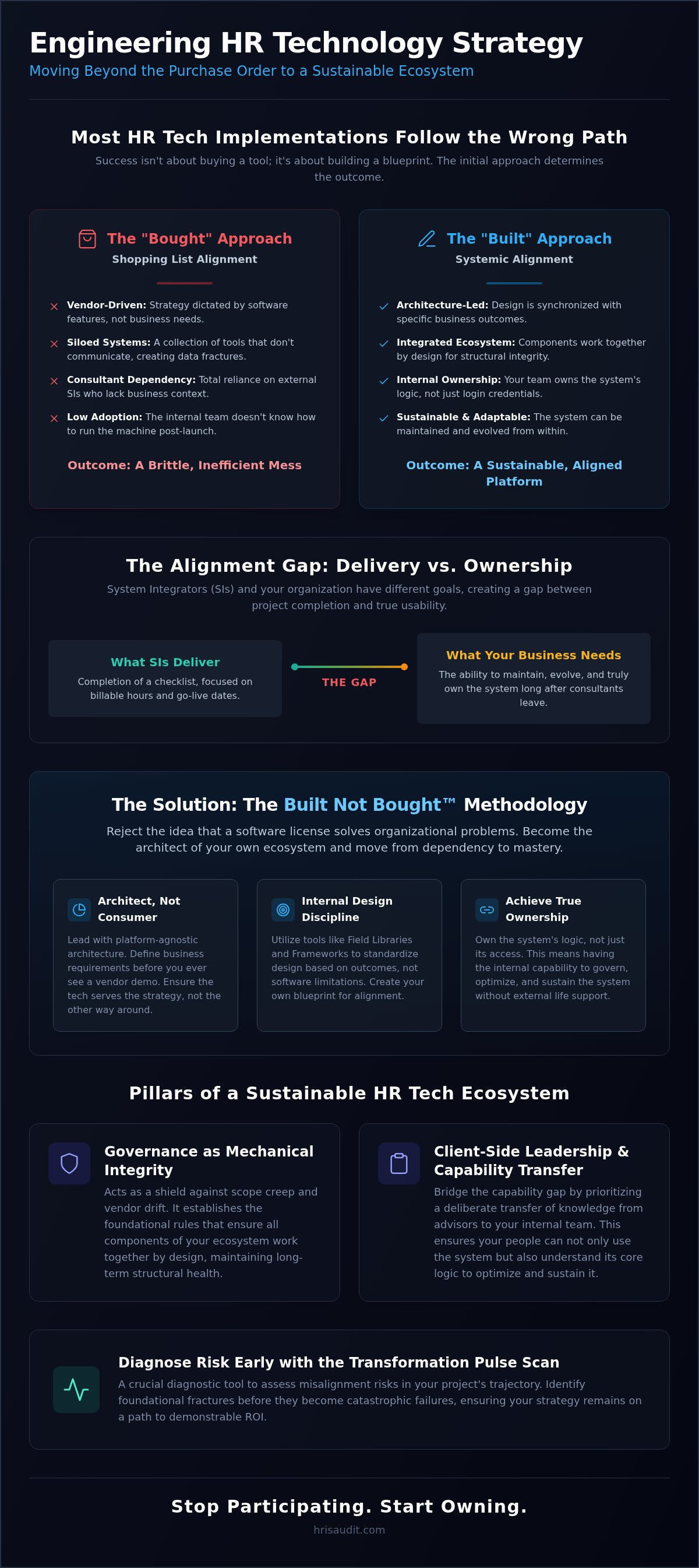
HR technology strategy alignment is not a collection of software licenses. It is the rigorous synchronization of architectural design with business outcomes. Most organizations approach digital transformation as a retail exercise. They buy tools to patch symptoms. They select vendors based on glossy demos. This is "Shopping List Alignment," and it's a recipe for structural failure. True alignment requires "Systemic Alignment," where you build internal capabilities rather than just purchasing external solutions.
A fractured strategy reveals itself through distinct, staccato fragments. Siloed data. Vendor bias. Ghost features that looked good in a slide deck but provide zero utility. These aren't just glitches; they're evidence of a foundation that can't support the weight of the enterprise. To achieve strategic alignment, you must prioritize the structural integrity of your HRIS ecosystem. If the components don't work together by design, no amount of post-implementation configuration will save them.
The SI Bias vs. Organizational Reality
System Integrators (SIs) operate on a different timeline than your business. Their incentives are tied to go-live dates and billable hours. They value "Delivery," which is simply the completion of a checklist. You need "Ownership," which is the ability to maintain and evolve the system after the consultants leave. The Alignment Gap is the space between what is implemented and what is actually usable. SIs don't lose sleep over your low adoption rates six months after the project ends. They've already moved on to the next contract. You're left holding the keys to a machine your team doesn't know how to drive.
Strategy as Architecture, Not a Purchase Order
It's time to trade the "Buy" mentality for an "Engineering" mindset. Your HR technology should be treated as a load-bearing structure. This requires platform-agnostic thinking long before you invite a single vendor to demo their product. You must define the requirements of the business, not the capabilities of the software. When you lead with architecture, you ensure the tech serves the strategy, not the other way around. For a deeper look at designing for long-term stability, consult The Enterprise HR Technology Governance Framework. Strategic intent without architectural discipline is just expensive wishful thinking. Don't let your purchase order dictate your future.
Built Not Bought: Engineering Sustainability into Your Strategy
Alignment isn't a purchase. It's a build. The Built Not Bought™ methodology rejects the idea that a software license solves organizational friction. Systems "bought" without internal design discipline fail the moment the implementation team signs off. They become legacy debt within months. Brittle. Rigid. Context-blind. To achieve sustainable HR technology strategy alignment, you must stop being a passive participant in a vendor’s project. You must become the architect of your own ecosystem. This paradigm shift is detailed in the Built Not Bought book, which provides the logic required to move from consumer to creator. It's about moving from a state of dependency to a state of mastery.
The Mechanics of Internal Ownership
Ownership is the ability to govern, optimize, and sustain the system without external life support. It isn't just having the login credentials. It's understanding the logic behind the configuration. This requires Capability Transfer. This is a deliberate process where knowledge moves from the advisor to the internal team. Strategy alignment requires a sober truth assessment of your team's current skills. Do they understand the system's architecture? Are they just following a manual? Understanding the broader landscape of Digital HR is essential for this maturity. You can't outsource your brain. You can't delegate the structural integrity of your workforce data to a third party who won't be there when the system breaks. Your internal team must be the guardians of the system's logic.
Using Field Libraries to Standardize Design
Design discipline requires tools that are platform-agnostic and outcome-focused. Vendor templates are often rigid. They're biased toward their own software limitations. In contrast, using a Field Library and Frameworks provides the blueprint for alignment. These editable workbooks allow you to define your business logic before it gets hard-coded into a tool. They standardize the design process. They ensure every decision serves long-term HR technology strategy alignment rather than a short-term workaround. If your current project feels like it's being led by the vendor rather than your vision, it's time to re-evaluate your strategic design approach. Blueprints matter more than buttons. Without a standardized design framework, you aren't building a system; you're just assembling a collection of accidents.
Governance: The Mechanism for Continuous Alignment
Governance is not red tape. It is the structural integrity of your project. Without a rigid governance framework, HR technology strategy alignment dissolves under the pressure of implementation. You face Scope Creep, where unnecessary features bloat the budget. You face Vendor Drift, where the software’s limitations begin to dictate your business processes. Effective governance acts as a shield. It protects the strategic intent from being diluted by tactical shortcuts. For a detailed roadmap on establishing these guardrails, see How to Govern HR Technology Projects. True alignment requires an independent, client-side perspective on your board. You need a guardian who values the long-term outcome over the short-term milestone.
The Gate Review Motion
Alignment isn't a one-time event. It's a recurring validation. The Gate Review process is a series of "Go/No-Go" checks that force the project to prove its integrity before moving forward. You must re-evaluate your HR technology strategy alignment at every critical junction: Design, Build, Test, and Deploy. If the project doesn't meet the criteria, it doesn't pass the gate. This discipline prevents technical debt from accumulating. Every Gate Review should answer these fundamental questions:
- Does this configuration still solve the original business problem?
- Has the internal team mastered the logic required to own this component?
- Are we building for long-term sustainability or just a go-live date?
Defining Success Beyond the Go-Live Date
Most projects fail because they use the wrong metrics. "On Time" and "On Budget" are delivery metrics, not alignment metrics. They tell you nothing about whether the system actually works for the business. The true North Star is Optimization Readiness. Can your team run the machine without external life support? Sponsor Decision Support is critical here. Executive sponsors must look past the launch party toward the first year of operation. They must prioritize structural health over superficial speed. If the foundation is cracked, hitting a go-live date is simply a faster way to reach a failure point. Build for the long term. Measure for maturity. Own the outcome.
Client-Side Leadership: Bridging the Implementation Capability Gap
The Critical Gap is a structural failure. It is the void between strategic intent and technical execution. Most enterprises believe that hiring a large implementation firm bridges this gap. It doesn't. Big 4 firms are built for scale, not for the granular, often uncomfortable work of ensuring HR technology strategy alignment. They prioritize the relationship. They avoid the tough love necessary to tell a client their processes are broken. True alignment requires a Client-Side Advisor. This role acts as the Guardian of the Strategic Outcome. They don't report to the vendor. They report to the vision. The Transformation Studio serves as the model for this bridge. It provides the client with the objective, platform-agnostic leadership required to keep the project on its strategic rails.
Why Implementation Support Isn’t Advisory
Implementation support is about hands. Advisory is about heads. If your consultant spends 90% of their time in the software configuration screens, they aren't advising you. They're doing the work you should eventually own. Independence is non-negotiable for alignment. If a firm receives kickbacks or has preferred partnerships with software vendors, their advice is compromised. You can spot vendor-biased advice easily. Does the solution always involve buying another module? Does the advisor ignore the business context in favor of best practices that just happen to match the software's default settings? True advisors challenge the software to meet the business. They don't challenge the business to fit the software.
Secure your strategic outcome in the Transformation Studio
Capability Transfer: The Ultimate Alignment Metric
Capability Transfer is the process of moving system knowledge from the consultant to the client. Your strategy is only as aligned as your team’s ability to execute it. If the knowledge stays in the consultant’s head, you haven't built a system; you've rented a brain. Real alignment requires that your internal team understands the why behind the how. This isn't just about technical training. It's about architectural understanding. Without this transfer, the system begins to decay the moment the consultants leave. For more on leading for ownership, see Client-Side HR Technology Leadership. Alignment is a living state. It requires an internal team capable of maintaining structural integrity long after the implementation ends.
Executing the Alignment: From Pulse Scan to Optimization
Alignment is a moving target. It requires constant calibration. The first motion of a strategic reset is diagnostic. You cannot fix what you haven't measured. The Transformation Pulse Scan serves as the early warning system for structural failure. It detects misalignment risk before it becomes a budget-breaking catastrophe. Most organizations wait until the system is unusable before asking what went wrong. A proactive diagnostic approach allows you to identify the specific points where your HR technology strategy alignment is fracturing. This is the difference between a controlled course correction and a desperate rescue mission.
Detecting Risk with Pulse Scans
You must recognize the red flags of a drifting strategy. Low adoption rates post-implementation are the most visible symptom. If your employees find workarounds to avoid the system, the system has failed. Another red flag is total reliance on external integrators for basic configuration changes. If your team can't adjust a business process without a billable SOW, you don't own your system; you're renting it. Finally, look for fragmented tech stacks that require manual data entry to "talk" to each other. These gaps are where ROI goes to die.
When these red flags appear, a Program Reset is mandatory. This isn't a sign of failure. It's an act of leadership. You use the data from a Pulse Scan to secure sponsor buy-in for necessary changes. Show the executives the cracks in the foundation. Prove the risk to the long-term business goals. A reset allows you to pause the noise, re-evaluate the architecture, and pivot toward structural health. It's about regaining control of the steering wheel before the project hits the wall.
The Studio Model for Rapid Alignment
Transformation is the heavy lift of engineering the system. Continuous Optimization is the steady state of refining it. The transition between these two phases is critical. During M&A or major organizational shifts, your HR technology strategy alignment is put to the ultimate test. A modular, well-governed architecture survives these shocks. A brittle, vendor-led configuration fractures under the pressure of new requirements. You must build for change, not just for today's org chart.
The Studio Model provides the environment for this rapid alignment. Workshops and Transformation Studio sessions convert high-level executive vision into executable design. These aren't brainstorming sessions. They're engineering reviews. Facilitation guides ensure that complex, multi-stakeholder environments remain focused on the strategic outcome rather than individual department silos. You need a disciplined environment to force these decisions. Alignment doesn't happen by accident. It happens by design. It requires a commitment to ownership and a rejection of the "good enough" implementation mindset.
Contact HRIS Audit to schedule a Transformation Pulse Scan or discuss your alignment strategy.
Secure the Architecture of Your Future
Transformation is not a software configuration. It is an engineering discipline. Achieving true HR technology strategy alignment requires moving beyond the "shopping list" mentality toward a foundation of structural integrity. You must prioritize the Built Not Bought™ methodology to ensure your team owns the logic long after the consultants depart. Governance is your shield. Client-side leadership is your guardian.
With 30+ years of enterprise transformation leadership, HRIS Audit provides the independent, platform-agnostic advisory needed to bridge the gap between strategic intent and technical execution. We don't just implement tools. We engineer sustainable ecosystems. It's time to stop renting your transformation and start building it.
Request a Transformation Pulse Scan to detect alignment risks
Take command of your system's destiny. Your organization's future depends on the strength of its structural foundations.
Frequently Asked Questions
What is HR technology strategy alignment?
HR technology strategy alignment is the rigorous synchronization of architectural design with specific business outcomes. It moves beyond simple tool selection to ensure the entire digital ecosystem supports the organization's long-term objectives. Without this alignment, you aren't building a platform; you're merely collecting software licenses. It requires a disciplined approach to ensure that technical capabilities match human processes and strategic intent.
Why do most HR technology transformations fail after go-live?
Most fail because they prioritize the go-live date over internal ownership. Organizations rely too heavily on System Integrators who lack business context. When the consultants leave, the internal team doesn't know how to run the machine. The foundation is brittle. It lacks the structural health needed for optimization. Failure is often baked into the design because the focus was on delivery, not sustainability.
How does Built Not Bought differ from traditional implementation?
Traditional implementation is a retail exercise focused on buying a solution. Built Not Bought™ is an engineering methodology focused on building internal capability. It shifts the organization from being a passive participant to being the architect of its own system. This ensures the system is sustainable. It's owned by the internal team rather than the vendor. You move from renting knowledge to owning the logic.
What is the role of a client-side advisor in HR tech alignment?
A client-side advisor acts as the guardian of the strategic outcome. They provide independent, platform-agnostic leadership to bridge the gap between intent and execution. Unlike System Integrators, they don't focus on vendor partnerships. Their only goal is ensuring the system meets the business requirements. They provide the tough love necessary to keep a project on its strategic rails and ensure the team is ready for ownership.
Can we achieve alignment if we have already started our implementation?
Yes, but it requires a program reset. You must stop the tactical noise and re-evaluate the architectural foundation. This often involves a diagnostic scan to identify where the strategy has drifted from the execution. It's better to pause and realign now than to hit a go-live date with a fractured system. True HR technology strategy alignment can be recovered through disciplined governance and a focus on structural integrity.
What is a Transformation Pulse Scan and when do I need one?
A Transformation Pulse Scan is a diagnostic tool used to detect misalignment risk early in the project lifecycle. You need one if you see red flags like low adoption, fragmented data, or total reliance on external consultants. It provides the sober truth about your project's structural health. Use it to secure sponsor buy-in for necessary course corrections before the foundation fractures beyond repair.
How does governance impact HR technology ROI?
Governance protects the ROI by preventing scope creep and vendor drift. It ensures that every configuration decision remains tied to the original business case. Without rigid governance, the system becomes bloated with features that add cost but zero value. It maintains the mechanical integrity of the project throughout its lifecycle. Effective governance is the mechanism that converts technical potential into demonstrable financial return.
Why is capability transfer important for strategy alignment?
Capability transfer ensures that the internal team masters the logic behind the system. Strategy alignment is a living state, not a one-time event. If your team doesn't understand the architecture, the system will decay as soon as business needs change. Ownership is the only way to sustain alignment. It ensures the technology continues to serve the strategy long after the implementation consultants have signed off.


