

Go-live isn't a victory; it's a liability. Most organizations celebrate the "flip of the switch" only to watch their multi-million dollar investment collapse into a heap of manual workarounds and vendor dependency within six months. This isn't a software failure. It's a failure of structural integrity.
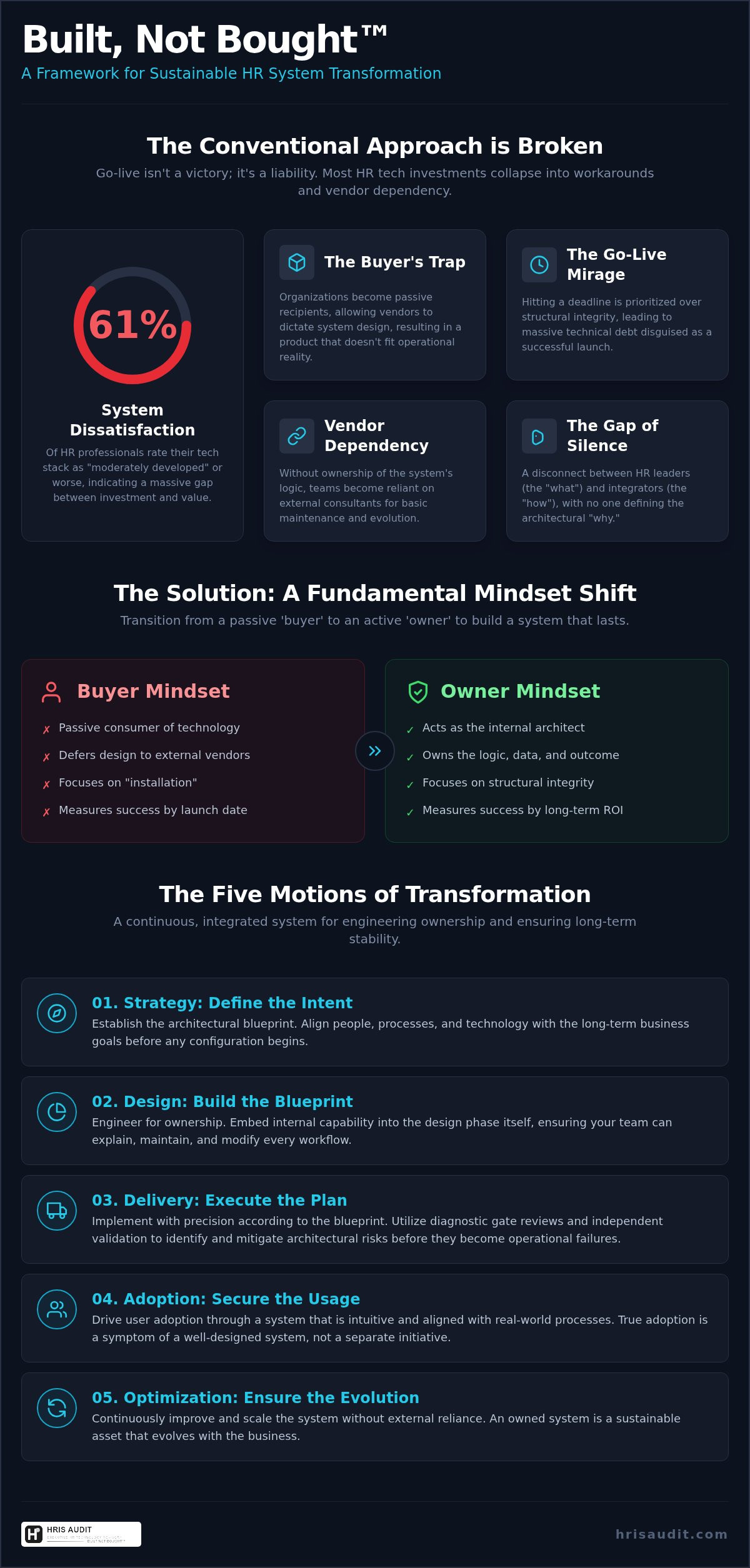
You've seen the symptoms. Post-adoption collapse. Total reliance on system integrators. A team that feels like guests in their own platform. Industry data indicates that 61% of HR professionals rate their tech stack as moderately developed or worse. To bridge this gap, you must stop being a passive recipient of technology. By adopting a rigorous HR system design framework, you can reclaim the blueprint of your organization’s digital foundation and ensure the system serves the business, not the vendor.
This article provides the strategic discipline needed to move from "bought" to "built." We'll outline a framework that prioritizes internal capability transfer and structural governance over mere installation. You'll discover how to secure a sustainable HR tech ecosystem that your team actually owns, operates, and scales long after the external consultants have cashed their final checks.
Key Takeaways
- Shift from a passive "buyer" mindset to an "owner" mindset to prevent post-go-live adoption collapse and vendor dependency.
- Implement a rigorous HR system design framework that treats your technology ecosystem as a structural asset rather than a one-time software installation.
- Master the Five Motions of Transformation—Strategy, Design, Delivery, Adoption, and Optimization—to maintain control throughout the system lifecycle.
- Utilize diagnostic gate reviews and independent validation to identify hidden architectural risks before they manifest as operational failures.
- Secure long-term ROI by prioritizing internal capability transfer, ensuring your organization can sustain and scale the system without external reliance.
The Foundation: Why Conventional HR System Design Fails
Most enterprise transformations are doomed before the first configuration workshop begins. They fail because they treat technology as a standalone solution rather than a structural component. A true HR system design framework serves as the architectural blueprint for your organization. It aligns people, processes, and technology into a single, functional machine. Without this foundation, you aren't transforming; you're just decorating a crumbling structure.
The industry is plagued by the "Buyer's Trap." This is a state of passive consumption where organizations defer critical design decisions to software vendors or system integrators. The result is a system that reflects the vendor's product map rather than the client's operational reality. Success requires an "Owner's Mindset." You must own the logic. You must own the data. You must own the outcome. Ownership is the difference between a system that works and a system that merely exists.
We often see the "Gap of Silence" manifest during implementation. This is the disconnect between technical integrators and internal HR leadership. Integrators focus on "how" to configure. Leaders focus on "what" they want. No one focuses on "why" the architecture must support the long-term business strategy. This silence is expensive. It leads to misaligned workflows and fragmented data environments that 61% of HR professionals admit are only moderately developed or worse.
The Go-Live Mirage
Hitting a launch date is not the same as achieving a business result. It's a deadline, nothing more. Organizations frequently rush the design phase to satisfy executive timelines, accruing massive technical debt in the process. This debt manifests as manual workarounds and a total reliance on external support. Go-live is a beginning. Not an end. If your team cannot manage the system on day two, the implementation has failed regardless of the launch date.
Structural Integrity in HR Tech
Structural integrity is the only metric that dictates long-term ROI. It requires rigid, mechanical links between high-level strategy and technical delivery. This is why platform-agnostic design is superior to vendor-specific configuration. Your business logic should remain constant even if your tools change. Robust governance acts as the mortar in this construction. It ensures that design standards are enforced and that the system remains sustainable. To verify your current standing, an independent Transformation Pulse Scan can expose the hidden risks in your architectural foundation before they become permanent liabilities.
The Built Not Bought™ Framework: Core Principles
Architecture requires more than a purchase order. It demands a fundamental shift in how organizations perceive their digital infrastructure. The philosophy of Built Not Bought HR Strategy rejects the notion that a system is something you simply "install." Instead, it treats the HR ecosystem as a structure that must be engineered from the ground up to ensure long-term stability. This isn't about software. It's about the discipline of ownership.
To achieve this, we utilize a rigorous HR system design framework organized into five distinct motions: Strategy, Design, Delivery, Adoption, and Optimization. These motions aren't linear phases; they're integrated components of a single, continuous system. Strategy defines the intent. Design builds the blueprint. Delivery executes the plan. Adoption secures the usage. Optimization ensures the evolution. When one motion fails, the entire structure is compromised.
Designing for Ownership
Ownership isn't granted; it's engineered. In most implementations, HR teams are relegated to the role of "users"—passive recipients of a system designed by outsiders. We replace this with the role of the Internal Architect. This requires embedding internal capability into the design phase itself. If your team can't explain why a specific workflow exists, they don't own it. They're merely renting it from the integrator. True ownership means your team can maintain, modify, and master the system without a permanent tether to a consulting firm.
The Field Library Advantage
Precision requires standardized tools. We don't believe in reinventing the wheel for every project. The Field Library serves as a repository for standardized design workbooks and blueprints that accelerate decision-making while maintaining high standards. These aren't generic templates. They're battle-tested frameworks that force clarity on complex architectural requirements. By integrating these proprietary diagnostics into the design lifecycle, you reduce operational risk and ensure every configuration choice is backed by rigorous logic. To explore these blueprints, consider how licensed frameworks can stabilize your transformation.
Executing the Design: A Step-by-Step Methodology
Execution is where strategic intent meets operational reality. A disciplined HR system design framework requires a methodical, step-by-step progression that prioritizes structural integrity over speed. The first step is defining strategic intent. Don't focus on software features. Focus on people-centric outcomes. What must the system achieve for the business? If you can't define the "why," the "how" is irrelevant.
Once intent is clear, you must move through a rigorous sequence of motions. First, define the strategic intent. Second, map the architectural requirements. Third, establish an HR technology governance framework to manage design deviations. Fourth, conduct capability evaluations to identify internal skill gaps. Fifth, execute iterative gate reviews to ensure design fidelity. This sequence ensures that the system is built to last, not just to launch.
Mapping Architectural Requirements
Most project teams confuse "requirements gathering" with "system design." Gathering is a passive collection of wishes. Design is an active construction of logic. Architectural requirements are the blueprints of the people system. You must define data integrity standards and integration logic with surgical precision before a single configuration screen is touched. Modern data environments require integrated logic to support advanced analytics. Without this, you'll join the 61% of professionals struggling with underdeveloped tech stacks. Design the logic first. The software follows.
Managing Design Deviations
Customization is often a euphemism for structural failure. Every "special request" that deviates from the core blueprint introduces long-term operational risk. The executive sponsor must act as the guardian of the design. Their role is to defend the framework against the "we've always done it this way" mentality. Use HR transformation tools and frameworks to maintain this discipline. Discipline isn't restrictive. It's protective. It ensures the system remains sustainable long after the consultants depart.
Finally, execute iterative gate reviews. These are not status updates. They're forensic audits of design fidelity. Ask the hard questions. Does the build match the blueprint? Does the team have the capability to run it? If the answer is no, stop. Fix the foundation before you add the roof. Structural integrity isn't optional. It's the only path to a return on your investment.
Validating the Blueprint: Diagnostics and Gate Reviews
Validation is the stress test of your organizational architecture. Most project managers mistake "green" status reports for project health. They track time. They track budget. They ignore integrity. An independent, client-side validation ensures that the HR system design framework is actually being followed, rather than merely being used as a reference document. Without this, you're building on shifting sand. You don't need a status update; you need a structural audit.
The Pulse Scan Methodology
To detect structural cracks before they manifest as operational failure, we utilize the HR Transformation Pulse Scan. This diagnostic targets three critical load-bearing areas: Leadership commitment, organizational alignment, and technical readiness. It moves beyond sentiment to measure the actual stability of your transformation environment.
Data from the scan isn't for vanity. It's for strategic pivots. If the pulse indicates a gap in leadership alignment, the design phase must pause. Proceeding with technical configuration while the strategic foundation is unstable is a recipe for post-go-live adoption collapse. Learn more about the Pulse Scan to see how diagnostic data can stabilize your delivery and reduce long-term risk.
Mastering the Gate Review
A disciplined approach to quality control requires more than a status update. It requires a Gate Review. This is a formal, objective evaluation where the project must prove its integrity before advancing to the next motion. It's the difference between "getting it done" and "getting it right." A true HR system design framework demands that these gates be treated as hard stops, not suggestions.
Every gate requires three critical answers. Does the build strictly adhere to the blueprint? Has the internal team demonstrated the capability to manage this specific component? Are there any design deviations that haven't been formally governed? These reviews should include objective, third-party voices who aren't incentivized by the software vendor or integrator. Integrity reporting replaces the "all-green" mirage with a sober assessment of reality.
Identify red flags early. Look for vague requirements, "out-of-the-box" excuses that ignore business logic, and a lack of internal documentation. If your integrator is doing all the talking during a review, you have a red flag. Your team should be the primary narrators of their own system. If they can't explain the logic, they don't own the design. Stop the build. Fix the capability gap. Only then can you proceed.
Secure your transformation with a Pulse Scan
From Design to Delivery: Securing Your ROI
Blueprints remain theoretical until the first line of configuration is written. Transitioning from a theoretical HR system design framework to an executable delivery plan is the most dangerous phase of the transformation lifecycle. This is where most organizations lose their way. They hand the keys to an implementation partner and hope for the best. Hope is not a strategy. Execution requires a disciplined hand that ensures the build remains faithful to the original architectural intent. If the delivery deviates from the design, the structural integrity of the entire system is compromised before it even launches.
Objective delivery requires a guardian of the client's interests. This is why an independent HR technology advisor is critical. Unlike system integrators, an independent advisor is not incentivized by billable implementation hours or software sales. Their sole metric is the stability of your system. They provide the "tough love" oversight necessary to challenge vendor assumptions and keep the project aligned with the strategic intent defined in the design phase.
Capability Transfer Mechanics
Knowledge is the fuel of ownership. Capability transfer is the mechanical process of moving expertise from external consultants to the internal team. It must happen during the build, not as a panicked handover two weeks before launch. You must move from "consultant-led" to "team-owned" through deliberate action. This involves documenting the "why" behind every configuration choice so future HRIS administrators understand the logic, not just the interface. Providing the Built Not Bought book to your project team establishes the philosophical foundation needed to sustain this discipline. Without this transfer, you don't own a system. You're merely renting it.
The ROI of Structural Integrity
ROI isn't found in the software license; it's found in system stability and user adoption. When a system is engineered with structural integrity, adoption follows naturally because the digital environment mirrors the operational reality. You eliminate the "adoption collapse" that plagues 88% of AI-driven HR initiatives that fail to deliver business value. The long-term cost savings of an internally owned system are realized through reduced reliance on external support and the ability to scale without total rebuilds. This is the ultimate reward for adhering to a disciplined HR system design framework. Success is a system that evolves with your business, rather than one that anchors it to the past.
Contact HRIS Audit for a design framework review
Securing Your Organizational Legacy
Transformation is not a software event. It is a structural evolution. By implementing a disciplined HR system design framework, you move from a state of vendor dependency to institutional mastery. You now have the logic to ensure your people systems are engineered for long-term stability rather than short-term convenience.
Success requires more than participation. It requires ownership. With 30+ years of battle-tested experience, HRIS Audit provides the independent, conflict-free advisory services necessary to protect your interests. Utilizing the proprietary Field Library ensures your team has access to licensed design tools that prevent costly architectural errors. Don't leave your ROI to chance.
Order the "Built Not Bought" Book to Master Your Transformation Strategy
Your organization deserves a system it actually owns. Take the first motion toward structural integrity and build a foundation that lasts.
Frequently Asked Questions
What is the difference between an HR system design framework and a software implementation plan?
A design framework is the structural blueprint for your organization, while an implementation plan is the technical schedule for software configuration. The framework defines the logic, data integrity, and people-centric outcomes that the technology must support. Most failures occur because teams start the implementation plan without a finished HR system design framework. You shouldn't start building until the architectural logic is locked, documented, and governed.
Why is client-side leadership necessary if we have a system integrator?
System integrators focus on technical configuration and timelines, whereas client-side leadership focuses on long-term operational sustainability. Client-side leadership acts as the "Internal Architect" to protect your interests and manage design deviations. This role ensures that capability transfer actually happens during the build process. Without independent oversight, you're building a system that serves the vendor's product map rather than your own unique operational reality.
How does the "Built Not Bought" method improve HR system adoption?
Adoption improves when the internal team shifts from being passive "users" to active "owners" of the system logic. The "Built Not Bought" method embeds internal capability into the design phase so your team understands the "why" behind every workflow. This eliminates the adoption collapse that happens when systems feel foreign to the business. Ownership ensures the team can maintain and scale the platform without constant, expensive external reliance.
What are the core components of a sustainable HR technology governance framework?
A sustainable governance framework requires three primary components: Strategic Intent, Design Standards, and clear Decision Rights. It acts as the mechanical link between your high-level strategy and your technical delivery. This structure prevents the "customization creep" that leads to massive technical debt and system instability. Effective governance ensures that every modification is documented, justified, and manageable by your internal HRIS administrators long after go-live.
When is the best time to conduct an HR Transformation Pulse Scan?
You should conduct an HR Transformation Pulse Scan during the pre-design phase and at every formal gate review. It serves as a diagnostic tool to detect hidden risks in leadership alignment, organizational readiness, and technical maturity. Early detection allows for strategic program resets before you invest in expensive configuration. It’s a sober assessment that replaces "green status" reporting with a true measure of structural integrity and project health.
Can this framework be applied to any HCM platform like Workday or Oracle?
This framework is platform-agnostic and applies to any enterprise HCM platform, including Workday, Oracle, or SAP. The structural requirements for data integrity, governance, and capability transfer remain constant regardless of the specific software tool. Your HR system design framework should dictate how the platform is configured to meet your business needs. Don't let the tool’s out-of-the-box settings override the architectural logic required for your organization’s unique people processes.
How do we identify if our current HRIS design lacks structural integrity?
You can identify structural failure through symptoms like fragmented data environments, manual workarounds, and a total reliance on external consultants for basic updates. If your team can't explain the logic behind a workflow, the system lacks integrity. High technical debt and a lack of actionable people analytics are clear red flags. These issues indicate the system was "bought" as a software package rather than "built" as a structural asset.


