

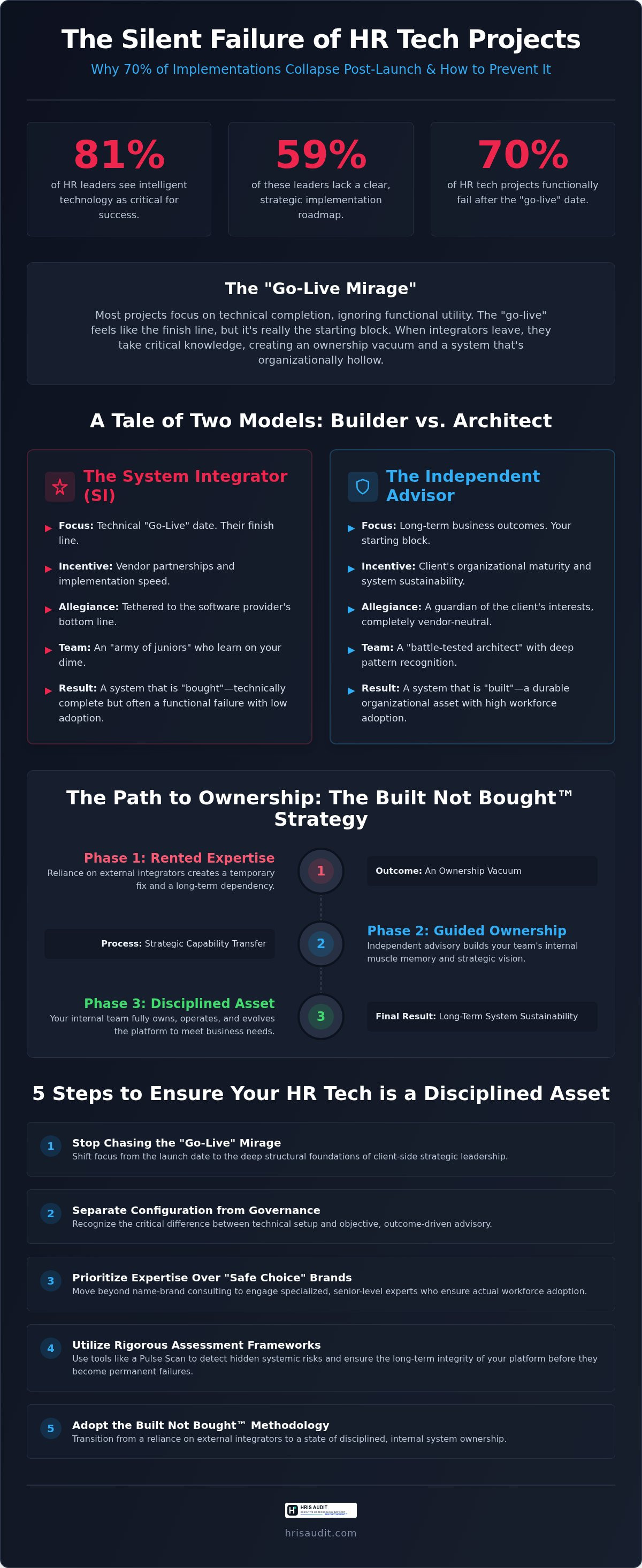
Most HRIS implementations don't fail because the software is broken. They fail because the leadership is borrowed. While 81% of HR leaders see intelligent technology as critical, 59% lack a clear implementation roadmap. You've seen the cycle: a massive capital outlay, a frantic build by external integrators, and a go-live that feels more like an abandonment than a beginning. It's a structural failure of ownership. Securing independent HR technology executive advisory is the only way to break this pattern and protect your investment.
We agree that the current model is unsustainable. You need a system that actually works long after the consultants have cashed their checks. This guide provides the blueprint for client-side leadership that prioritizes your interests over vendor quotas. We'll show you how to command the complex landscape of advisory services to ensure long-term system sustainability. You'll learn to move past surface-level solutions toward deep structural foundations. We'll explore how to build internal capability, enforce vendor-neutral governance, and transform your HR technology from a liability into a disciplined asset.
Key Takeaways
- Stop chasing the "go-live" mirage by shifting your focus toward the deeper structural foundations of client-side strategic leadership.
- Evaluate the critical differences between technical system configuration and the objective, outcome-driven governance provided by independent HR technology executive advisory.
- Move beyond the "safe choice" fallacy of name-brand consulting to prioritize specialized, senior-level expertise that ensures actual workforce adoption.
- Utilize rigorous assessment frameworks like the Pulse Scan to detect hidden systemic risks and ensure the long-term integrity of your platform.
- Adopt the Built Not Bought™ methodology to transition from a reliance on external integrators to a state of disciplined, internal system ownership.
The Critical Gap in Enterprise HR Technology Executive Advisory
HR technology executive advisory isn't a technical support function. It's client-side strategic leadership. Most enterprises mistake software configuration for organizational transformation. This is a fatal error. Real advisory acts as a guardian of the client's interests. It ensures that technology serves the broader Human Resource Management goals rather than the vendor's quarterly sales targets. Without this independent layer of governance, projects drift toward technical completion while ignoring functional utility.
Systems integrators focus on the go-live date. It's their finish line. For you, it's the starting block. When these consultants depart, they often take the institutional knowledge with them. This creates an ownership vacuum. The result is a "Go-Live Mirage" where the system is technically functional but organizationally hollow. The financial consequences are steep. Misalignment leads to expensive rework, low adoption rates, and a continuous reliance on high-priced external support to fix basic process flaws.
The Distinction Between Participation and Ownership
Is your team participating in a project or owning a transformation? Participation is passive. It involves attending meetings and checking boxes. Ownership is active. It requires a deep understanding of the platform's mechanics and the strategic vision to evolve it. Rented expertise is a temporary fix. It leaves your internal team dependent on external labor that doesn't understand your culture. True advisory focuses on capability transfer. It's the difference between buying a solution and building a durable organizational asset. Most projects are "bought" because leadership fails to invest in the internal muscle memory required to sustain the platform.
Why 70% of HR Tech Projects Fail Post-Launch
Implementation metrics are deceptive. A project can be on time and on budget while remaining a total functional failure. If the workforce doesn't adopt the tool, the ROI is zero. This is the sober truth of the industry. Vendor bias often masks these structural weaknesses during the build phase. Advisors who are incentivized by software sales cannot provide objective guidance. They overlook the friction points that cause long-term decay.
Structural integrity in HRIS is the alignment of technical configuration with long-term operational resilience and workforce scalability. To prevent this decay, proactive leaders use tools like the Transformation Pulse Scan to detect risks before they become permanent failures. You must look past the interface to the foundation. If the foundation is built on vendor priorities rather than your own, the system will eventually collapse under its own complexity.
Comparing Advisory Models: Independent Experts vs. System Integrators
The System Integrator (SI) model is built for the install. They prioritize technical configuration, data mapping, and script execution. Their success is measured by a functional go-live on a specific date. In contrast, the Independent Advisor model focuses on the outcome. This is where HR technology executive advisory proves its worth. It provides the client-side governance necessary to ensure the system actually solves business problems. One builds the machine; the other ensures the machine serves the mission.
Allowing your integrator to be your sole advisor is a conflict of interest. It is letting the builder approve the foundation they just poured. Integrators are often incentivized by vendor partnerships and implementation speed. An independent advisor has no such allegiances. They prioritize your organizational maturity over the vendor's roadmap. If you want a system that works for your people, you need a voice that isn't tethered to the software provider's bottom line.
Resource allocation reveals the true nature of these models. Big firms often deploy an "army of juniors" to handle your enterprise transformation. These consultants learn the industry on your dime. Specialized advisory provides a "battle-tested architect" instead. One senior leader with 30 years of experience provides more value than ten associates with certifications but no context. You are paying for pattern recognition, not just billable hours.
The System Integrator's Scope vs. The Client's Interest
Integrators are incentivized by speed. They want to move to the next project as quickly as possible. You want systemic health. This creates a "Critical Gap" between technical go-live and actual business transformation. If the configuration does not match your long-term operational needs, you are left with a system that is technically live but practically useless. Real leadership requires looking past the launch date toward the decades of operation that follow. To ensure your project doesn't stall at the finish line, consider a Transformation Pulse Scan to verify your trajectory.
Platform-Agnostic Guidance vs. Vendor-Specific Expertise
Specialized advisors bridge the gap between platforms like Workday, Oracle, or SAP. They don't just know the tool; they understand the patterns of failure that haunt all enterprise systems. This platform-agnostic viewpoint allows them to anticipate risks before they manifest. It's about designing for ownership, not just surviving the launch. For a deeper look at this distinction, see the analysis on Strategic Advisory vs. System Integration. You need an advisor who understands the machinery of HR, regardless of the brand name on the software.
Beyond the Big 4: The Case for Specialized Transformation Leadership
Hiring a Big 4 firm is often a defensive move. It's a way to shift blame if the project fails. But high-tier branding doesn't ensure system adoption. Large firms rely on volume. They deploy junior staff who follow rigid, pre-defined scripts. This is the "Safe Choice" fallacy. Specialized HR technology executive advisory offers a different path. It provides senior-level precision that name-brand firms cannot scale. You need an architect, not an army of associates.
The delivery model matters. Most consultants offer service delivery. They finish the task and leave. We prioritize capability transfer. The goal is to leave your team stronger, not dependent. This is the core of the Built Not Bought™ methodology. It's about constructing a system that your organization actually owns. When you build the capability internally, you eliminate the need for perpetual external support. You move from a state of reliance to a state of resilience.
Escaping the 'Template' Trap
Standardized workbooks are the enemy of adoption. They ignore your company's specific DNA. A Project Manager tracks a timeline. A Transformation Architect builds a future. Specialized advisors don't use templates; they use frameworks. These frameworks adapt to your culture, not the other way around. If your advisor is simply filling out a vendor's pre-formatted spreadsheet, they aren't advising you. They're just clerical support for the software company. Real transformation requires a bespoke structural design that reflects your unique operational requirements.
Independence and Objectivity in Decision Support
CHROs need a "Guardian of Interests" who isn't tethered to a vendor's ecosystem. Big firms often have back-channel relationships or referral agreements with software providers. This creates a subtle, persistent bias. Independence is your only defense. During high-stakes negotiations and design sessions, you need an advisor who only answers to you. This objectivity is the bedrock of effective decision support. It ensures that every choice made during the program is filtered through the lens of your long-term success, not the vendor's roadmap. Use a Transformation Pulse Scan to verify that your current guidance is truly objective.
Evaluating Structural Integrity: A Framework for Choosing Your Advisor
Choosing an advisor shouldn't be a beauty contest. It's a structural audit. Most leaders look for certifications or brand names; they should be looking for a blueprint. High-level HR technology executive advisory requires more than just industry tenure. It demands a repeatable system for identifying and neutralizing risk. Does your advisor have a proprietary engine, or are they just reacting to the noise of the project? You need a partner who brings their own scaffolding to the build.
Maturity modeling is the baseline. You need a clear view of how the advisor moves your HR function from manual, disconnected processes to an optimized, integrated system. This isn't a philosophical shift; it's a mechanical one. If the advisor doesn't have a plan for capability transfer, they're creating a permanent dependency. Your team must be smarter and more capable when the engagement ends. If you're still calling the consultant for basic governance six months after go-live, the advisory failed to build the necessary internal muscle.
The Advisor's Toolkit: Field Libraries and Diagnostics
Generic "best practices" are a trap. They're too broad to be useful and too vague to be actionable. Look for advisors who provide a Field Library of editable workbooks and facilitation guides. These are the specialized tools of the trade. A Transformation Pulse Scan isn't a luxury; it's a diagnostic requirement. It allows you to see the cracks in the foundation before the walls start to lean. Frameworks provide the structure that generic advice lacks, ensuring that every decision is backed by a disciplined methodology rather than a consultant's hunch.
Governance and Gate Reviews
Governance is the load-bearing wall of any HCM program. It's maintained through rigorous Gate Reviews. These are not social gatherings or status updates. They're technical audits where progress is measured against the original architectural vision. Disciplined program motions must replace the frantic, ad-hoc troubleshooting common in failing projects. A sophisticated advisor has the authority to halt a project that has drifted off course. They possess the pattern recognition to "Reset" a program before it collapses. This level of uncompromising oversight is the hallmark of true HR technology executive advisory.
Secure your transformation with a Pulse Scan
Implementing the Built Not Bought™ Strategy for Sustainable Ownership
Ownership isn't a status you reach at go-live; it's a discipline you build during the design phase. The Built Not Bought™ philosophy challenges the standard procurement model that treats software as a finished product. It's not. Software is just raw material. To extract value, you must adopt an architect's approach to HRIS. This means prioritizing the strategic elements of technology over the specific tools themselves. High-level HR technology executive advisory exists to facilitate this transition from a passive "Buyer" mindset to an active "Builder" mindset.
A "Buyer" expects the software to solve the problem. A "Builder" knows the system must be engineered to fit the organization's unique machinery. This is where the Transformation Studio becomes critical. It isn't a training session. It's a rigorous environment for capability building where your team learns to manage the platform post-launch. You aren't just installing a module; you're installing a new way of working. This ensures the system remains effective long after the external consultants have moved on to their next billable event.
The Architecture of a Sustainable HR System
Sustainable systems align strategy, delivery, and adoption into a single, synchronized mechanical motion. Most projects treat these as isolated events. They configure features without considering the systemic design required for long-term health. A "Built" approach ensures that the platform is resilient enough to handle organizational shifts. It focuses on structural integrity rather than surface-level functionality. If you only configure features, you're building on sand. If you design for ownership, you're building on stone. This structural focus prevents the slow decay of data quality and user adoption that plagues most enterprise systems.
Next Steps: Securing Your Transformation
Securing your transformation starts with a cold, hard look at your current program risks. You can't fix what you haven't diagnosed. Engaging an advisor for client-side leadership during the design phase is the most effective way to prevent future failure. This isn't about adding more project managers. It's about adding strategic oversight that prioritizes your interests over vendor quotas. Take the first step toward disciplined ownership by identifying the cracks in your current foundation. Objective guidance is the only way to ensure your system survives its first year of operation.
Contact HRIS Audit for a Transformation Pulse Scan to verify your program's structural integrity.
Own Your Transformation Architecture
Enterprise HR technology is too complex to be left to the mercy of system integrators. You've seen the pattern: expensive software, rushed go-lives, and a subsequent collapse in adoption. True structural integrity requires a shift in leadership. Securing independent HR technology executive advisory ensures that your interests remain the priority throughout the build. It's the difference between a system that looks good on paper and one that actually functions in the field. This is about building a capability, not just installing a tool.
We provide a platform-agnostic viewpoint backed by 30 years of transformation experience. Our proprietary Field Library of frameworks isn't just a collection of templates; it's a blueprint for organizational maturity. You shouldn't settle for rented expertise that leaves no institutional knowledge behind. Move past the "safe choice" of name-brand firms and choose the precision of battle-tested architects. Build a system your workforce can actually adopt.
Secure your transformation with HRIS Audit's client-side leadership
It's time to move beyond participation and start exercising true ownership. Your organization deserves a foundation that lasts.
Frequently Asked Questions
What is the difference between an HR technology advisor and a system integrator?
System integrators are technical laborers focused on configuration and script execution. Their success is defined by a technical go-live on a specific date. An advisor is a strategic architect focused on the organizational outcome. While the integrator follows a vendor's script, the advisor protects your interests. They ensure the system aligns with your long-term business logic rather than just fulfilling a technical checklist provided by the software company.
Why should I hire an independent advisor if I already have a Big 4 firm?
Big 4 firms often prioritize volume and junior-led standardized templates over bespoke strategic guidance. They may have back-channel alliances with software vendors that cloud their objectivity. An independent advisor provides a platform-agnostic viewpoint. This specialized HR technology executive advisory acts as a guardian of your interests. It prevents the bias that often accompanies large-scale consulting contracts, ensuring your unique organizational DNA isn't lost in a generic workbook.
What does 'client-side leadership' actually mean in an HRIS project?
Client-side leadership is the active governance of a project from the perspective of the business owner, not the vendor. It means moving beyond passive participation to disciplined ownership. You aren't just attending meetings; you're directing the architecture. This approach ensures that the internal team develops the muscle memory to manage the platform after the consultants leave. It shifts the power dynamic from the software provider back to the enterprise leadership.
How can an executive advisor help with a failing HCM implementation?
An advisor identifies the structural cracks in your implementation before they lead to a total collapse. They conduct diagnostics like a Pulse Scan to pinpoint where the alignment between technology and process has failed. Instead of throwing more labor at the problem, an advisor implements a program reset. They enforce disciplined gate reviews and clear ownership boundaries. This stabilizes the foundation and redirects the program toward actual workforce adoption.
What is the 'Built Not Bought' method for HR technology?
The Built Not Bought method is a philosophy that treats HRIS as an organizational capability rather than a retail product. Buying a system implies a passive transaction where the software is expected to solve the problem. Building a system requires an architect's approach. You engineer the solution to fit your specific operational machinery. This method prioritizes capability transfer, ensuring your team has the internal expertise to evolve the platform long after launch.
How do I measure the ROI of HR technology executive advisory?
ROI is measured through workforce adoption rates, reduced reliance on external support, and long-term system sustainability. A successful HR technology executive advisory engagement results in a system that requires fewer expensive reworks. You see a decrease in technical debt and an increase in internal capability. If your team can manage complex governance and configuration without calling for high-priced consultants, the advisory has paid for itself by building a durable asset.
Can an advisor help with platform-specific issues like Workday or Oracle?
Advisors possess pattern recognition across all major enterprise platforms, focusing on strategic mechanics rather than just the buttons. They understand how Workday or Oracle should be structured to support high-level business goals. While they don't sell the software, they know how to hold the vendor and integrator accountable. They ensure the technical configuration doesn't compromise the structural integrity of your HR processes or leave your team unable to manage the system.
What are the first signs that our HR transformation needs a program reset?
Red flags include a reliance on "workarounds," stagnant adoption numbers, and a project team that can't explain the system's business logic. If your go-live date is moving but your functional requirements are shrinking, your program is in trouble. Another sign is an over-reliance on system integrators for basic decision-making. When the technical build takes precedence over organizational readiness, you've lost control. A reset is necessary to restore disciplined governance.


