

Your system integrator is not your architect. They are the contractor you hired to build a house you haven't designed yet. Most enterprise leaders treat a multi-million dollar HCM rollout as a procurement event, but software cannot fix a broken foundation. If you are looking for an HR transformation book that moves beyond corporate platitudes, you must confront a hard truth. Success isn't bought; it's engineered through internal capability.
It's exhausting to watch projects stall while internal ownership evaporates after go-live. You've likely seen the high failure rates and felt the weight of an over-reliance on external vendors. This article explores the 188-page first review edition of "Built Not Bought," a manual for survival in the 2026 landscape. We'll show you how structural integrity beats software selection every time. You'll learn how the Built Not Bought™ method reduces implementation risk and transfers power back to your team. We are moving past the vendor-first era into a disciplined, platform-agnostic approach to organizational maturity. It's time to stop participating in your transformation and start owning it.
Key Takeaways
- Shift your focus from software procurement to architectural integrity. Learn why structural foundations matter more than tool selection for long-term project stability.
- Master the five motions of transformation: Strategy, Delivery, Governance, Adoption, and Optimization. This HR transformation book serves as a blueprint for building internal capability rather than renting it.
- Recognize that your system integrator is a contractor, not an architect. Discover how to reclaim strategic control and minimize the risk of post-go-live capability loss.
- Bridge the gap between theory and execution using the Field Library frameworks. Use the book as a practical manual to implement repeatable, disciplined system design.
- Understand the roadmap for securing the first review edition of "Built Not Bought" through the authenticated member portal. Transition from a passive participant to a battle-tested owner of your HR technology landscape.
Beyond the Software: Why Most HR Transformation Books Miss the Mark
The gap between executive vision and technical reality is a graveyard for enterprise ambition. Most literature on Human Resource Management (HRM) treats transformation as a philosophical exercise. They focus on "outside-in" theories designed for a different century. In the era of enterprise SaaS and agentic AI, these legacy models are insufficient. They ignore the plumbing. They ignore the load-bearing walls of data integrity. It requires a sober, architectural perspective that treats business processes as integrated systems rather than isolated events. This is why a modern HR transformation book must do more than inspire; it must provide a structural blueprint.
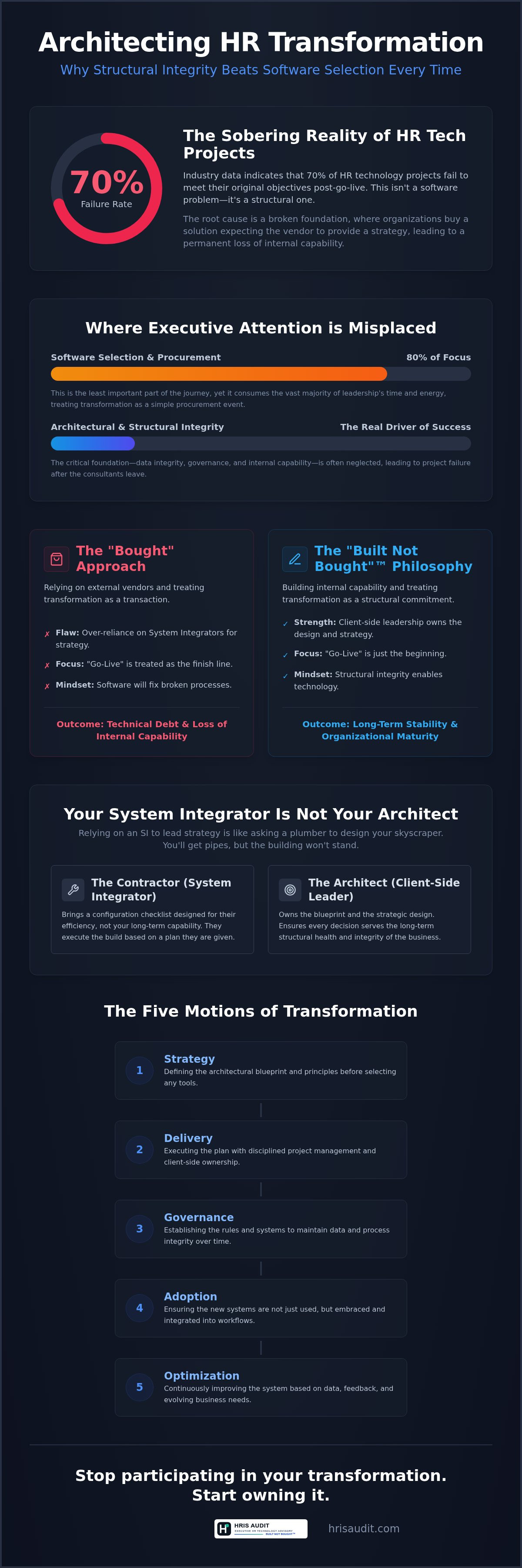
The statistics are sobering. Industry data indicates that 70% of HR technology projects fail to meet their original objectives post-go-live. This isn't usually because the software is "bad." It's because the structural foundation was never built. Organizations buy a solution and expect the vendor to provide the strategy. This is a fundamental error in judgment that leads to a permanent loss of internal capability.
The Failure of Conventional HR Wisdom
Software selection is the least important part of your journey. Yet, it consumes 80% of the executive's attention. You've been told that system integrators bring "best practices" to the table. They don't. They bring a configuration checklist designed for their own efficiency, not your long-term capability. Relying on an SI to lead your strategy is like asking a plumber to design your skyscraper. You'll get pipes, but the building won't stand. You can read more about Why HR Technology Projects Fail to understand the depth of this structural neglect. Conventional wisdom suggests that "going live" is the finish line. In reality, it's just the beginning of your technical debt if the foundation is weak.
The Shift from Strategy to Structural Integrity
Transformation in 2026 requires a move from generic strategy to disciplined governance. We are seeing a convergence of HR and IT that demands a new level of technical literacy from people leaders. You cannot delegate the integrity of your systems to a third party and expect to own the outcome. Client-side leadership is the only way to secure an investment. This HR transformation book argues that your legacy is not the tool you chose, but the capability you built within your own walls. The complexity of agentic AI and skills-based models requires a manual for survival, not a high-level theory. If you don't own the design, you don't own the data. If you don't own the data, you don't own the future of your workforce.
The Built Not Bought™ Philosophy: Restoring Integrity to HR Tech
Transformation isn't a transaction. It's a structural commitment. The Built Not Bought™ method rejects the industry's obsession with procurement as a substitute for capability. Most organizations "buy" their way into technical debt by delegating their future to third-party vendors. We advocate for a different path. This philosophy treats your people-centric systems as integrated architectures rather than a series of isolated software events. It's about shifting from a passive consumer of technology to an active architect of organizational maturity. To survive the 2026 enterprise environment, you need more than a tool; you need a disciplined system of ownership.
This approach requires a specific persona: the Battle-Tested Architect. This isn't a title you find in a standard HR job description. It's a mindset. This leader understands pattern recognition. They've seen the failures of generic implementations and possess the frameworks to prevent them. They bridge the gap between high-level vision and the practical machinery of the system. In this HR transformation book, we define how this role acts as a guardian of the client's interests, ensuring that every design choice serves the long-term health of the business.
Designing for Ownership, Not Just Go-Live
Go-live is a milestone, not a destination. For most, it's a false finish line that precedes a slow collapse of system integrity. When the consultants leave, the internal knowledge often leaves with them. We design for the "day two" reality from the very first meeting. This means building internal capability into the project plan itself. You don't just want a system that works on launch day; you want a system your team can actually govern. You can explore the mechanics of this in our guide on Built Not Bought HR Strategy. Ownership is the only way to ensure your investment doesn't evaporate six months after the project ends.
The Five Dimensions of Systemic Health
Sustainable transformation moves through five distinct motions. Strategy defines the "why." Delivery executes the "how." Governance maintains the "what." Adoption secures the "who." Optimization ensures the "next." This tiered structure is vital in the evolving landscape of HR, where static models are obsolete. Our HR transformation book provides a diagnostic framework to measure your maturity across these dimensions. If you are ready to stop renting your strategy and start building your legacy, request access to the Built Not Bought book to begin your assessment. A healthy system is a disciplined system. There are no shortcuts to structural integrity.
Strategic Advisory vs. System Integration: A Comparison
Your system integrator is a vendor. An advisor is an architect. One delivers a technical configuration; the other delivers organizational maturity. Confusing these roles is a high-stakes error that often leads to systemic failure. The integrator's primary objective is to complete a checklist within the scope of their contract. They focus on the "how" of the software. An advisor focuses on the "why" of the business. If you lack objective, client-side leadership, you aren't leading a transformation. You're simply watching a software installation.
This HR transformation book provides the pattern recognition needed to differentiate between these two functions. It empowers sponsors to ask the difficult questions that vendors often avoid. Why is this configuration being proposed? How does this design support our 2026 talent model? Who owns the data when the integrator leaves? Without these answers, your project is a house of cards. True transformation requires a bridge between high-level executive vision and the practical machinery of implementation.
The Conflict of Interest in HRIS Implementations
System integrators prioritize speed. They value volume. Their business model depends on moving resources from your project to the next as quickly as possible. This creates a natural bias toward "standard" configurations that may not fit your specific structural needs. They sell you a "bought" solution. We advocate for a "built" capability. When you buy a solution, you inherit the vendor's logic. When you build a capability, you establish your own governance.
A robust HR Technology Governance Framework is the only way to counteract this vendor bias. It ensures that every decision serves the long-term sustainability of the platform, not just the project timeline. Don't let your vendor's delivery schedule dictate your organizational maturity. You need a design that survives the departure of the implementation team.
Client-Side Leadership: Your Secret Weapon
The advisor acts as a guardian of your interests. They facilitate program resets when the roadmap drifts and lead gate reviews that actually have teeth. Their goal isn't just a successful go-live; it's a successful capability transfer. Transformation requires a shift from mere participation to active ownership. By focusing on People-Centric HR Transformation, you ensure that the system supports the humans it was designed for.
This HR transformation book acts as your manual for this transition. It provides the tools to challenge vendor assumptions and secure the structural integrity of your HCM investment. It's a sober perspective earned through long-term industry experience. Don't let your integrator define your success. Define it yourself through disciplined, client-side leadership.
From Reading to Execution: Utilizing the Field Library Frameworks
Passive reading is a luxury enterprise leaders cannot afford. A HR transformation book should not be a coffee table ornament; it must be a tactical guide for the machinery of change. We don't stop at theory. The "Built Not Bought" manual is the technical operating guide for a complete ecosystem of delivery. It's designed to move your team from high-level understanding to the practical application of system design. This is where architectural metaphors meet the ground. If you aren't using a disciplined framework, you are guessing. In the current environment, guessing is expensive.
Execution requires more than a vision statement. It requires a system of pattern recognition that identifies failure points before they become technical debt. By integrating the book's principles with our Transformation Studio, we ensure that every design choice is validated against structural integrity. We are building a bridge between high-level executive vision and the practical machinery of implementation. You don't just learn what to do; you get the tools to do it.
The Field Library: A Practical Extension of the Book
The Field Library is where the philosophy becomes tangible. Accessing these licensed frameworks allows for enterprise-wide deployment of the Built Not Bought™ method. We provide editable workbooks and facilitation guides that empower your internal team to lead. This isn't about providing a fish; it's about building the hatchery. You can Explore the HRIS Field Library Frameworks to see the specific components of this system. These tools are designed to facilitate complex HR projects without the typical over-reliance on system integrators. You maintain the capability. You keep the knowledge.
Studio Sessions and Pulse Scans
Structural neglect is a silent project killer. By the time it's visible, the budget is gone and the timeline is blown. We use the diagnostic tools found in the 188-page first review edition to conduct a Transformation Pulse Scan. This is a high-impact event that identifies where your roadmap is drifting. It's a sober assessment of systemic health. You can Detect Risk with a Transformation Pulse Scan to secure your investment before go-live. This is how you move from executive theory to tactical ownership.
Access the authenticated member portal for launch updates
Designing Your Legacy: How to Order the Built Not Bought Manual
Your legacy as a leader is not defined by the software you select. It's defined by the systems you leave behind. This HR transformation book serves as the definitive manual for enterprise leaders navigating the complexities of 2026. It's a call to move beyond passive observation. Most CHROs are trapped in a cycle of vendor dependency. They rent their strategy and wonder why their capability evaporates. We offer a different path. The "Built Not Bought" method is for those who demand structural integrity over marketing promises. It's time to stop being a spectator in your own transformation.
Securing the 188-page first review edition is the first step toward reclaiming your project. This text isn't a collection of corporate platitudes. It's a sober, battle-tested architect’s guide to systemic health. It provides the pattern recognition needed to spot structural neglect before it leads to a multi-million dollar failure. By reading this manual, you transition from a reader to a transformation architect. You gain the vocabulary of governance. You gain the frameworks of ownership. You prepare your organization for the convergence of HR, IT, and agentic AI.
A Resource for Enterprise Decision Makers
Enterprise leaders choose the Built Not Bought method because it prioritizes the human and strategic elements of technology. It treats your business processes as integrated systems. This focus on client-side leadership is what separates sustainable outcomes from expensive mistakes. If you are responsible for an HCM investment, this manual is required reading. It empowers you to challenge vendor bias and secure the long-term health of your platform. You can Order the Built Not Bought Book through our authenticated member portal to start your journey toward structural maturity. Ownership begins with the right blueprint.
Contacting HRIS Audit for Strategic Advisory
A book is a foundation, but execution often requires hands-on expertise. We move beyond the page to provide high-level executive decision support. Whether you are facing a program drift or preparing for a high-stakes gate review, our advisory services provide the objectivity you need. We act as guardians of your interests. We facilitate the capability transfer that ensures your team can govern the system long after the consultants depart. From Transformation Studio workshops to the Field Library frameworks, we provide the machinery of change. If you are ready to reset your roadmap, you should Contact an HRIS Audit Advisor for a sober assessment of your current trajectory. Discipline is the only sustainable strategy.
Reclaiming the Architect’s Mantle
The era of delegating your organizational future to a software vendor is over. Sustainable transformation is not a procurement event; it is an architectural challenge that requires disciplined, client-side leadership. You've seen the high failure rates of vendor-led projects and the erosion of internal capability that follows. By shifting your focus toward structural integrity and internal ownership, you secure the long-term health of your HCM investment. This HR transformation book provides the pattern recognition and diagnostic tools needed to navigate the complexities of 2026. It is a manual for those who value discipline over participation.
Success is engineered. With 30 years of battle-tested experience and proprietary governance frameworks used by enterprise HR leaders nationwide, we provide the blueprint for your legacy. It's time to stop renting your strategy and start building your internal capability. Move past the theory and into the practical machinery of change.
Order the Built Not Bought HR Transformation Book
Your systems are the load-bearing walls of your business. Build them to last.
Frequently Asked Questions
What makes this the best HR transformation book for 2026?
This HR transformation book is specifically designed for the 2026 landscape, where agentic AI and skills-based workforce models demand a shift from procurement to architectural design. Unlike legacy texts, it focuses on the 188-page first review edition's mission: building internal capability. It treats business processes as integrated systems. It provides the pattern recognition necessary to survive the convergence of HR and IT, ensuring your organizational maturity outpaces your technical debt.
How does the Built Not Bought method differ from Dave Ulrich’s model?
Dave Ulrich's legacy model prioritizes an "outside-in" philosophical approach to HR value. In contrast, the Built Not Bought method focuses on the mechanical and systemic design of the HRIS itself. We argue that behavioral change is impossible without structural integrity. While Ulrich addresses the "what" of HR strategy, this manual addresses the "how" of technical execution. It replaces generic HR models with disciplined governance and client-side leadership to prevent capability loss.
Does the book cover specific software like Workday or Oracle?
The manual maintains a platform-agnostic viewpoint. It prioritizes the human and strategic elements of technology over specific tools like Workday or Oracle. We believe that if you don't own the architectural design, the specific software is irrelevant. By focusing on systemic health and governance, the book prepares you to lead any HCM rollout. It provides the frameworks to challenge vendor bias regardless of the underlying technology stack your organization chooses.
Is this book suitable for CHROs or technical HRIS managers?
This text is essential for both CHROs and HRIS managers. It acts as a bridge between high-level executive vision and the practical machinery of implementation. CHROs gain the vocabulary of governance needed to secure multi-million dollar investments. Technical managers receive the tactical frameworks required for capability transfer. It's a manual for any leader who values ownership over mere participation and seeks to reduce the high failure rates of HRIS projects.
Can I use the frameworks in the book without hiring a consultant?
Yes. While we offer Advisory Services, the book is designed to work in tandem with the Field Library License. This provides your team with editable workbooks and facilitation guides for enterprise-wide deployment. You can utilize these proprietary frameworks to lead your own transformation Studio sessions. This approach ensures that the knowledge remains within your organization. It's about building the hatchery rather than just buying the fish from external consultants.
How does this book help with HRIS implementation failure recovery?
The book facilitates recovery by identifying the "pattern recognition" of failure. It uses the Transformation Pulse Scan to detect structural neglect in existing rollouts. By applying the five motions of transformation Strategy, Delivery, Governance, Adoption, and Optimization, you can reset a drifting roadmap. It provides a sober, architectural perspective to stabilize a failing system. You'll learn to diagnose whether the issue is the software or a broken foundational design.
What is the primary cause of HR technology project failure according to the book?
The primary cause is structural neglect stemming from an over-reliance on system integrators. Organizations often treat a transformation as a procurement event rather than an architectural challenge. When you "buy" a solution instead of "building" a capability, you inherit technical debt. This HR transformation book argues that the loss of internal ownership after go-live is the ultimate project killer. Without disciplined governance and client-side leadership, the system's integrity inevitably collapses.
Is there a digital version of the Field Library workbooks available?
Digital access is provided through our authenticated member portal. This includes the licensed Field Library frameworks, editable workbooks, and facilitation guides. These resources are designed for tactical execution, moving beyond the executive theory found in the 188-page review edition. By utilizing these digital tools, your team can conduct internal workshops and system design reviews. This ensures a methodical and structured flow from philosophical shifts to practical, sustainable organizational outcomes.


