

Why are you investing millions in a software solution that your employees treat like a foreign invader? Most leaders mistake a vendor's roadmap for a strategic vision. They buy the platform but ignore the foundation. A true people-centric HR transformation isn't found in a feature list or a cloud subscription. It's an architectural challenge. It requires a shift from passive consumption to disciplined ownership. If you don't own the logic of your system, the system will eventually own you.
You've likely experienced the post-go-live reality: adoption rates plummet, data integrity fails, and the system becomes a burden rather than an asset. It's frustrating to watch a massive investment yield minimal ROI because of a vendor-driven agenda that ignores your internal capabilities. This article moves beyond the tech industry's hollow promises. You'll learn how to design a system your organization actually owns, governs, and sustains long after the consultants depart. We will examine the five pillars of structural integrity, the necessity of internal capability, and why your HR ecosystem must be built, not just bought.
Key Takeaways
- Understand why software "go-live" is a false finish line and how structural integrity prevents the common 18-month adoption collapse.
- Execute a people-centric HR transformation by designing for the specific operational workflows of end-users, managers, and administrators.
- Transition from being a software renter to a system owner by applying the Built Not Bought™ methodology to cultivate internal capability.
- Establish a disciplined governance framework that uses rigorous gate reviews to protect your investment from vendor-driven agendas.
- Bridge the gap between executive vision and technical implementation by securing independent, client-side leadership.
The Failure of Performance-Based HR Transformation
A people-centric HR transformation isn't a cultural initiative. It's an engineering requirement. Most organizations treat transformation as a performance. They hire an army of consultants. They run elaborate workshops. They check boxes on a vendor’s spreadsheet. This is "Participation." It feels like progress, but it lacks the bone-deep ownership required to sustain a system once the implementation partner leaves. Software is a tool. It's not a strategy. If you don't design for internal capability, you're just decorating a collapsing building.
The industry standard for failure is roughly 18 months post-go-live. Why? Because the system was "bought," not built. When you buy a transformation, you're renting someone else's logic. When the contract ends, the logic departs. Without internal capability, the system begins to decay. Data integrity slips. Workarounds emerge. Users revert to spreadsheets. The structural foundation was never poured.
The "Bought" Transformation Trap
Relying solely on System Integrators (SIs) creates an inherent conflict of interest. SIs are incentivized by speed and billable hours. Their goal is a "green" status report at the moment of go-live. They often push "vanilla" configurations because they're faster to deploy, not because they fit your unique organizational mechanics. This structural neglect is why a people-centric HR transformation often stalls before it truly begins. You can't expect a generic blueprint to support a bespoke operation. Following a Human-centered design philosophy means building for the actual humans in your workflows, not the ones in the vendor's demo. When you ignore these unique mechanics, you aren't transforming. You're just installing.
The Shift from Process to People-Systems
We must treat HR as an integrated mechanical system. It's not a series of isolated events like hiring or payroll. It's a machine. If the gears don't mesh, the machine grinds to a halt. True structural integrity is the only path to genuine ROI. This requires moving past the "Go-Live" finish line mindset. Go-live is just the start of the system's life cycle. To achieve a sustainable Built Not Bought™ method, the organization must shift its focus from merely using the software to mastering the system's architecture. Ownership is the difference between a system that serves the business and a business that serves the system.
This shift requires a disciplined approach to three core areas:
- Governance: Establishing decision-making authority before configuration begins.
- Capability: Training internal teams to manage the logic, not just the clicks.
- Alignment: Ensuring every technical decision serves a documented human outcome.
The goal isn't to survive the implementation. It's to own the result. Without this foundation, your transformation is just an expensive exercise in software selection.
The Mechanics of a People-Centric HR Technology Ecosystem
Technology is the skin. Your organizational workflows are the skeleton. A people-centric HR transformation fails when you try to stretch a pre-defined software skin over a skeleton it wasn't designed to fit. You must design for the human at the center: the end-user who needs simplicity, the manager who needs insight, and the HR administrator who needs control. If the system doesn't account for these distinct "motions," it will fail. This is the reality of Transforming Human Resources in a complex environment. You aren't just selecting a platform. You are architecting an ecosystem.
Platform-agnostic design is your insurance policy. It ensures that your strategic logic remains intact even if you swap out the underlying tool. Why tie your future to a single vendor's roadmap? By focusing on the structural integrity of your processes first, you maintain long-term flexibility. This alignment ensures that executive vision doesn't get lost in the practical machinery of daily operations. It bridges the gap between high-level strategy and the actual work your people do every day.
Designing for the "Human System"
Before you even look at a demo, you must identify the repeatable motions of your workforce. How do people actually work? Where does friction occur? Using our field library workbooks, you can map these requirements before committing to a vendor. Prioritize adoption over automation. An automated process that nobody uses is just a faster way to generate bad data. We focus on three critical dimensions:
- Structural Alignment: Does the tech support the actual process?
- User Experience: Is it intuitive for the non-expert?
- Data Governance: Who owns the source of truth?
The Capability Transfer Requirement
Wait until the final week of training to teach your team, and you've already lost. Capability transfer must begin on Day 1. Does your team have the maturity to own the system? Are they being trained as "Administrators" who follow a manual, or as "Architects" who understand the system's logic? Design for ownership. Build for sustainability. If you want to identify where your team's maturity currently stands, a Transformation Pulse Scan can provide the necessary diagnostic clarity.
The difference between an Administrator and an Architect is the difference between participation and ownership. An Administrator knows which buttons to click. An Architect knows why those buttons exist and what happens to the downstream data when they're pressed. True people-centric HR transformation requires a team of internal architects. They are the guardians of your structural integrity. They ensure the system evolves with the business rather than becoming a legacy anchor.
Is your team ready? Or are they just waiting for the consultants to tell them what to do? Genuine transformation requires a sober assessment of internal maturity. It demands a shift in mindset from using software to managing a platform. This is the only way to secure a sustainable ROI.
Built Not Bought: Shifting from Participation to Ownership
Buying a license is easy. Building a capability is hard. Most organizations confuse the two. They sign a contract and assume the transformation is handled. It isn't. A people-centric HR transformation is an internal build. It requires your team to own the logic, the data, and the outcomes. If you outsource the thinking, you outsource the value. You become a renter of your own strategy. This is a precarious position that leads to systemic fragility.
The traditional consulting model relies on perpetual dependency. They arrive with a proprietary methodology designed to keep them on-site for years. We challenge this. The Built Not Bought™ method is a radical departure. It focuses on transferring authority and knowledge back to the client. It’s about building a foundation that lasts long after the consultants depart. Stop participating in someone else's project. Start owning your own.
The Built Not Bought™ Philosophy
The "Big 4" model often breeds a culture of passivity. Using the Built Not Bought book as a foundational manual, organizations can navigate the five motions of sustainable transformation: Strategy, Design, Governance, Delivery, and Adoption. These are not isolated steps. They are a disciplined system. When these motions are executed with internal ownership, the result is a resilient HR ecosystem. You don't just follow a script; you write the manual for your own success. This is how you move from a software roll-out to a genuine people-centric HR transformation.
Beware of "Best Practice." In the HR tech world, this phrase is often a euphemism for "Vendor Convenience." It’s a shortcut used by implementation partners to avoid the hard work of configuring a system to meet your specific operational needs. When you accept their "best practice," you are often sacrificing your competitive advantage for their deployment speed. You are fitting your business into their box. That is the opposite of structural integrity.
Independence vs. Vendor Bias
Who is looking out for you? The person guiding your strategy should never be the one selling the software. The conflict is structural. Independent, client-side leadership acts as a guardian. It ensures that gate reviews are rigorous and that sponsor decisions are based on data, not vendor promises. This is where "pattern recognition" becomes invaluable. We recognize the early warning signs of a failing implementation. We see the structural cracks before they become catastrophic collapses. Independent advisors provide the sober, objective perspective required to bridge the gap between executive vision and technical reality.
Transformation is not a spectator sport. It demands active, informed leadership. You don't just participate; you lead. This requires a shift from passive consumption to aggressive ownership. Build the capability. Secure the foundation. Own the future.
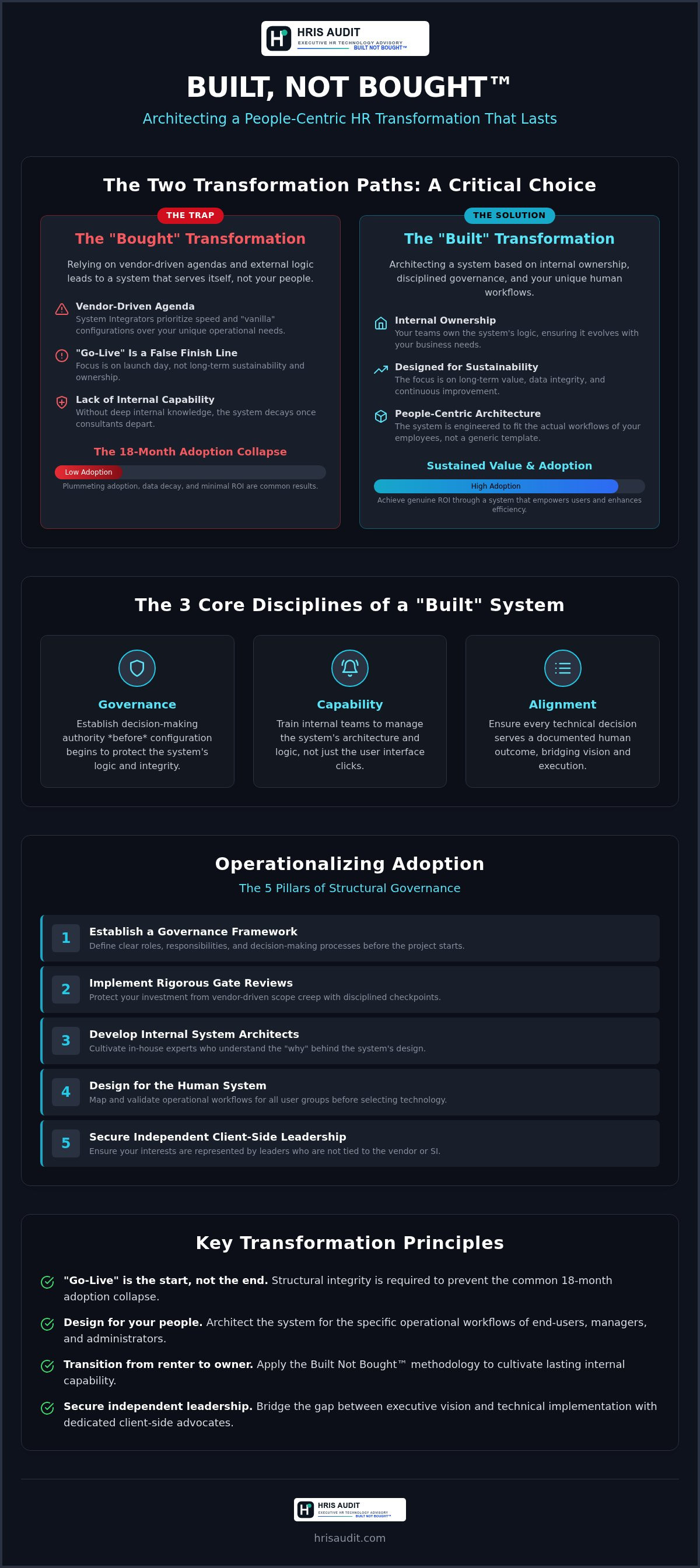
Operationalizing Adoption: 5 Pillars of Structural Governance
Governance is not a committee. It is not a social club for stakeholders to exchange polite updates. It is a discipline of decision-making. In a people-centric HR transformation, governance acts as the steering mechanism that keeps the technical machinery aligned with the human objective. Without a rigorous HR technology governance framework, your project will drift. It will succumb to scope creep, vendor bias, and internal politics. Structure provides the guardrails. Discipline provides the results.
We measure what matters. Most organizations obsess over "System Uptime." This is a vanity metric. If the software is running but your employees are still using manual workarounds, the system is a failure. Shift your focus to "Process Completion." Success is defined by the integrity of the data and the adoption of the workflow. If the process isn't finished within the system, the transformation hasn't happened. It’s that simple.
The Gate Review Discipline
Establish "Go/No-Go" criteria that actually have teeth. A gate review is not a formality; it is a structural inspection. If the requirements aren't met, the project does not advance. This requires a level of professional gravity often missing from standard implementations. You must move past optimism and rely on evidence. Use Pulse Scans to detect structural risks before they manifest as systemic failures. These diagnostics provide the sober data necessary for sponsor decision support. Stop guessing. Start inspecting.
A disciplined gate review process focuses on three core realities:
- Technical Readiness: Is the configuration stable and tested?
- Operational Readiness: Is the business prepared to receive the change?
- Capability Maturity: Does the internal team understand the logic they are about to inherit?
Sustaining the System Post-Live
The "Hyper-Care" myth is dangerous. Vendors tell you the first two weeks are the hardest. They’re wrong. The real work starts at Month 3. This is when the novelty wears off and the structural flaws begin to surface. True people-centric HR transformation requires a commitment to continuous optimization rather than static maintenance. You aren't just keeping the lights on. You are tuning the engine. Build a culture of systemic discipline where every update and every change is evaluated against the original architectural vision. Don't let your system decay into a legacy anchor.
Evaluate your project health with a Transformation Pulse Scan
Ownership demands vigilance. It requires an internal team that views the HRIS not as a finished product, but as a living infrastructure. This is the difference between a system that is "bought" and one that is truly "built." Secure your foundation. Govern your assets. Own your outcomes.
Securing the Foundation: The Case for Independent Client-Side Leadership
In the complex machinery of enterprise HR, there is a missing gear: independent client-side representation. Software vendors sell licenses. System Integrators sell billable hours. Neither is structurally aligned with your long-term operational health. This creates a vacuum where executive vision is lost in technical complexity. To achieve a sustainable people-centric HR transformation, you need an advocate who is platform-agnostic and outcome-obsessed. You need someone who prioritizes your structural integrity over their own deployment speed.
Independent advisory bridges the gap between high-level strategy and the practical machinery of implementation. We reduce transformation risk by applying battle-tested frameworks developed over 30 years of industry experience. This isn't about following a vendor's script. It's about designing a system that your organization actually owns, governs, and sustains. If you don't have an independent voice at the table, you aren't leading the transformation. You're just paying for it.
Beyond the Big 4: The Boutique Advantage
Generalist consulting firms prioritize the project over the product. They deploy junior resources who follow generic scripts. Specialized advisory offers a different architecture. We focus on deep capability transfer through Transformation Studio sessions. This isn't a series of passive meetings. It's a mechanical overhaul of your team's internal logic. We prioritize outcomes over billable hours. Our Field Library License provides the tools to build internal maturity from Day 1. We don't just give you a map. We help you build the engine.
Next Steps for HR Leaders
Is your project currently in structural danger? Don't wait for the post-go-live collapse to find out. Most failures are visible months before they become catastrophic. Start with a diagnostic. A Transformation Pulse Scan identifies the cracks in your governance, data, and configuration. You need an independent HR technology advisor who can provide a sober, objective perspective on your progress. People-centricity is the structural ability for an organization to thrive within its own technology.
The choice is clear. You can continue to rent your strategy from vendors, or you can build the internal capability to lead. Secure your foundation. Govern your assets. Own your system, or it will own you.
Architecting a Resilient Future
Transformation is a build; it is not a purchase. You've seen why structural integrity outweighs software selection and why internal capability is the only defense against systemic decay. A successful people-centric HR transformation requires more than a signed contract. It demands a disciplined commitment to governance and ownership. We move past the hype of software features to focus on the machinery of delivery. Design for ownership. Govern for integrity.
With 30+ years of client-side leadership, we recognize the patterns of success and failure. Use Pulse Scan diagnostics to identify structural risks before they become failures. Leverage the Built Not Bought™ framework to transfer capability to your team. It's time to stop renting your strategy and start owning your system. Secure your foundation now to ensure your technology serves your people, rather than the other way around.
Contact HRIS Audit for Independent Transformation Advisory
Build a system that lasts. Your organization deserves a foundation that supports its growth rather than limiting its potential. You have the map. Now, build the engine.
Frequently Asked Questions
What is people-centric HR transformation?
A people-centric HR transformation is the structural alignment of organizational strategy, service delivery, and user adoption. It moves beyond software features to prioritize the human systems that drive the business. This approach treats HR as an integrated mechanical system rather than a series of isolated events. It ensures the organization owns the logic and governance of its technology. It's about designing for the end-user, the manager, and the administrator simultaneously.
How does people-centric HR transformation differ from traditional implementation?
Traditional implementations are vendor-led and software-first. They focus on "go-live" as a false finish line. In contrast, a people-centric approach is client-led and architecture-first. It prioritizes internal capability transfer from Day 1. While traditional models often result in "bought" systems that decay, this method builds a sustainable ecosystem that the organization actually owns. It’s the difference between renting a vendor’s roadmap and building your own strategic foundation.
Why do most HR technology transformations fail to deliver ROI?
Failure usually stems from structural neglect. Organizations often buy a license but fail to build a capability. When the implementation partner leaves, the internal team lacks the maturity to manage the system's logic. This leads to the common post-go-live adoption collapse. ROI isn't found in a feature list; it’s earned through disciplined governance and genuine user adoption. Without internal ownership, the system becomes a legacy anchor rather than a strategic asset.
Can we achieve a people-centric transformation with our current System Integrator?
It's difficult. System Integrators are structurally incentivized by deployment speed and billable hours. Their goal is a "green" status report, not your long-term operational health. They often push "vanilla" configurations that ignore your unique organizational mechanics. To succeed, you need independent, client-side leadership to act as a guardian of your interests. This leadership bridges the gap between the technical implementation and your executive vision. Ownership cannot be outsourced.
What are the key pillars of a people-centric HR strategy?
A people-centric HR transformation rests on five structural pillars: Strategy, Design, Governance, Delivery, and Adoption. Strategy defines the "why." Design maps the "how" through the lens of human motions. Governance provides the discipline for decision-making. Delivery ensures technical execution aligns with user needs. Finally, Adoption measures the system's actual utility. When these five pillars are integrated, the result is a resilient HR ecosystem that survives the departure of external consultants.
How do you measure the success of a people-centric transformation?
Success is measured by process completion and data integrity, not "system uptime." Is the work actually getting done within the system? Are users reverting to offline spreadsheets? We look for high adoption rates across all user groups: end-users, managers, and administrators. ROI is realized when the system reduces friction and provides actionable insights. If the process isn't finished in the platform, the transformation hasn't happened. Discipline is the primary metric.
Is people-centricity just about employee experience?
No. While employee experience is a component, people-centricity is fundamentally about structural integrity. It is the organizational ability to thrive within its own technology. It encompasses the manager’s need for data and the administrator’s need for control. A system that is easy for employees but impossible for HR to govern is not people-centric; it’s broken. True people-centricity ensures the entire human system operates with maximum efficiency and minimal friction.
What is the "Built Not Bought" method?
The "Built Not Bought" method is a foundational methodology focused on internal ownership over vendor dependency. It challenges the traditional consulting model of perpetual reliance. By using frameworks from the Built Not Bought™ book, organizations learn to architect their own systems. It emphasizes capability transfer and rigorous governance. The goal is to move from being a passive participant in a software roll-out to becoming the aggressive owner of a strategic platform.


