

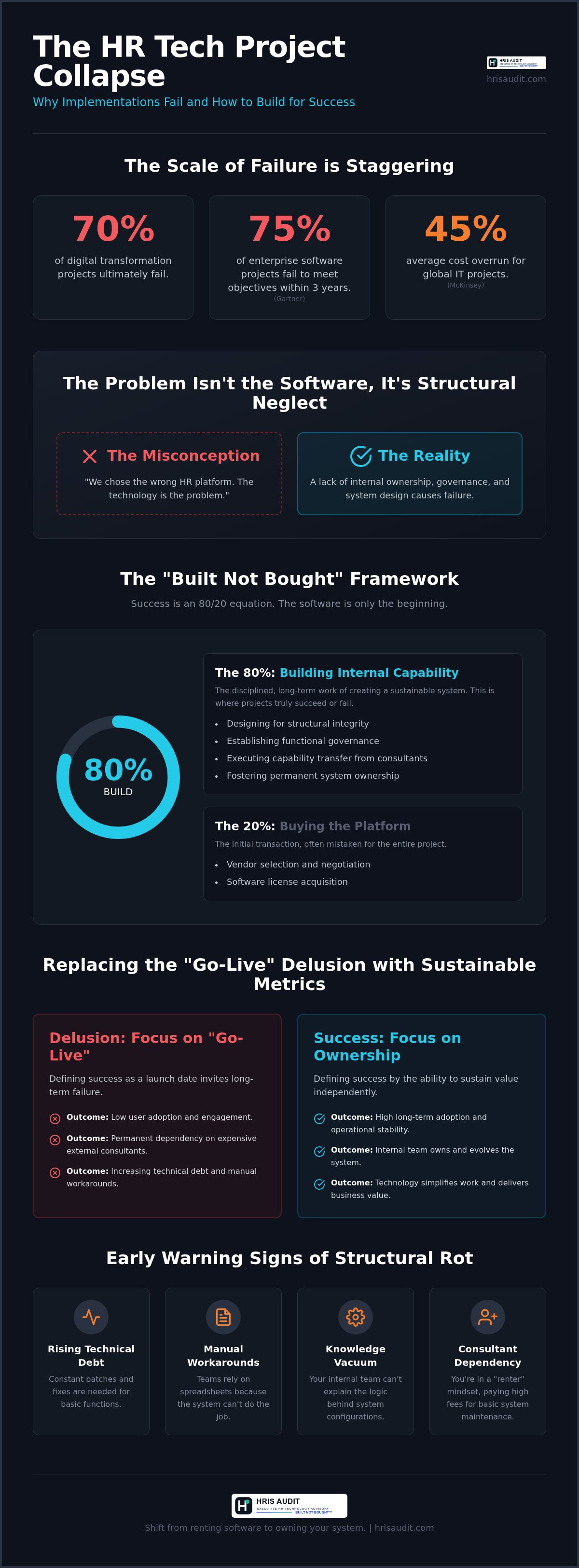
Seventy percent of digital transformation projects fail. In the arena of enterprise software, the Standish Group reports that a mere 29.7% reach completion successfully. These figures represent more than just wasted capital. They signify a fundamental collapse of organizational design. You've likely experienced the "go-live" delusion firsthand. You endure the cost overruns and the exhaustion of implementation, only to find that your team remains tethered to expensive external integrators. Adoption stays low. The internal machinery remains broken.
It's time to understand why HR technology projects fail at such a consistent rate. The issue isn't the software. The issue is structural neglect. This article dismantles the myth that you can simply purchase a solution to a human system problem. We'll introduce the "Built Not Bought" framework, a disciplined approach to ensuring your internal team actually owns the technology they use. We'll move through the systemic failures of modern HRIS transformations and provide a clear path toward sustainable governance that survives long after the consultants leave the building.
Key Takeaways
- Understand that structural neglect, not software choice, is the primary reason why HR technology projects fail in the long term.
- Recognize that "buying" a platform only accounts for 20% of the journey; the remaining 80% is the disciplined work of building internal governance.
- Replace the dangerous "Go-Live" delusion with a performance metric based on long-term adoption and operational stability.
- Use the Built Not Bought framework to move beyond basic training and establish permanent, high-level ownership roles.
- Identify the critical signals that indicate a program reset is required to stop the bleeding and restore architectural integrity.
The Sober Truth About HRIS Transformation Failures
Failure in the enterprise space is rarely a single event. It's a slow, structural decay. Many organizations define success by the "go-live" date. This is a mistake. A project that hits its launch date but fails to deliver its business case is a failed project. Industry data confirms this grim reality. McKinsey reports global IT projects face an average cost overrun of 45%. Gartner notes that 75% of enterprise software projects fail to meet original objectives within three years. This is why HR technology projects fail: the focus remains on the event of implementation rather than the integrity of the system. Success is not a date. Success is the ability to sustain value.
Pattern recognition is vital for the executive. You must see the cracks before the foundation shifts. Early warning signs include rising technical debt, a reliance on manual workarounds, and a total lack of internal system knowledge. There is a sharp distinction between project participation and system ownership. Participation is passive. Ownership is active, disciplined, and structural. One is a temporary state of being. The other is a permanent organizational capability.
The High Cost of Systemic Neglect
Neglect has a price tag. Beyond the immediate capital loss, failed rollouts create a lasting drain on organizational morale. When technology complicates work instead of simplifying it, employees disengage. Fixing these issues "later" is a fallacy. Technical debt accumulates interest. Every patch applied to a broken architecture increases the cost of future repairs. A Transformation Pulse Scan can often reveal these hidden costs before they become catastrophic. It's cheaper to audit the design than to rebuild the wreckage.
The Consultant Dependency Trap
System Integrators (SIs) are often the architects of their own necessity. They build the system, but they rarely transfer the capability to run it. This creates a knowledge vacuum. Organizations fall into a renter mindset, paying high fees for basic maintenance. Vendor-led implementations often have an inherent conflict of interest. Their goal is to finish the project. Your goal is to own the system. Moving from a "renter" to an "owner" requires a shift in how you view the project lifecycle. You aren't just buying software. You're building a permanent internal capability. If your team can't explain the logic behind your system configuration, you don't own it. You're just renting it from your consultants.
The Built Not Bought™ Trap: Why Software Can’t Fix Structural Rot
Purchasing an enterprise platform is a transaction. Building a system is a discipline. This is the core of the Built Not Bought™ methodology. It's a fundamental shift from viewing HRIS as a product to seeing it as a living infrastructure. Most executives believe that selecting a top-tier vendor like Workday, SAP, or Oracle is the primary hurdle. In reality, the software acquisition is only 20% of the journey. The remaining 80% is the rigorous work of designing and governing for long-term sustainability. If you don't build the internal machinery to own the system, you're just renting a very expensive problem.
When organizations ignore this, they invite structural rot. Poor design decisions made during the rush to implementation don't just disappear. They haunt the organization for years. They manifest as broken integrations, manual spreadsheets, and a system that nobody trusts. You can buy a high-end blueprint, but you must build the house with integrity. This structural failure is exactly why HR technology projects fail. The rot begins the moment you prioritize the software license over the system design. You can't patch your way out of a foundation that was never properly poured.
Designing for Structural Integrity
A system only works if it mirrors the business logic. This requires a dedicated client-side architect who understands your organizational DNA. Relying on off-the-shelf "best practices" is a common trap. These practices are often designed for vendor efficiency, not your operational complexity. Real integrity requires Designing for Sustainable HR Transformation by aligning the technology with your specific requirements. If the fit is forced, the system will eventually crack under the pressure of real-world use.
The Governance Gap in HR Tech
Governance is often treated as a ceremony. Steering committees meet, review slides, and nod. This is not governance. It's theater. Functional governance requires a clear HR Technology Governance Framework that supports high-stakes trade-offs. Sponsors must provide actual decision support, not just signatures. Decisions shouldn't be delegated to junior consultants who won't be there to deal with the consequences. For a deeper dive into these principles, the Built Not Bought book offers a complete manual for avoiding these architectural pitfalls and reclaiming ownership of your digital landscape.
The "Go-Live" Delusion and the Post-Implementation Crash
Go-live is a vanity metric. In the world of enterprise architecture, it's often the point of maximum risk rather than the moment of victory. Organizations treat the launch date as a finish line, pouring all resources into a binary event. This is a dangerous delusion. A technical launch is not a business transformation. If the system is technically "up" but the business logic is flawed, you haven't succeeded. You've simply automated your inefficiencies at scale. This obsession with the ribbon-cutting ceremony is a primary reason why HR technology projects fail to deliver long-term ROI.
The "Post-Implementation Crash" is the inevitable result of this short-term focus. Once the consultants roll off and the project team dissolves, the structural weaknesses emerge. Support tickets spike. Users retreat to manual spreadsheets. Data integrity begins to bleed out. A 2022 Gartner survey found that the average HRIS is used by only 32% of employees. This adoption cliff happens because the organization focused on "Project Delivery" instead of "Capability Delivery." You built a system for the implementation team, not for the people who have to live in it every day.
The Fallacy of the Finish Line
The most critical work begins the morning after go-live. Unfortunately, most budgets are exhausted by then. Day 2 optimization must be part of the Day 1 design. Without a clear plan for post-launch evolution, the system enters a state of permanent "stabilization." This is a euphemism for a project that never actually works. To avoid this trap, you must shift your perspective. View the launch as the beginning of the system's lifecycle, not the end of the project's timeline. Ownership requires a sustained operational state, not a temporary project high.
Detecting Risk with Transformation Pulse Scans
Executive sponsors are often the last to know a project is failing. Project status reports frequently suffer from "green-melon" reporting. On the outside, everything looks green and healthy. On the inside, the architecture is red and rotting. You need an independent diagnostic to cut through the noise. You can Detect Risk with a Transformation Pulse Scan to identify structural flaws before they trigger a post-go-live crash. These gate reviews provide the objectivity that internal teams and system integrators often lack. Don't wait for the system to collapse to find out the foundation was never sound. Audit the design while you still have the leverage to change it.
Capability Transfer: Designing for Ownership Instead of Participation
Participation is a low bar. It requires presence, but not responsibility. In the context of enterprise systems, participation is why the "Post-Implementation Crash" occurs. Ownership, however, is a structural state. It's the difference between driving a car and knowing how to rebuild the engine. To ensure long-term sustainability, you must design for ownership from the first day of the project. This is the only way to address the systemic reasons why HR technology projects fail once the external experts depart. You don't need a project team that participates in the implementation; you need an internal team that owns the architecture.
Capability transfer is not an accident. It's a deliberate, five-step motion:
- Step 1: Conduct an HR system capability evaluation early. Assess the technical and logical maturity of your internal team before the first configuration starts.
- Step 2: Define "Ownership Roles." These are not job titles. They are specific accountabilities for system logic, data integrity, and process governance.
- Step 3: Implement a shadow-and-reverse-shadow methodology. Your team watches the System Integrator (SI) build, then your team builds while the SI watches. If your team isn't touching the keys, they aren't learning.
- Step 4: Utilize Field Library workbooks. Documenting the "how" is useless without the "why." These workbooks capture the institutional logic behind every design decision.
- Step 5: Execute a formal "Handover for Ownership" gate review. This is an objective audit to confirm the team can maintain the system without external life support.
Beyond End-User Training
Clicking buttons is not the same as understanding system logic. Most training programs focus on surface-level navigation. They ignore the mechanical underpinnings of the platform. Building "Systemic Fluency" within your HR Center of Excellence (COE) requires a deeper dive into how data flows and how configurations impact downstream processes. This is where licensed field libraries become essential. They provide the diagnostic tools and workbooks needed to accelerate team maturity. Without this fluency, your team will remain in a state of perpetual dependency, which is exactly why HR technology projects fail to deliver on their original business case.
The Battle-Tested Architect Persona
Your team doesn't need another project manager to track deadlines. They need a battle-tested architect to mentor them through the complexity. This requires a "Tough Love" approach to capability transfer. It demands a rigorous attention to detail and a refusal to accept "the consultant did it" as an answer. This persona acts as the guardian of your structural integrity, ensuring that every design choice is understood and documented by the people who will actually run the system.
Access the Field Library for System Design
Recovering the Mission: How to Reset a Failing HR Program
Not every project starts from a clean slate. Many are already in a state of structural decay by the time the executive team notices the drift. A "Program Reset" isn't an admission of defeat; it's a strategic intervention to save the business case. You must stop the bleeding. This requires stripping away the marketing promises and evaluating the actual machinery. If the foundation is cracked, adding more features is just adding weight to a collapsing structure. You can't fix a systemic failure with more software. You fix it with better architecture.
Objective HCM advisory is the only way to get an honest assessment of the wreckage. System Integrators (SIs) often have a vested interest in maintaining the status quo of billable hours and project milestones. They aren't incentivized to tell you that the design is fundamentally flawed. An independent voice provides the pattern recognition needed to identify why HR technology projects fail in your specific environment. It moves the conversation from "when will it be done" to "is it built to last." Shifting from a "Bought" mess to a "Built" foundation mid-stream is difficult, but it's the only path to long-term ownership.
The Program Health Check
A formal audit is required when support tickets exceed capacity or when the internal team remains entirely dependent on external help. You must identify conflicts of interest where vendors prioritize their own implementation metrics over your organizational health. Re-aligning executive sponsors requires a common language of ownership. For a definitive guide on this transition, consult Built Not Bought: The Strategy for Sustainable HR Systems. It serves as the manual for turning a "Bought" mess into a "Built" foundation mid-stream.
Securing the Future
Recovery is only the first step. You must establish a permanent governance structure that survives the implementation phase. This means designing for continuous optimization in a platform-agnostic world. Your systems will change. Your vendor might change. Your internal capability must remain constant. Committing to the "Built Not Bought" philosophy ensures that future transformations don't repeat the same architectural errors. It's a shift from being a spectator of your own technology to becoming its primary architect. This is the only way to permanently solve the riddle of why HR technology projects fail. Don't just implement. Build.
Reclaiming the Architecture of Ownership
A successful HRIS transformation requires more than a software license. It demands a fundamental shift from passive participation to active ownership. You've seen the patterns of structural neglect. Understanding why HR technology projects fail allows you to stop treating implementation as a binary event and start treating it as the construction of permanent internal machinery. The go-live date is just a starting line. The real victory is an internal team that governs the system without external life support.
With over 30 years of battle-tested experience, HRIS Audit provides the independent, platform-agnostic advisory needed to secure your investment. Our proprietary Built Not Bought™ methodology replaces the implementation illusion with structural integrity. You have a choice. You can continue renting a broken system, or you can build a foundation that lasts. It's time to move past the delusion of easy fixes and embrace the discipline of ownership. Your organization deserves a system that actually works.
Secure your transformation strategy with a Pulse Scan
The path to a sustainable system is clear. Build it with the rigor it requires.
Frequently Asked Questions
Why do most HR technology projects fail even with top-tier software?
Top-tier software is merely a tool, not a solution. Most projects fail because organizations prioritize the transaction of buying a platform over the discipline of building a system. They ignore the internal governance and architectural integrity required to run the technology long-term. This structural neglect is the primary reason why HR technology projects fail at such a high rate. You cannot outsource the responsibility of owning your own business logic.
What is the difference between an HR system integrator and a client-side advisor?
A system integrator (SI) focuses on technical configuration and meeting project milestones. Their primary objective is a successful "go-live" event. A client-side advisor, however, focuses on your long-term operational maturity and structural health. They act as an independent guardian of your interests. While the SI builds the platform, the advisor ensures your internal team has the capability to own and govern it after the consultants depart.
How can I tell if my current HRIS implementation is at risk of failure?
Risk manifests through a heavy reliance on manual workarounds and an internal team that cannot explain system logic. If your project status reports are consistently green while support tickets are rising, you're likely seeing "green-melon" reporting. A high dependency on external integrators for basic configuration changes is a clear signal of structural decay. These symptoms indicate a project that is technically active but operationally failing.
What does "Built Not Bought" actually mean for an HR leader?
"Built Not Bought" is a methodology that shifts focus from the software transaction to the discipline of internal ownership. It means recognizing that you don't just buy a solution; you build a permanent organizational capability. For an HR leader, this involves investing in "Systemic Fluency" and establishing clear governance roles. It's a commitment to designing a system that fits your specific business logic rather than forcing your organization into a vendor's default template.
Can a failing HR technology project be rescued after go-live?
Yes, but it requires a formal program reset and an objective audit of the current architecture. Recovery isn't about adding more features. It's about stripping back the "Bought" mess to establish a "Built" foundation. You must stop the bleeding by identifying technical debt and re-aligning your governance structure. An independent HCM advisory can help you navigate this transition and reclaim the original mission of the transformation before the system collapses entirely.
Why is capability transfer more important than end-user training?
End-user training focuses on surface-level navigation and button-clicking. It's a temporary fix. Capability transfer, however, builds the deep "Systemic Fluency" required to manage the platform's underlying logic. Without this transfer, your team remains in a state of perpetual dependency. This lack of deep internal knowledge is a primary reason why HR technology projects fail to sustain value after the implementation team leaves. Ownership requires understanding the "why," not just the "how."
What are the most common "red flags" in an HR transformation gate review?
Common red flags include a lack of internal documentation and a project team that cannot articulate the business logic behind configurations. If the system integrator is the only party that understands the architecture, the project is in trouble. Other warnings include ceremonial governance committees that lack actual decision-making power. These indicators suggest that the project is prioritizing the implementation date over the structural integrity and long-term sustainability of the final system.
How does independent advisory reduce the risk of HCM implementation failure?
Independent advisory provides the objectivity that vendors and internal teams often lack. Advisors bring "pattern recognition" from decades of industry experience to identify risks before they become catastrophic. They act as a bridge between executive vision and technical execution. By remaining platform-agnostic, they prioritize your organizational outcomes over software sales or billable implementation hours. This ensures that the system is built for your long-term sustainability rather than vendor convenience.


