

Status reports track activities. They do not measure structural integrity. Most HR leaders are flying blind, relying on vendor-led dashboards that prioritize project milestones over operational reality. Are you building a sustainable platform, or are you simply decorating a collapse? You feel the friction. You see the gaps between marketing promises and technical capability. With 88% of HR leaders reporting they haven't realized significant value from their technology investments, an HR transformation pulse scan is the only way to verify your trajectory.
It is time for a sober assessment. This diagnostic tool serves as a high-fidelity audit for your transformation machinery. It strips away the hyperbole to reveal the hidden structural risks threatening your investment. You need more than a status update; you need an audit of your governance, your design logic, and your team's maturity. This article outlines how to use the pulse scan to identify post-go-live risks, reset failing workstreams, and ensure your system is Built Not Bought™ for long-term ownership.
Key Takeaways
- Stop relying on superficial status reports that mask systemic risks. Learn why "Green" dashboards often precede catastrophic post-go-live failures.
- Conduct an HR transformation pulse scan to audit the five pillars of structural integrity, from strategic alignment to governance maturity.
- Distinguish between the activity-tracking of system integrators and the objective diagnostics required for long-term platform health.
- Discover how to interpret diagnostic data to make high-impact program resets within a critical 48-hour decision window.
- Shift your implementation strategy from mere participation to true ownership using the Built Not Bought™ methodology.
Beyond the Green Status Report: The Need for an HR Transformation Pulse Scan
Activity is not progress. Most HCM implementations fail because they prioritize the timeline over the foundation. Your system integrator provides a weekly dashboard glowing with "Green" status indicators. These metrics track task completion. They do not track systemic viability. An HR transformation pulse scan is an independent, high-fidelity diagnostic designed to expose the structural debt accumulating beneath the surface of your project. It is the difference between tracking project milestones and auditing systemic health.
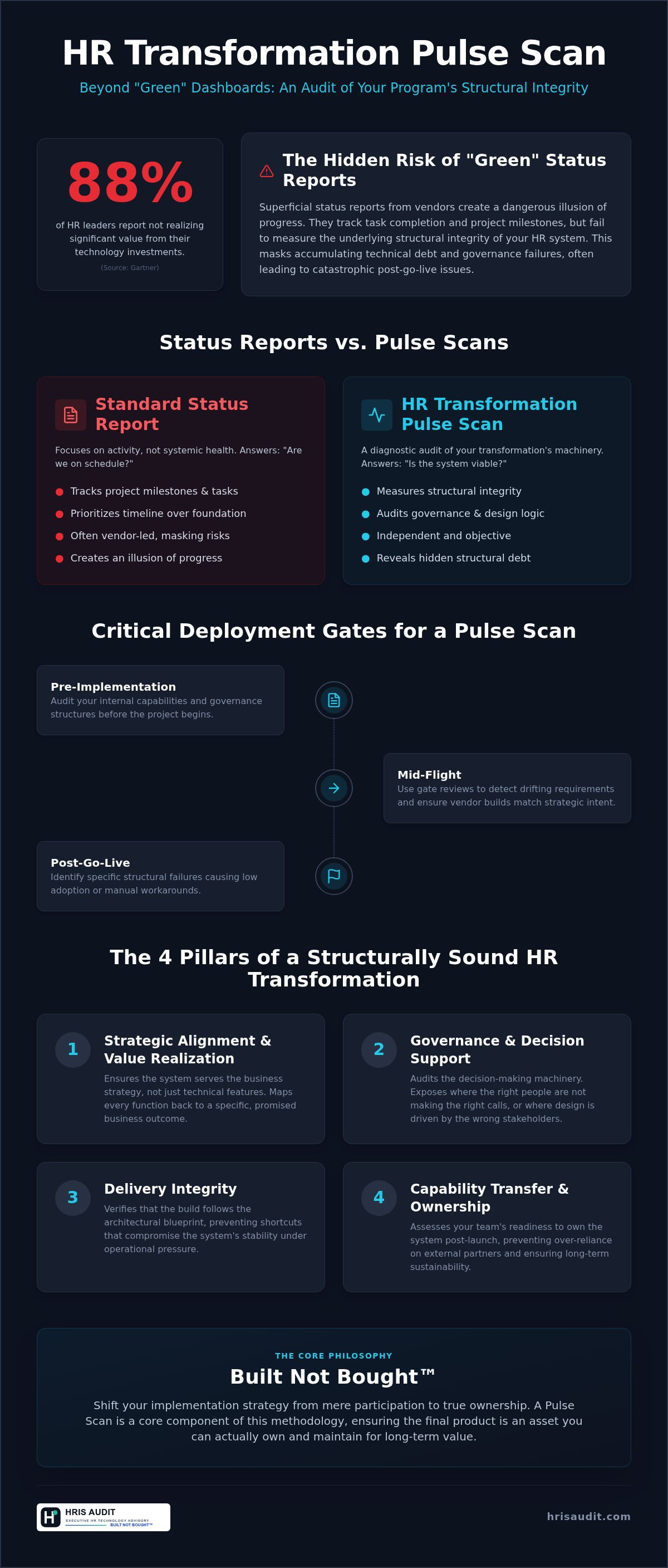
In the broader context of Human Resource Management, technology is the machinery that drives policy and performance. If that machinery is flawed, the entire function stalls. According to Gartner (October 2025), 88% of HR leaders report their organization has not realized significant business value from AI and HR tech tools. This gap exists because traditional governance focuses on whether a system is built, not whether it is fit for purpose. This diagnostic acts as a core component within the Built Not Bought™ methodology, ensuring that the final product is an asset you can actually own.
The Blind Spot in Enterprise HR Technology
Executive sponsors are often the last to know when a project is drifting. The reporting mechanism is frequently compromised by a conflict of interest. Vendors have a vested interest in project momentum. They report on what they have built. They rarely report on what your internal team is capable of maintaining. This creates a disconnect where 81% of HR professionals (Sapient Insights) use "shadow AI" tools because the official systems fail to meet their needs. Structural debt accumulates during the design and build phases, hidden by the very reports meant to track success.
When to Deploy a Transformation Pulse Scan
Timing is as critical as the diagnostic itself. Deploying an HR transformation pulse scan at key gates prevents the accumulation of structural debt. Consider these three critical entry points:
- Pre-implementation: Audit your internal capability and governance structures before the first line of code is written.
- Mid-flight: Use gate reviews to detect drifting requirements and ensure the vendor's build matches your strategic intent.
- Post-Go-Live: Identify the specific structural failures causing low adoption or manual workarounds.
Do not wait for a post-mortem to discover your system is broken. Use a pulse scan to verify the integrity of your transformation while you still have the leverage to fix it.
The 5 Pillars of the HR Transformation Pulse Scan
Structural integrity is not a vague sentiment. It is a measurable state of organizational health. An HR transformation pulse scan evaluates the project through five distinct lenses to determine if you are building an asset or simply decorating a collapse. These pillars provide the objective data required to move past vendor-led optimism and toward systemic reality.
Pillar 1: Strategic Alignment and Value Realization
Does the technology actually serve the people strategy? Many implementations fall into the trap of "feature creep," where technical capabilities are added simply because they exist, not because they solve a business problem. This pillar maps every software feature back to a specific business outcome. We evaluate the current project trajectory against the original business case. If the build drifts from the strategic intent, the investment is compromised. This is about ensuring the system delivers the value promised to the board, not just the functionality promised by the vendor.
Pillar 2: Governance and Decision Support and Pillar 3: Delivery Integrity focus on the machinery of the implementation. Governance asks if the right people are making the right calls. It exposes where decision-making has stalled or where the wrong stakeholders are driving design. Delivery Integrity audits whether the build follows the architectural blueprint or if the team is taking shortcuts to hit a go-live date. Without these two pillars, the system becomes a collection of compromises that will fail under operational pressure.
Pillar 4: Capability Transfer and Internal Ownership
This is the core of the Built Not Bought™ philosophy. External consultants will eventually leave your building. When they do, your internal team must be ready to own the system. We assess the "Built Not Bought" mindset within your project team to detect over-reliance on external partners. Are your people active architects or passive observers? If your team cannot maintain the system post-implementation, you haven't secured a solution; you've rented a permanent problem. Review our governance frameworks to see how we structure this transfer of power.
Pillar 5: Adoption Readiness is the final gate. It measures whether the business will actually use what is being built. Technology is useless if it creates friction for the end user. We look for misalignments between the system design and the actual workflow of your employees. By identifying these friction points early, you can adjust the build before adoption failure becomes a headline. These five pillars together create a disciplined, high-fidelity view of your transformation's true health.
Status Reports vs. Pulse Scans: Why Traditional Governance Fails
Status reports are performance art. They are designed to reassure, not to reveal. Most large-scale HCM transformations rely on these weekly updates to track progress, but they track the wrong metrics. They track activity. They track task completion. They do not track the structural integrity of the build. This is where traditional governance fails. An HR transformation pulse scan serves a different purpose. It is a diagnostic audit, not a progress report.
Traditional reporting suffers from the "Iceberg Effect." The status report shows the 10% of the project above the waterline: the milestones, the timeline, and the budget. Beneath the surface lies the 90% that actually determines failure: design debt, governance gaps, and internal capability deficits. You cannot manage what you cannot see. Passive monitoring leads to post-go-live adoption failure because the foundation was never stress-tested. It's the difference between looking at a blueprint and inspecting the concrete.
The System Integrator Bias
System Integrators (SIs) operate under a specific set of incentives. Their success is defined by a successful deployment on a specific date. They are incentivized to keep the project moving, even when the underlying design is flawed. This leads to a "check the box" mentality where milestones are met at the expense of long-term ownership. You must distinguish between Strategic Advisory vs. System Integration. One builds the tool; the other ensures you can actually use it. Without independent oversight, your project becomes a series of technical compromises.
Independence as a Strategic Advantage
Objectivity is the only currency that matters in a high-risk implementation. Most project boards are flooded with vendor-heavy perspectives. This creates a vacuum of independent thought. By utilizing an HR transformation pulse scan, the CHRO and CIO gain a platform-agnostic view of their investment. It removes the "us vs. them" friction between the internal team and the vendor. Instead of arguing over opinions, you are making decisions based on transparent diagnostics. It provides the sobriety required to lead a complex organizational shift.
This shift from passive observation to active client-side leadership is mandatory. You are not a passenger in your own transformation. You are the architect. Independent data provides the leverage needed to course-correct before the costs of failure become irreversible. Ownership isn't something you're given at go-live. It's something you build through disciplined governance.
Interpreting the Diagnostics: From Pulse Scan to Program Reset
Reading a diagnostic report is an exercise in triage. It's not a document for passive review. It is a catalyst for immediate action. An HR transformation pulse scan provides a binary view of your project's health: either the foundation is solid, or it's compromised. You must distinguish between cautionary risks, which require monitoring, and critical risks, which demand a program reset. The data doesn't just inform; it mandates a decision. It's about separating the noise of project activity from the signal of systemic health.
We operate within a 48-hour window. Once the scan reveals a structural failure, the executive team has two days to decide on a course of correction. Delay is the enemy of recovery. High-velocity decision-making prevents the "sunk cost" fallacy from anchoring your project to a failing design. These findings facilitate executive Transformation Studio sessions where the focus shifts from technical features to organizational maturity. This is where you decide if the project continues as planned or if you stop the line to save the investment.
Identifying Structural Gaps in System Design
Design gaps are often masked by technical jargon and vendor-led optimism. Structural integrity in HRIS is the degree to which technical configurations mirror the actual operational logic of the human system. Most designs fail because they prioritize software defaults over business reality. We utilize Field Library workbooks to bridge these gaps. These tools re-align technical builds with human-centric processes. They ensure the system is built for the user, not just for the database. You're building a platform for the next decade. Don't compromise it for a quarterly deadline.
Secure your transformation with a structural diagnostic
Facilitating the Program Reset
Communication is the next motion. You must present these findings to the Board and Steering Committee with surgical precision. This is not about assigning blame. It's about protecting the capital investment. Use the diagnostic data to negotiate course corrections with your System Integrator. They respond to objective evidence, not subjective frustration. The HR transformation pulse scan provides the leverage needed to challenge the vendor's narrative and re-assert client-side leadership.
Establishing new gate reviews is the final step of the reset. These gates are not based on vendor milestones or arbitrary dates. They're based on the pulse scan criteria of integrity and ownership. You're shifting the project from a race toward go-live to a disciplined march toward operational excellence. This roadmap ensures the reset isn't just a pause, but a pivot toward success. It forces the project team to confront the reality of the build before the costs of failure become irreversible.
Securing Your Investment with HRIS Audit’s Pulse Scan
A transformation is a capital investment, not just a software purchase. Protecting that investment requires more than hope. It requires a disciplined, objective audit of your progress. The HR transformation pulse scan is the primary diagnostic tool we use to verify the health of your implementation. It is built on 30 years of industry experience. This tenure has provided us with a specific type of pattern recognition. We have seen the same architectural flaws repeated across different industries and software platforms. We identify the subtle indicators of structural failure that vendors often overlook or obscure. We don't just find problems; we identify the root causes within your organizational machinery. This objective viewpoint is what secures your capital investment against the common pitfalls of enterprise software deployment.
Success is not a destination at go-live. It is a state of ongoing operational maturity. By integrating the scan into a broader governance framework, you ensure that systemic design remains aligned with your people strategy. This creates a sustainable, people-centric ecosystem where technology serves the business, not the other way around. You move from being a consumer of software to an architect of enterprise value. This is the only path to long-term stability in a volatile HR technology market. It forces a shift from passive participation to active, client-side leadership.
The Built Not Bought™ Advantage
Ownership is the only metric that matters after the consultants leave your building. If your team cannot maintain, evolve, and troubleshoot the system, the project is a failure. The HR transformation pulse scan protects your multi-year investment by auditing for this specific capability. We look for the Built Not Bought™ mindset within your internal team. Are they passive recipients of a vendor's build? Or are they active owners of a strategic asset? For a deeper dive into this long-term strategy, refer to the Built Not Bought book. It provides the philosophical and practical foundation for everything we do. Without this shift in mindset, you aren't building a solution; you're renting a permanent problem.
Next Steps: Initiating Your Scan
The diagnostic process is rapid and rigorous. We begin with a high-fidelity data collection phase, interviewing key stakeholders and auditing current design documents. This is followed by a period of deep analysis where we map findings against our proprietary maturity models. Within a focused timeline, we deliver an executive briefing that outlines critical risks and actionable course corrections. This is not a lengthy, academic exercise. It is a tactical strike designed to provide immediate clarity to the CHRO and CIO. Stop guessing about your project's health. Verify it. Schedule your Transformation Pulse Scan today and secure the structural integrity of your HR technology ecosystem.
Take Control of Your Transformation Machinery
Transformation is a complex engineering challenge. You cannot rely on the passive optimism of vendor-led status reports to protect your capital investment. Real progress requires a sober audit of your system's structural integrity. By auditing the five pillars of alignment, governance, delivery, capability, and adoption, you move from being a passenger to becoming the architect of your own ecosystem.
Leverage our 30 years of transformation leadership and independent, vendor-agnostic perspective to verify your build. An HR transformation pulse scan provides the objective data required to stop the line and course-correct before design debt becomes permanent. This diagnostic is the practical application of the Built Not Bought™ methodology. You've seen the pattern of failure in other organizations. Don't let your project become the next case study in adoption failure.
Request Your Free HR Transformation Pulse Scan
Take command of your technology roadmap. You have the leverage to build a system that serves your people strategy for the next decade. Success is earned through discipline and ownership.
Frequently Asked Questions
What is the difference between a project audit and an HR transformation pulse scan?
An HR transformation pulse scan differs from a standard project audit by focusing on structural integrity rather than historical compliance. While an audit verifies that tasks were completed according to a contract, a pulse scan audits the systemic health of the build. It evaluates if the design can actually support the human system it was intended for. It is a forward-looking diagnostic designed to detect failure before it happens.
How long does a typical pulse scan take to complete?
The timeline is designed for high-velocity decision-making. A typical diagnostic cycle spans two to four weeks from initial data collection to the final executive briefing. We prioritize speed to ensure findings remain actionable. This prevents the "sunk cost" fallacy from taking root. You receive the clarity needed to course-correct without stalling project momentum. It is a surgical strike into the project's logic.
Does a pulse scan require access to our HRIS software environment?
Direct access to your software sandbox is rarely the primary requirement. We focus on the architectural blueprints, governance structures, and design workbooks. We audit the logic of the configuration rather than the code itself. The goal is to verify that the technical build matches the strategic intent. We look at the machinery of the implementation process. This provides a platform-agnostic view of your organizational maturity.
Can a pulse scan help if we have already gone live but adoption is low?
Low adoption is almost always a symptom of structural failure. A pulse scan identifies the specific friction points between the system design and the actual employee workflow. We diagnose why the system is being rejected by the business. This allows for a targeted optimization phase rather than a blind re-training effort. We fix the machinery so the people can actually use it. It is a recovery roadmap for failing implementations.
Is the pulse scan specific to Workday, Oracle, or SAP implementations?
The diagnostic is entirely platform-agnostic. Whether you are deploying Workday, Oracle, SAP, or a specialized HCM suite, the structural requirements for success remain the same. Governance, capability transfer, and strategic alignment are human and systemic challenges, not software features. We focus on the organizational foundations that support the technology. This independence ensures our findings are objective and free from vendor bias.
Who from our team needs to be involved in the pulse scan process?
We require engagement from the project’s high-level architects. This includes the executive sponsors, the project director, and key functional leads. These are the individuals responsible for the strategic design and long-term ownership of the system. Their insights reveal the gap between vendor promises and internal capability. We minimize the time commitment for your team while maximizing the depth of the diagnostic. We value discipline over mere participation.
What kind of deliverables do we receive at the end of the scan?
You receive a high-fidelity executive briefing and a structural risk map. This report categorizes findings into critical and cautionary risks. We provide an actionable roadmap for program reset or optimization. These deliverables are designed for immediate consumption by the Steering Committee. You gain a clear, unbiased view of your transformation's trajectory. It is the data required to lead with authority and protect your capital investment.
How much does an independent HR transformation diagnostic cost?
Professional fees for independent diagnostics vary based on the complexity of the transformation and the size of the organization. However, HRIS Audit currently offers the initial HR transformation pulse scan as a free diagnostic for qualified organizations. This allows leaders to experience the Built Not Bought™ methodology without an initial capital outlay. Our goal is to provide immediate clarity on your structural integrity and help you secure your technology ecosystem.


