

Why are enterprise organizations still treating HCM implementations like software purchases rather than structural engineering projects? In 2026, the average enterprise HRIS budget has climbed toward $400 per employee annually, yet the failure rate for these transformations remains stubbornly high. You likely feel the weight of this risk. You've seen the over-reliance on system integrators who vanish after go-live, leaving your internal team without the capability to own the machinery they're supposed to operate. It's a cycle of expensive dependency that compromises long-term structural integrity.
This article moves past the marketing gloss to examine the sober HR transformation tools and frameworks required to build a sustainable, client-led system. We'll explore how to shift from a "bought" mindset to a "built" reality through clear governance and rigorous architectural blueprints. You'll discover the specific client-side tools found in our Field Library that ensure your team is ready to lead the system on day two. We'll outline the exact motions needed to secure internal ownership and design a transformation that actually lasts.
Key Takeaways
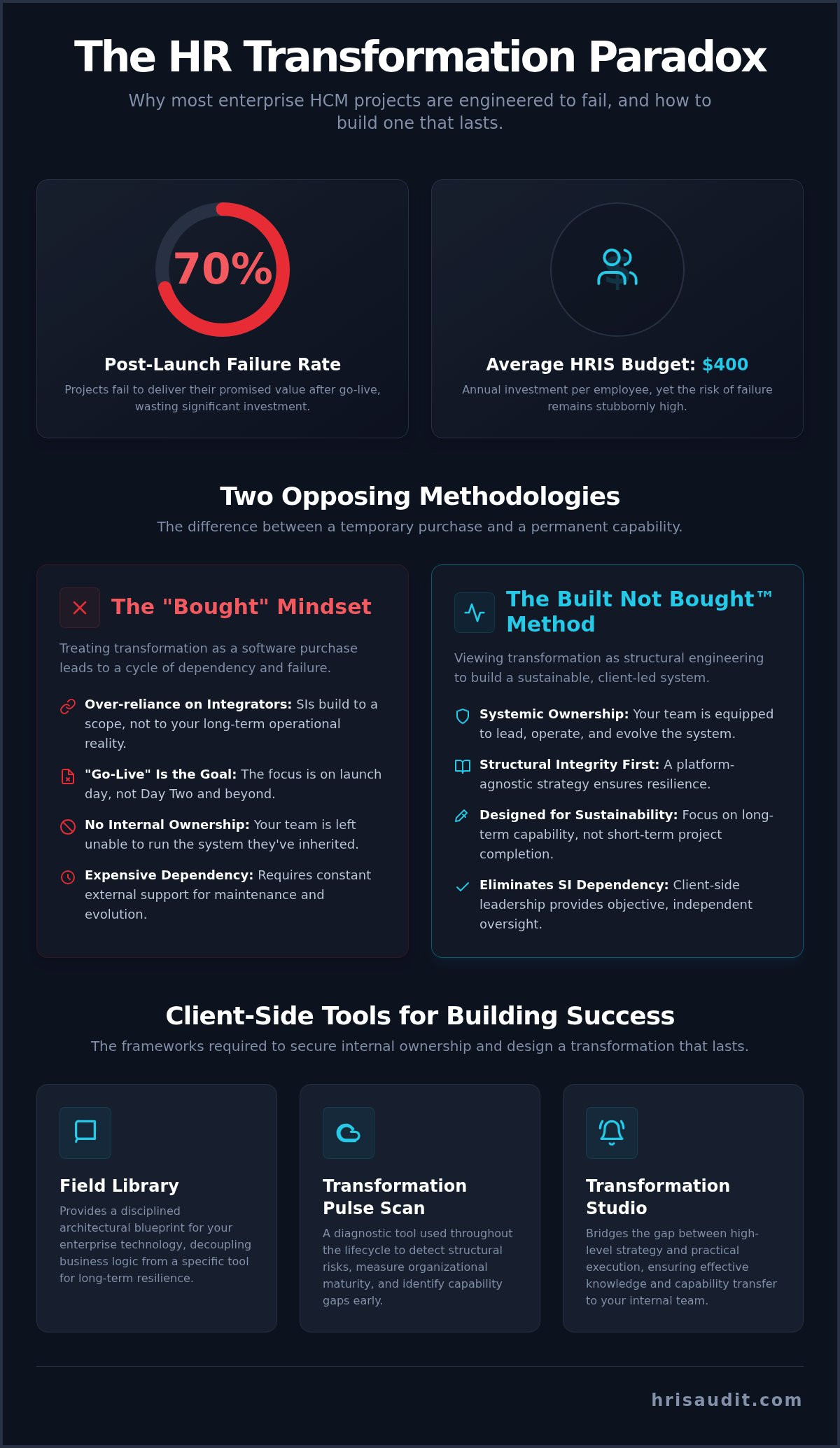
- Understand the distinction between surface-level software updates and true structural transformation to avoid the 70% post-launch failure rate.
- Adopt the Built Not Bought™ methodology to secure systemic ownership and eliminate long-term reliance on system integrators.
- Deploy specific HR transformation tools and frameworks like the Field Library to provide a disciplined architectural blueprint for your enterprise technology.
- Use the Transformation Pulse Scan as a diagnostic tool to detect structural risks and measure organizational maturity throughout the implementation lifecycle.
- Leverage the Transformation Studio to bridge the gap between high-level strategy and practical, internal capability transfer.
Beyond the Software: Why Most HR Transformation Frameworks Fail
Enterprise HR technology is not a procurement exercise. It's a structural engineering challenge. Most organizations treat the implementation of a new HCM as a simple software upgrade, yet in 2026, the data remains grim. Research consistently shows that 70% of HR tech projects fail to deliver their promised value after go-live. This isn't a failure of the software. It's a failure of the foundation. When you prioritize digital modernization over structural transformation, you're simply putting old, broken processes into a more expensive box.
The industry is plagued by the 'Tool-First Trap.' Executives buy expensive software before they've defined the architectural foundation. They hope the tool will dictate the strategy. It won't. Without a disciplined approach to Strategic Human Resource Planning, you're simply automating chaos. True transformation requires a shift from transactional tasks to systemic design. It requires a move toward HR transformation tools and frameworks that prioritize long-term ownership over immediate automation. You must build the house before you pick the furniture.
The Critical Gap: Client-Side Leadership vs. System Integration
Your System Integrator (SI) is a builder. They're paid to configure the software according to a pre-defined scope. They aren't architects. They don't live with the system after the final payment is made. This creates a dangerous gap in governance. An SI cannot provide the objective, independent oversight your program requires. Their incentives are tied to project completion, not your organizational maturity. Leading a sustainable enterprise project requires independent client-side advisory. You need a guardian of your interests who ensures the system is built for your specific operational reality, not just the SI's delivery timeline.
Identifying the Symptoms of Structural Weakness
Pattern recognition is a survival skill in enterprise technology. Failing implementations often show early warning signs that leadership ignores. If your team is over-reliant on the SI for basic configuration decisions, or if you lack a clear internal roadmap for post-launch maintenance, your project is at risk. Buying a solution is easy. Building the internal capability to run it is the real work. Without this focus, you're simply leasing a temporary fix. For a deeper look at this dynamic, examine our guide on Client-Side HR Technology Leadership. Spotting these symptoms early allows you to pivot toward better HR transformation tools and frameworks before the structural integrity of your program collapses. Don't wait for the post-mortem to realize your foundation was made of sand.
The Built Not Bought™ Method: A Framework for Systemic Ownership
Most HR leaders are sold a lie. They're told that buying a top-tier HCM platform is the same as transforming their organization. It isn't. Transformation is an internal achievement, not a vendor transaction. The Built Not Bought™ method is a philosophy that shifts the target from a successful "go-live" to long-term systemic ownership. It's about ensuring your team possesses the knowledge to drive the system, rather than being driven by it. If you don't own the logic of your system, you don't own your HR function.
Designing for sustainability means building for 2026 and beyond. A system that requires constant external intervention is a failed design. To achieve structural integrity, we focus on five specific pillars: strategic alignment, rigorous governance, data architecture, process discipline, and internal capability. These pillars ensure the practical machinery of the HRIS remains synchronized with the executive vision. High-level academic perspectives, such as those found in Cornell's HR Transformation Frameworks, emphasize that strategic partnership is impossible without this technical and operational foundation.
Phase 1: Designing for Structural Integrity
Structural integrity begins by establishing the "Why" before the "What." You don't start with a software demo. You start with a platform-agnostic strategy. This ensures your transformation survives vendor shifts or market volatility. By decoupling your business logic from the specific tool, you create a resilient architecture. This approach is explored in depth in our guide on Built Not Bought HR Strategy. It's the difference between building a custom home and renting a pre-furnished apartment. Focus on the foundation first. The tool is secondary.
Phase 2: Building Internal Capability
The ultimate ROI of any transformation is capability transfer. If your internal team isn't more capable on day two than they were on day one, the project has failed. Moving from consultant-led to team-owned requires a disciplined system for design. This is where the Field Library becomes essential. It acts as the architectural blueprint for your transformation, providing the specific HR transformation tools and frameworks your team needs to maintain the system's health. For those seeking a comprehensive guide to this methodology, the Built Not Bought book provides the necessary roadmap. Capability transfer isn't a side effect of implementation. It is the primary objective. Ownership is the only path to a sustainable enterprise system.
Diagnostic Tools for Enterprise HR Technology Risk
Most project dashboards are performance theater. They track milestones and budget burn while ignoring the structural rot underneath the surface. In 2026, enterprise HRIS budgets average between $150 and $400 per employee per year. With that level of investment, "green" status reports are not enough. You need a way to detect hidden risks before they manifest as catastrophic failures. This requires moving beyond generic maturity models toward ground-level diagnostic precision that evaluates the actual integrity of your implementation.
Effective HR transformation tools and frameworks must do more than organize tasks. They must provide sponsor decision support. If the diagnostic data suggests your internal team isn't ready to own the system, the framework should trigger a program reset. It's a binary reality: either the foundation is solid, or it isn't. Measuring organizational maturity against project progress allows you to see if you're building a capability or just configure-ing a tool.
Pulse Scans: The Early Warning System
A Transformation Pulse Scan acts as a surgical intervention. It's designed to detect friction in the implementation lifecycle without halting the machinery. We conduct these diagnostic scans to identify the critical gap between "Go-Live" and "Effective." Interpreting these results requires a sober look at your internal readiness. Are your people equipped to manage the logic of the system on day two? The scan provides the data needed to pivot during the build phase, which is far less expensive than a post-launch recovery. It is the ultimate tool for maintaining program discipline.
Leveraging the Licensed Field Library
Once risks are identified, you need architectural blueprints to rectify them. Most teams waste months starting from blank pages or using ad-hoc templates that lack systemic logic. The Field Library Frameworks offer a repository of licensed, battle-tested workbooks and facilitation guides. These are the specific HR transformation tools and frameworks that transition your team from passive participants to disciplined designers. Moving from ad-hoc templates to a licensed system ensures consistency across every workstream. These editable workbooks provide the structure your internal team needs to document decisions, define processes, and ensure the system remains effective long after the consultants have left the building. Discipline is not optional; it's the only way to ensure structural integrity.
Governance Frameworks: Implementing Structural Controls and Gate Reviews
Governance is often mistaken for a collection of status reports. It is not. In 2026, as agentic AI begins to automate complex HR workflows, true governance is the mechanism of control that ensures a project remains aligned with its architectural intent. Without it, the HR transformation tools and frameworks you've licensed become mere suggestions. To move from passive participation to active ownership, you must implement a cadence of accountability that survives long after the initial implementation phase. This requires a shift in mindset. Governance is an active process of pattern recognition and risk mitigation.
The Enterprise HR Technology Governance Framework provides the blueprint for this discipline. It replaces ad-hoc meetings with structured gate reviews. These reviews are the most critical tool in an executive's arsenal. They force a pause in the momentum of a project to evaluate structural integrity. Are we building what we intended? Does the internal team actually own the logic? If the answer is no, the project stops. Discipline is the only way to avoid a system that collapses under its own weight on day two.
The Architecture of a Gate Review
A gate review is a formal evaluation of project health against specific, non-negotiable criteria. It follows a three-step motion:
- Step 1: Defining Criteria. Distinguish between a "Soft Gate," where minor adjustments are needed, and a "Hard Gate," where a project halt is required. A Hard Gate is typically triggered by failures in capability transfer or data architecture.
- Step 2: Independent Conduct. The review must be led by independent, client-side leadership. Your system integrator cannot grade their own work. Objective advisory ensures the results are untainted by implementation bias.
- Step 3: Forcing Decisions. The review must result in a binary decision. You either proceed because the foundation is sound, or you reset. There is no middle ground in structural integrity.
For a detailed breakdown of these motions, consult The Enterprise HR Technology Governance Framework.
Sponsor Decision Support
Executive sponsors often feel trapped by the momentum of a project. They see the budget burn and feel pressured to hit an arbitrary go-live date. Effective HR transformation tools and frameworks provide these leaders with the data needed to say "No" to a bad go-live. This bridges the gap between the technical project team and the C-Suite. The sponsor acts as the guardian of structural integrity, ensuring that the long-term health of the organization is never sacrificed for a short-term milestone. They aren't there to cheerlead. They are there to govern. They are the final check against a system that is "bought" but never "built."
Access our Governance Frameworks
Executing the Transformation: From Strategy to Capability Transfer
Execution is where the architectural vision meets the friction of reality. Many organizations treat "go-live" as the finish line. It isn't. It's merely the point where the machinery is handed over to the people who must operate it. If you haven't prioritized capability transfer, you've built a system that will inevitably stall. Adoption isn't a byproduct of training; it's the result of people-centric design frameworks that integrate the system into the daily rhythm of the business. You don't just need a system that works. You need a team that knows how to make it work.
The final motion of any disciplined transformation is the hand-off to business as usual. This is the moment of truth. Does your internal team have the maturity to own the logic? Can they troubleshoot the workflows without calling an external integrator? These are the questions that define structural integrity. Without internal ownership, your investment is a depreciating asset. While some industry voices focus on KPIs as the end goal, we recognize that KPIs are meaningless if the underlying system isn't adopted. You cannot measure what you do not own.
Studio Workshops: The Tactical Hunt for Value
Studio sessions are not standard project meetings. Standard meetings track tasks; Studio workshops hunt for value. They are high-impact facilitation events where you use proprietary guides to solve complex design challenges. This is where you apply the HR transformation tools and frameworks found in our Field Library to real-world scenarios. You aren't just discussing the system. You're building the internal muscles required to operate it. By engaging in the Transformation Studio, you move past theory and into executable design. It's a shift from passive observation to active construction. Your team learns the why. They master the how. They own the outcome. This is the only way to ensure they can manage the "how" when the consultants are gone.
The Path to Sustainable Success
In the 2026 landscape, staying platform-agnostic is a survival strategy. Vendors shift. AI evolves. Capability remains. The ultimate test of your transformation isn't the go-live party. It's the system's performance six months after the consultants leave. If the workflows are breaking and the data is drifting, your foundation was flawed. A truly successful project is one where the client-side leadership has completely absorbed the architectural logic of the system. You must design for the long-term, not the launch date.
The Built Not Bought book serves as the essential manual for this journey. It provides the disciplined roadmap needed to navigate the complexities of enterprise technology without losing sight of the structural goal. It reinforces the use of HR transformation tools and frameworks that prioritize long-term health over short-term milestones. Ownership is the only sustainable outcome. Don't just participate in a project. Build a capability. Ensure your organization is ready for the technical and strategic demands of the future. The integrity of your HR function depends on it.
Building for Longevity: The Path to Systemic Ownership
True transformation is not a software purchase. It's a structural achievement. By 2026, the organizations that thrive will be those that prioritize internal capability over vendor dependency. You must move past the "bought" mindset and embrace the Built Not Bought™ methodology. This requires a disciplined application of HR transformation tools and frameworks that emphasize rigorous governance, independent gate reviews, and ground-level diagnostics.
With 30+ years of battle-tested experience, we provide the independent, client-side leadership necessary to ensure your foundation is solid. We don't just help you launch a tool. We help you build a capability that lasts. The integrity of your HR function is too important to leave in the hands of those who won't be there to maintain it. A system that works on day one is common. A system that remains effective on day two hundred is the result of architectural discipline.
Secure your transformation’s structural integrity. Contact HRIS Audit today.
Take the first step toward a system that your team truly owns.
Frequently Asked Questions
What are the essential components of an HR transformation framework in 2026?
Essential components include strategic alignment, rigorous governance controls, and a disciplined focus on capability transfer. In 2026, any framework must address the rise of agentic AI and the concurrent need for human-in-the-loop oversight. You need architectural blueprints that define how the system will function as an integrated whole. This isn't just about a project plan. It's about designing a system that remains effective long after the initial implementation is complete.
How do HR transformation tools differ from standard HRIS software?
Standard HRIS software is the technical platform used to manage employee data. In contrast, HR transformation tools and frameworks are the client-side instruments used to design, govern, and audit the implementation process itself. Tools like our Field Library provide the workbooks and facilitation guides needed to ensure the software is configured correctly. They help you build the internal capability to own the system rather than just leasing a temporary configuration.
Why is a client-side advisor necessary if we already have a system integrator?
A system integrator is responsible for technical configuration and meeting a scoped go-live date. They're builders, not architects. A client-side advisor provides the independent oversight and objective governance your program requires. They act as the guardian of your interests, ensuring the system is built for your specific operational reality. Without this independent perspective, you lack the leverage to force tough decisions during critical gate reviews. Ownership requires an objective advocate.
What is the 'Built Not Bought' method and how does it apply to tools?
The Built Not Bought™ method is a philosophy that shifts the objective from a software launch to systemic ownership. It applies to tools by providing the internal team with the architectural blueprints needed to construct their own capability. Instead of following a consultant's black-box process, your team uses licensed workbooks from the Field Library to document their own logic. This ensures the system is built on a foundation of internal knowledge and long-term sustainability.
Can a transformation pulse scan save a failing HCM implementation?
A Transformation Pulse Scan acts as a surgical intervention for projects in distress. It detects hidden risks in the implementation lifecycle that standard project dashboards often ignore. By identifying the gap between "Go-Live" and "Effective," the scan provides the data needed for a program reset. It's an early warning system that allows sponsors to pivot before the structural integrity of the project is permanently compromised. Diagnostics are the first step toward recovery.
How do I ensure capability transfer during an HR technology project?
Capability transfer is ensured by moving your team from passive observation to active design. You achieve this through Transformation Studio workshops and the use of disciplined workbooks. Instead of watching a consultant configure the system, your team must lead the design sessions using proprietary guides. This hands-on approach ensures they understand the "why" behind every configuration. It makes them ready to own the system on day two without external dependency.
What role does governance play in choosing HR transformation tools?
Governance is the mechanism of control that dictates which HR transformation tools and frameworks are necessary for a project. It establishes the cadence of accountability and the criteria for gate reviews. Your choice of tools should be driven by their ability to provide the data and structure needed for executive decision support. Governance ensures that every tool used contributes directly to the structural integrity and long-term sustainability of the entire people-centric system.
How much should an organization rely on Big 4 frameworks for HR tech?
While Big 4 frameworks provide high-level structure, they often lack the ground-level precision required for true ownership. These models are frequently designed to keep you dependent on external resources. In 2026, enterprise organizations need platform-agnostic, client-side leadership that prioritizes internal maturity. Relying on generic templates can lead to a system that is "bought" but never truly "built" to meet your specific organizational needs. Precision beats generic methodology every time.


