

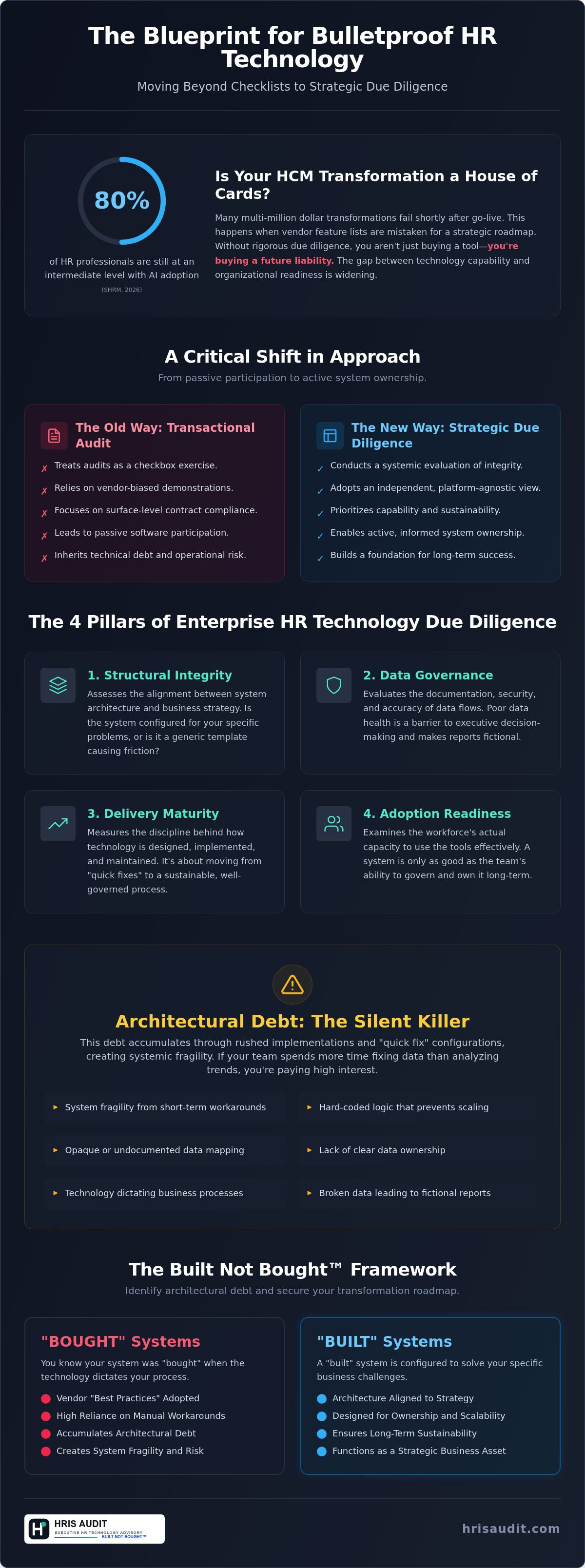
Why does your multi-million dollar HCM transformation feel like a house of cards three months after go-live? Most enterprise leaders mistake a vendor feature list for a strategic roadmap. They buy the software but inherit the debt. Without a rigorous HR technology due diligence process, you aren't just buying a tool. You're buying a future liability.
You've likely felt the frustration of inheriting a poorly governed system. You're not alone. With 80% of HR professionals still at an intermediate level with AI adoption according to 2026 SHRM data, the gap between technology capability and organizational readiness is widening. You need more than a demo. You need a structural audit.
This article shifts the focus. We're moving beyond surface-level checklists to a rigorous framework that ensures your infrastructure is built for long-term sustainability. We'll replace vendor bias with objective governance and systemic design. It's time to move from passive participation to active system ownership.
We'll provide a repeatable framework for assessing system health. You'll learn how to identify architectural debt before it's too late. We'll map a clear path to capability transfer. Your technology should support the business, not drain it.
Key Takeaways
- Stop treating audits as a checkbox exercise and start conducting a systemic evaluation of architectural integrity to detect hidden operational risks.
- Prioritize structural integrity and data governance as the foundational pillars of your HR technology due diligence to ensure long-term system sustainability.
- Eliminate vendor bias by adopting an independent, platform-agnostic perspective that puts your organization’s strategic needs before software features.
- Utilize the Built Not Bought™ framework and the Transformation Pulse Scan to identify immediate architectural debt and secure your transformation roadmap.
- Shift from passive software participation to active system ownership by leveraging independent client-side advisory to protect your interests post-go-live.
Beyond the Checklist: Why Traditional HR Due Diligence Misses the Technology Gap
Traditional audits are post-mortems waiting to happen. Most enterprise leaders treat the Due diligence process as a legal formality. They verify contracts. They check compliance boxes. They focus on the transaction. This approach is fatal for HCM success. True HR technology due diligence is not a checklist. It's a systemic evaluation of architectural integrity. It identifies whether your system is a cohesive engine or a collection of parts held together by manual workarounds.
Transactional diligence for M&A focuses on risk mitigation for the deal. Transformation diligence focuses on operational sustainability for the business. One protects the buyer; the other protects the user. Surface-level audits fail because they look at what the system is rather than what it does. They ignore the mechanical reality of how data moves, how processes scale, and how users interact with the machine. Without a structural audit, you inherit a legacy of failure before the first login.
The Hidden Cost of Architectural Debt
Architectural debt is the silent killer of HRIS environments. It accumulates through "quick fix" configurations and rushed implementations. These shortcuts create system fragility. You know your system was "bought" rather than "built" when the technology dictates your process. If your team spends more time fixing data errors than analyzing workforce trends, you're paying high interest on that debt. Poor data health isn't just an IT problem. It's a barrier to executive decision-making. If the foundation is cracked, the reports are fiction. You cannot drive a business on broken data.
Moving from Compliance Check to Capability Assessment
Verifying a software contract isn't enough. Modern HCM success requires a shift from compliance to capability. You must assess your internal team’s ability to govern and own the system long-term. Many organizations fail because they outsource the thinking to vendors. They then wonder why they lack control. Effective HR technology due diligence evaluates the human machinery alongside the software. It asks if your staff has the skills to sustain the platform post-go-live. Design for ownership. Don't just design for a date on a calendar. For a deeper look at this shift, explore Client-Side HR Technology Leadership. True ownership starts with a rigorous audit of your current maturity.
The Core Pillars of Enterprise HR Technology Due Diligence
A rigorous audit requires a multidimensional lens. It is not enough to look at a software's feature set. You must evaluate the system's ability to function as a strategic asset. Effective HR technology due diligence rests on four non-negotiable pillars. These pillars separate high-performing platforms from expensive failures.
- Structural Integrity: Alignment between system architecture and business strategy.
- Data Governance: Documentation, security, and accuracy of data flows.
- Delivery Maturity: The discipline behind how the technology is designed and delivered.
- Adoption Readiness: The workforce’s actual capacity to utilize the provided tools.
While Human Due Diligence often focuses on culture and leadership retention during transitions, the technical audit must dissect the mechanical foundations. If the foundation is flawed, the culture will eventually suffer from the friction of broken processes. You cannot fix a cultural problem with a system that creates daily frustration.
Assessing Structural Integrity and Data Health
Structural integrity asks a simple question. Is the system configured to solve your specific business problems, or did you adopt the vendor’s generic "best practices"? Auditing this requires comparing system configuration against actual business requirements. You must look for red flags. These include hard-coded logic that prevents scaling, opaque data mapping, and a lack of clear ownership for specific data fields. Organizations must operate within a robust HR technology governance framework to ensure these flows remain secure and accurate. Without this discipline, your data is a liability, not an insight.
Governance and the Built Not Bought Philosophy
Sustainability is earned, not purchased. A system must be "built" by the organization to be resilient. Many leaders make the mistake of outsourcing the "thinking" to a system integrator. They pay for implementation but fail to invest in understanding. This creates a dangerous dependency. Your HR technology due diligence must evaluate if the project is designed for a one-time go-live or for continuous optimization. If your team cannot explain the "why" behind a configuration, they don't own the system. They are merely renting it from the consultant. To build a truly independent capability, you need the right tools in your engine room. You can explore our Field Library frameworks to start building that internal discipline today.
Due Diligence in M&A vs. Digital Transformation
Pre-deal diligence is a snapshot. Transformation diligence is a motion. One is about the transaction; the other is about the machine's long-term health. In an M&A context, the goal is to identify liabilities before the ink dries. In a digital transformation, the goal is to ensure the system doesn't collapse under its own weight six months after go-live. Rigorous HR technology due diligence must bridge this gap. It's the difference between buying an asset and building a sustainable capability.
Transactional Risk vs. Operational Sustainability
A "passed" legal audit is no guarantee of an effective HRIS. Legal teams check for litigation risk and contract compliance. They don't check for architectural debt. You can have a perfectly legal system that is functionally broken. This creates the "go-live gap." It's the space where a project meets its launch date but fails the business. To avoid this, sponsors must ask harder questions. Can the internal team manage this configuration without external support? Is the data model built for your future state or your past limitations? Don't settle for a system that only works on paper. Demand operational sustainability.
Identifying Vendor Bias in the Diligence Process
Vendor bias is the silent tax on enterprise transformation. You cannot ask a system integrator to audit their own design. That isn't an audit; it's a marketing exercise. Big 4 firms often struggle with this conflict of interest. They sell implementation services while simultaneously offering advisory. This creates a circular logic that favors the consultant's methodology over the client's interests.
Objective diligence requires a platform-agnostic viewpoint. You need a "battle-tested" architect who has no stake in which software you choose or how many billable hours the implementation takes. This independent, client-side leadership is the only way to get a sober assessment of your system's health. For a deeper look at this dynamic, read our analysis on the Objective HCM Program Advisor. True independence is the foundation of structural integrity. Without it, you aren't auditing the system. You're just validating the vendor's roadmap.
Executing a Strategic HR Technology Audit: The Built Not Bought™ Framework
Execution is where strategy meets the machine. You cannot rely on a generic administrative checklist to manage a complex HCM ecosystem. The Built Not Bought™ framework provides a disciplined sequence for HR technology due diligence. It moves beyond passive observation into active structural validation. This framework ensures that every configuration decision aligns with the long-term health of the organization.
- Conduct a Transformation Pulse Scan: This diagnostic identifies immediate risks in your current trajectory. It highlights where the machinery is misaligned before you commit more capital.
- Review Architectural Design: Compare your system’s blueprints against established Field Library standards. Ensure the configuration supports long-term scaling rather than just meeting a deadline.
- Execute a Gate Review: Validate that the project meets specific structural criteria before moving to the next phase. This prevents the compounding of errors.
- Assess Capability Transfer: Verify the internal team's readiness to manage the system post-implementation. Ownership cannot be an afterthought.
- Document the "State of the Union": Provide executive leadership with a clear, objective report on system health and remaining risks. It is the sober truth required for strategic steering.
Request a Transformation Pulse Scan to detect your immediate project risks.
Gate Reviews and Sponsor Decision Support
Gate reviews are the regulatory valves of your transformation. They prevent the momentum of a project from overriding the logic of the business. A Gate Review is a strategic pause for alignment. It provides sponsors with the sober truth about program health. Are we building a sustainable asset, or are we just rushing toward an arbitrary date? Sponsors need objective data to make informed go/no-go decisions during the HR technology due diligence process. Without these gates, you're flying blind into a potential implementation failure.
Assessing Team Capability Transfer
The ultimate test of any audit is the transition of power. You must evaluate if the internal HR team is being trained for ownership or merely for participation. There is a fundamental difference between knowing the software and owning the process. If your team cannot explain the system’s logic without calling a consultant, the transfer has failed. Use Field Library workbooks to facilitate this assessment. Audit the skills, the documentation, and the governance maturity. If the team isn't ready to own the machine, the machine will eventually break under the weight of its own complexity.
Securing Your Transformation with Client-Side Advisory
The machinery of transformation is indifferent to your intent. It only responds to your architecture. Most enterprise leaders find themselves caught between a vendor’s sales quotas and an integrator’s billable hours. Neither of these parties is incentivized to tell you your foundation is cracked. This is where HR technology due diligence evolves from a passive review into an active defense of your strategic interests. You need a guardian of the client-side who prioritizes structural integrity over project velocity.
HRIS Audit leverages 30 years of industry experience to provide "tough love" expertise. We don't offer generic advice. We offer a sober, strategic perspective earned through decades of seeing what actually fails post-go-live. By integrating the Built Not Bought™ methodology into your HR technology due diligence, you move from being a passenger in your own transformation to being the architect of it. It’s time to stop renting your systems and start owning them.
The Role of the Independent Advisor
An independent advisor acts as the bridge between executive vision and the practical machinery of implementation. Big 4 firms often provide scale but lack the specific pattern recognition required for structural integrity. They follow a playbook; we audit the system. This objective viewpoint ensures that your technology serves the business strategy rather than the other way around. For a deeper dive into this discipline, review our guide on HR Technology Executive Advisory. Independence is the only way to secure an unbiased assessment.
Leveraging the Field Library and Pulse Scans
Visibility is the first step toward control. The Transformation Pulse Scan provides immediate visibility into the health of your current project. It detects the friction points and architectural debt that traditional audits ignore. From there, you can access the Field Library for licensed tools and workbooks designed to drive internal capability. These are not mere templates. They are the engine room of your diligence process. For those seeking the philosophical foundation of this approach, the Built Not Bought book offers the strategic roadmap for long-term sustainability.
The shift from audit to execution is where most organizations stumble. They identify the risks but lack the discipline to remediate them. Securing your transformation requires more than a report. It requires a commitment to structural integrity and a refusal to accept vendor-driven compromises. Your systems are the backbone of your workforce. Protect them accordingly.
Owning the Architecture of Your Future State
Your HRIS is the mechanical heart of your organization. It shouldn't be a black box managed by external parties. Rigorous HR technology due diligence demands a shift from passive participation to active structural ownership. We've moved beyond surface-level checklists to a framework that prioritizes architectural integrity and data governance. You've seen why traditional audits miss the mark and how the Built Not Bought™ method secures long-term sustainability. It's about ensuring your team can run the machine when the consultants leave.
Now is the time for a strategic pause. Don't wait for the post-go-live debris to settle before assessing your system's health. With 30+ years of executive advisory and a proprietary Field Library of frameworks, we provide the sober perspective your transformation deserves. You can identify architectural debt today or pay for it for years to come. Choose the discipline of structural integrity.
Request a Transformation Pulse Scan to identify your technology risks today.
Take control of your infrastructure. Your workforce and your bottom line depend on a foundation that is built to last. Build for the future you want, not the one you inherited.
Frequently Asked Questions
What is the primary goal of HR technology due diligence?
The primary goal is to validate the structural integrity and long-term sustainability of the platform. It moves beyond checking boxes to ensure the system architecture aligns with your business strategy. This process identifies hidden liabilities and architectural debt before they compromise your ROI. You aren't just verifying a software purchase. You are auditing the machinery that will drive your workforce operations for the next decade.
How does HR technology due diligence differ in M&A vs. a standard implementation?
M&A diligence is a transactional snapshot focused on mitigating immediate deal risks and legal liabilities. In contrast, implementation diligence is a continuous governance motion designed to ensure operational health post-go-live. One asks if the asset is worth buying. The other asks if the system is built to be sustained by your internal team. Both require a sober, strategic perspective to avoid inheriting a legacy of failure.
What are the most common red flags found during an HRIS audit?
Red flags include hard-coded configurations that prevent scaling, opaque data mapping, and a heavy reliance on manual workarounds. Another critical warning sign is the "capability gap," where the internal team cannot explain the logic behind the system's design. If your system integrator owns the process knowledge while your staff merely observes, you have a structural failure in progress. These flaws indicate a system that is fragile and expensive.
Why shouldn’t my system integrator perform the technology due diligence?
It is a fundamental conflict of interest. You shouldn't ask the person who built the house to conduct the structural inspection. System integrators are often incentivized by project velocity and billable implementation hours. They may overlook architectural flaws in their own work. Independent HR technology due diligence provides the platform-agnostic viewpoint required to protect your interests. It ensures the design prioritizes your long-term ownership over the vendor's roadmap.
How long does a comprehensive HR technology due diligence process take?
A comprehensive audit typically requires four to eight weeks, depending on the complexity of the enterprise ecosystem. This timeline allows for a methodical review of architectural designs, data governance models, and team readiness. Rushing this diagnostic phase is a strategic error. It takes time to peel back the surface-level marketing and reveal the mechanical reality of how the system actually functions under pressure.
What is "architectural debt" in the context of HR systems?
Architectural debt is the interest you pay on shortcuts taken during the design and implementation phases. It manifests as rigid configurations, fragile integrations, and a lack of scalable logic. This debt accumulates when a system is "bought" as a generic product rather than "built" as a strategic asset. Over time, the cost of maintaining these workarounds exceeds the original implementation price, leading to systemic failure.
How can a Pulse Scan help identify risks in a failing implementation?
A Transformation Pulse Scan acts as a high-speed diagnostic tool for your implementation. It uses pattern recognition from 30 years of industry experience to detect immediate project risks. This scan provides sponsors with the sober truth about whether the program is on track or heading toward a "go-live gap." It identifies friction points in the delivery model before they escalate into expensive, multi-year liabilities.
What documents are required for a strategic HR technology audit?
A strategic HR technology due diligence review requires architectural blueprints, data flow diagrams, and detailed governance charters. You must also provide project decision logs and capability transfer plans to assess team readiness. These documents serve as the evidence for a structural audit. They reveal whether the system was designed for organizational maturity or if it was merely configured to meet an arbitrary launch date.


