

Most enterprise HR technology projects are designed to fail before the first line of code is ever configured. It's a harsh reality. You've likely felt the disconnect between the polished sales pitch and the messy, fragmented reality of a system that your team can't actually manage. You're tired of "partners" who are more interested in their referral fees than your long-term operational maturity. You know that software alone isn't a strategy, yet the industry continues to treat it like a magic bullet.
Finding a genuine objective HCM program advisor requires looking past the glossy brochures. It's about structural independence. This article strips away the marketing veneer to reveal what true advisory looks like for enterprise transformation. You'll learn how to identify hidden vendor biases, establish rigorous governance, and build internal capability. We'll move from the myth of software-led success to the reality of client-side leadership. It's time to stop buying solutions and start building a sustainable foundation that works long after the consultants leave.
Key Takeaways
- Define true objectivity by stripping away the "platform-agnostic" label to reveal the financial incentives driving your consulting partners.
- Distinguish between technical implementation and strategic leadership to avoid the common trap of treating your system integrator as a neutral advisor.
- Learn to vet an objective HCM program advisor by assessing their structural independence and commitment to your internal capability.
- Challenge the assumption that firm size guarantees quality. Boutique expertise often provides the precise pattern recognition required for complex transitions.
- Transition toward a "Built Not Bought" philosophy to ensure your HR system remains functional and governed long after the external consultants depart.
The Myth of Software Neutrality in HCM Advisory
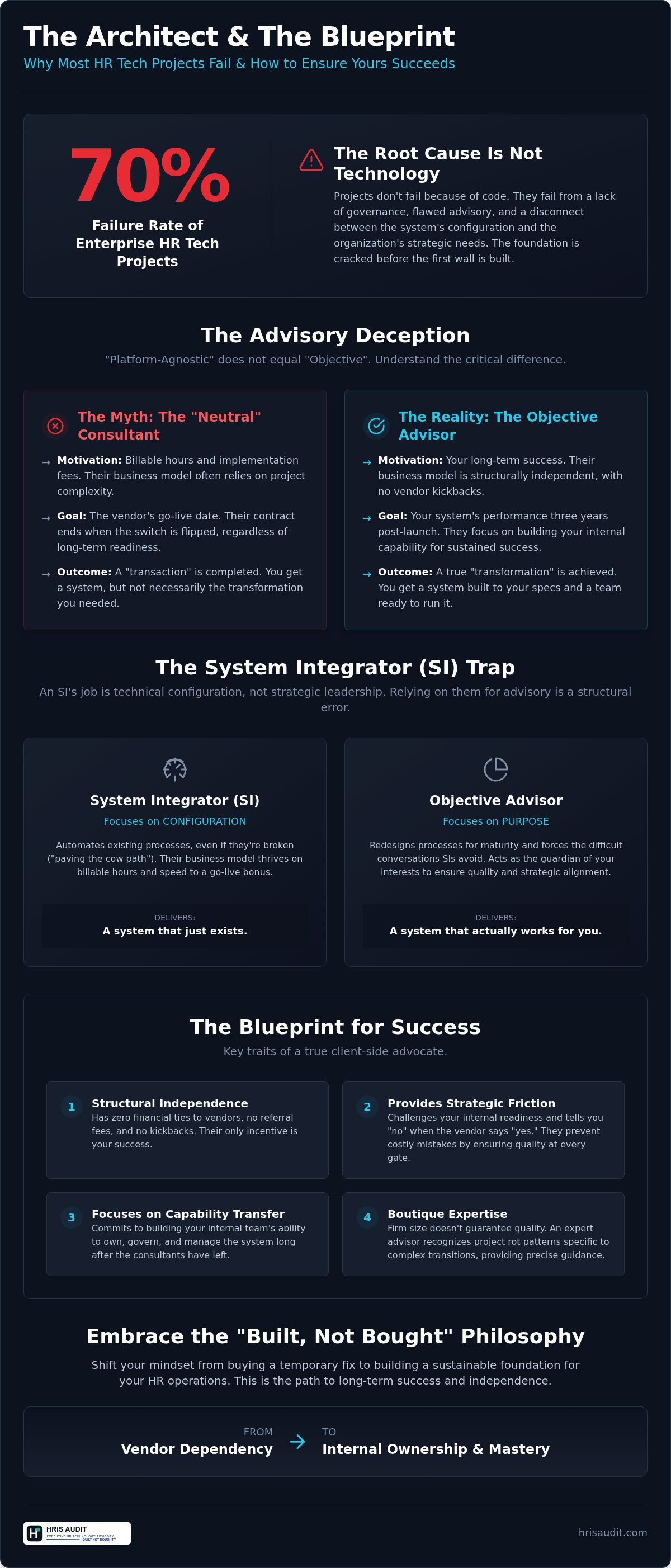
Industry data suggests a 70% failure rate for large scale HR technology projects. This isn't a failure of code. It's a failure of governance. Most organizations seek out "platform-agnostic" consultants, believing neutrality is the same as objectivity. It isn't. A consultant can be agnostic about which software you buy while remaining fully invested in how many billable hours they can extract from the implementation. A true objective HCM program advisor operates with structural independence. They have no financial ties to vendors. No kickbacks. No implementation incentives. They represent the client, not the ecosystem.
Structural integrity in Human resource management technology requires a shift in perspective. You aren't just buying a tool; you're designing a system. If your advisor's business model relies on the complexity of the rollout, their advice is compromised. Objectivity isn't a personality trait. It's a business model. It requires a sober, strategic perspective that prioritizes structural foundations over surface-level features.
Why 'Neutral' Is Not Enough
Neutrality is a passive state. It's a baseline requirement that offers zero strategic advantage. In fact, "neutral" advice often results in "safe" recommendations that avoid the hard truths your organization needs to hear. These consultants focus on the vendor's go-live date because that's when their contract ends. They prioritize the transaction over the transformation. An objective advisor looks at the horizon. They prioritize your long-term ownership and the system's performance three years after the consultants have left the building. They demand discipline. They challenge your internal readiness. They tell you "no" when the vendor says "yes."
Defining the Client-Side Advocate
The advisor acts as a seasoned architect. They serve as the bridge between high-level executive vision and the practical machinery of implementation. This isn't a role you can simply hire out to a system integrator. It's a capability that must be established through rigorous methodology. If you're unsure where your current project stands, a Transformation Pulse Scan can provide an immediate reality check. Client-side leadership serves as the ultimate guardian of the organization’s strategic interests. It ensures the system is built to your specifications, not the vendor's defaults. This distinction is the difference between a system that works and a system that just exists.
Myth: Your System Integrator (SI) is Your Strategic Advisor
Relying on your system integrator (SI) for strategic guidance is a fundamental structural error. They aren't your partner. They're a vendor with a specific technical mandate. Their business model thrives on billable hours and the swift attainment of go-live bonuses. If your internal processes are flawed, an SI will rarely stop the clock to challenge them. Why would they? Complexity increases their revenue. This creates a critical gap where capability transfer is sacrificed for speed. You're left with a system that works on paper but fails in practice because your team wasn't built to sustain it.
The Implementation vs. Advisory Gap
SIs focus on configuration. Advisors focus on purpose. A standard implementation is a commodity product. Your business isn't a commodity. Without a client-side advocate, you'll receive a system configured to the vendor's defaults rather than your specific organizational requirements. This is "paving the cow path." It's the act of automating a broken process instead of redesigning it for maturity. An objective HCM program advisor identifies these structural weaknesses early. They force the difficult conversations that SIs avoid to keep the project on schedule. This distinction is explored in our guide on Strategic Advisory vs. System Integration: The Critical Gap.
Sponsor Decision Support
Program sponsors need decision support that isn't filtered through the SI's project manager. You need an architect who has seen this movie before. Someone who recognizes the patterns of project rot before they manifest as system failure. An objective HCM program advisor provides the friction necessary to ensure quality. They don't just attend meetings. They manage the gate reviews. They vet the technical workstreams. They ensure the machinery actually fits the building. They act as the guardian of your interests, ensuring the SI delivers what was promised, not just what was easiest to configure. To understand how to lead these transitions effectively, many executives turn to the Built Not Bought book as their primary operational manual. It provides the framework for maintaining control when the pressure to go-live threatens to derail long-term sustainability.
Myth: Scale Equals Safety in HCM Consulting
Large consulting firms sell the illusion of safety through sheer headcount. It's a comfort blanket for risk-averse executives. But scale is not a substitute for strategy. These firms often deploy "B-teams" of junior associates who follow a rigid, one-size-fits-all playbook. This approach prioritizes the firm’s internal methodology over your specific organizational maturity. You don't need a thousand bodies. You need one architect who understands the structural stress points of your project. This is the primary value of an objective HCM program advisor. They bring the specialized pattern recognition required to navigate complex transformations without the baggage of a massive consulting machine.
The Big 4 Alternative
Specialized advisory is about depth, not breadth. Large firms are designed for volume. Boutique firms are designed for outcomes. When you engage a specialized objective HCM program advisor, you’re accessing 30+ years of industry experience directly. You aren't subsidizing a partner's overhead or a junior consultant's training. You're investing in executive-level decision support. This level of leadership is essential for steering a program through the inevitable "trough of disillusionment" that follows a major go-live. For a detailed breakdown of what to look for in a partner, see our HR Transformation Program Leadership: A Buying Guide.
Custom Frameworks vs. Licensed Libraries
Most consultants start with a blank page. They call it "discovery." We call it billable delay. There is no need to reinvent the wheel for every transformation. Objective advisory relies on high-integrity structures that are already battle-tested. Utilizing a licensed Field Library allows your team to move from theory to execution in weeks, not months. Frameworks like the Enterprise HR Technology Governance Framework provide the immediate structural integrity your project needs to survive executive scrutiny. This is the essence of the "Built Not Bought™" philosophy. It's about empowering your internal team to own the system, rather than remaining dependent on an external firm's expensive, proprietary methodology. Ownership is built. It isn't something you can buy from a vendor's catalog.
Structural Integrity: Assessing Advisor Independence
Integrity is a structural requirement. It isn't an optional virtue. When you vet an objective HCM program advisor, you must look past the professional biography and examine the underlying business model. Incentives drive behavior. Always. If an advisor receives referral fees from software vendors, their advice is a sales pitch in disguise. If their methodology requires an endless stream of junior consultants, their focus is on their margin, not your maturity. True independence requires a clean break from the vendor ecosystem. It demands a partner who has no skin in the software game.
How do you verify this independence? Use this five-point diagnostic to assess your advisory support:
- Do they accept commissions or kickbacks from software vendors?
- Do they bring proprietary tools, such as a licensed Field Library, to accelerate your team?
- Is their contract tied to your internal capability transfer or just a go-live date?
- Can they demonstrate a history of halting projects to fix structural flaws?
- Do they prioritize your long-term ownership over their own billable longevity?
The Pulse Scan: An Objective Diagnostic
Consulting is often a subjective exercise in "gut feel." Executives need evidence. A Transformation Pulse Scan detects risk early by providing a mechanical diagnostic of program health. It replaces ambiguity with data. It identifies where the machinery of your implementation is grinding against the reality of your organization. This isn't about blaming the system integrator. It's about providing the sponsor with the decision support needed to course-correct before the budget is exhausted. Evidence-based leadership is the only way to move from a state of reactive crisis to proactive governance.
Evaluate your transformation health now
Capability Transfer and Ownership
The ultimate goal of an objective HCM program advisor is to become unnecessary. This is the "Built Not Bought" mindset in action. Sustainable systems aren't delivered. They're cultivated. If your advisor isn't actively transferring knowledge to your internal team, they're building a dependency. They're creating a system that will collapse the moment they leave the building. An advisor with structural integrity focuses on building your internal "muscles." They provide the frameworks, the governance, and the discipline. You provide the ownership. This partnership ensures that the system remains functional, governed, and relevant long after the final invoice is paid. Ownership is the only true measure of success.
The Built Not Bought™ Path to Sustainable Success
True sustainability isn't delivered in a box. It's built through discipline. Most organizations treat an HCM rollout as a procurement exercise. They buy the software. They buy the integration. They wonder why the system feels like a foreign object six months after launch. An objective HCM program advisor ensures that your organization doesn't just survive the transition but gains the capability to lead it. This is the core of the "Built Not Bought" philosophy. It's a refusal to accept the industry standard of dependency. Success is not a destination reached at the go-live milestone; it's a state of continuous operational maturity.
The Built Not Bought book serves as the definitive manual for this shift. It provides the blueprints for leaders who are tired of the "go-live and go-fail" cycle. For those ready to move beyond theory, the Transformation Studio provides the environment where strategy meets delivery. It's a controlled space to align your executive vision with the practical machinery of your HRIS. This isn't just about technical configuration. It's about systemic design. It's about ensuring your people, processes, and platforms are integrated into a single, high-performance engine. It's about building internal muscles and establishing a legacy of self-sufficiency.
Reclaiming the Narrative
Stop acting like a passive purchaser. Start acting like an active architect. The long-term ROI of your technology isn't found in the software's feature set. It's found in your team's ability to govern it. When you invest in client-side leadership, you're buying insurance against obsolescence. You're ensuring that your structural foundations are solid enough to support future growth. The future of HRIS belongs to the disciplined. It belongs to those who value ownership over participation. Does your current advisor challenge your assumptions, or do they simply echo your vendor's promises?
Next Steps for Executives
The first step toward reclaiming control is a sober assessment of your current trajectory. If your project feels like it's drifting, it probably is. Engaging an objective HCM program advisor is the first motion in reclaiming your transformation's trajectory. Initiate a program reset. Perform a health check. Utilize the HRIS Audit frameworks to establish a new standard of governance. These tools provide the structural integrity required to vet recommendations and enforce accountability. Don't wait for a crisis to demand clarity. Reclaim your role as the guardian of your organization's interests. Independent oversight is not a luxury; it is a structural necessity for enterprise integrity.
Securing Your Structural Foundation
The gap between a failed implementation and a sustainable system is defined by the quality of your oversight. You've seen how neutrality often masks deep-seated vendor biases. You've recognized that scale is no substitute for the specialized pattern recognition of a battle-tested architect. True enterprise transformation demands a departure from the "bought" solutions that prioritize vendor milestones over your internal maturity. It requires a commitment to structural integrity that only a 100% independent objective HCM program advisor can provide.
Reclaiming your trajectory starts with a refusal to accept the status quo. By utilizing a proprietary Field Library and 30 years of industry experience, you can move from reactive troubleshooting to proactive governance. Success is earned. You don't have to navigate these complex transitions alone, but you do have to lead them. Ownership isn't a gift from your software provider; it's a capability you build.
Reclaim your transformation with the Built Not Bought™ method
The path to a resilient HR system is clear. It's time to stop managing software and start leading your organization toward a more disciplined, self-sufficient future.
Frequently Asked Questions
What is the difference between an HCM program advisor and a system integrator?
An objective HCM program advisor represents the client’s strategic interests. They bridge the gap between executive vision and technical delivery. In contrast, a system integrator (SI) is a technical vendor focused on configuration and meeting a go-live date. SIs prioritize the "how" of software. Advisors prioritize the "why" of the business system. This distinction ensures your organization builds a sustainable foundation rather than just installing a tool.
Why is objectivity so important in HR technology transformation?
Objectivity is the primary defense against project rot. Without it, decisions are often influenced by vendor referral fees or implementation bonuses. An objective advisor has no financial ties to the software ecosystem. This independence allows them to provide sober, strategic advice that prioritizes your organizational maturity. They can challenge flawed internal processes that a biased consultant might ignore to keep the project moving. It's about structural integrity, not just software knowledge.
How do I know if my current HCM consultant has a conflict of interest?
Examine the consultant’s revenue model. Ask if they accept commissions from software vendors or if they are incentivized by the number of implementation hours billed. Conflicts of interest are often baked into the business structure of large firms. If your consultant’s primary goal is a successful "hand-off" to their own implementation team, their strategic advice is compromised. True objectivity requires a clean break from vendor incentives and referral-based revenue streams.
What does 'Built Not Bought' mean for my HR strategy?
"Built Not Bought" is a shift from passive procurement to active architecture. It’s a methodology that prioritizes internal ownership and capability transfer. Instead of treating your HRIS as a one-time purchase, you treat it as a living system that your team must govern. This approach ensures long-term sustainability. It moves the focus from buying a solution to building the internal muscles required to manage a complex transformation and maintain its performance after go-live.
Can an objective advisor help rescue a failing implementation?
An objective HCM program advisor is often the only one capable of performing a successful program reset. They identify the structural stress points that lead to implementation failure. While an SI might continue to bill hours on a failing project, an independent advisor provides the friction necessary to fix flawed configurations. They act as a seasoned architect, providing the decision support needed to stabilize the project before go-live. They rescue systems by demanding discipline.
How much should I budget for independent client-side leadership?
Budgeting for client-side leadership is an investment in risk mitigation. Professional fees for advisory services should be viewed relative to the high failure rate typical of enterprise HR technology projects. While specific costs vary, organizations should account for the strategic oversight required to manage the implementation vendor. This investment ensures that the capital spent on software and integration actually results in a functional, sustainable system that works long after the final invoice is paid.
What tools does an objective HCM advisor use to measure program health?
High-integrity advisors use mechanical diagnostics rather than subjective opinions. They utilize tools like the Transformation Pulse Scan to detect project risks early. Licensed Field Libraries provide battle-tested workbooks and governance frameworks that replace billable "discovery" phases. These evidence-based tools move the narrative from "gut feel" to structural data. They provide sponsors with the clarity needed to make informed decisions about program health and technical readiness.
Is an independent advisor necessary for a small to mid-sized enterprise?
Independent oversight is essential regardless of company size. Small to mid-sized enterprises often have less internal capability to manage complex HRIS transitions. They are also more vulnerable to the high cost of failure. An objective advisor provides the pattern recognition that smaller teams lack. This oversight ensures that the organization isn't bullied by aggressive vendor sales tactics or saddled with a system that is too complex for their specific operational reality.


