

Most enterprise HR projects are architectural failures disguised as technology successes. You sign the contract, the system integrator arrives with a "standard" blueprint, and your internal team is sidelined by a process meant to empower them. It's a cycle of dependency that ends the moment the vendor leaves. If you feel your project is slipping into a "check-the-box" implementation, you're right to be concerned. Most systems are built for the go-live, not for the decade of operation that follows.
Securing independent HR transformation program leadership is the only way to break this cycle. You need a battle-tested architect who prioritizes your structural integrity over a vendor's configuration template. This guide provides a strategic framework for buying client-side success. We'll explore how to establish clear governance, ensure genuine capability transfer, and build a system that your team actually owns. It's time to stop renting your transformation and start building a foundation that lasts.
Key Takeaways
- Shift your focus from simply buying a software package to building a permanent organizational capability.
- Recognize the critical role of HR transformation program leadership in bridging the gap between executive vision and technical implementation.
- Differentiate between system integrators focused on deployment speed and client-side advisors focused on long-term business outcomes.
- Demand strategic governance that provides executive sponsors with the sober truth instead of superficial status updates.
- Adopt a methodology that ensures internal ownership and structural integrity from the first day of the project.
The Structural Gap in HR Transformation Program Leadership
HR transformation isn't a transaction. It's a structural overhaul. Many executives treat it like a software purchase. They sign the contract and expect the vendor to drive the bus. This is a fundamental error. Effective HR transformation program leadership serves as the critical bridge between executive vision and technical execution. It's the difference between buying a tool and building a permanent organizational capability.
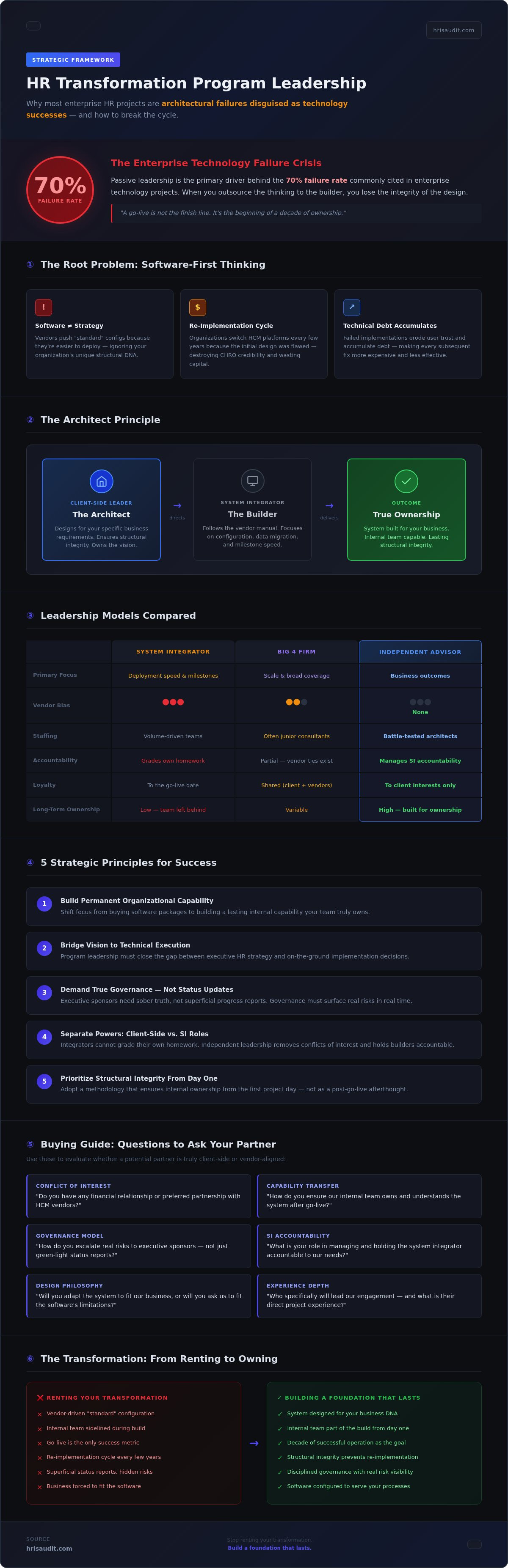
Consider the architectural metaphor. You don't hire a construction crew to design your headquarters. You hire an architect first. In the world of HRIS, the system integrator is the builder. They follow the manual. The architect is your client-side leader. They ensure the system's foundation is built for your specific business requirements, not just the vendor's "best practices." Passive leadership is the primary driver behind the 70% failure rate often cited in enterprise technology projects. When you outsource the thinking to the builder, you lose the integrity of the design.
The Problem with Software-First Thinking
Software is a tool, not a strategy. Leadership must define the destination before configuration begins. Vendors often push "standard" configurations because they're easier to deploy. However, these templates frequently ignore the unique structural DNA of your organization. A go-live is not the finish line. It's the beginning of a decade of ownership. If your team hasn't been part of the build, they won't know how to maintain the machine. You shouldn't settle for a system that forces you to change your business to fit its code.
The High Cost of Implementation Failure
Failed implementations carry a heavy price. It's more than just a missed date. It's the accumulation of technical debt and the erosion of user trust. Many organizations find themselves in a "re-implementation" cycle, switching HCM platforms every few years because the initial design was flawed. This cycle destroys the credibility of the CHRO and wastes capital. Strong HR transformation program leadership provides the disciplined governance needed to protect your reputation and ensure the system works long after the consultants have left. You can learn more about this philosophy in the Built Not Bought book. It's time to stop the cycle of expensive, superficial fixes and start investing in structural integrity.
Evaluating Leadership Models: Client-Side Advisory vs. System Integration
The system integrator is a builder. Their incentive is the finish line. A System Integrator (SI) focuses on the machine's assembly: software configuration, data migration, and milestone completion. While these are necessary technical functions, they don't equate to HR transformation program leadership. The SI model is built for speed and volume. It's not built for your long-term organizational health.
Integrators cannot grade their own homework. It's a fundamental conflict of interest that leaves the client exposed. When the builder also acts as the inspector, structural flaws are often ignored to meet a go-live date. Independent leadership removes this conflict. An independent advisor prioritizes business outcomes, internal readiness, and governance over mere technical milestones. They ensure the system fits the business, rather than forcing the business to bend to the software's limitations. You can explore the structural frameworks required to maintain this level of objectivity.
The Big 4 vs. Boutique Independent Advisors
The choice between a global firm and a boutique advisor is a choice between scale and specialized integrity. Big 4 firms offer massive reach but often carry hidden burdens. They frequently maintain financial alliances with software vendors, creating a "preferred partner" bias. Their projects are often staffed by junior consultants who lack the pattern recognition of a seasoned architect. Boutique advisors provide battle-tested expertise. They offer total objectivity because their only loyalty is to the client's interests. They don't have a software quota to fill.
The Role of the Independent HCM Program Advisor
An independent advisor acts as the "owner’s representative." They manage the SI's accountability and bridge the gap between high-level HR strategy and technical reality. This role is about discipline. It's about ensuring that every configuration choice aligns with the original executive vision. Effective HR transformation program leadership requires more than just project management; it requires the authority to challenge the vendor and the technical depth to know when you're being sold a shortcut. By maintaining this separation of powers, you ensure the transformation is built for ownership, not just a successful exit for the consultants.
Core Competencies of Effective HR Transformation Leadership
Transformation isn't a series of checked boxes. It's a structural evolution. Real HR transformation program leadership requires a shift from passive oversight to active architecture. You don't just manage a timeline; you manage structural integrity. This requires four specific pillars: strategic governance, decision support, capability transfer, and structural design. Without these, you aren't leading a project. You're simply watching a vendor spend your budget while your team remains on the sidelines.
Effective leaders provide the "sober truth" to executive sponsors. They don't hide behind polished slide decks. They identify the hard choices early, ensuring that every design decision serves the long-term business strategy. This isn't about being liked by the implementation partner. It's about being the guardian of the client's interests and the integrity of the final system.
Mastering the Gate Review Process
Weekly status reports are often a trap. They focus on tasks rather than readiness. Most project dashboards show "green" status right up until the moment the system fails during user acceptance testing. Disciplined leadership replaces these superficial updates with rigorous gate reviews. These are hard stops where the project cannot proceed until specific structural criteria are met. You don't move from design to configuration based on a calendar date. You move based on evidence of design integrity. You can learn about our framework for structural integrity to see how we define these critical transitions.
Ensuring Internal Capability Transfer
The greatest risk in any transformation is consultant dependency. If your team cannot explain the "why" behind a configuration choice, they don't own the system. They're just renting it. High-impact HR transformation program leadership forces internal staff into the design process from day one. It's about building the internal muscle required to maintain the machine after the consultants exit. We measure readiness by the team's ability to troubleshoot and evolve the system independently. If they can't do it during the build, they won't do it after go-live.
This "Built Not Bought" philosophy ensures the system is an organic extension of your business logic. It's not a bolted-on vendor template. It requires a commitment to discipline over convenience. It means choosing the hard path of internal growth over the easy path of total outsourcing. In the end, the only system that works is the one your team is prepared to lead.
A Buying Guide for Selecting Your Transformation Partner
Selecting the right HR transformation program leadership is a high-stakes architectural decision. It’s not about finding a project manager who can track tasks in a spreadsheet. It’s about finding an advisor with the pattern recognition to see structural failure before it manifests. You need an advocate who prioritizes your organization’s long-term ownership over a vendor’s quarterly targets. This requires vetting for three non-negotiable traits. Experience. Independence. Methodology.
Look for an advisor with over 30 years of battle-tested experience. They should have seen the evolution of the industry and the recurring failure modes of large-scale implementations. Independence is equally critical. If your advisor has financial ties to software vendors, their objectivity is compromised. Finally, demand a proven framework. A methodology like Built Not Bought™ ensures the system is an asset you own, not a liability you lease. These leaders should arrive with a Field Library of diagnostics and workbooks to accelerate your design process without reinventing the wheel.
Questions to Ask Potential Advisors
Don't settle for generic case studies. Ask provocative questions that reveal tactical depth. How do they handle the inevitable friction between your business requirements and the system integrator’s "standard" configuration? What is their specific mechanism for transferring technical capability to your internal team? How do they detect the "silent" risks that don't show up on a green status report? Their answers should be rooted in logic and structural design, not corporate buzzwords.
Assessing Program Health Early
The cost of remediation increases exponentially the closer you get to go-live. An early audit is a strategic investment that saves millions in post-launch repairs. You can use a Transformation Pulse Scan to identify gaps in your HR transformation program leadership before the first line of code is configured. This is about establishing a baseline of integrity. A seasoned advisor brings the objectivity required to tell you the sober truth about your project’s health, even when that truth is uncomfortable for the executive team.
Secure independent leadership for your transformation
The HRIS Audit Approach: Leadership for Sustainable Outcomes
Architecture is not a suggestion. It is a requirement. HRIS Audit provides the HR transformation program leadership needed to ensure your system survives the departure of your implementation partner. We act as your guardian. We protect your interests. Our approach moves beyond the superficial "go-live" to focus on sustainable performance. This is client-side leadership as a specialized service. It is about structural integrity. It is about ownership.
The Transformation Studio is where strategy meets the machine. It is a hands-on environment designed to transfer expertise from battle-tested architects to your internal team. We don't believe in the black-box model of consulting. If your team doesn't understand the configuration, they can't own the outcome. We provide the diagnostics and workbooks required to bridge that gap. This ensures that the system you launch is one you can actually operate. The goal is moving from the simple milestone of a "Go-Live" to the long-term reality of "Sustainable Performance." A system that doesn't evolve with your business is a system that is already failing.
The Built Not Bought™ Philosophy
Most companies rent their transformation. They buy a vendor's configuration template and wonder why it doesn't fit their unique business logic. We believe in building. You can explore the Built Not Bought book to understand the depth of this philosophy. This is about designing systems that reflect your organization's DNA. It requires a fundamental shift in how you view technology. For a deeper dive into the strategic implications, read about Built Not Bought HR Strategy: Designing Sustainable HR Transformation. We don't just implement software. We build internal capacity. We ensure the system is built for the decade, not just the quarter.
Next Steps for Executive Sponsors
If your program has lost its way, you don't need more consultants. You need a reset. Start by engaging for a Transformation Pulse Scan to baseline your project's health. This diagnostic identifies structural gaps in your HR transformation program leadership before they become catastrophic failures. It is a sober assessment of reality. It provides the pattern recognition needed to course-correct. Once the baseline is established, the path to ownership becomes clear. You stop reacting to vendor timelines and start leading based on structural readiness.
Integrity is the only foundation for long-term success. Don't let your transformation become another statistic of enterprise failure. Contact HRIS Audit for a confidential advisory discussion and stop settling for vendor-driven outcomes. It's time to build a system you actually own.
The Path to Ownership Starts with Structural Integrity
Transformation isn't a single event. It is a continuous state of operational excellence. To achieve this, you must move beyond the vendor-led model that leaves your team dependent and your system rigid. True HR transformation program leadership demands a commitment to structural design and internal capability. It requires an advisor who values your long-term ownership over a successful go-live date. By prioritizing independent, client-side oversight, you protect your investment and your reputation.
We believe that systems should be built, not just bought. This means establishing a disciplined governance model that provides the sober truth at every stage. It means ensuring your internal team has the muscle to lead the system long after the consultants have exited. HRIS Audit brings over 30 years of industry experience and the proprietary Built Not Bought™ Framework to every engagement. We provide a completely independent perspective that ensures your system is an asset, not a liability. You don't have to settle for a standard configuration that ignores your organizational DNA.
Secure your transformation with a Pulse Scan
You have the power to build a foundation that lasts. Your organization deserves a system that reflects its unique structural integrity.
Frequently Asked Questions
What is the role of a client-side HR transformation leader?
A client-side leader acts as the owner's representative, ensuring the final system aligns with the original executive vision. They don't just manage a timeline; they manage structural integrity. This role provides the HR transformation program leadership needed to challenge vendor assumptions and prioritize internal readiness. By focusing on governance and decision support, they protect the organization from the common trap of passive implementation and vendor-led "standard" configurations.
How does an independent advisor differ from a system integrator?
The difference lies in the incentive structure. A system integrator is a builder focused on technical configuration and hitting the go-live milestone. An independent advisor is an architect focused on business outcomes and long-term ownership. The advisor provides objective oversight, essentially grading the integrator's homework. This separation of powers ensures that shortcuts taken for speed don't result in permanent structural debt or a system that fails to meet unique business requirements.
Why do most HR transformation programs fail after go-live?
Failure usually stems from a lack of internal capability transfer. When consultants build a system in a vacuum, your team doesn't learn how to operate the machine. Post-launch, the organization is left with a "standard" configuration that ignores its unique DNA. Without the right HR transformation program leadership, the system becomes a rigid liability rather than a strategic asset. You end up renting your transformation instead of owning it for the long term.
When is the best time to engage an HR transformation program leader?
Engagement should happen during the architectural design phase, ideally before you sign a contract with a system integrator. Early involvement allows the advisor to shape the governance framework and define the criteria for success. Waiting until the build phase often leads to expensive remediation. By establishing a foundation of independent leadership early, you prevent the technical debt and misaligned configurations that cause most enterprise technology projects to stall or fail.
What are the key components of the Built Not Bought™ method?
The Built Not Bought™ method is a philosophy of ownership and integrity. It prioritizes designing systems that reflect your organization's specific business logic rather than generic vendor templates. Key components include hands-on capability transfer, rigorous gate reviews, and the use of structural diagnostics. It's a methodical approach to building internal "muscle" so your team can lead the system independently once the advisors depart, ensuring the technology serves the strategy, not the other way around.
Can an independent advisor help with a failing Workday or Oracle implementation?
Yes, recovery is possible through a disciplined reset. An independent advisor uses pattern recognition to identify exactly where the implementation diverged from the business requirements. This process often begins with a diagnostic scan to baseline the project's health. By resetting the governance motions and clarifying decision support, an advisor can guide a failing project back toward structural integrity, user adoption, and the business outcomes promised in the original business case.
How much does HR transformation program leadership typically cost?
The cost of independent leadership is an investment in risk mitigation. While fees vary based on project complexity, the price of failure is always higher. Organizations should view this as insurance for their multi-million dollar software investment. Professional advisory prevents the "re-implementation" cycle that forces companies to redo their HCM systems every few years. It's about spending strategically to avoid the high cost of technical debt and internal team burnout.
What tools should an HR transformation leader provide?
A seasoned leader provides more than just advice; they provide a toolkit for success. This includes proprietary frameworks, diagnostic scans, and a field library of workbooks. These tools accelerate the design process and ensure that configuration choices are rooted in logic. Effective leadership also involves providing executive sponsors with the "sober truth" through objective reporting and clear criteria for moving between project phases, ensuring the system is built for sustainable performance.


