

The most dangerous moment in your HRIS transformation isn't the go-live. It's the gate review you just rubber-stamped. Most organizations treat these sessions as ceremonial check-boxes, designed to satisfy a project plan rather than verify a system's health. You feel the tension already. You're likely feeling held hostage by your System Integrator, staring at "watermelon" project reports that are green on the outside but bleeding red underneath. You suspect the system being built doesn't actually meet your long-term business needs. You're right to be concerned.
A true HR system gate review isn't a milestone; it's a structural audit. It's the moment you stop being a passenger and start acting as the architect. We'll show you how to use these reviews as strategic Pulse Scans to ensure your transformation survives the transition to reality. You'll gain a clear, objective framework to evaluate project health and the confidence to reset if the structural integrity isn't there. It's time to move past mere participation. Let's ensure your system is Built Not Bought, owned by your team and ready for the complex 2026 regulatory landscape.
Key Takeaways
- Shift from ceremonial milestone tracking to a disciplined governance motion that verifies the structural integrity of your HRIS transformation.
- Identify the "watermelon" project effect by confronting System Integrator reporting with objective, client-side reality checks.
- Conduct a rigorous HR system gate review to audit strategy alignment and ensure the configuration directly addresses your primary business pains.
- Apply the "Built Not Bought" philosophy to reclaim internal ownership and stop being held hostage by external implementation partners.
- Implement a framework for decision support that empowers leadership to halt or reset projects built on unsustainable data foundations.
Beyond the Rubber Stamp: Redefining the HR System Gate Review
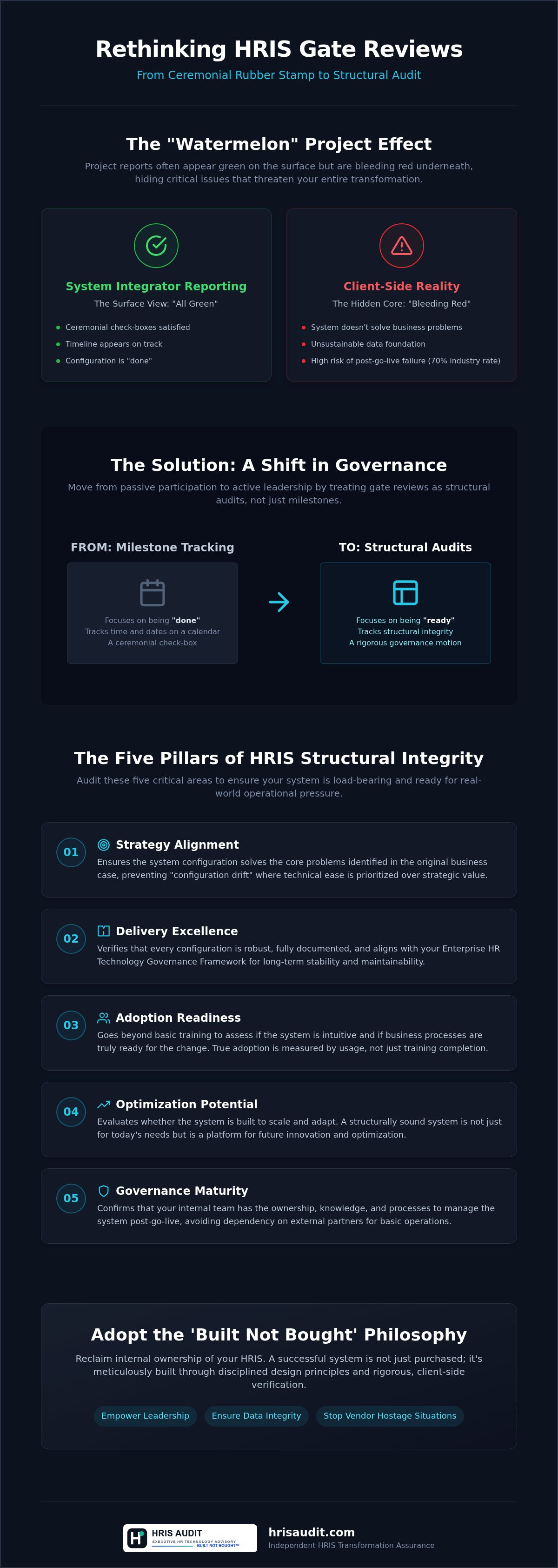
A gate review is not a task completion check. It is a governance motion. Most project teams treat these sessions as a formality to keep the timeline moving, but this passivity is exactly where transformations begin to bleed. Traditional project management often fails in HRIS because it focuses on being "done" rather than being "ready." A system can be 100% configured according to a technical specification and yet remain 100% incapable of solving a business problem. This gap between configuration and capability is where projects die.
Success requires a psychological shift. You must move from being a passive participant in your vendor's project plan to becoming a client-side leader. When you treat the HR system gate review as a strategic audit, you reclaim ownership. You stop accepting "green" status reports at face value and start demanding evidence of structural integrity. The cost of a failed gate is high. It manifests as technical debt, poor user adoption, and an eventual, expensive program reset that costs far more than a temporary delay in the project timeline.
The Difference Between a Milestone and a Gate
Milestones track time; gates track structural integrity. A milestone tells you that you've reached a date on a calendar. A gate tells you if the machine you're building is actually safe to operate. This methodology draws from the established Phase-gate process, yet it requires a specialized lens for human capital technology. Sponsors must be willing to say no. If the evidence doesn't support a "Go" decision, the project must stop. Moving from vendor-led reporting to client-side verification is the only way to ensure the system is "Built Not Bought."
The Anatomy of a High-Stakes Gate Review
You need the right people in the room. This goes beyond the PMO and the System Integrator. You need business owners who will live with the consequences of the design and technical architects who can spot fragile configurations. A high-stakes review requires three essential inputs: objective evidence of configuration, independent analysis of that evidence, and a sober assessment of residual risk. Often, a Transformation Pulse Scan is the only way to get this level of objectivity.
Structural integrity in an HRIS project is the state where technical configuration, data architecture, and business process design align perfectly to sustain the organization’s long-term operational requirements without manual intervention or systemic collapse. Without this integrity, you're building on sand. A rigorous HR system gate review ensures that every component of the system is load-bearing and ready for the pressures of go-live.
The Five Pillars of HRIS Structural Integrity
Structural integrity in a digital transformation is the load-bearing capacity of your system. It's the difference between a platform that scales and one that collapses under the weight of real-world operational pressure. During a HR system gate review, you aren't just checking off completed tasks. You're auditing five critical pillars: Strategy Alignment, Delivery Excellence, Adoption Readiness, Optimization Potential, and Governance Maturity. If any pillar is fractured, the entire program is at risk. Industry data suggests a 70% failure rate for HR tech projects post-go-live, often because these structural foundations were never verified.
Strategy and Delivery: The Foundation
Strategy alignment ensures the system actually solves the problems identified in your original business case. It's common for configuration drift to occur, where the System Integrator (SI) takes the path of least resistance to meet a timeline. This results in a system that works technically but fails strategically. Delivery excellence requires that every configuration is robust and fully documented. You must verify that the build matches the Enterprise HR Technology Governance Framework to ensure long-term stability.
The HR system gate review must expose where the SI has prioritized speed over structural soundess. Are you building a bespoke solution that you can't maintain, or are you following disciplined design principles? If you're unsure, reviewing the principles in the Built Not Bought book can help you reset your expectations for delivery quality.
Adoption and Optimization: The Sustainability Layer
Training is not adoption. A project can be "done" in terms of technical deployment while the workforce remains completely unready. Adoption readiness measures the organization’s actual capability to use the new machinery. This requires a genuine capability transfer. Is your internal team learning to fish, or are they simply buying the fish from consultants? If the knowledge remains with the SI, you've failed the gate.
Designing for Day 2 is the final test of sustainability. You must ensure the system doesn't break the moment the consultants leave the building. This involves assessing optimization potential: is the architecture flexible enough for 2026 regulatory shifts, such as the new state-mandated Paid Family and Medical Leave programs? A system with integrity is one that is owned, understood, and optimized by the people who use it every day. You aren't just building for today's go-live; you're building for the next decade of organizational maturity.
SI Reporting vs. Client-Side Reality: Exposing the Gaps
Your System Integrator (SI) provides a dashboard. It's glowing green. Every milestone is marked as complete. Yet, your internal team is drowning. This is the "Watermelon" effect. It's the most common failure pattern in HRIS transformation. The project looks healthy on the surface but is bleeding red internally. A standard HR system gate review often fails because it relies on the SI's own reporting. This is a fundamental conflict of interest. The SI is incentivized for a successful go-live to trigger milestone payments. They are rarely incentivized for your organization's long-term ownership or structural integrity.
Relying solely on vendor-led status reports is a governance failure. SIs are built for speed and deployment, not necessarily for the nuances of your specific organizational maturity. To protect your investment, you must validate their claims against reality. Independent advisory acts as a guardian of the client's interests, providing the pattern recognition necessary to spot risks before they become permanent technical debt.
Common Blind Spots in Vendor-Led Reviews
SIs often push "standard" functionality at the expense of your business logic. This simplifies their implementation but ignores the complexities of your operating model. They frequently underestimate the gravity of data migration. "Dirty data" gets moved into a new, expensive system, ensuring the same failures occur at a higher price point. This is the Success Trap. You meet the deadline and hit the budget, yet the system is unusable for the workforce. You've bought software, but you haven't built a capability.
The Independent Pulse Scan: A Diagnostic Approach
To break this cycle, you need objectivity. A Transformation Pulse Scan acts as a diagnostic audit. It looks past the SI’s status reports to evaluate the actual health of the build. Internal teams are often too close to the project to see the cracks. They've invested too much emotional capital to admit the foundation is failing. Independent advisory provides objectivity as a service. It gives leadership the evidence needed to challenge SI claims during the HR system gate review.
This motion is about transitioning from a "bought" mindset to a "built" organizational capability. You must verify that the knowledge transfer is real. If your team cannot explain the configuration without the consultant in the room, the project lacks structural integrity. Don't let a green dashboard blind you to a failing reality. Demand independent validation before you sign off on the next phase. Use the gate to force a hard conversation about readiness, not just completion.
The Executive HR System Gate Review Checklist
Executive leadership is the last line of defense against a structural collapse. During a HR system gate review, your role is to look past the slide decks and verify the load-bearing capacity of the solution. This requires a shift from project oversight to systemic auditing. You aren't checking if the work is finished; you're checking if the work is sound. If the data architecture is built on sand, the entire transformation will sink post-go-live, regardless of how "green" the status reports appear. You must demand evidence of structural integrity before allowing the project to proceed.
- Strategic Fit: Does this configuration solve the specific business pains identified in the investment case, or have we drifted into generic automation?
- Data Integrity: Is the architecture sustainable for 2026 compliance, such as the increased 1099 reporting thresholds and new state-mandated leave programs?
- Process Ownership: Can your internal HR team explain every automated workflow and configuration choice without consultant assistance?
- Change Readiness: Have you measured the functional readiness of end-users, or are you mistaking their silence for acceptance?
- Risk Mitigation: Is there a documented remediation plan for every "red" item in the log, including a clear owner and deadline?
Phase-Specific Gate Questions
Your questions must evolve as the project matures. At the Design Gate, you must ask: is this blueprint "Built Not Bought," or is it a generic vendor template that ignores our unique operational logic? During the Build Gate, the focus shifts to resilience. Does the configuration handle our complex edge cases, or have we ignored the 20% of scenarios that cause 80% of the manual work? Finally, at the Test Gate, verify that User Acceptance Testing (UAT) is being conducted by the actual business users. If IT is doing the testing, you aren't testing for adoption; you're testing for uptime.
The "Tough Love" Audit Points
Real governance requires uncomfortable transparency. Force your System Integrator to move beyond high-level summaries. Demand to see the documentation for every custom workaround. If they can't produce it, they haven't built a system; they've built a liability. Every sponsor should apply the ultimate litmus test: "Would I bet my bonus on this system being stable and compliant in six months?" If the answer isn't a definitive yes, the gate remains closed. High-integrity projects are built on discipline, not hope.
Access editable gate review workbooks in the Field Library
Navigating the 'Built Not Bought' Motion: Professional Decision Support
A successful HR system gate review must result in a decision. Meetings are expensive; decisions are valuable. If you leave a review without a clear "Go," "No-Go," or "Fix-and-Return" mandate, you've wasted your team's time. This is where the battle-tested architect becomes essential. They act as the bridge between executive vision and the practical machinery of implementation. They ensure the system isn't just a collection of features, but a functional organ of the business. It’s about leadership, not just attendance.
The ultimate goal is capability transfer. Your internal team must gain the muscles to lead post-transformation. If they remain dependent on consultants for basic configuration logic, the transformation is a failure. Disciplined ownership means your team knows how the gears turn. They should be able to defend every design choice made during the build. Don't settle for a system that requires a permanent consultant life-support system. Build the internal capacity to own the machine you're creating.
Integrating the Field Library into Your Governance
Standardizing these governance motions requires the right tools. You can use licensed workbooks to create a "Pattern Recognition" culture within your HR technology team. This allows your people to spot structural flaws before they become permanent liabilities. The Built Not Bought book serves as the philosophical anchor for this shift. It moves your team from a consumer mindset to an architect mindset. When you standardize your gate reviews using these frameworks, you ensure every project phase meets the same rigorous standard of structural integrity.
When to Call for a Program Reset
Sometimes, the most professional decision is to stop. You must recognize when a HR system gate review has exposed flaws that are beyond immediate repair. This is the "Sober Truth." Project recovery isn't always possible within the existing framework. If the data architecture is compromised or the design drift is too severe, rebuilding is often the only sustainable path. Continuing a failing project only compounds your technical debt. It takes courage to halt a project, but it takes even more to live with a broken system for the next decade.
If your current transformation is showing signs of systemic failure, don't wait for a total collapse. Objective, third-party analysis can provide the clarity needed to salvage your investment or reset the foundation. Professional decision support ensures you aren't making these high-stakes choices in a vacuum.
Contact HRIS Audit for a confidential program reset consultation.
Securing the Structural Integrity of Your HRIS Transformation
Your HRIS transformation is too significant an investment to leave to chance. Stop accepting the "watermelon" status reports that mask underlying fragility. You must start demanding a HR system gate review that functions as a rigorous structural audit. True success requires a definitive shift from passive participation to disciplined, client-side leadership. By focusing on the five pillars of integrity and the "Built Not Bought" methodology, you ensure the system is a load-bearing asset rather than a fragile liability. It's the difference between simply buying software and building a genuine organizational capability.
You don't have to navigate this complex machinery alone. With over 30 years of industry experience and a strictly independent, vendor-agnostic perspective, we provide the pattern recognition required to detect hidden risks before they become permanent technical debt. It's time to reclaim ownership of your technology strategy and protect your organization’s future. Governance is not a burden; it is the foundation of your success.
Schedule a Transformation Pulse Scan to Audit Your Project Health
Take the first step toward a system that truly serves your organization's long-term vision. Build with confidence and lead with authority.
Frequently Asked Questions
What is the primary purpose of an HR system gate review?
The primary purpose of an HR system gate review is to verify the structural integrity of the project before committing further capital. It serves as a rigorous governance motion that evaluates organizational readiness rather than just tracking task completion. This process ensures the system is actually built to handle real-world operational pressure rather than just meeting a vendor's arbitrary deadline.
How often should we conduct a gate review during an HCM implementation?
You should conduct a formal review at the conclusion of every major phase: Design, Build, and Test. These transition points are the only moments where leadership can effectively halt configuration drift. Skipping these audits allows technical debt to accumulate. This makes an eventual program reset far more likely and expensive for the organization.
Who should participate in an HR technology gate review committee?
The committee must include executive sponsors, business process owners, and independent technical architects. You need participants who will live with the long-term consequences of the design. It's critical to exclude the System Integrator from the decision-making vote to maintain objectivity. This ensures the review remains a guardian of the client's interests, not the vendor's timeline.
What happens if a project fails a gate review?
If a project fails, the motion is to stop. A failure indicates that the foundation is unsound and the system cannot support the business. You must enter a mandatory remediation phase to fix the specific architectural flaws identified. Proceeding with a "No-Go" status is a conscious choice to accept the high failure rates common in poorly governed transformations.
How does a gate review differ from a regular project status meeting?
Status meetings track the calendar; gate reviews track the machine. A status meeting asks if you're on schedule according to the project plan. A gate review asks if the system configuration is robust, documented, and fully owned by your internal team. One is about monitoring activity, while the other is about auditing the structural outcome.
Can we conduct a gate review internally, or do we need an outside advisor?
While internal reviews are possible, they often lack the necessary objectivity. Internal teams frequently suffer from sunk-cost bias and may be too close to the project to see emerging cracks. An outside advisor provides the "pattern recognition" and independent authority needed to challenge vendor-led reporting. They act as a battle-tested architect for your transformation.
What are the most common reasons HRIS projects fail their gate reviews?
Failure usually stems from configuration drift where the vendor takes the path of least resistance. Other common causes include poor data integrity and a lack of internal capability transfer. If your team cannot explain the configuration logic without a consultant present, the project has failed the gate. Success requires building a capability, not just buying software.
How do I ensure our gate review isn't just a 'tick-box' exercise for the SI?
Move beyond the System Integrator's glowing status reports and demand objective evidence. Use a structured HR system gate review framework that requires the vendor to prove the configuration handles your complex edge cases. Don't settle for "standard" templates. Force hard conversations about data architecture and documentation before you sign off on the next phase.


