

Why are you paying millions to a system integrator only to feel like a passenger in your own transformation? Most leaders realize too late that their implementation partner is incentivized by speed and templates, not your long-term operational health. You feel held hostage by vendor timelines. You worry about what happens when the consultants roll off. You lack the technical depth to challenge their "standard" configurations. This friction is a symptom of a structural gap. Understanding what is client-side HRIS advisory is the only way to bridge it.
It's time to stop borrowing leadership and start building internal capability. You deserve a system that is Built Not Bought™. This article provides a clear framework for protecting your organization's interests against vendor-driven failure. You'll discover how an independent advisor acts as an "owner's representative" to ensure structural integrity. We will examine the three pillars of systemic design, rigorous governance, and disciplined delivery. By the end, you'll have the confidence to reject vanilla templates and demand a platform that serves your specific organizational architecture.
Key Takeaways
- Recognize the role of an independent "Owner’s Representative" in shielding your transformation from the misaligned incentives of software vendors and integrators.
- Define what is client-side HRIS advisory to close the structural gap between buying a product and building a permanent organizational capability.
- Master the three critical pillars—Design, Governance, and Delivery—to ensure your HRIS architecture is built for structural integrity, not just a go-live milestone.
- Adopt the Built Not Bought™ philosophy to reclaim ownership of your data models and operating structures from external consultants.
Defining the Role: The Owner’s Representative of HR Technology
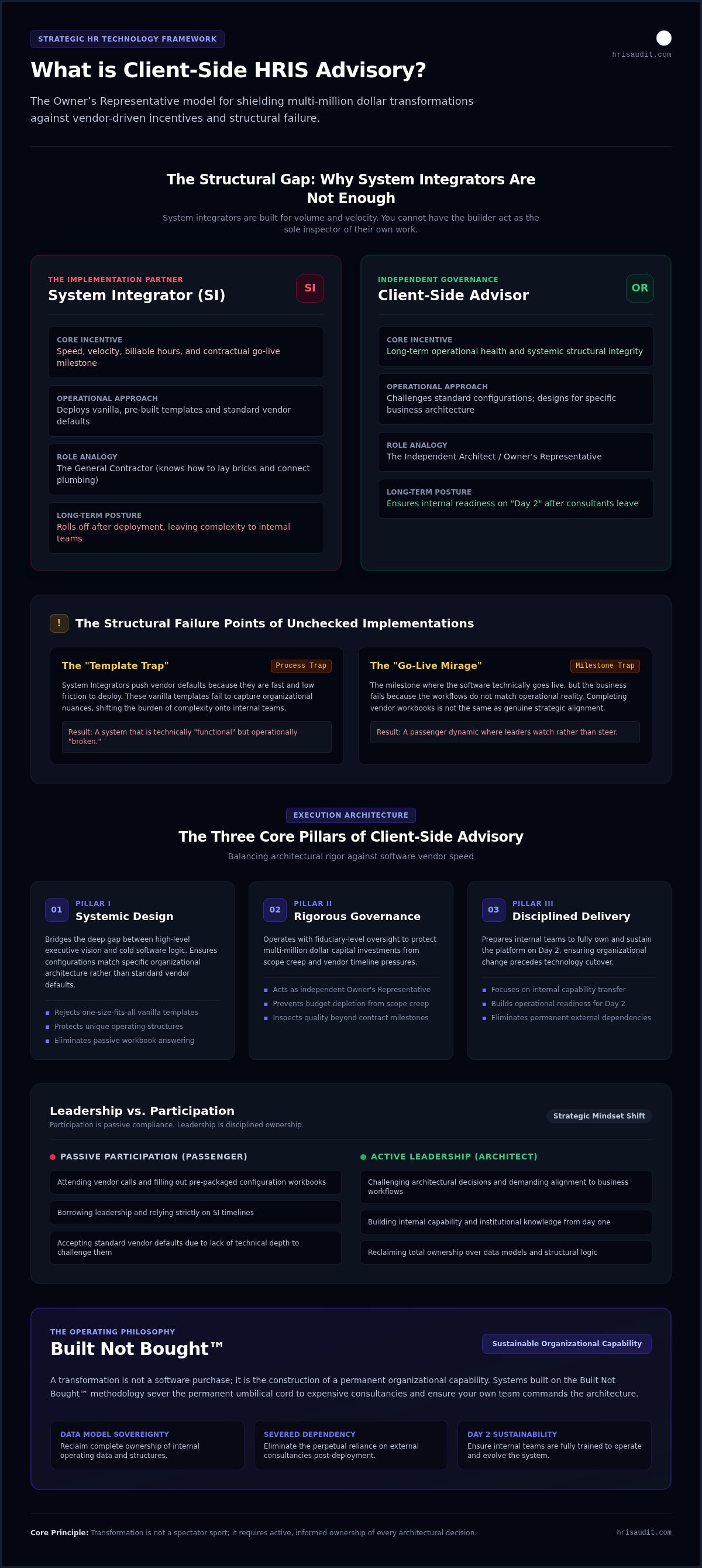
Client-side HRIS advisory is the architectural guardian of the transformation project. It is the strategic function that represents the buyer’s interests throughout the entire transformation lifecycle. While systems integrators focus on technical configuration and meeting contractual milestones, the client-side advisor ensures the machinery actually serves the business. This role bridges the deep structural gap between a high-level executive vision and the cold, mechanical reality of software logic. It is a position of independence, objectivity, and relentless focus on the organization's long-term maturity.
When executives ask what is client-side HRIS advisory, they are essentially asking who is watching the watchmen. The advisor acts as an "Owner’s Representative," a term borrowed from the world of commercial architecture. Just as a property owner hires a representative to oversee architects and general contractors, an HR leader needs a proxy to manage the software vendor and the implementation partner. This ensures that the final build conforms to the client's specific needs, not just the vendor's standard template. It moves the project from a generic deployment to a customized organizational capability.
Leadership vs. Participation
Participation is a passive act. Leadership is a disciplined motion. Many HR teams believe they are leading a project simply because they show up to vendor meetings and answer configuration workbooks. This is a mistake. Answering a workbook is merely providing data for someone else's design. True leadership requires challenging the design itself. Understanding what is client-side HRIS advisory means recognizing the distinction between technical configuration and strategic alignment. Advisors prevent the "go-live mirage." This is the point where the system technically works, but the business fails because the workflows don't match the operational reality. Transformation is not a spectator sport; it requires active, informed ownership of every architectural decision.
The Fiduciary Duty of the Advisor
A transformation project is a multi-million dollar capital outlay. The client-side advisor has a fiduciary-level duty to protect this investment from scope creep and template-dependency. Software vendors often prioritize speed over structural integrity. They want to move to the next client as quickly as possible. The advisor stands in the gap. They ensure the organization is ready to own the system on "Day 2" after the external consultants roll off. This involves a rigorous application of the Built Not Bought™ methodology. It forces a focus on data models, governance, and internal capability transfer. The goal is a system that is sustained by your own people, not one that requires a permanent umbilical cord to an expensive consultancy.
The Structural Gap: Why System Integrators Are Not Enough
Most organizations believe that hiring a Tier-1 system integrator (SI) is a guarantee of success. It isn't. SIs are built for volume and velocity. Their business model relies on billable hours and the rapid deployment of pre-built templates. This creates a fundamental misalignment of incentives. The SI's definition of success is a technical go-live achieved within the contract's scope. Your definition of success is a system that actually works for your people. This is the structural gap where most transformations bleed value. Understanding what is client-side HRIS advisory requires acknowledging that you cannot have the builder act as the sole inspector of their own work.
The "Template Trap" is the most common failure point. SIs push vendor defaults because they are easy to configure and quick to deploy. However, these defaults rarely capture the unique nuances of your organizational architecture. They shift the burden of complexity from the software onto your internal teams. You end up with a system that is technically "functional" but operationally "broken." To avoid this, you must prioritize organizational change over technology alone. If you suspect your current project is drifting into a template-driven failure, a Transformation Pulse Scan can expose the structural weaknesses before they become permanent.
The Builder vs. The Architect
You wouldn't build a skyscraper without an independent architect overseeing the general contractor. The system integrator is your contractor. They know how to lay the bricks and connect the plumbing of the software. But they don't live in the building. The client-side advisor is the architect. Their role is to design the transformation and ensure the SI follows the blueprints. This independent oversight is critical for reducing technical debt. Without it, the SI will make configuration choices that favor their timeline over your long-term sustainability. The advisor ensures that every technical decision serves a strategic business outcome.
Escaping Borrowed Leadership
Relying on external consultants to make critical business policy decisions is a dangerous form of borrowed leadership. It feels efficient in the short term, but it leaves your organization hollowed out. Most projects fail because the leadership was "rented" rather than built internally. When the consultants leave, they take the logic of the system with them. What is client-side HRIS advisory if not the mechanism for transferring that capability back to your team? You must move toward Client-Side HR Technology Leadership: Designing for Ownership. This shift ensures that your team understands the "why" behind the configuration, allowing them to manage and optimize the platform long after the implementation project ends.
The Core Pillars of Client-Side Advisory: Design, Governance, and Delivery
Structural integrity in a transformation project is the byproduct of discipline. It is not something you buy from a software vendor. It is something you build through three core pillars: Strategic Design, Rigorous Governance, and Delivery Excellence. When organizations ask what is client-side HRIS advisory in a practical sense, they are looking for the framework that prevents their multi-million dollar investment from collapsing under its own complexity. These pillars ensure that the system is an integrated engine for your people strategy, not just a digital filing cabinet for HR records.
Strategic Design is the blueprint. It aligns the HCM platform with your long-term organizational architecture. This means looking past the immediate requirements of the payroll cycle to the data models and operating structures required five years from now. Delivery Excellence is the execution of the "motions" of change. It covers the human elements—user readiness, manager enablement, and data integrity—that system integrators often treat as secondary tasks. Without these pillars, you are simply installing software. With them, you are transforming an organization.
Governance and Gate Reviews
Control is maintained through a series of Gate Reviews. A Gate Review is a formal quality control checkpoint where the project must prove its readiness to proceed to the next phase. It is the only effective way to stop a failing project before it reaches a catastrophic go-live. The advisor provides objective decision support to executive sponsors, stripping away the optimistic "green-status" reporting often provided by implementation partners. This transparency is the foundation of The Enterprise HR Technology Governance Framework. It ensures that sponsors make decisions based on mechanical reality, not vendor promises.
Capability Transfer: Building for Day 2
The success of an advisor is measured by their eventual obsolescence. True what is client-side HRIS advisory value is found in Capability Transfer. This is the process of ensuring your internal team has the skills and structural knowledge to manage the system on "Day 2" after the consultants depart. We facilitate this through Transformation Studio sessions—intensive, hands-on workshops designed to bridge the knowledge gap between technical configuration and operational ownership. Capability transfer is not a byproduct of the project; it is a primary metric of success. If your team cannot optimize the system independently after go-live, the transformation has failed, regardless of whether the software was installed on time.
The 'Built Not Bought™' Philosophy: A Path to Sustainability
Purchasing a top-tier HCM platform is a procurement exercise. Building a sustainable organizational capability is a transformation. Most leaders fail because they treat these as identical. They believe that the software contains the solution to their cultural and process-driven problems. It doesn't. Software is an empty vessel. The "Built Not Bought™" philosophy demands that you own the design, the data, and the delivery of the system. This shift in mindset is the core of what is client-side HRIS advisory. It moves you away from surface-level features toward deep structural foundations. It requires you to treat your business processes as integrated systems rather than isolated events.
A system that is "bought" relies on external consultants for every minor adjustment. A system that is "built" is owned by your internal team from the first day of configuration. This distinction determines whether your investment survives the first year post-go-live. You cannot outsource your strategy and expect to retain the value. For a deeper dive into this architectural shift, the Built Not Bought book serves as a foundational resource for leaders who refuse to be hostage to vendor templates. It provides the strategic perspective earned through long-term industry experience.
The Transformation Lifecycle
The journey from executive vision to operational optimization is rarely linear. It moves through distinct motions: strategy, delivery, adoption, and finally, optimization. During the implementation phase, chaos is the default state. The system integrator is focused on their specific technical silo. The internal HR team is often overwhelmed by their existing day jobs. The client-side advisor remains the constant anchor throughout this lifecycle. They detect early warning signs of structural failure using diagnostics like the Transformation Pulse Scan. This objective data prevents emotional decision-making when the project timeline gets tight. It ensures the integrity of the build remains the priority.
Using the Field Library
Do not start from a blank page. Successful builds require blueprints. Standardizing the transformation language across the entire enterprise is critical for clarity and speed. This is where the Field Library becomes essential. By using licensed frameworks and workbooks, you bypass the trial-and-error phase that plagues most projects. These are the mechanical drawings for your HRIS architecture. They define what is client-side HRIS advisory in practice: the application of battle-tested models to your unique organizational needs. You are not experimenting; you are executing a proven system. This disciplined approach ensures that your internal capability grows alongside the technical build.
Access the Field Library blueprints
Securing Your Transformation with Independent Advisory
Independence is not a preference; it's a prerequisite for structural integrity. When evaluating what is client-side HRIS advisory, the most critical factor is the absence of vendor-side incentives. Traditional "Big 4" firms often operate within tiered alliance programs with major software providers. These alliances create an inherent conflict of interest that prioritizes vendor relationships over your specific organizational needs. A boutique, independent advisor functions as a pure fiduciary. They have no reseller quotas to meet. They have no commissions to protect. Their only metric of success is the resilience of your internal capability.
This independence allows for a direct, no-nonsense approach to complex challenges. It enables the advisor to challenge a system integrator’s technical decisions without fear of damaging a corporate partnership. Protecting your multi-million dollar investment requires a guardian who is willing to say "no" to a vendor-standard template when it threatens your operational health. You need someone who prioritizes the human and strategic elements of technology over the specific tools themselves.
Pattern Recognition: The 30-Year Advantage
Experience in HR technology is about pattern recognition. An advisor with 30 years of transformation experience has seen the evolution of the industry from on-premise legacy systems to modern SaaS architectures. They recognize the "ghosts in the machine"—those recurring failure points that plague enterprise projects. This battle-tested perspective allows you to move from a state of passive participation to one of absolute command over your technology landscape. You aren't just following a project plan. You are executing a disciplined strategy informed by decades of seen-it-before expertise. It's the difference between guessing and knowing.
Taking the First Step
Transformation is a journey of managed risks. The first motion is to assess the structural integrity of your current trajectory. Starting with a Transformation Pulse Scan allows you to detect early warning signs of failure before they become permanent technical debt. From there, engaging in Transformation Studio sessions aligns the executive team around a shared architectural vision. This shift in leadership style is detailed further in our guide to HR Technology Executive Advisory: A Guide to Client-Side Leadership. Your transformation deserves a guardian, not just a vendor. Secure your investment by ensuring your leadership is built on a foundation of independent, strategic authority.
Reclaiming Command of Your HRIS Architecture
The era of passive procurement must end. Your organization cannot afford to be a passenger in a multi-million dollar transformation. You have seen how the structural gap between vendor speed and business health creates permanent technical debt. Understanding what is client-side HRIS advisory is the first motion toward regaining control. It is the difference between renting a solution and building a permanent organizational capability.
Integrity is not optional. It is the result of disciplined design, rigorous governance, and battle-tested experience. With over 30 years of industry perspective, we provide the independent, vendor-neutral guidance required to protect your interests. The Built Not Bought™ methodology ensures that your team owns the logic of the system long after the consultants roll off. You deserve a system that is engineered for your specific maturity; not just a configuration of generic defaults.
Book a Pulse Scan or Contact HRIS Audit today
It's time to stop borrowing leadership and start building for the future. Your transformation success is within reach when you prioritize structural integrity over surface-level features.
Frequently Asked Questions
What is the difference between a project manager and a client-side advisor?
A project manager tracks milestones and resources; a client-side advisor protects your strategic interests and architectural integrity. While a PM ensures the project moves, the advisor ensures it moves in the right direction. They bridge the gap between executive vision and technical configuration. You hire a PM to manage the "when" of the build. You hire an advisor to define the "why" and ensure the final system actually serves your people.
Why doesn't the system integrator provide client-side advisory?
System integrators are builders, not architects. Their business model relies on rapid deployment of vendor templates and billable hours. Providing what is client-side HRIS advisory would create a fundamental conflict of interest. They cannot objectively audit their own work or challenge the software vendor's defaults. An independent advisor acts as a pure fiduciary. They serve as the "Owner’s Representative" to ensure the builder delivers a system that meets your specific organizational needs.
At what stage of the project should I hire a client-side advisor?
Engagement should begin during the pre-procurement or design phase. Waiting until implementation is a mistake. Early advisory ensures your requirements aren't sacrificed for vendor speed. It prevents the technical debt that occurs when you accept generic workflows. If you've already started, a Transformation Pulse Scan can identify risks before go-live. The goal is to establish structural integrity before the first line of configuration is ever finalized in the system.
Can our internal HR team handle the client-side role without external help?
Internal teams often lack the specialized "pattern recognition" earned through decades of transformation cycles. While your HR team knows your business, they rarely have the technical depth to challenge a system integrator's technical decisions. They are also burdened by their existing day jobs. An advisor provides the battle-tested frameworks and objective oversight necessary to protect the project. This allows your team to focus on adoption while the advisor secures the structural foundation.
How much does client-side HRIS advisory typically cost?
Advisory fees are structured as strategic investments in risk mitigation rather than simple line-item costs. The price typically depends on the organization's scale and the complexity of the transformation lifecycle. Whether through a project-based fee or a strategic retainer, the value is found in preventing the catastrophic 70% failure rate common in HR tech. You're investing in a guardian who ensures your multi-million dollar capital outlay results in a sustainable internal capability.
Is client-side advisory only for large global enterprises?
Complexity isn't exclusive to global giants. Mid-market organizations face the same vendor pressures and "template traps" as large enterprises. While the scale of data might differ, the need for structural integrity and independent oversight remains constant. Any organization making a significant capital investment in HCM technology needs a guardian. What is client-side HRIS advisory provides is a scalable framework for ownership, regardless of your headcount or geographic footprint.
What are the common signs that my implementation needs a client-side program reset?
Feeling "held hostage" by vendor timelines or suffering from post-go-live anxiety are clear indicators. If your team lacks the expertise to challenge the system integrator, or if the system feels "bought" off a shelf rather than "built" for your needs, you need a reset. Other signs include excessive workarounds or a lack of internal capability to manage the platform. These symptoms suggest your transformation lacks the structural foundations required for long-term sustainability.
How does the Built Not Bought™ method differ from traditional consulting?
Traditional consulting often provides borrowed leadership that disappears when the contract ends. The Built Not Bought™ method focuses on internal capability transfer. It is a disciplined motion designed to ensure your team owns the system's logic and architecture. We use the Field Library and Transformation Studio sessions to bridge knowledge gaps. Success isn't measured by a go-live date; it's measured by your ability to optimize the system independently on Day 2.


