

Why does the average enterprise system sit idle, utilized by a mere 32% of the workforce? It's a sobering reality for leadership. You've invested millions in a digital transformation, only to find your HR system implementation not adopted by the people it was meant to serve. The go-live date passed, but the manual workarounds remained. You see the spreadsheets. You feel the anxiety of the sunk cost. Leadership demands ROI data that doesn't exist because the foundation is fractured. You're operating a high-performance engine with no one at the wheel.
We understand the frustration of a stalled rollout. It's a common pattern in organizations that prioritize procurement over participation. This article provides a clear diagnostic of why your adoption has flatlined. You'll discover how to transition from a "bought" mentality to a "built" culture of true ownership. We'll outline a recovery plan that focuses on structural integrity rather than buying more software. It's time to stop managing a tool and start leading a system. We'll move from philosophical shifts to a practical framework for sustainable ownership.
Key Takeaways
- Distinguish between a technical go-live and functional utility to identify the "Ghost System" draining your organizational resources.
- Diagnose why an HR system implementation not adopted is a failure of architectural ownership rather than a lack of user training.
- Move beyond the "bought" commodity trap by aligning system configuration with the specific mechanical realities of your business processes.
- Execute a structured program reset using a Transformation Pulse Scan to detect structural risks and re-engage executive sponsors.
- Establish independent, client-side leadership to act as the guardian of your interests against conflicting vendor and integrator timelines.
The Silent Crisis: When HR System Implementation is Not Adopted
Celebrate the launch. Pop the champagne. Then, watch the silence. Most organizations mistake a technical cutover for a strategic victory. When an HR system implementation not adopted correctly occurs, you aren't just facing a software glitch. You're facing a structural collapse. The gap between "system live" and "system used" is where ROI goes to die. This isn't a minor delay. It's a systemic failure that leaves your organization tethered to the past while paying for a future it can't reach.
You've built a Ghost System. You pay for a high-performance engine but use it as a paperweight. Your license fees cover automated workflows, predictive analytics, and self-service portals. Yet, your team remains trapped in the "Excel Underground." They use the new platform just enough to satisfy basic payroll requirements, then retreat to manual spreadsheets for everything else. It's an expensive facade. You're maintaining two worlds: the digital one you bought and the manual one you can't leave.
Don't blame the employees. "User resistance" is a lazy diagnosis for poor architecture. According to the Technology Acceptance Model (TAM), users adopt tools based on perceived usefulness and ease of use. If the system is clunky or irrelevant to their daily motions, they'll reject it. Resistance isn't a personality trait. It's a rational response to a broken design. When an HR system implementation not adopted persists, the problem is rarely the people. It's the process.
The economic impact is staggering. You lose the initial capital investment. You lose the annual subscription fees. Most importantly, you lose the productivity of your staff. Research indicates manual processes can consume up to 65% of an HR team's workday. That's a massive drain on resources that should be focused on talent strategy, not data entry.
Identifying the Symptoms of a Non-Adopted System
- Data integrity decay: Managers stop updating records in real-time. The database becomes a graveyard of outdated information.
- Shadow HR processes: Manual workarounds and offline spreadsheets become the "real" system of record.
- Help desk fatigue: Your support team answers the same "how-to" questions six months post-launch because the workflow isn't intuitive.
The Go-Live Mirage
Meeting a launch date isn't the same as achieving a successful outcome. Project managers often prioritize the timeline over the user experience. They check the box for stakeholders without verifying if the workforce actually possesses the capability to use the tool. This creates a false sense of security. The Go-Live Mirage is the moment technical success masks strategic failure. It's a dangerous illusion that prevents leadership from seeing the adoption crisis until the sunk costs are already too high to ignore.
The 'Bought, Not Built' Trap: Why Standard Playbooks Fail
Treating your HRIS as a commodity is a strategic error. It ignores the mechanical reality of your business. Most leaders approach procurement with a "bought" mentality. They assume that if they pay for the best software and the best integrator, success is guaranteed. It isn't. When an HR system implementation not adopted by the workforce occurs, it's usually because the system was installed, not integrated into the organizational fabric. You've acquired a tool, but you haven't engineered a solution.
The System Integrator (SI) conflict is central to this failure. Their definition of "done" is the go-live date. Your definition of "success" is long-term utility. SIs prioritize throughput. They want to move resources to the next project as quickly as possible. They follow a standard playbook that prioritizes feature functionality over your structural integrity. You receive a system that is technically correct but organizationally useless. It's a machine with no operator manual for your specific environment. Configuring a system is not the same as designing for ownership.
The Conflict of Interest in Traditional Implementation
Traditional implementation models create a knowledge vacuum. Consultants arrive, configure the modules based on generic "best practices," and roll off the project. They deliver the tool, but they don't transfer the architectural logic. They focus on throughput rather than sustainability. Without independent, objective advisory during the design phase, you're left with a system built for the vendor's ease of delivery rather than your team's ease of use. You need a guardian of your interests, not just a technician for the vendor's software.
Mindset Shift: Built Not Bought™
To solve the adoption crisis, you must move from participating in a project to designing a sustainable system. This requires the Built Not Bought™ method. Ownership is not something you inherit at go-live. It is something you engineer during the design phase. You aren't just buying software; you are building a proprietary workflow. This shift in perspective ensures that the system serves the business, rather than the business serving the system.
Structural design dictates long-term user behavior. If the process is built around how your people actually work, they will use it. If it's built around how the software functions, they won't. You need client-side leadership to bridge this gap between vendor delivery and internal adoption. This role ensures the system is organizationally relevant from day one. If you want to identify where your current structure is failing, consider exploring our latest insights on organizational maturity and systemic design.
Structural Integrity: Why Training Can’t Fix a Design Flaw
Stop blaming the learning curve. When an HR system implementation not adopted stalls, leadership often doubles down on training. They produce more videos. They schedule more webinars. They send more "how-to" emails. It's a waste of energy. You cannot train your way out of a design flaw. If the system's architecture adds friction to a user's daily motions, they will reject it. Training assumes the system works and the person is the problem. Structural integrity assumes the system must be built for the person.
Build for utility. Design for ownership. Most implementations fail because they prioritize how the software functions over how the business operates. You need a system that maps to your internal reality. This requires a shift from vendor-led configuration to client-led design. It's about capturing the logic behind every field, every workflow, and every validation rule. If the foundation is cracked, no amount of cosmetic training will keep the structure standing. You're trying to teach people how to navigate a maze that shouldn't exist.
Training vs. Capability
Training is tactical. Capability is systemic. Users ignore systems that complicate their work. They seek the path of least resistance. To bridge the "Capability Transfer" gap, you must move beyond temporary project knowledge. We advocate for utilizing a Field Library of editable workbooks. This ensures your internal team understands the "why" behind the configuration long after the consultants depart. It transforms your staff from passive users into disciplined system owners who can troubleshoot and evolve the platform independently. Without this mastery, you're left with another HR system implementation not adopted because no one internally has the authority or expertise to fix it.
The Governance Deficit
Adoption dies in the transition. The Project Team dissolves at go-live, leaving a vacuum where the Product Team should be. Without defined ownership roles, data integrity decays and processes drift. Who owns the outcomes? Who manages the upgrades? Who polices the standards? Clear governance is the engine of adoption. It provides the structural foundation required for long-term stability. See how our Governance Frameworks establish the discipline needed to maintain a high-performing HRIS environment. Without these rules of engagement, your system is just a collection of dormant features.
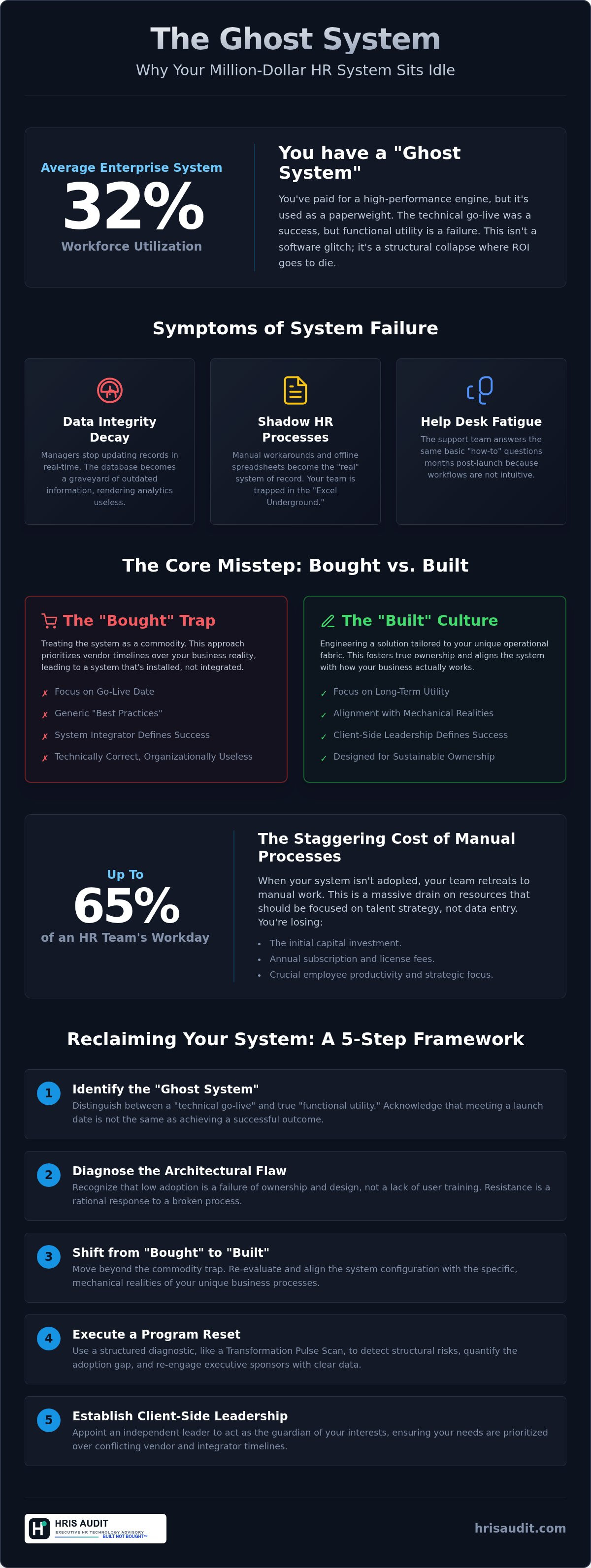
The Program Reset: 5 Steps to Reclaim Your HR System
Most vendors suggest that if your rollout failed, you need a new platform. They're wrong. They want another sale. We want structural integrity. If you're facing an HR system implementation not adopted by your team, you don't necessarily need new software. You need a program reset. This is a disciplined motion designed to salvage your existing investment by correcting the foundational errors made during the initial build. You're not starting over. You're stabilizing the foundation.
The reset follows a methodical five-step progression:
- Step 1: The Diagnostic. Utilize a Transformation Pulse Scan to pinpoint exactly where the architectural integrity broke down.
- Step 2: Stakeholder Realignment. Re-engage executive sponsors. Shift their focus from the "launch date" to long-term "system sustainability."
- Step 3: Process Simplification. Identify the configuration noise. Strip away the over-engineered workflows that create friction for the end user.
- Step 4: Governance Stand-up. Establish the decision-making machinery. Ensure you have a clear structure for managing the system as a living, evolving platform.
- Step 5: Capability Transfer. Conduct intensive workshops. Move the burden of ownership from external advisors to your internal leadership team.
Diagnostic: Detecting the Risk
Anecdotal complaints are useless. You can't fix "people don't like it." You can fix "the validation logic in the performance module contradicts the payroll cycle." A Transformation Pulse Scan provides a data-driven risk assessment. It's a "tough love" audit of your current state. We look past the marketing promises and examine the practical mechanics. Where does the data leak? Where does the process stall? Identifying these specific friction points is the only way to move from frustration to resolution. You need the cold, hard logic of the system's current performance.
The Reset Motion
Facilitating a reset requires a controlled environment. You can't rebuild the engine while the car is moving at top speed. This is where our Transformation Studio comes into play. It provides the space and frameworks to redesign your path forward without losing organizational momentum. A program reset is an investment in protecting your original capital outlay.
Schedule your Transformation Pulse Scan to detect implementation risks
Client-Side Leadership: The Guardian of Adoption
Adoption is not a byproduct of a successful launch. It is the result of persistent, independent discipline. When an HR system implementation not adopted by the workforce occurs, the root cause is often a leadership vacuum on the client side. You've outsourced your strategic thinking to the very people who profit from the complexity of the tool. To reclaim your investment, you must install a guardian of your interests. You need client-side leadership that prioritizes organizational utility over vendor timelines. Success requires an architect, not just a contractor.
The transition from project management to platform ownership is critical. Project management is obsessed with dates, budgets, and milestones. Platform ownership is focused on outcomes, data integrity, and systemic evolution. If your leadership team views the HRIS as a "finished project," it will inevitably decay. You must treat the system as a living piece of infrastructure that requires ongoing governance and rigorous maintenance. Sustainable outcomes are only achieved when you move past the "go-live" finish line and begin the work of long-term systemic design.
The Independent Advisor Advantage
Removing vendor bias is the first step toward structural integrity. If your advisor's revenue is tied to software sales or specific implementation hours, their objectivity is compromised. They'll naturally steer you toward "out-of-the-box" solutions that suit their delivery model rather than your business reality. Independent leadership ensures the system is built for your specific culture and mechanical needs. It provides the "tough love" necessary to challenge executive assumptions and vendor promises. Learn more about the critical role of Client-Side HR Technology Leadership and how it shifts the focus from launch to long-term ownership.
Next Steps for Stalled Implementations
Stop the training cycle. It's a placebo for a broken process. If your workforce hasn't embraced the tool after six months, more webinars won't change their behavior. You must pivot to an audit cycle. This requires executive sponsor decision support to make the hard calls about reconfiguration and process simplification. You aren't just fixing a software issue; you're repairing a trust issue with your employees. Be honest about the friction points. Be direct about the recovery plan. Recovery is a motion of discipline, not a marketing campaign.
Ready to fix your implementation? Contact HRIS Audit for a Strategic Advisory consultation.
Engineering Sustainable Systemic Ownership
The failure of an HR system implementation not adopted by your workforce is not a software defect. It is an architectural collapse. You've seen how the "bought" mentality creates a vacuum of ownership, leaving your organization with expensive, idle infrastructure. Sustainable adoption requires a transition from passive participation to disciplined, systemic design. By implementing a program reset and establishing client-side leadership, you can reclaim your original capital investment and turn a stagnant tool into a high-performance engine. You aren't just fixing a rollout. You're building a culture of mastery.
Stop managing a "Ghost System" and start leading a transformation. We bring 30 plus years of battle-tested experience to your recovery. Our proprietary Built Not Bought™ methodology and independent, platform-agnostic advisory provide the structural integrity your organization demands. You possess the internal capability to fix the foundation. It's time to install the guardian of your interests and secure the ROI you were promised. The road to recovery begins with a single motion of discipline.
Contact HRIS Audit to Reset Your HR Transformation
Your organization deserves a system that works as hard as your people. We're ready to help you build it.
Frequently Asked Questions
Why is our HR system implementation not being adopted by employees?
Adoption failure usually stems from a misalignment between software configuration and organizational reality. When an HR system implementation not adopted correctly happens, it's because the tool adds friction to daily work. Users aren't resisting change; they're avoiding inefficiency. If the digital workflow is more complex than the manual one, employees will revert to spreadsheets. You've likely built a system for the vendor's ease of delivery rather than your team's ease of use.
Can we fix a poorly adopted HRIS after it has already gone live?
Yes, a failing implementation can be salvaged through a disciplined program reset. This doesn't require buying new software. It requires a diagnostic audit to identify structural risks and a realignment of your configuration. By stripping away over-engineered processes and simplifying the user experience, you can reclaim your original capital investment. Success depends on moving from a launch mindset to a sustainability mindset, focusing on how the system actually serves the business.
Is low HR system adoption always a training problem?
No, training is rarely the root cause of adoption failure. Training is a tactical solution for a systemic problem. If the system's architecture is fundamentally flawed, no amount of how-to videos will convince users to embrace it. Adoption is a byproduct of structural integrity. When a system is intuitive and provides immediate utility, the need for extensive training diminishes. You can't train your way out of a bad design; you must engineer a better one.
What is a Transformation Pulse Scan and how does it help with adoption?
A Transformation Pulse Scan is a data-driven diagnostic used to detect implementation risks. It moves beyond anecdotal complaints to identify the specific mechanical friction points in your system. By auditing your current configuration and stakeholder alignment, the scan provides a clear roadmap for recovery. It helps adoption by pinpointing exactly where the integrity of the system broke down, allowing you to focus your reset efforts on the areas that will drive the most immediate value.
How do we transition from a 'Bought' to a 'Built' mentality in HR tech?
Transitioning requires a shift in ownership. A bought mentality treats the HRIS as a commodity provided by a vendor. A built mentality treats it as a proprietary system designed for your specific organizational motions. This shift happens when you stop participating in the vendor's project and start leading your own transformation. It involves establishing client-side leadership and using tools like our Field Library to ensure your team understands the why behind every configuration choice.
What role does governance play in HR system adoption?
Governance is the engine that sustains adoption after go-live. It defines who owns the data, who manages the process, and who makes strategic decisions about the platform's evolution. Adoption often fails because the project team dissolves without a dedicated product team taking over. Without clear governance, data integrity decays and users lose trust in the system. A disciplined governance framework ensures the system remains organizationally relevant and structurally sound over the long term.
Should we fire our System Integrator if adoption is low?
Not necessarily, but you must recognize the inherent conflict of interest. A System Integrator's goal is throughput and meeting the go-live date. Your goal is long-term sustainability. If adoption is low, it's often because the SI followed a standard playbook that didn't account for your structural needs. Rather than firing them, you should install independent, client-side leadership to manage them. This ensures the SI's technical delivery aligns with your organization's strategic interests and adoption goals.
How long does a program reset take for a failing HRIS?
The duration of a program reset varies based on the complexity of the failure. However, a structured reset motion usually begins with a Transformation Pulse Scan, which can identify key risks within weeks. The subsequent realignment of stakeholders and configuration simplification may take several months. The goal isn't a quick fix; it's a permanent correction of the system's foundation. A disciplined reset focuses on achieving sustainable outcomes rather than meeting another arbitrary deadline.


