

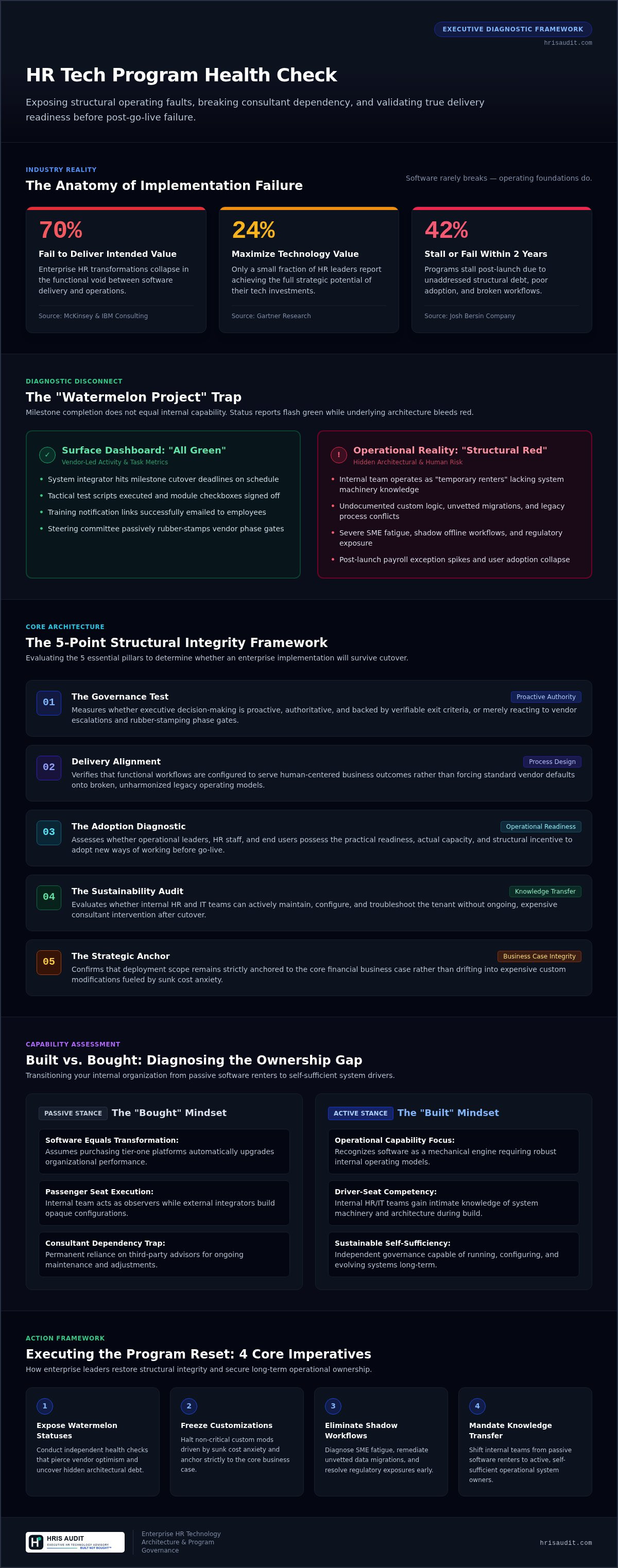
A project dashboard showing green across every milestone is often the most dangerous signal in an enterprise transformation. According to research from McKinsey and IBM Consulting, 70% of enterprise HR transformations fail to reach their intended business outcomes. The software rarely breaks; the operating foundation does. If you are questioning whether your project is genuinely on track or heading toward a post-go-live disaster, conducting a rigorous HR tech program health check is the only way to expose structural faults before deployment.
You likely already feel the friction. Your system integrator hits timeline targets, yet your internal team still operates like temporary renters who don't understand the machinery. Workstreams continue to burn capital, end users resist change, and leadership clings to failing configurations out of sunk cost anxiety.
A successful program is built for operational ownership, not just delivered for go-live. In this guide, you will gain an objective framework to assess your true program health, isolate foundational risks, and establish sustainable internal control long after external advisors leave.
Key Takeaways
- Expose "watermelon status reporting" where project scorecards show green progress while masking fatal architectural and operating model defects.
- Apply an enterprise HR tech program health check across five core structural pillars to test data integrity, governance, and process design.
- Break the consultant dependency trap by transitioning internal teams from passive software renters to active, self-sufficient system owners.
- Identify behavioral indicators of failure beneath the surface, from SME fatigue and shadow workflows to unaddressed regulatory exposure.
- Execute a decisive program reset that freezes non-critical customizations and anchors delivery to sustainable operational capability.
The Anatomy of a Failing HR Transformation
Enterprise software rollouts rarely collapse because of platform defects. They collapse in the functional void between delivery and operations. Research from Gartner reveals that only 24% of HR leaders believe their organizations maximize the business value of their technology investments, while Josh Bersin Company data indicates that 42% of implementations stall or fail within two years. The disconnect is systemic. Standard program management offices track budget burn, task completion, and vendor sign-offs, yet remain completely blind to internal operational readiness.
This dynamic creates the classic "watermelon project": status reports flash bright green on executive dashboards while the underlying architecture bleeds red. When traditional governance measures activity instead of operational competency, leadership confuses software delivery with organizational transformation. The true cost surfaces after go-live. Payroll exceptions spike, user adoption plummets to single digits, and HR teams resort to manual offline workarounds. Reconstructing compromised data structures and broken processes after cutover costs exponentially more than establishing architectural discipline during the build phase.
The Illusion of Progress
Milestone completion does not equal capability transfer. System integrators operate under commercial incentives to hit cutover dates and bill against milestones. Consequently, vendor status reports frequently mask strategic misalignments and internal knowledge deficits. This dynamic fuels the "bought" mentality, where executives assume that purchasing tier-one software automatically upgrades organizational performance. A rigorous HR tech program health check pierces through vendor-led optimism, assessing whether internal teams are learning to drive the machinery or simply observing it from the passenger seat.
The Structural Integrity Gap
Modern human resource management systems function as interconnected mechanical engines rather than standalone software databases. If one foundational gear slips, the entire system binds. Cracks in the program appear early through subtle governance lapses: undocumented custom logic, unvetted data migrations, and business leaders refusing to harmonize legacy operating models.
Structural integrity is the unbroken alignment of executive strategy, technical delivery, and operational adoption. When this alignment fractures, post-launch sustainability collapses. A disciplined HR tech program health check interrogates these stress points before technical configurations harden, ensuring that your enterprise foundation can withstand real-world operational pressure long after external advisors depart.
Structural Integrity: The 5-Point Health Check Framework
Most organizations evaluate enterprise implementations by checking tactical delivery boxes. They confirm that test scripts ran, modules activated, and training links were emailed. This approach misses the target entirely. A diagnostic why digital transformations fail reveals that project breakdowns stem from organizational misalignment rather than technical code flaws. To determine if an implementation will survive cutover, an enterprise HR tech program health check must stress-test the operational architecture across five foundational pillars:
- The Governance Test: Measures whether executive decision-making is proactive and authoritative or merely reacting to vendor escalations.
- Delivery Alignment: Verifies that functional workflows are configured to serve human-centered business outcomes rather than forcing standard vendor defaults onto broken operating models.
- The Adoption Diagnostic: Assesses whether operational leaders and employees possess the readiness, capacity, and incentive to adopt new ways of working.
- The Sustainability Audit: Evaluates whether your internal HR and IT teams can maintain, configure, and troubleshoot the tenant without ongoing consultant intervention.
- The Strategic Anchor: Confirms that the deployment remains tied to the core financial business case rather than drifting into expensive custom modifications.
Evaluating Program Governance
Sponsor involvement must extend beyond passive attendance at bi-weekly steering meetings. True governance requires an active gate review process with verifiable exit criteria. When steering committees simply rubber-stamp vendor phase gates without independent validation, critical structural debt accumulates unnoticed. Utilizing an established HR technology governance framework helps leadership audit internal decision velocity, enforce scope control, and ensure the program serves strategic enterprise goals.
Testing for Capability Transfer
Watch your team during design playback sessions. Are your subject matter experts actively challenging technical configurations, or are they passively observing consultant presentations? If your team isn't driving the configurations, capability transfer hasn't occurred. Organizations should deploy structured toolkits like the proprietary Field Library to capture operational knowledge and document design logic systematically. Your staff must master the actual functional motions of the platform before cutover occurs. If leadership needs an unvarnished, objective baseline of these five pillars, conducting a Transformation Pulse Scan provides rapid diagnostic clarity on operational vulnerabilities before they calcify into post-launch crises.
Built vs. Bought: Diagnosing the Ownership Gap
Purchasing modern cloud software does not solve structural organizational debt. When leadership falls into the "bought" trap, they assume external consulting contracts substitute for internal capability. An expensive software license paired with a massive systems integration contract will not create a self-sustaining HR function. You cannot outsource ownership. When enterprises treat complex systems as turnkey commodities, they end up with "renter syndrome." They possess a login, but external contractors retain the keys to the engine room.
Diagnosing this gap requires looking past technical deliverables to examine internal agency. Are your business analysts writing the testing scenarios, or are they signing off on boilerplate vendor spreadsheets? If third-party resources drive every architectural decision, your program is being bought, not built. Moving from passive consumption to internal capability demands an intentional shift in posture. Your team must cultivate deep operational proficiency so they can govern, configure, and adapt the platform independently over its decade-long lifecycle.
The System Integrator Paradox
System Integrators face a core conflict of interest: their contracts incentivize milestone completion and billable hours, not long-term self-sufficiency. They are measured on technical go-live, not whether your payroll team can handle tenant updates six months later. This is why relying solely on SI status updates creates a false sense of security. Engaging independent HR technology advisory establishes an uncompromised client-side advocate. Objective oversight evaluates vendor claims, cuts through technical obfuscation, and protects your operational interests against aggressive scope cuts.
Building for Sustainability
Sustainable operating models cannot be an afterthought reserved for the weeks following go-live. An authoritative project governance framework requires organizations to architect their "Day 2" support structure during the earliest phases of "Day 1" design. Internal teams must practice running configurations, resolving functional exceptions, and executing business process handoffs while external experts are still on hand to guide them.
This discipline forms the foundation of the Built Not Bought method. Instead of allowing consultants to build black-box automations, internal teams co-design every workflow. A structured Built Not Bought HR strategy ensures your staff understands the architectural logic behind every configuration choice. Conducting a periodic HR tech program health check validates whether this knowledge transfer is genuinely occurring, transforming your internal staff from dependent spectators into confident system architects.
Beyond the Green Dashboard: Uncovering Hidden Program Risks
A conventional RAID log catalogs surface issues. It tracks scheduled deadlines, integration test cycles, and system access tickets. Yet the most fatal organizational defects lurk deep beneath these tracked activities. A program can finish exactly on time and fully within budget while still producing an operational disaster. According to Sapient Insights Group, nearly 25% of enterprise software rollouts fail to meet baseline adoption targets, and Gartner notes that enterprise HR platforms see active utilization of just 32% beyond mandatory payroll functions. When success is measured solely by technical cutover dates, leadership mistakes technical deployment for true business adoption.
Diagnosing organizational failure before go-live requires watching behavioral indicators across the enterprise. The warning signs rarely appear in official PMO decks:
- Subject matter expert fatigue: Critical functional leads disengage from design workshops, leaving key decisions to outside consultants.
- Proliferation of shadow tools: Operations teams quietly construct offline spreadsheets and secondary databases to bypass core system constraints.
- Superficial testing protocols: UAT scripts validate isolated system fields instead of testing messy, end-to-end employee lifecycles.
- Sunk cost paralysis: Leadership pours additional resources into broken design workstreams rather than pausing to refactor flawed foundational logic.
Detecting Strategic Drift
Strategic drift happens when standard software defaults overwrite your operating model. System integrators often push out-of-the-box templates to protect delivery schedules, compromising distinct business requirements in the process. Efficiency displaces strategy. When this trade-off occurs, the platform ceases to serve workforce enablement and becomes an administrative burden. Conducting an objective HR tech program health check exposes this drift before testing begins, allowing program leaders to halt misaligned tracks and recalibrate the build around core people outcomes.
The Transformation Pulse Scan
Subjective sentiment cannot fix a drifting transformation. Project directors often rely on gut feel or polished vendor presentations, both of which obscure hard operational truths. Executing a Transformation Pulse Scan cuts through bureaucratic theater, replacing wishful thinking with a clear, data-driven baseline of structural risks.
This diagnostic brings independence to the governance layer. It bridges the communication disconnect between executive sponsors focused on strategic outcomes and delivery workstreams consumed by daily tasks. Armed with objective diagnostic evidence, leadership can make decisive, non-punitive course corrections, resetting the program for operational viability before critical go-live milestones expire.
Request a Transformation Pulse Scan to evaluate your program health
Executing the Reset: From Diagnostic to Sustainable Delivery
Diagnosing organizational cracks is useless without the discipline to repair them. Once an enterprise identifies misalignment, continuing down the same delivery path guarantees operational failure. Recovery requires an immediate, structured intervention across five practical steps:
- Acknowledge structural gaps without blame: Treat process debt and configuration errors as mechanical friction rather than individual shortcomings. Removing corporate fear enables honest evaluation.
- Re-align governance around Built Not Bought principles: Pivot from passive vendor reliance to active client-side ownership, ensuring all system configurations reflect operational reality.
- Enforce a strict gate review across workstreams: Freeze all secondary scope and custom integrations until core foundational processes pass end-to-end user validation.
- Place internal leadership in the driver's seat: Shift authority back to internal process leads, ensuring your subject matter experts retain final sign-off on design decisions.
- Prioritize capability transfer over milestone velocity: Measure delivery success by your team's demonstrable ability to maintain the tenant, not by calendar deadlines.
The Path to Recovery
Course correction requires candid conversations with your implementation partners. System integrators will resist scope freezes because delays complicate resource allocations and billing schedules. Leadership must stand firm, anchoring discussions in measurable business viability rather than external contractual convenience. Leverage your established Field Library of tools and frameworks to establish objective design standards, enforce audit controls, and protect human-centric outcomes against hasty vendor compromises.
Securing the Future
Stabilizing a troubled program marks the transition from crisis mode to lasting operational maturity. A successful transformation doesn't end when cutover finishes; it matures into everyday business operations. For that reason, an enterprise HR tech program health check cannot remain an isolated emergency drill. It must become an institutionalized operating motion deployed at regular intervals to maintain architectural integrity, manage bi-annual cloud vendor updates, and continuously align technical capabilities with long-term business goals.
If your enterprise implementation is showing signs of distress or you need an uncompromised review of your delivery risks, contact HRIS Audit for a sober assessment of your program health.
Reclaiming Architectural Control of Your HR Transformation
A successful deployment is never defined by a checked milestone on a vendor invoice. Real success lives in your team's demonstrable capability to govern, configure, and evolve the platform long after launch day. Relying on passive vendor scorecards leaves your enterprise vulnerable to operational paralysis, user rejection, and accumulating technical debt. Performing a disciplined HR tech program health check provides the unvarnished diagnostic baseline required to expose structural fractures before they compromise cutover.
Backed by more than 30 years of battle-tested transformation experience and our proprietary Field Library of diagnostic workbooks, our independent, platform-agnostic advisory restores clarity to complex programs. You don't have to remain trapped by vendor dependency. Realign delivery to human-centered business outcomes and ensure your team sits firmly in the driver's seat.
Request a Transformation Pulse Scan
Take decisive control of your operational foundation today. When internal capability drives the machinery, long-term enterprise sustainability inevitably follows.
Frequently Asked Questions
What is a "Pulse Scan" in the context of HR tech program health?
A Transformation Pulse Scan is a rapid, objective diagnostic evaluation designed to uncover structural vulnerabilities across active transformation tracks. Unlike traditional PMO checklists that monitor superficial tasks, the Pulse Scan assesses governance rigor, capability transfer, and architectural stability. It provides executive sponsors with an unvarnished baseline of risks, identifying process friction and operational deficits before technical configurations freeze into permanent debt.
How does a health check differ from a standard project audit?
A standard project audit focuses on compliance, budget burn, and milestone completion against vendor contracts. In contrast, an HR tech program health check investigates whether your organization is architecting sustainable operational ownership. It looks past vendor sign-offs to evaluate system mechanics, data model integrity, and internal team enablement. The goal isn't verifying past task completion, but ensuring the system remains functional once external implementers depart.
Why do most HRIS implementations face an adoption crisis after go-live?
Adoption crises occur because implementations prioritize software configuration over operational redesign. When organizations automate broken processes without standardizing workflows, employees encounter unnecessary friction and retreat to offline spreadsheets. The issue rarely stems from technical bugs; it stems from treating the deployment as an IT installation rather than an operating model evolution. Without intentional end-user enablement and process alignment during the build, workforce utilization inevitably plummets.
Can we perform a health check if we are already in the testing phase?
Yes, the testing phase is often the most critical window to conduct a health check. In fact, User Acceptance Testing usually exposes the first tangible symptoms of strategic drift and user resistance. Executing an HR tech program health check during testing enables leadership to freeze defective workflows, halt premature phase gates, and recalibrate validation scripts around actual daily operational scenarios before cutover occurs.
What is the role of the Program Sponsor during a health check?
The Program Sponsor must move from passive steering committee attendee to authoritative decision-maker. During a diagnostic review, sponsors must protect client-side interests by challenging vendor progress reports, enforcing exit criteria, and supporting scope freezes when architectural gaps emerge. Their primary mandate is maintaining alignment between the program's original business case and the functional reality being constructed by delivery teams.
How do we fix a project that is "Green" on reports but failing in reality?
Fixing a falsely green project starts with halting milestone momentum to conduct an honest diagnostic reset. Leadership must strip away vendor-reported metrics and evaluate functional readiness directly with internal process owners. Suspend custom development, audit core data structures, and establish objective gate reviews. You can't fix operational friction with optimistic reporting; you must rebuild governance around demonstrable capability rather than scheduled calendar dates.
What are the most common signs of structural failure in an HCM transformation?
Structural failure manifests through behavioral symptoms long before go-live. Primary indicators include subject matter expert burnout, heavy reliance on third parties for standard tenant adjustments, and the quiet creation of secondary offline tracking sheets. Architecturally, watch for excessive custom code overrides, brittle point-to-point integrations, and test scripts designed to confirm technical field validation rather than complex, cross-functional employee lifecycles.
How does the "Built Not Bought" method impact program health?
The Built Not Bought method fundamentally shifts an organization from passive software consumer to active operational architect. Instead of outsourcing critical design logic to external consultants, the methodology equips internal teams to understand and govern the machinery they inherit. This deliberate focus on capability transfer and client-side leadership eliminates long-term vendor dependency, ensuring your HR technology operates with genuine structural integrity post-launch.


