

What if the weakest part of your HRIS business case isn’t the software choice, but the assumptions underneath it? Building a business case for a new HRIS means giving executives a decision they can defend, not simply listing attractive features. The system is only one part of the investment.
It can be difficult to quantify benefits before selection. Time savings, cleaner data, and better workforce decisions depend on process changes, integrations, adoption, and clear ownership. If stakeholders disagree on priorities or the case understates these dependencies, projected value can seem less credible than the costs and risks.
This guide shows how to build a decision-ready case tied to organizational strategy and workforce needs. You’ll learn how to compare alternatives, make total costs and delivery realities visible, and define how benefits will be measured and who will own them over time. The case should fund lasting organizational capability, not software alone.
Key Takeaways
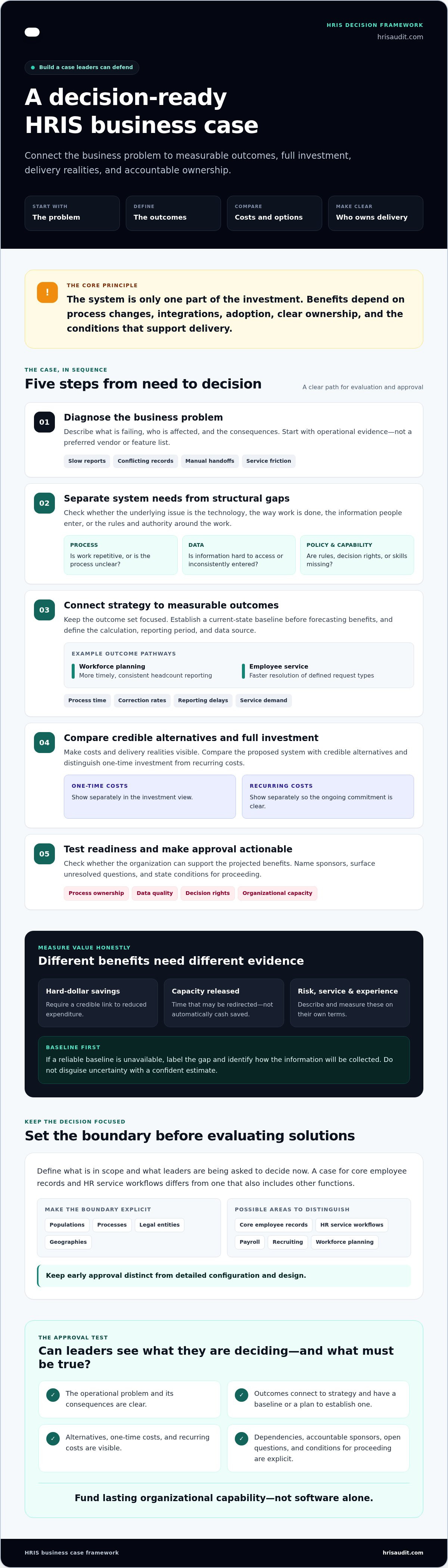
- Start with the operational problem and its consequences, not a preferred vendor or feature list.
- Translate strategy into a focused set of workforce outcomes, then establish baselines before forecasting benefits.
- When building a business case for a new HRIS, compare the proposed system with credible alternatives and show one-time and recurring costs separately.
- Test whether process ownership, data quality, decision rights, and organizational capacity can support the benefits the case projects.
- Make the approval request actionable by naming sponsors, surfacing unresolved questions, and setting clear conditions for proceeding.
Why a new HRIS business case must start with the business problem
A request for a new HRIS often begins with a visible frustration: reports take too long, employee records conflict, or routine transactions pass through too many hands. These are signals, not yet a case for technology. Describe what is failing, who is affected, and what the consequences are. Otherwise, a preferred platform or feature list can define the problem before leaders agree on what needs to change.
An HRIS business case is a decision document that connects organizational needs to available options, required investment, expected outcomes, and accountable ownership. It helps leaders decide whether to act, which path to pursue, and what conditions must be in place for the investment to deliver value. Building a business case for a new HRIS is an exercise in disciplined diagnosis, not software advocacy.
Identify the organizational conditions driving the HRIS decision
Document friction across core processes, reporting, employee service, and workforce decisions. For example, a slow headcount report may reflect disconnected data, but it could also result from inconsistent definitions of “active employee” or unclear approval rights. Interview HR, IT, finance, managers, and employees where relevant. Compare their accounts with available evidence, such as recurring corrections, manual handoffs, delayed reports, or service requests. Treat missing evidence as an open question, not as proof that a problem does or doesn’t exist.
Then separate system limitations from structural gaps:
- Process: Is work unnecessarily repetitive, or is the process itself unclear?
- Data: Are records difficult to access, or are teams entering inconsistent information?
- Policy and capability: Do people lack clear rules, decision authority, or the skills to carry out the work?
A new system may support better controls and easier access to information. It won’t resolve conflicting policies or establish ownership on its own. Name those dependencies in the case.
Set a decision boundary before evaluating solutions
Define the populations, processes, legal entities, and geographies under consideration. A case covering core employee records and HR service workflows is materially different from one that also includes payroll, recruiting, or workforce planning. State what leaders are being asked to decide now, such as whether to fund further evaluation or approve a defined scope. Detailed configuration and design can follow; they shouldn’t be folded into an early approval.
This boundary keeps the case focused and makes accountability visible. Client-side HR technology leadership can help maintain the line between executive intent and delivery realities. See client-side HR technology leadership insights for a related perspective.
Build the HRIS business case around strategic outcomes and measurable value
A system’s feature set is not a benefit. The case must show how a change in workforce technology supports a business priority, then define the evidence leaders can use to judge whether that change occurred. Keep the outcome set small. A long list of loosely connected benefits makes ownership harder and weakens the decision.
Translate strategy into outcomes people can track after approval. If the organization needs more reliable workforce planning, the outcome might be more timely, consistent headcount reporting. If employee service is the problem, it could be faster resolution of defined request types. Choose measures that connect directly to the diagnosed issue, such as process time, correction rates, reporting delays, or service demand.
Choose outcomes leaders can track after approval
Establish a current-state baseline before setting a target. Define the calculation, reporting period, and data source first. For example, measure the elapsed time from submission to completion for a specified transaction, using existing case records or process logs. If the organization can’t produce a reliable baseline, label the data as unavailable and identify how it will be collected. Don’t disguise a gap with a confident estimate.
Separate different forms of value. Hard-dollar savings require a credible link to reduced expenditure. Capacity released is time that may be redirected, not automatically cash saved. Risk reduction, service quality, and employee experience matter, but describe and measure them on their own terms rather than forcing them into a financial figure.
Write each proposed measure as a complete statement: “For [process], the current baseline is [value or unavailable], the target is [defined result], [named business owner] is accountable, and progress will be assessed by [timeframe] using [data source].” This makes the measure testable and gives leaders a clear point of accountability. Benefits belong to business owners who can change the process, not to the software.
Make assumptions visible instead of disguising uncertainty
Separate observed evidence from estimates, dependencies, and untested assumptions. A projected reduction in manual handling, for instance, depends on process redesign, data quality, adoption, and available capacity. Name those conditions. Use conservative, expected, and upside scenarios only when the inputs and logic behind each are defensible; otherwise, show the uncertainty plainly.
Good governance defines who owns measures, reviews evidence, and can intervene when assumptions fail. For a deeper look at decision ownership and oversight, explore these HR technology governance insights. This discipline turns the business case into a benefits-management structure, not a forecast left behind after approval.
Calculate total HRIS investment and compare credible alternatives
A credible case compares the proposed HRIS with other ways to address the same problem. Options may include improving existing processes, upgrading selected tools, continuing current operations, or phasing change over time. Define a consistent scope and planning horizon before comparing them. Otherwise, one option may look cheaper simply because its costs are missing from the calculation.
Build a whole-life cost model, not a license comparison
Separate one-time costs from recurring costs, and include the work required to prepare, deliver, and own the system. Depending on scope, costs may include software, implementation, integrations, data migration and remediation, testing, training, internal backfill, transition support, ongoing administration, and future optimization. Record the source and confidence level for each estimate. Vendor quotes, contract terms, internal labor assumptions, and integration or support estimates that are unavailable should be marked for validation, not presented as confirmed.
Use the same cost categories and time horizon for every option. A simple comparison structure can expose gaps before leaders debate totals:
| Option | One-time costs | Recurring costs | Key assumptions to validate |
|---|---|---|---|
| Continue current operation | Process remediation or deferred work | Current tools, support, and ongoing manual effort | Expected service demand and cost of unresolved issues |
| Improve processes or upgrade selected tools | Redesign, configuration, data work, and training | Existing and added tool support | Coverage of priority processes and dependencies |
| Adopt a new HRIS, all at once or in phases | Software setup, integrations, data work, testing, and transition | Subscription, support, administration, and optimization | Vendor terms, implementation scope, adoption, and ownership |
Internal effort still consumes capacity, even when it doesn’t appear as a new external charge. Make that demand visible, including time needed from HR, IT, payroll, finance, managers, and employees. Building a business case for a new HRIS without accounting for this work understates the organization’s actual commitment.
Compare options against the same decision criteria
Assess each option against strategic fit, process coverage, risk, scalability, adoption demands, and organizational readiness. The status quo is not a zero-cost baseline: it carries ongoing labor, service constraints, and the risk of leaving identified problems unresolved. Show those consequences without treating uncertain estimates as facts.
Document who validates assumptions and who approves changes to scope or investment. The HR technology governance framework offers a useful reference for structuring evaluation and decision controls.
Address the hardest objection: software alone cannot deliver the promised value
System delivery creates capability; sustained organizational value depends on people using that capability within owned processes. A platform may support cleaner records or faster transactions. It can’t, by itself, resolve competing definitions, assign decision rights, improve data stewardship, or help teams adopt a new way of working.
That distinction is central to building a business case for a new HRIS. If process ownership is fragmented, data quality is weak, decisions remain unclear, or key people lack capacity, the benefits forecast rests on conditions the organization hasn’t established. Show those dependencies plainly, then pair each material risk with a mitigation, named owner, decision gate, and evidence required to proceed.
Test readiness before presenting benefits as commitments
Assess executive sponsorship, process ownership, data stewardship, change capacity, and decision rights before treating projected benefits as commitments. For each area, record what is in place, what remains unresolved, and who can address the gap. For instance, if a process has no accountable owner, name the role that must accept ownership before design decisions are finalized.
Separate risks the organization can actively manage from uncertainty it can’t yet resolve. A lack of assigned data stewards is a controllable gap; an unconfirmed integration dependency may require further investigation or a staged decision. Set gates around evidence, such as confirmed ownership, agreed process principles, or validated data readiness. Don’t move a commitment forward just because a vendor selection deadline is approaching.
Make adoption and ownership part of the investment logic
The business case should identify who will own processes, data, configuration decisions, and improvement after go-live. Include the work required to transfer capability, prepare communications and training, and involve managers in reinforcing changed practices. These aren’t optional additions to the technology plan. They are part of the conditions that make expected value plausible.
Check that the people responsible have the authority and capacity to do the work. If they don’t, identify what must change before approval or treat the benefit as conditional. Build ownership into governance from the outset, so operational teams can maintain the system and adapt processes rather than relying indefinitely on the project team.
The Built Not Bought™ perspective emphasizes designing and governing HR technology for effectiveness beyond go-live. You can explore the Built Not Bought™ approach to sustained HR technology value to learn more.
When you are ready to move forward, you can discuss your HRIS business case with HRIS Audit to ensure your strategy is fully aligned and ready for executive review.
Turn the HRIS business case into an approval plan with accountable next steps
A decision document earns approval by making the decision explicit. Lead with what leaders must authorize, why it matters strategically, and what may happen if action is deferred. Then present the supporting logic in order: the problem, expected outcomes, options considered, whole-life investment, key risks, assumptions, and recommendation.
Building a business case for a new HRIS should end with a decision path, not a vague request to “move forward.” Specify whether leaders are being asked to approve funding, authorize further evaluation, or endorse a defined scope. Identify unresolved questions, the sponsor accountable for answering each, and the approval conditions that must be met before the next stage.
Structure the executive decision in a clear sequence
Keep the evidence traceable. Show how the recommendation follows from current-state evidence, comparison of alternatives, cost assumptions, and expected outcomes. Name the assumptions that still need validation, who has authority to resolve them, and when they must be settled. If a vendor quote, data assessment, or capacity commitment is pending, make that visible and state whether approval depends on it.
Approval should also establish how the case will be maintained. Assign an owner for each baseline and expected benefit, set review points, and define who will report progress after go-live. Agree how measures will be captured, what happens when outcomes fall short, and who can authorize corrective action. Benefits realization needs a governance rhythm, not just a forecast in a presentation.
Connect approval to sustained capability and independent challenge
HRIS Audit provides client-side advisory services. It doesn’t sell HRIS software or provide software implementation and system integration. Its advisory work can support sponsor decisions, gate reviews, program resets, and capability transfer, helping client organizations strengthen decision quality and ownership without guaranteeing outcomes.
Before treating the case as final, test whether sponsorship, governance, and organizational readiness support its commitments. A free Transformation Pulse Scan may offer a useful starting point for assessing readiness. HRIS Audit also offers licensed Field Library resources. For practical reference, review the HR transformation frameworks and consider how they apply to your decision and oversight structure.
A decision-ready case is not one that hides uncertainty. It gives leaders a controlled way to resolve it. If you need an independent challenge to your assumptions, ownership model, or approval conditions, discuss your HRIS business case with HRIS Audit.
Discuss your HRIS business case with HRIS Audit
Make the Decision Strong Enough to Own
A defensible HRIS case starts with the business problem, not a product shortlist. It ties strategic outcomes to measurable baselines, compares the full investment with credible alternatives, and makes assumptions and risks visible. Most importantly, it treats adoption, process ownership, and ongoing improvement as part of the decision, not as work to consider after approval.
That discipline is the difference between approving software and funding lasting organizational capability. HRIS Audit brings more than 30 years of HR transformation experience and provides client-side advisory. Organizations can also explore free Transformation Pulse Scans and licensed Field Library resources as they assess readiness and strengthen their approach.
Building a business case for a new HRIS takes clear evidence and honest ownership. You don’t need every uncertainty resolved before taking the next step, but you do need to know which questions remain and who will answer them.
Build the case with care, and leaders can make a decision they’re prepared to own beyond go-live.
Frequently Asked Questions
What should a business case for a new HRIS include?
A business case should connect the problem to a clear decision and a plan for measuring value. Include organizational needs, strategic outcomes, current-state evidence, options, whole-life costs, assumptions, risks, dependencies, and a recommendation. State the decision requested, unresolved questions, and approval conditions. Name an accountable owner for each expected benefit and explain how progress will be measured after approval. This structure makes building a business case for a new HRIS more than a software request.
How do you calculate the ROI of a new HRIS?
Calculate ROI from defensible baselines and transparent estimates, not promised savings. Identify specific outcomes, such as reduced processing time, and show how each expected benefit is calculated. Compare the value estimate with the full investment, including software, implementation, internal effort, change activities, and ongoing operations. If reliable inputs are missing, disclose the gap and show defensible scenarios or assumptions. Don’t present estimates as guaranteed returns or assign financial value to benefits without a sound basis.
How much does a new HRIS cost?
There’s no single meaningful cost without defined scope, workforce needs, integrations, implementation requirements, and an operating model. Build a whole-life estimate that separates one-time costs, such as data work and transition effort, from recurring costs, such as software and ongoing support. Use validated vendor information and label estimates clearly. Compare proposals only when they cover the same scope, planning horizon, and assumptions. Include internal effort, even when it doesn’t appear as an external invoice.
How long does it take to build an HRIS business case?
The timeline depends on the quality of current-state information, stakeholder availability, scope, and the number of options under review. A focused case may progress faster when baselines, decision owners, and relevant evidence are already available. A complex organization may need more discovery to validate needs and dependencies. Set the schedule after identifying evidence gaps, required reviews, and executive decision dates. Avoid relying on a standard duration that doesn’t reflect the work your case requires.
Can an organization build an HRIS business case before choosing a vendor?
Yes. Establish the business problem, outcomes, decision criteria, investment boundaries, risks, and organizational readiness before selecting a preferred vendor. Vendor information can later refine capability and cost assumptions, but it shouldn’t determine the case’s central argument. A platform-agnostic approach helps leaders compare alternatives against consistent criteria. It also guards against treating a compelling product demonstration as proof that the organization will achieve the expected value.
What is the difference between an HRIS business case and an HRIS implementation plan?
An HRIS business case supports an investment decision. It explains why change may be needed, what outcomes are expected, which options were considered, and what investment and ownership are required. An implementation plan defines how an approved initiative will be delivered, including activities, resources, milestones, and controls. The business case should identify delivery dependencies and readiness conditions, but it doesn’t replace detailed implementation planning or establish that the organization is ready to begin.
How do you get executive approval for a new HRIS?
Make a specific decision request and support it with organizational evidence, strategic outcomes, comparable options, whole-life costs, and visible assumptions. Address risks directly. Identify accountable sponsors, benefit owners, unresolved questions, and conditions for approval. Executives need to understand not only what the system may enable, but what the organization must change, resource, and own to realize the intended outcomes. A clear request gives leaders a decision to make, not just a proposal to review.
What happens if HRIS benefits are difficult to quantify?
Don’t invent precision. Establish a baseline where reliable data exists, then use operational evidence to describe benefits that can’t yet be expressed financially. Define any proxy measure and explain its limits. Identify the data that must be collected, who will collect it, and when assumptions will be reviewed. For example, if transaction time isn’t currently tracked, make that an evidence gap with an owner and collection plan. Transparent uncertainty is more credible than unsupported savings claims.


