

A polished vendor demonstration can make a poor-fit HRIS look like the obvious choice. HRIS selection advisory services should do more than organize comparisons. They should help your team assess options against how the organization actually operates, not just the story a vendor tells about its platform. Your internal stakeholders know the business, and vendors know their products. An independent, client-side perspective can help bridge that gap by clarifying requirements, trade-offs, and future ownership.
A well-run selection process should clarify what the organization needs and which system can support it. But who sets the criteria? Who makes the final call when priorities conflict? And who will govern the system after go-live? This guide explains how independent advisory can strengthen those decisions without replacing your team’s judgment. You’ll learn what to look for in an advisor, how to establish clear decision rights and evaluation criteria, and why long-term capability should shape the choice from the start. The goal isn’t simply to select a platform. It’s to make a defensible business decision your organization can own.
Key Takeaways
- Use HRIS selection advisory services to strengthen your team’s decision-making, not replace its accountability for the choice.
- Turn broad business needs into observable requirements so vendor evidence can be compared on consistent terms.
- Assess advisors, internal teams, and implementation partners by their mandates, incentives, and accountabilities.
- Before engaging an advisory partner, clarify the mandate, test the approach, and agree how decisions and knowledge will transfer.
- Plan for governance and ongoing system ownership from the outset. Selection is only one stage in the system’s lifecycle.
Why HRIS selection advisory services matter before vendor demos begin
A vendor demo is designed to show a system’s capabilities. It isn’t designed to determine whether those capabilities fit your operating model, decision structure, or ability to govern the system after go-live. Without agreed requirements, a compelling feature can become an assumed priority. Stakeholders may start comparing platforms before they have agreed on the problems the organization needs to solve.
That sequence can introduce avoidable bias. A team impressed by an employee self-service workflow, for example, may prioritize it over data controls or complex approval paths that matter more to daily operations. Client-side guidance helps establish the frame first: which outcomes matter, who evaluates the evidence, and who has authority to make trade-offs. A foundational overview of a Human Resource Information System (HRIS) can clarify the system category, but it can’t define your organization’s requirements.
HRIS selection advisory services provide independent support for the decision process. Advisory is not the sale of HRIS software, software implementation or system integration, nor recruitment or staffing. It strengthens the client team’s analysis and governance while accountable decision-makers retain responsibility for the choice.
What HRIS selection advisory services should cover
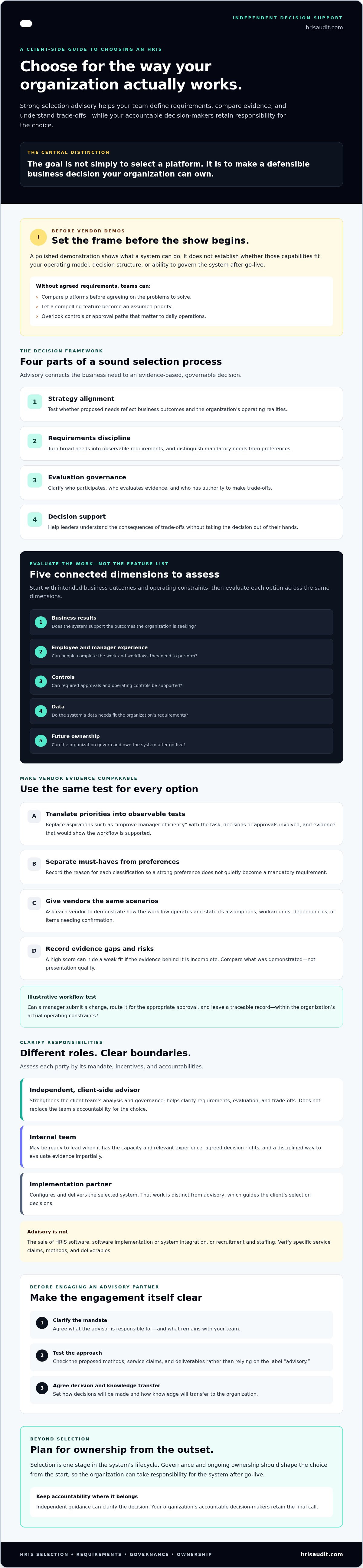
At a minimum, sound advisory connects four parts of the decision: strategy alignment, requirements discipline, evaluation governance, and decision support. In practice, that means testing whether proposed needs reflect business outcomes, defining how options will be assessed, clarifying who participates and decides, and helping leaders understand the consequences of trade-offs.
Advisory guides the client’s HRIS decisions; implementation configures and delivers the selected system. The boundary matters. Scope varies by organization and engagement, so verify specific service claims, methods, and deliverables rather than inferring them from the word “advisory.”
When an organization needs independent selection guidance
Look for structural warning signs: stakeholders rank priorities differently, nobody can name the final decision-maker, or requirements seem to follow a vendor’s demonstration instead of documented operating needs. In those conditions, procurement administration may keep the process moving without resolving the underlying disagreement.
Enterprise transformations can span multiple functions, workflows, data needs, and control requirements. Client-side leadership can help connect those areas and challenge assumptions while internal leaders retain authority. External guidance isn’t necessary for every selection. If your team has the capacity and relevant experience, with agreed decision rights and a disciplined way to evaluate evidence impartially, it may be ready to lead internally. The test is readiness, not the size of the vendor shortlist.
How to evaluate HRIS options against real operating requirements
A useful evaluation starts with the work the system must support, not a catalogue of features. Define intended business outcomes and operating constraints first. Then assess each option across five connected dimensions: business results, employee and manager experience, controls, data, and future ownership. HRIS selection advisory services can help keep the evaluation focused on what the operating model requires, rather than what sounds attractive in a presentation.
Turn HR priorities into testable selection criteria
Translate each priority into something observable. “Improve manager efficiency” is an aspiration, not a test. Specify the task a manager needs to complete, the decisions or approvals involved, and what evidence would show that a system supports the workflow. Separate mandatory requirements from preferences, and record the reason for each classification. Otherwise, a strong preference can quietly become a must-have.
For example, an illustrative core HR change workflow might require a manager to submit a change, route it for the appropriate approval, and leave a traceable record. Test that sequence against the organization’s actual operating constraints. Don’t assume that a feature label proves the system can support the workflow.
Compare vendor claims with evidence, not presentation quality
Give vendors the same agreed scenarios. Ask each to demonstrate how a workflow operates, state its assumptions, and identify any workaround, dependency, or capability that needs further confirmation. Record evidence gaps and risks alongside scores. A high score can hide a weak fit if the evidence behind it is incomplete.
Use a comparison record such as this to make the reasoning visible:
| Criterion | Evidence | Importance | Risk | Decision owner |
|---|---|---|---|---|
| Core HR change workflow | Scenario demonstration and documented assumptions | Mandatory or preferred, with rationale | Gap, workaround, dependency, or none identified | Named accountable role |
| Manager approval path | Observed steps, controls, and exceptions | Mandatory or preferred, with rationale | Unverified control or process impact | Named accountable role |
| Data and reporting needs | Evidence tied to defined business questions | Mandatory or preferred, with rationale | Data limitation or ownership question | Named accountable role |
Scores help organize the discussion, but they don’t make the decision. Decide who can resolve competing priorities and how exceptions will be recorded. The HR technology governance framework offers a related lens for considering decision controls and structural integrity.
If your team is assessing whether its governance is ready to support a selection, HRIS Audit’s advisory services can help leaders examine the decision structure and evaluation approach. The decision remains yours, and the evaluation should make its basis clear.
Independent advisor, internal team, or implementation partner: what fits?
These roles aren’t interchangeable. Compare them by mandate, incentives, decision rights, and accountability, not by title. The internal team represents the organization and retains authority over business priorities and system choice. An independent advisor can structure the evaluation, challenge assumptions, and help stakeholders reach a clear decision. An implementation partner focuses on the delivery scope it has agreed to. Commercial incentives depend on the partner’s contract and relationships, so assess them directly rather than assuming every partner has the same interests.
This distinction also addresses a common concern: will HRIS selection advisory services duplicate work the internal team is already doing? They shouldn’t. The useful question is whether the team has enough capacity, experience, and authority to manage the work well. Advisory can fill specific gaps, such as facilitating competing priorities, bringing structure to an evaluation, or helping leaders identify risks that fall between functional teams. It should strengthen internal ownership, not create dependence on an outside voice.
What an independent client-side advisor contributes
A client-side advisor may bring objective challenge, structured decision support, and alignment across stakeholders. “Independent” is a claim to verify, not a label to accept. Ask about commercial relationships with software vendors and delivery partners, how conflicts are disclosed, and what the engagement terms allow the advisor to recommend. For the broader principle of retaining client ownership across transformation, see client-side HR technology leadership.
How to decide whether external advisory is justified
Test the need against four conditions: internal capacity, transformation complexity, stakeholder alignment, and executive availability to resolve trade-offs. A capable team with clear decision rights may lead the selection internally. External advisory is more relevant when the team lacks time or specialized experience, priorities remain unresolved, or leaders need a structured basis for decisions. Additional delivery support may be appropriate when the gap concerns execution capacity rather than decision governance.
- Internal leadership: The team has capacity, relevant expertise, aligned stakeholders, and available decision-makers.
- Advisory: The organization owns the decision but needs help structuring the process, challenging assumptions, or aligning stakeholders.
- Delivery support: The selected scope requires execution capabilities the organization doesn’t have internally. Define the provider’s responsibilities and commercial incentives.
Set the measure of success before engaging anyone: better-informed decisions and stronger internal capability. If you’re considering client-side advisory, compare the support available with the gaps your team has identified.
A practical process for selecting an HRIS advisory partner
Select an advisor with the same discipline you’d apply to the system decision. The goal isn’t to outsource accountability. It’s to appoint support that fits the mandate, works transparently with your team, and leaves the organization better equipped to own its decisions. Use these five steps to assess fit.
- Define the mandate. Specify the problem to solve, the decisions the advisor may support, and what remains with the organization.
- Verify relevant experience. Ask for examples of work with comparable transformation complexity and stakeholder structures. Focus on the advisor’s role and lessons, not just the project name.
- Test the approach. Ask how the advisor translates business needs into requirements, makes trade-offs visible, and works alongside internal teams, vendors, and implementation partners.
- Agree governance. Document responsibilities, client accountabilities, scope boundaries, decision forums, and escalation paths before work begins.
- Plan knowledge transfer. Clarify how methods, rationale, and decision records will be shared so client ownership increases rather than shifts to the advisor.
Request examples of decision artifacts, such as an anonymized evaluation structure or a sample governance approach. Don’t ask for confidential client materials. You’re assessing the advisor’s method and clarity, not seeking access to another organization’s private information.
Questions to ask prospective HRIS advisors
Ask how they turn business priorities into testable requirements and help stakeholders resolve competing needs. How do they distinguish evidence from recommendation? What do they do when a vendor’s proposed approach conflicts with the client’s operating needs? Ask how they coordinate with your team and other parties without taking over the organization’s decision rights.
Make knowledge transfer concrete, too. Ask what the client team will understand, maintain, and decide independently as the engagement progresses. Strong answers explain how ownership is built into the work, not postponed until the end.
Set the engagement up for client ownership
Before work begins, name accountable roles, expected artifacts, review points, and the forums where decisions will be made. Agree how recommendations can be challenged, how unresolved questions will be documented, and who can escalate them. Practical HR transformation tools and frameworks can help teams establish a consistent working structure.
Use the same test throughout: can your leaders explain the recommendation, its evidence, its trade-offs, and who owns the decision? If not, clarify the engagement before proceeding. HRIS Audit’s Transformation Studio and Pulse Scan provide a way to explore related offerings.
From HRIS selection to sustainable ownership: what happens next?
Selection is a decision point, not the finish line. The reasoning behind the choice needs to carry into design, implementation governance, adoption, and ongoing optimization. If selection records only the winning platform, the organization can lose the assumptions, trade-offs, dependencies, and unresolved risks that shaped the decision. Those details matter when delivery teams translate requirements into processes and controls.
A vendor choice can’t compensate for unclear ownership or missing internal capability. The organization still needs people who can make process and data decisions, oversee change, support users, and determine how the system should evolve. HRIS selection advisory services can help keep client decisions connected across the transformation, but advisory alone doesn’t guarantee implementation success or post-go-live adoption.
Keep selection decisions connected to delivery
Carry the decision rationale forward as a working reference, not an archive. Make clear who is accountable for the areas that translate the selected system into organizational practice:
- Process design: Who confirms how work should operate, including exceptions?
- Data decisions: Who defines data ownership, quality expectations, and reporting needs?
- Testing and adoption: Who validates that workflows meet requirements and prepares affected users?
- Future changes: Who assesses requests, sets priorities, and approves changes after go-live?
These responsibilities may sit across different teams. Name the accountable roles and establish how they coordinate. Keep dependencies and unresolved risks visible so they can be reviewed in the appropriate governance forums, rather than rediscovered during delivery.
Build the capability to govern the HRIS after go-live
Sustainable ownership requires more than access to the system. The organization needs decision rights, defined processes for managing change, people who understand the system’s purpose and constraints, and controls for reviewing whether it continues to meet operating needs. Consider those capabilities during selection, not as a later handoff task.
An advisor should help the client team build the understanding and confidence to make future decisions independently. Ask whether internal leaders can explain why the system was chosen, who owns its key processes, and how new needs will be evaluated. If those answers depend on an external advisor, ownership hasn’t fully transferred.
Select for fit. Govern for sustainability. Retain client ownership. Leaders considering support for that work can discuss their advisory needs with HRIS Audit.
Make the HRIS decision one your organization can own
A sound system choice begins with operating needs, not the strength of a vendor presentation. Clear criteria and decision rights help leaders compare evidence, weigh trade-offs, and make a defensible choice. HRIS selection advisory services can bring structure and independent challenge to that work while accountability stays with the organization.
The decision also sets the foundation for what follows. Carry its rationale into delivery governance, clarify who owns process and data decisions, and build the capability to manage system change after go-live. A platform can support the organization’s work, but it can’t replace sound governance or internal ownership.
HRIS Audit provides client-side advisory for enterprise HR technology transformation, drawing on more than 30 years of experience in HR transformation. Its Built Not Bought™ method guides organizations through designing, governing, and delivering HR systems that remain effective after go-live. The aim is to strengthen your team’s ability to make and govern its own decisions, not substitute for it.
With clear criteria, accountable decision-makers, and ownership built into the process, your organization can move forward with greater clarity and a stronger foundation for the system’s long-term role.
Discuss your HR technology advisory needs with HRIS Audit.
Frequently Asked Questions
What do HRIS selection advisory services include?
HRIS selection advisory services provide client-side guidance to help an organization frame its needs, assess options, and govern decisions. Depending on the engagement, that may include aligning the selection with business priorities, clarifying requirements, structuring the evaluation, and helping leaders weigh evidence and trade-offs. Scope varies, so confirm specific methods and deliverables before engaging an advisor. The advisor supports decision-making; accountable client leaders retain authority over the selection.
When should an organization hire an HRIS selection advisor?
Consider an advisor when priorities conflict, decision rights are unclear, or vendor presentations are shaping requirements before the organization has defined its needs. External guidance may also help when a complex transformation spans functions and the internal team lacks the capacity or relevant experience to coordinate the decision. First assess whether internal leaders can own the process, resolve trade-offs, and evaluate evidence. If they can, external advisory may not be necessary.
How is an independent HRIS advisor different from a system integrator?
An independent HRIS advisor works on the client side to support decision structure, challenge assumptions, and help leaders assess options. A system integrator typically focuses on delivering agreed technical or implementation scope. These are different mandates, though actual responsibilities and commercial relationships vary by provider. Check how an advisor is compensated, whether vendor relationships exist, and what the contract says about conflicts, recommendations, and decision authority. Neither role replaces the organization’s accountability.
Can an organization select an HRIS without external advisory support?
Yes. An organization can lead selection internally if it has the capacity, relevant expertise, clear decision rights, aligned stakeholders, and leaders available to resolve competing priorities. Assign ownership for requirements, evaluation, and final approval before vendor discussions begin. If the team can compare evidence impartially and document its rationale, external support may add little. The key test is readiness to manage the decision, not whether hiring an advisor is customary.
How should we compare HRIS vendors beyond feature lists?
Compare vendors against requirements tied to actual work, not feature labels. Define shared scenarios, such as an approval workflow or a change to employee information, and ask each vendor to demonstrate them. Record what the demonstration proves, what assumptions it relies on, and any workaround, dependency, or evidence gap. Assess business fit, user experience, controls, data needs, and future ownership. Treat scores as inputs to judgment, not as the decision itself.
What should we ask a prospective HRIS selection advisor?
Ask how the advisor turns business needs into testable requirements and helps stakeholders make trade-offs visible. Find out how they work with internal teams, vendors, and implementation partners, and how they handle differing recommendations or conflicts of interest. Request examples of decision methods or anonymized artifacts, not confidential client files. Also ask what knowledge will transfer to your team and how the advisor will keep client decision ownership clear throughout the engagement.
How does HRIS selection advisory support ownership after go-live?
Good advisory connects selection decisions to the capabilities needed to manage the system over time. It can help the organization carry forward decision rationale, assumptions, dependencies, and open risks while clarifying who owns process design, data decisions, testing, adoption, and future changes. It should also build the client team’s ability to govern those responsibilities independently. Advisory can support preparation and governance, but it can’t guarantee implementation success or adoption after go-live.


