

What if the vendor with the best demo is the wrong choice for your organization? A polished presentation can make different HRIS platforms look equally capable. The most useful questions to ask potential HRIS vendors expose what sits beneath the surface: assumptions about your data, integrations, implementation responsibilities, and the decisions your team will own after go-live.
It’s reasonable to focus on features, but feature fit alone won’t show whether a system can support your operating realities or whether your organization can sustain it. Vendor questions test product fit. Ownership questions test whether your team can make the system work over time.
This 2026 evaluation guide gives you practical questions to compare vendor answers against business requirements and organizational readiness. It covers functionality, integrations, data, implementation, costs, security, reporting, and support, while highlighting the trade-offs each answer may conceal. It also explains why governance, decision rights, and internal capability belong in the evaluation, not as afterthoughts once the contract is signed.
Key Takeaways
- Map requirements across processes, users, locations, and data before comparing platforms. Ask vendors to distinguish standard functionality from configuration and dependencies.
- Use questions to ask potential HRIS vendors to uncover delivery assumptions, client responsibilities, decision deadlines, and change-control processes.
- Assess implementation claims against your organization’s capacity to make decisions, provide data, and meet its responsibilities.
- Make governance, adoption, support boundaries, and release decisions part of vendor selection, not issues deferred until after go-live.
- Score vendor answers against evidence and organizational readiness, then assign owners and resolution dates to open questions before making a decision.
Why the Right Questions to Ask Potential HRIS Vendors Go Beyond the Demo
Vendor selection is not a contest to count features. It’s a test of organizational fit: can the platform support the outcomes you need, and can your organization make the decisions and own the work required to achieve them? A system may look capable in a demonstration while depending on process consistency, clean data, available integrations, or internal ownership that your organization hasn’t established.
The categories can blur. A Human resource management system (HRMS) may bring together employee records, workflows, and other HR functions, but a list of capabilities won’t show how those functions fit your operating model. The questions to ask potential HRIS vendors should reveal what the platform does, what delivery depends on, and what your team must decide or maintain.
What should an HRIS vendor evaluation actually reveal?
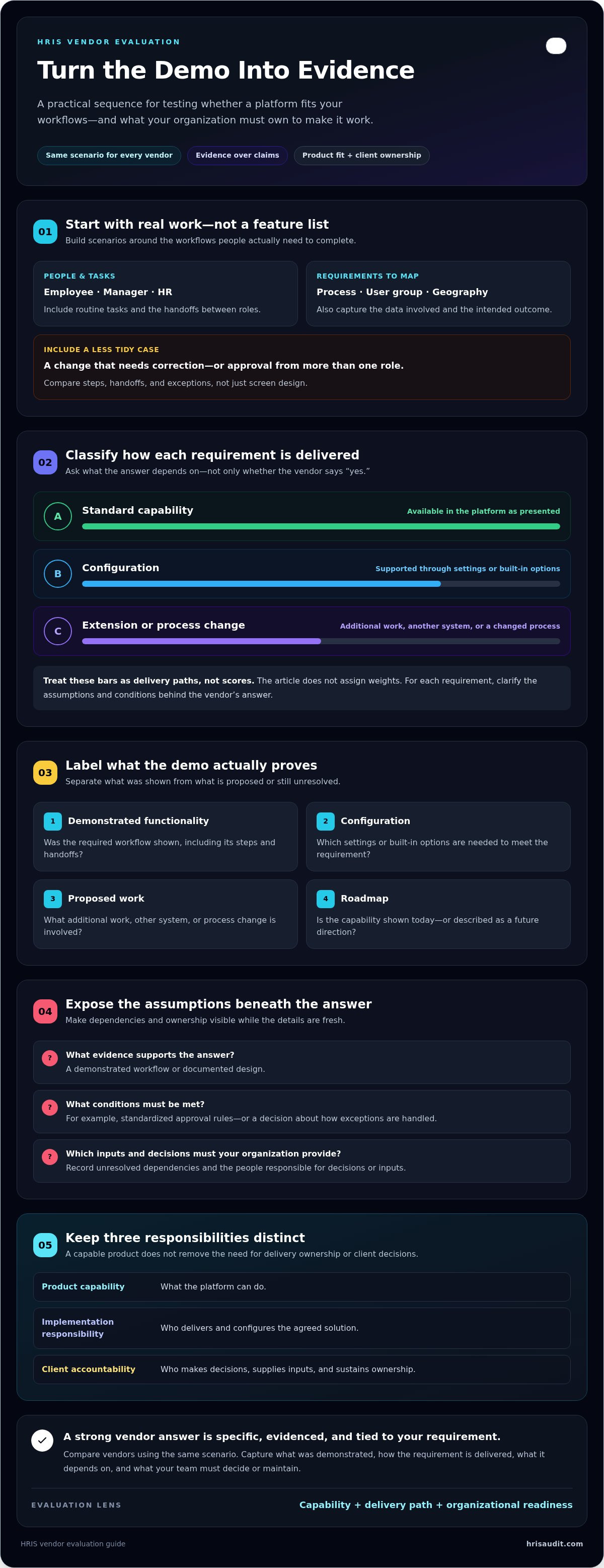
Start with priority outcomes and the employee experiences behind them. If employees need to update personal information and managers need to approve changes, ask the vendor to demonstrate the entire workflow, including handoffs and the data created along the way. Then map each requirement to a clear delivery path:
- Standard capability: Available in the platform as presented.
- Configuration: Supported through settings or built-in options.
- Extension or process change: Depends on additional work, another system, or a change to how your organization operates.
A strong answer is specific, supported by evidence, tied to your stated requirement, and explicit about dependencies. “The system can do that” is not enough. Ask what was demonstrated, what conditions must be met, and which decisions or inputs your organization must provide.
How do you keep a vendor demo from driving the decision?
Build scenarios from actual employee, manager, and HR workflows. Include routine tasks and a less tidy case, such as a change that needs correction or approval from more than one role. Give each vendor the same scenario and compare the steps, handoffs, and exceptions, not just the screen design.
Ask the vendor to label each answer as demonstrated functionality, configuration, proposed work, or roadmap. A feature shown in a presentation is not necessarily available in the form your requirements demand. Record evidence and unresolved dependencies while the details are fresh.
This is also a test of buyer ownership. Your organization must define requirements, make timely decisions, and establish who will govern the system after selection. The client-side HR technology ownership framework reinforces that responsibility belongs with the organization, not the demonstration. Keep the boundaries visible:
Product capability: What the platform can do.
Implementation responsibility: Who delivers and configures the agreed solution.
Client accountability: Who makes decisions, supplies inputs, and sustains ownership.
Questions to Ask Potential HRIS Vendors About Requirements, Architecture, and Fit
Turn each business requirement into a testable question. Group requirements by process, user group, geography, data, and intended outcome. This prevents a broad claim such as “the platform supports global HR” from being mistaken for evidence that it fits your locations, workflows, or reporting needs. This collection of HRIS vendor questions also points to the value of looking beyond feature lists to how a system performs in practice.
For every priority requirement, ask whether it is met through standard functionality, configuration, an extension, a connected system, or a change to your process. Ask what assumptions support the answer. If a workflow depends on standardized approval rules, clarify which teams must adopt those rules and who decides how exceptions are handled.
Which questions test process and functional fit?
Trace each important workflow from initiation through approval and reporting. Ask: “What steps does the employee, manager, or HR team complete? Where does the information go? What happens when the process differs by role or location?” Establish whether the design can accommodate necessary local variation or depends on standardizing the process. Evaluate the answer using agreed requirements and realistic user roles, not a generic walkthrough.
Which questions expose data and integration assumptions?
Map the system boundaries. Ask which applications exchange data, what event triggers each exchange, how errors are identified, and who owns reconciliation. Clarify which system is authoritative for each data element. For migration, ask how data quality issues are identified, who decides how to cleanse and map records, and which historical records will be carried forward.
Architecture questions should expose dependencies, not just connections. A vendor may describe an integration, but your evaluation needs to capture its scope, required inputs, ownership, and unresolved decisions. The HR technology governance framework can help clarify decision rights around these boundaries.
- Evidence: What supports the answer, such as a demonstrated workflow or documented design?
- Responsible party: Who provides the data, makes the decision, or resolves the issue?
- Open decision: What assumption or dependency remains unresolved?
- Status: Is the requirement met, conditional, at risk, or still unknown?
These questions to ask potential HRIS vendors create a traceable comparison between requirements and proposed solutions. Use the same record for every vendor. A concise client-side governance and decision-rights framework can help your team assign ownership before selection decisions become delivery commitments.
Questions That Test the HRIS Vendor’s Implementation Claims and Trade-Offs
A confident timeline is not proof that delivery is feasible. A demo shows what can be presented. An implementation plan must account for scope, data, integrations, decision-making, and the capacity of both parties. Ask how the proposed plan was built, what assumptions it relies on, and what changes if those assumptions prove wrong.
How can buyers test an implementation plan?
Ask the vendor to walk through the path from agreed scope to key milestones. Which decisions must your organization make, and by when, to keep the plan on track? What data, access, subject-matter expertise, and review capacity must your team provide? Ask how dependencies between configuration, migration, integrations, and testing affect the sequence and timing.
Test the plan against a change in conditions. If a data issue appears or a decision deadline slips, how is the impact assessed, communicated, and approved? Ask which delivery risks the vendor monitors and what governance route is used to escalate them. A credible response explains the process, not just a reassuring outcome.
How should you compare promises, risks, and responsibilities?
Separate what is contractually committed from what is an estimate, a proposed approach, or a roadmap statement. These categories carry different weight. Record the exact claim, its supporting evidence, the dependency it rests on, the owner, the associated risk, and the follow-up needed to resolve uncertainty. Use the same format for each vendor so confidence and detail don’t distort the comparison.
A credible implementation commitment ties a claim to evidence, explicit assumptions, and accountable owners. Apply that test to configuration, testing, migration decisions, training, and issue resolution. Ask who performs each activity, who approves the result, and who handles an unresolved issue. Shared responsibility is not the same as clear accountability.
Compare implementation answers consistently:
- Claim: What has the vendor said will happen?
- Evidence: What plan, deliverable, or demonstrated approach supports the claim?
- Dependency and owner: What must be true, and who is accountable?
- Risk and follow-up: What could change the outcome, and what must be clarified before selection?
These questions to ask potential HRIS vendors turn broad promises into delivery conditions your team can assess. HRIS Audit’s transformation tools and frameworks support a structured evaluation, helping your organization distinguish vendor commitments from the decisions and capabilities it must own.
Questions About Governance, Adoption, and Life After HRIS Go-Live
Go-live is a transition, not an end state. The organization still has to govern the system, manage releases, support users, and decide which processes should change. Make that operating model part of vendor selection. Otherwise, you may choose a platform without knowing who will keep it aligned with the business after the project team disbands.
Ask how the vendor supports adoption and capability transfer while leaving decision authority with your organization. The Built Not Bought HR strategy frames sustainable transformation around organizational ownership: the client must be able to govern and improve the system over time, not simply use it at launch.
What questions reveal who owns the system after launch?
Get specific about decision rights. Which decisions remain with the client, such as approving process changes, prioritizing enhancements, or deciding how to respond to a release? Who participates, who has final authority, and how are conflicts resolved? Ask how administrators and process owners will learn to assess changes, retain configuration knowledge, and manage recurring work without relying on informal handoffs.
Clarify the support boundary, too. What issues does the vendor handle, what falls to your internal team, and where do responsibilities overlap? Ask how users escalate problems, how urgent issues are distinguished from routine requests, and who tracks an issue through resolution. Support language is useful only when responsibilities and routes are clear.
How will the organization know adoption and value are lasting?
Logins alone don’t prove that a system is helping people complete work. Ask how adoption measures connect to intended workflow outcomes. If the goal is a reliable approval process, for example, consider whether the organization can see where approvals stall, whether exceptions are handled consistently, and whether employees understand what action is expected of them.
Then ask how feedback becomes action. Who reviews user input, decides whether the cause is training, process design, or system configuration, and prioritizes a response? Establish a regular review of system performance, open issues, user needs, and changes to the operating model. The right questions to ask potential HRIS vendors test whether they can support that discipline while your team builds lasting internal capability.
- Governance: Who owns release, process, and enhancement decisions?
- Capability: How will administrators and process owners gain and retain the knowledge to manage change?
- Adoption: Which workflow outcomes show that the system is working for its users?
Make the answers part of your selection record. A vendor’s post-launch approach should fit the governance structure and capacity your organization is prepared to sustain.
HRIS Audit provides client-side HR technology advisory to help organizations strengthen ownership, decision-making, and transformation governance.
Turn HRIS Vendor Answers into a Decision and a Stronger Client-Side Plan
A vendor comparison is only useful if it leads to a decision your organization can defend and deliver. Score each option against agreed priorities, but assess organizational readiness alongside vendor capability. A platform may fit the requirements and still expose gaps in decision authority, internal capacity, or post-launch ownership. Those gaps belong in the decision, not in a footnote after selection.
What belongs in an HRIS vendor evaluation scorecard?
Use consistent criteria and weight them against business priorities and decision principles established before scoring. For each vendor, record the rating, evidence, assumptions, dependencies, accountable owner, and any open question. A simple scorecard can cover:
- Fit: Does the proposed solution meet priority requirements?
- Evidence: Are answers supported by demonstrations, documented commitments, or other verifiable material?
- Delivery: Are assumptions, responsibilities, and dependencies understood?
- Governance: Can your organization make and sustain the required decisions?
- Adoption: Is there a credible path from system use to intended workflow outcomes?
- Sustainability: Can internal teams govern and improve the system over time?
Don’t treat an unanswered question as an established risk. Mark it as unresolved, assign an owner, and set a date to close it. A risk exists when evidence shows a condition could threaten an outcome. Keep both visible. Document trade-offs, too. If one option fits a critical workflow better but requires more internal capacity, executives need to see that balance and understand why the recommendation still holds.
What should leaders do before making the final selection?
Confirm that the evaluation has an accountable sponsor, clear decision rights, agreed requirements, consistent scenarios, and a governance cadence. Then test readiness: who can direct delivery, make timely decisions, provide subject-matter input, and own the system after launch? If those roles or capabilities are missing, identify how the organization will address the gap before committing.
The questions to ask potential HRIS vendors are only one part of the decision. The other part is whether your organization can meet the responsibilities those answers reveal. A defensible selection connects evidence, trade-offs, and readiness to a client-side plan, with owners for unresolved items and a clear path to resolution.
HRIS Audit’s advisory services support client-side leadership through program resets, gate reviews, sponsor decision support, and capability transfer. The client-side HR technology advisory team can help your organization structure the evaluation and plan for sustainable ownership.
Choose a Platform Your Organization Can Sustain
The questions to ask potential HRIS vendors should do more than confirm what a platform can do. They should expose delivery assumptions, clarify who owns key decisions, and show whether your organization can govern the system after launch. Compare vendor evidence against your requirements and your readiness to lead the work.
That client-side discipline is central to HRIS Audit’s Built Not Bought™ method, which focuses on sustainable organizational ownership. With more than 30 years of HR transformation experience, HRIS Audit supports organizations through program resets, gate reviews, sponsor decision support, and capability transfer. Its advisory work strengthens the client-side plan and leadership, while the selected vendor remains responsible for its own implementation work.
Make the decision with clear eyes, named owners, and a plan for what comes after go-live. Your organization can choose a system it is equipped to lead and sustain.
Frequently Asked Questions
What questions should you ask an HRIS vendor during a demo?
Ask the vendor to demonstrate realistic workflows agreed in advance for employees, managers, and HR. For each scenario, clarify whether the capability is standard, requires configuration, depends on another system, or needs a client decision. Ask what evidence supports each claim, and distinguish demonstrated functionality from a polished screen or scripted path. Record assumptions, unanswered questions, and follow-up owners so every vendor is assessed against the same evidence standard.
How do you compare HRIS vendors objectively?
Start with shared requirements and evaluation criteria tied to business outcomes. Score each vendor against the same scenarios, evidence standards, delivery assumptions, integration needs, governance approach, and post-go-live ownership. Keep demonstrated capability separate from estimates and roadmap statements. Record trade-offs and open questions before making a recommendation. A consistent scorecard makes meaningful differences visible without turning selection into a feature-counting exercise or allowing a persuasive presentation to outweigh evidence.
What should you ask about HRIS implementation timelines?
Ask how the timeline was developed and what assumptions support it. Clarify client decision deadlines, data readiness, integration dependencies, testing responsibilities, change activities, and scope boundaries. Ask which conditions could alter the plan and how changes will be assessed and governed. A timeline only becomes useful when dependencies and accountable owners are visible. Treat dates without supporting assumptions as estimates to investigate, not reliable commitments for planning.
How can you tell whether an HRIS vendor understands your requirements?
Give vendors specific business scenarios and ask them to map each requirement to demonstrated capability, configuration, process change, or dependency. Strong answers make limitations and trade-offs clear, including where your organization must provide input or make a decision. Broad assurances don’t establish fit. The questions to ask potential HRIS vendors should test how the proposed design supports actual workflows, user needs, and operating conditions, not simply whether a feature appears on a list.
What questions should you ask about HRIS data migration and integrations?
Clarify which systems exchange data, what information moves, what triggers each exchange, and who owns each interface and reconciliation step. Ask how the teams will address data quality, historical records, migration decisions, testing, and issue resolution. Identify assumptions that require client action, such as data cleansing or approving mappings. The goal is to expose dependencies and ownership boundaries early, before unclear responsibilities become delivery delays or operational problems.
Why ask HRIS vendors about post-go-live support and ownership?
Go-live doesn’t automatically give your organization the capability to operate and improve the system. Ask who handles support, release decisions, configuration changes, governance, and continuous improvement after launch. Clarify what knowledge your team will retain and where vendor responsibilities begin and end. These answers reveal whether the operating arrangement supports durable internal ownership or leaves essential decisions and system knowledge dependent on ongoing external assistance.
Should HRIS vendor selection focus on features or organizational readiness?
Evaluate both, because feature fit alone can’t show whether your organization can deliver and sustain the change. Assess requirements alongside governance, decision capacity, data readiness, adoption, and internal capability. Ask vendors to state their assumptions, then compare those assumptions with your organization’s actual conditions. Readiness isn’t a reason to avoid selection. It’s a condition to address in the plan, with clear owners for decisions and ongoing system performance.


