

Why do most enterprise HR tech projects feel like a victory on launch day but a structural failure six months later? You've seen the pattern. The technical configuration is complete. The integrations are wired. The vendor has moved on to the next client. Yet, your internal team is left staring at a sophisticated engine they don't know how to maintain. You've realized that technical deployment isn't the same as organizational transformation. To bridge this gap, you need an HR transformation advisor instead of system integrator to act as the guardian of your interests. One builds the software. The other builds the organization that owns it.
It's time to look past the surface level of "going live." We understand the pressure to deliver. We also know that a system without internal ownership is just an expensive liability. You deserve a platform that aligns with your processes, not a process forced into a software's constraints. Discover why a system integrator is not enough to secure your HR technology investment and how client-side advisory ensures long-term organizational ownership. We will explore the critical difference between technical configuration and business readiness. You'll learn how to establish a disciplined framework for governance, design, and long-term capability transfer.
Key Takeaways
- Stop treating "go-live" as the finish line. It is merely the deployment of a tool; true success requires a foundation of organizational readiness and internal capability.
- Learn why hiring an HR transformation advisor instead of system integrator protects your investment by prioritizing strategic alignment over mere billable hours and technical speed.
- Internalize the Built Not Bought™ philosophy. Ownership cannot be outsourced, and your teams must shift from passive consumers to active architects of the system.
- Deploy a client-side leadership model. Use gate reviews and independent risk detection to bridge the gap between executive vision and technical execution.
The System Integration Trap: Why Go-Live Does Not Equal Success
The "Go-Live" date is a vanity metric. In the machinery of enterprise software, it represents the moment the wires are connected, not the moment the business begins to thrive. Most organizations treat this date as a finish line. They celebrate the launch, cut the ribbon, and watch the system integrator (SI) walk out the door. This is a structural mistake. A technical launch is a binary event; true organizational success is a continuous state of operational maturity. When you prioritize an HR transformation advisor instead of system integrator, you shift your focus from the "event" to the "outcome."
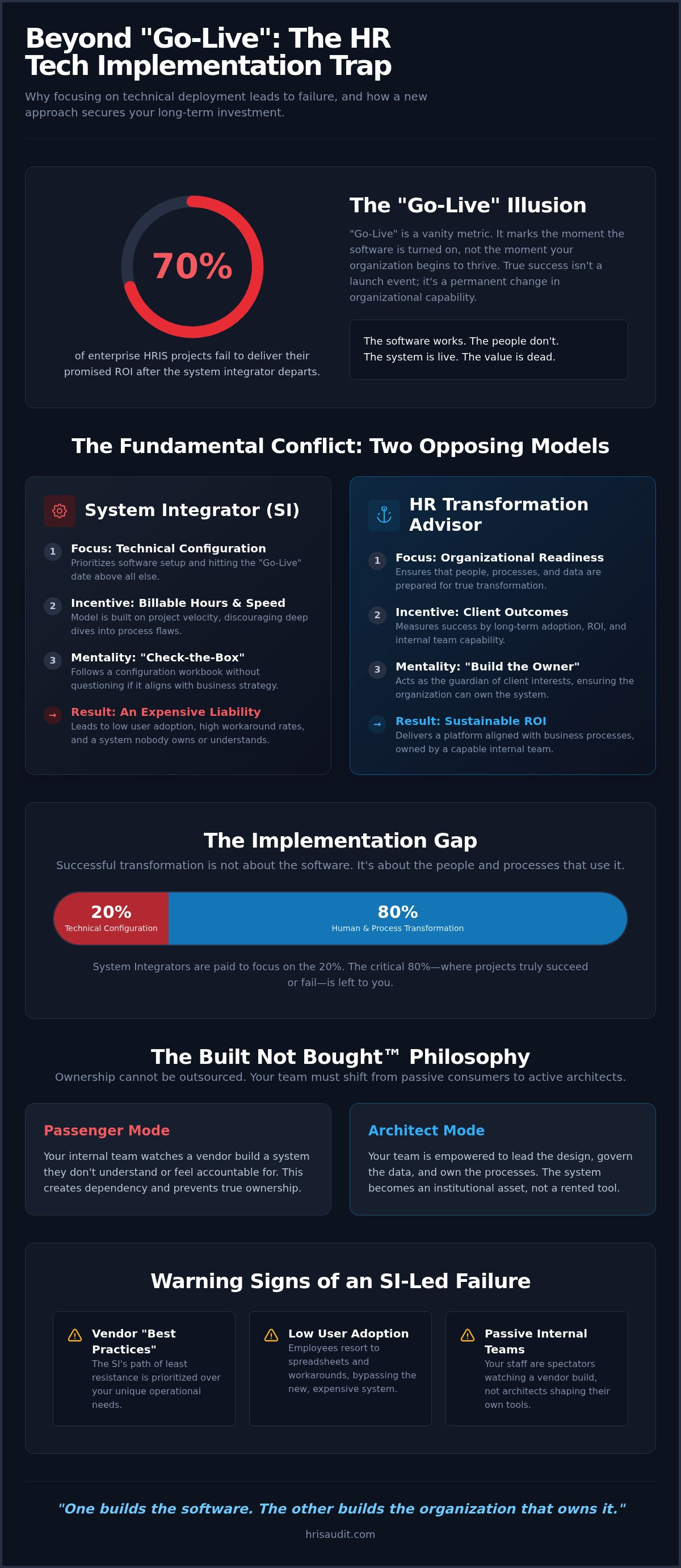
Technical configuration accounts for roughly 20% of the effort required for a successful Human Resource Management System (HRMS) overhaul. The remaining 80% is purely human and process-driven. This is where the Implementation Gap resides. It is the void between software delivery and actual organizational adoption. The sober truth is that 70% of enterprise HRIS projects fail to deliver their promised ROI once the SI departs. The software works. The people don't. The system is live. The value is dead. You cannot configure your way out of a design problem.
The SI business model is built on technical milestones. They are paid to build the box, not to ensure you know how to use it. This creates a fundamental misalignment. While the SI checks boxes on a configuration workbook, the deeper structural foundations of your business often remain untouched. Relying on an HR transformation advisor instead of system integrator allows you to bridge this gap. It ensures the technology serves the strategy, rather than the strategy being warped to fit the software's limitations.
The Definition of True Transformation
Transformation is a structural shift in how people work, not just a UI update. HR transformation is a permanent change in organizational capability. It's the difference between "installing" a tool and "integrating" a new operating model. Installing software is a technical task; integrating a model is an architectural challenge. One changes the screen; the other changes the culture, the data flow, and the decision rights. You aren't buying a product. You are building a system.
Identifying the Symptoms of an SI-Led Failure
Failure rarely looks like a crashed server. It looks like a slow erosion of trust and utility. If your project is led solely by an SI, you will likely encounter these specific symptoms:
- Heavy reliance on vendor "best practices": These are often just the path of least resistance for the SI, ignoring your unique cultural and operational requirements.
- Low adoption and high workaround rates: If your workforce is still using spreadsheets to bypass the new system, your implementation has failed.
- Passenger-mode HR teams: Your internal staff should be the architects of the system, not spectators watching a vendor build something they don't understand.
The Fundamental Conflict: System Integrator Incentives vs. Client Outcomes
The system integrator (SI) operates on a model of high-volume throughput. Their commercial success depends on two primary factors: maximizing billable hours and maintaining speed-to-delivery. This creates a structural misalignment with your long-term organizational interests. A true transformation demands friction. It requires pausing to interrogate flawed processes. It demands difficult conversations about data integrity and organizational design. For an SI, this friction is a threat to the project timeline. They are incentivized to bypass the "why" to reach the "how" as quickly as possible.
This results in a "check-the-box" mentality. The SI completes the configuration workbook and declares victory. But technical completion is a shallow metric. It ignores the reality of whether the business can actually operate the new machinery. Technical expertise is not strategic program leadership. By prioritizing an HR transformation advisor instead of system integrator to lead the strategy, you ensure that your project is guided by judgment rather than just execution. You need a guardian who is willing to slow down the configuration engine to protect the integrity of the transformation.
Incentive Alignment: SI vs. Transformation Advisor
The SI focuses on the mechanics of configuration. An advisor focuses on the architecture of ownership. When the SI leads decision support, vendor bias is inevitable. They will often recommend the path of least resistance for their technical team, rather than the path of highest value for your HR function. Independent oversight provides the only objective lens for your HCM program. If your project feels like it's drifting toward a technical-only launch, a Transformation Pulse Scan can detect these hidden risks before they become permanent failures.
The Strategic Gap: What the SI Won't Tell You
Your SI has a vested interest in keeping the project moving. They won't tell you that your data quality issues are a structural rot that no software can mask. They rarely challenge "process debt." Lifting and shifting old, broken processes into a modern platform is a recipe for expensive disaster. As outlined in the guide for Transforming Human Resources, the strategic foundations must be solid before the first line of configuration is written. The SI leaves when the contract ends. Your organization stays to live with the consequences of their shortcuts.
Built Not Bought™: The Architecture of Institutional Ownership
Ownership is not a commodity. It cannot be purchased, packaged, or outsourced to a third party. Many executives believe that by signing a massive implementation contract, they are buying a transformed organization. They aren't. They are merely renting technical labor. The Built Not Bought™ philosophy rejects this passive consumption. It demands that the client organization becomes the architect of its own future. When you choose an HR transformation advisor instead of system integrator, you are investing in the capability to lead your own system long after the consultants have left the building.
True institutional ownership requires a fundamental shift in identity. You must move from being a consumer of a project to the architect of a system. This shift is supported by a disciplined framework of tools and methodologies. Our proprietary Field Library of tools facilitates this transition. These aren't generic templates. They are specialized instruments designed for rigorous design and governance. They force your team to engage with the structural reality of the software. Capability transfer is the only metric that matters. If your team cannot explain why a configuration choice was made, you don't own the system. You are just using it.
The Built Not Bought™ Methodology
Designing for the "Day After" means focusing on the operational reality that begins when the implementation project ends. We use a Field Library License to provide your team with the same workbooks and frameworks used by industry veterans. This methodology moves your staff from passive participation to active system ownership. It ensures your internal teams are "building" the solution alongside the technical experts. You aren't just watching a house being built; you are the lead architect ensuring the foundation supports your specific weight-bearing requirements.
Governance as a Protective Mechanism
Governance is not red tape. It is a protective mechanism for your investment. It requires establishing a framework that survives the implementation phase and transitions into business-as-usual operations. This begins with rigorous HR technology due diligence before a single line of code is configured. We utilize structured gate reviews to ensure the project remains aligned with the original business case. These reviews act as a circuit breaker. They prevent the technical configuration from drifting away from the strategic intent. If the design doesn't serve the business outcome, the project doesn't move forward. Discipline is the only antidote to project drift.
The Client-Side Leadership Model: Securing Your Transformation ROI
The system integrator builds the engine. The HR transformation advisor instead of system integrator ensures you have a pilot, a flight plan, and a destination. ROI is not a byproduct of technical completion. It is the result of disciplined, client-side leadership. This model is defined by specific, high-stakes motions: sponsor support, gate reviews, and proactive risk detection. Without these, your project is a rudderless ship. You aren't just managing a project; you are securing a multi-million dollar asset.
An independent advisor acts as the "Guardian of the Client Interest." They provide the project sponsor with an unvarnished view of the landscape. While an SI might sugarcoat a status report to maintain their billing velocity, an advisor exposes the structural rot. We utilize the Transformation Pulse Scan to identify these hidden failure points before they become catastrophic. It is a diagnostic tool for the health of your transformation. It detects misaligned decision rights, data gaps, and operational friction. It provides the pattern recognition necessary to course-correct before the budget is exhausted.
We must move beyond the traditional concept of "Change Management." Most change management is cosmetic. It focuses on communication plans and user manuals. We prioritize "Capability Readiness." This is a structural assessment of your organization's ability to own the technology. Can your teams maintain the integrations? Do they understand the governance framework? If the answer is no, the system is a liability. To ensure your project remains on the rails, consider a Transformation Pulse Scan to audit your current trajectory.
Sponsor Decision Support
Executives require judgment-based data for high-stakes decisions. They don't need more spreadsheets; they need clarity. Removing the "SI Filter" from project reporting is essential for transparency. This ensures that the sponsor is reacting to reality, not a vendor's curated narrative. Objective advisory removes the emotional noise from transformation resets. It allows for sober, strategic pivots when the technical machinery clashes with the business intent.
The Transformation Studio: Executing with Discipline
The Transformation Studio uses structured workshops to align high-level strategy with practical machinery. This is where the vision meets the dirt. We utilize specialized facilitation guides to navigate complex, global enterprise projects. These guides ensure that every stakeholder is speaking the same language. It is critical to integrate the "Field", the end-users, into the design process early. This isn't about gathering feedback; it's about building a system that reflects the operational reality of the workforce.
Executing with Independence: Why HRIS Audit is the Strategic Alternative
Independence is not a marketing slogan; it is a structural requirement for objectivity. Most consulting firms operate with a hidden conflict of interest. They are either tethered to software vendors through partnership agreements or they are hunting for the next massive implementation contract. This creates a filtered perspective. When you engage an HR transformation advisor instead of system integrator, you are hiring a fiduciary for your project's integrity. We don't sell software. We don't perform technical implementations. We provide the independent oversight necessary to ensure your executive vision isn't sacrificed for technical convenience.
HRIS Audit bridges the gap between the boardroom and the server room. We translate high-level strategic intent into the practical machinery of configuration. Our perspective is "battle-tested," earned through 30 years of industry experience and deep pattern recognition. We have seen the same failure modes repeat across global enterprises. We know where the SIs cut corners. We know where the data will break. This seasoned perspective allows us to act as a bridge, ensuring that the technical execution remains subordinate to the business outcome. We see the rot. We fix the foundation. We ensure the system serves the organization, not the other way around.
The HRIS Audit Advantage
Our methodology is powered by the Field Library and Pulse Scan diagnostics. These tools provide a disciplined framework for detecting risk and enforcing governance. We lead with "Tough Love" expertise. This means we prioritize structural outcomes over corporate optics. We aren't here to provide comfortable status reports; we are here to provide the truth. You can engage us through our Transformation Studio sessions for targeted alignment or through long-term transformation leadership. In every engagement, our goal is the same: to protect the client's interest against the inertia of a standard SI-led project.
Building for the Future
Success is measured by the state of your system three, five, and ten years after the launch party is over. A system that requires a permanent "shadow army" of consultants to maintain is a failed system. The ultimate goal of our advisory is a self-sufficient HR organization. We build the internal muscles of your team so they can own the technology, manage the governance, and drive continuous improvement without external dependency. You are moving from a state of technical debt to a state of strategic capability. To begin this transition, you must first understand your current structural health. Assess your transformation health with a Pulse Scan to identify the gaps in your current trajectory and secure your long-term ROI.
Architecting Your Institutional Future
Transformation is a structural discipline. It is not a software purchase. It requires order. It demands logic. It necessitates ownership. You've seen how the system integration trap prioritizes technical configuration over organizational readiness. True success requires a shift in perspective. You must move from passive participation to active architectural leadership. This means establishing a governance framework that survives the launch. It ensures your internal teams possess the capability to own the machinery they use every day.
Choosing an HR transformation advisor instead of system integrator is the only way to secure a platform-agnostic guardian for your interests. At HRIS Audit, we leverage our Built Not Bought™ methodology and 30+ years of battle-tested experience to bridge the gap between executive vision and technical execution. We don't just build systems. We build the organizations that run them. It's time to reclaim your project from the inertia of vendor-led delivery. Secure your HR transformation with client-side leadership and ensure your technology investment delivers the structural integrity your business demands. Your organization is ready for a foundation that lasts.
Frequently Asked Questions
What is the main difference between a system integrator and an HR transformation advisor?
The primary difference lies in the focus of the engagement. A system integrator is a technical contractor hired to configure software based on a workbook. An HR transformation advisor instead of system integrator is a strategic architect hired to ensure the organization is structurally ready to own and operate that software. One focuses on the "how" of technical wiring; the other focuses on the "why" of business outcomes and the "who" of internal capability.
Why do system integrators often fail to deliver long-term ROI?
System integrators are commercial entities incentivized by billable hours and speed-to-delivery. Their finish line is the "go-live" date, which is merely the start of your operational journey. They often bypass difficult strategic conversations about process debt or data quality to keep the configuration engine moving. This results in a technically functional system that the business cannot actually adopt or maintain once the vendor departs.
How does the Built Not Bought™ method help my internal team?
The Built Not Bought™ method forces your internal team to move from passive participation to active system ownership. It utilizes a proprietary Field Library License to provide the same workbooks and frameworks used by industry veterans. This methodology ensures your staff isn't just watching a project happen; they're building the institutional knowledge required to run the system for the next decade without external dependency.
When is the best time to bring in a client-side HRIS advisor?
The optimal time to engage a client-side advisor is during the pre-discovery phase. You need independent oversight before you select a vendor or sign an implementation contract. Bringing in an advisor early allows you to establish a disciplined governance framework and conduct the necessary HR technology due diligence. This protects your investment from the start by aligning software capabilities with your strategic operating model.
Can an independent advisor work alongside my existing Big 4 system integrator?
Yes, and this is often the most effective way to secure your investment. An independent advisor acts as a guardian for the project sponsor, removing the "SI filter" from project reporting. Large SIs focus on technical deployment. An independent advisor provides the judgment-based data and objective oversight needed to ensure those technical teams remain aligned with your specific business case rather than their own delivery milestones.
What is a transformation pulse scan and why do I need one?
A Transformation Pulse Scan is a diagnostic tool designed to detect hidden structural risks in your project. It identifies misaligned decision rights, governance gaps, and operational friction points that lead to post-launch failure. You need one to provide an unvarnished view of your project's health. It allows for sober course-correction before your budget is exhausted and your internal teams are overwhelmed by technical debt.
How do you measure the success of an HR transformation after the SI leaves?
Success is measured by capability transfer and organizational adoption. If your internal team cannot maintain the system or if your workforce is using spreadsheets to bypass the software, the transformation has failed. We look for a self-sufficient HR organization where the technology is integrated into a disciplined operating model. The ultimate metric is whether the system remains effective three, five, and ten years after the launch party.
Does HRIS Audit help with software selection or just implementation leadership?
HRIS Audit provides platform-agnostic advisory that includes both software selection and implementation leadership. We help you navigate the complexity of the market without vendor bias. We don't sell software or perform technical configuration. Our role is to act as your strategic architect, ensuring that whichever tool you select is built to serve your organizational goals rather than forcing your business to fit the software's constraints.


