

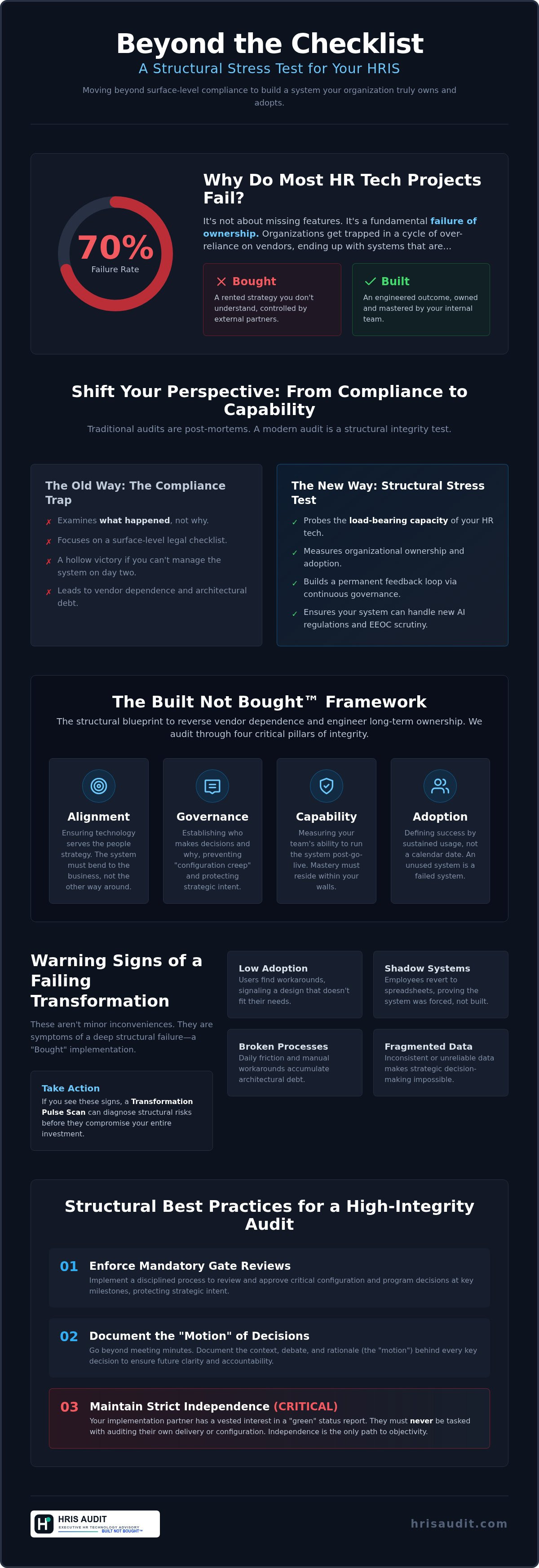
Why do 70% of HR technology projects fail to deliver their promised value? It isn't a lack of features. It's a failure of ownership. Most organizations are trapped in a cycle of over-reliance on system integrators. They end up with platforms that feel "bought" rather than "built" for their specific organizational DNA. To break this cycle, you must look beyond the standard compliance checklist. Implementing best practices for HRIS Audit in 2026 requires a shift toward a deep structural stress test of your internal capabilities. It's about ensuring your system can handle the weight of new AI regulations and record-breaking EEOC scrutiny.
You know the frustration of a system that works in a demo but fails in the field. We agree that a "successful" go-live is a hollow victory if you can't manage the technology on day two. This article promises to move you beyond surface-level fixes toward a framework for long-term organizational sustainability. We will preview the shift from vendor dependence to internal mastery, the mechanics of clear governance, and the specific motions required to build a system you actually own. It's time to stop renting your strategy and start building your foundation.
Key Takeaways
- Shift your perspective from a legal "compliance trap" to a structural stress test that measures organizational ownership and adoption.
- Adopt the Built Not Bought™ framework to ensure your internal team, not your vendor, holds the keys to your technology’s long-term success.
- Implement best practices for HRIS Audit by enforcing a mandatory gate review process and documenting the "motion" of every program decision.
- Maintain strict independence by ensuring your implementation partner is never tasked with auditing their own delivery or configuration.
- Utilize a Transformation Pulse Scan to identify immediate structural risks and determine if a program reset is required to protect your investment.
Beyond Compliance: Why Traditional HR Audits Fail HRIS Transformations
Traditional audits are often post-mortems. They examine what happened, not why the engine stalled. In the high-stakes environment of 2026, a standard checklist is no longer sufficient. A true HRIS audit is a structural integrity test. It probes the load-bearing capacity of your people technology. It asks if the system can withstand the weight of your strategic ambitions. Most organizations mistake a legal pass for a functional success. This is the "Compliance Trap."
Meeting the legal minimums is the baseline, not the finish line. The U.S. Equal Employment Opportunity Commission (EEOC) secured $660 million for discrimination victims in fiscal year 2025. With new AI-related legislation taking effect in Illinois and Texas as of January 1, 2026, the regulatory floor has shifted. Yet, a system that satisfies a regulator can still be a failure for your employees. We see a persistent "Integrity Gap" between vendor promises and operational reality. Bridging this gap requires a move toward continuous governance. You don't need a point-in-time review. You need a permanent feedback loop.
The Difference Between HR Policy and HRIS Architecture
Policy is the blueprint. Architecture is the foundation. You can draft a perfect policy on paper and still face a catastrophic failure in the configuration. Auditing the "how" is just as critical as auditing the "what." When you ignore the technical delivery, you accumulate architectural debt. Every manual workaround and poorly mapped data field adds a layer of systemic risk. One of the primary best practices for HRIS Audit is maintaining absolute independence. Your system integrator has a vested interest in a "green" status report. They should never be the ones auditing their own delivery. Independence is the only path to objectivity.
Recognizing the Symptoms of a Failing Transformation
How do you know your transformation is failing? Look at the users. Low adoption is rarely a training issue. It's a structural failure. When employees revert to spreadsheets, they are building shadow systems. These are silent indicators of a "Bought" implementation. They prove the system was forced upon the organization rather than built for it. The evidence is clear in the daily friction. Broken processes. Fragmented data. Disengaged users. These aren't minor inconveniences. They are the early warning signs of a project destined for the 70% failure rate typical of HR tech projects. If you suspect these symptoms, initiating a Transformation Pulse Scan is the first step in diagnosing the rot before it reaches the core.
The Built Not Bought™ Framework: Auditing for Long-Term Ownership
Ownership is not a fortunate accident. It is an engineered outcome. Most organizations "buy" their way into a transformation, only to realize they've actually rented a system they don't understand. The Built Not Bought™ methodology provides the structural blueprint to reverse this trend. It shifts the focus from passive participation to active construction. When applying best practices for HRIS Audit, we evaluate the system through four critical pillars of integrity.
- Alignment: Ensuring the technology serves the people strategy. The system must bend to the business, not the other way around.
- Governance: Establishing who makes the decisions and why. Disciplined governance prevents "configuration creep" and protects the original strategic intent.
- Capability: Measuring the team’s ability to run the system post-go-live. Mastery must reside within your walls.
- Adoption: Defining success by sustained usage rather than a calendar date. A system that isn't used is a system that failed.
Shifting from Participation to Ownership
Consultants are temporary horsepower. They are "rented experts" who provide speed but rarely leave behind wisdom. If your project relies entirely on external knowledge, you have a structural vulnerability. Auditing internal skill sets is non-negotiable. Do you have architects who understand the underlying logic? Or do you have operators who merely follow a vendor’s manual? Capability transfer is the deliberate migration of system logic and strategic intent from external partners to internal stakeholders. Without this transfer, the system remains a foreign object within your organization. You must audit for the presence of internal expertise, not just the completion of tasks.
The Role of the Client-Side Leader
The Program Sponsor is the most critical subject of any audit. Their detachment is the primary cause of project drift. High-integrity audits require client-side hr technology leadership that acts as an independent guardian of the organization’s interests. This leadership ensures that decisions are grounded in long-term sustainability rather than short-term implementation ease. Real-world examples, such as the Multnomah County HR System Audit, show that objective, external reviews are essential for exposing the gaps between executive vision and technical reality. Independence is the only way to ensure the audit remains a tool for truth rather than a PR exercise for the vendor. For those seeking to formalize this process, reviewing our established frameworks is a necessary first step.
Governance as the North Star: Auditing Program Decision-Making
Governance is the steering mechanism of your transformation. Without it, you aren't driving; you're drifting. Most organizations treat governance as a series of passive committee meetings. In reality, governance is the active management of risk and the rigorous documentation of intent. When we examine best practices for HRIS Audit, we look for the "motion" of the project. Are decisions being made based on strategic blueprints, or are they reactive responses to technical hurdles? If your decision-making process isn't documented, it doesn't exist. It's just a collection of opinions.
High-integrity governance requires an audit of the auditors. Is your auditor incentivized to find no problems? If your implementation partner is the one grading their own work, the audit is a performance, not a protection. This conflict of interest is a primary driver of project failure. To achieve true oversight, you must utilize independent Field Library frameworks to benchmark your governance maturity. These tools provide the objective standards needed to evaluate whether your project is being managed or merely survived.
The Architecture of a Decision
Every decision is a load-bearing wall. If it's weak, the whole structure is at risk. An audit must compare the original business case against the current reality. Where do they diverge? This gap is often where the most significant risks hide. We also measure the "Sponsor Pulse." This isn't a check on their satisfaction; it's a measure of their engagement. Are top-tier leaders actively shaping the system, or are they merely signing checks? Clear accountability lines are essential. You cannot audit what you cannot trace. Every configuration choice must be linked back to a specific business requirement and a named owner.
Gate Reviews: The Structural Checkpoints
Gate reviews are the toll booths of integrity. They are mandatory checkpoints where the project must prove its readiness to proceed. A pre-configuration audit ensures the design is sound before the first line of code is written. Later, the User Acceptance Testing (UAT) audit shifts the focus from the machine to the people. We don't just test for code bugs. We test for user readiness. Can your people actually perform their jobs in the new environment? Finally, a 90-day post-implementation review serves as the ultimate structural check. It identifies where the "Built Not Bought" philosophy succeeded and where the organization is still leaning on external crutches. These reviews aren't hurdles. They're safeguards.
Structural Best Practices for a High-Integrity HRIS Audit
High-integrity audits aren't about checking boxes. They're about structural load-bearing tests. One of the core best practices for HRIS Audit is the absolute enforcement of independence. If the firm that built your system is the one auditing it, you aren't getting an audit. You're getting a brochure. True independence is the only way to expose the "Features vs. Intent" gap. Does the configuration actually reflect the strategy? Or did the vendor just flip every switch to "on" to meet a deadline? Configuration is not strategy. Intent is the only metric that matters.
We must measure the team's ability to operate without training wheels. Capability transfer isn't a feeling; it's a measurable skill set. Can your team troubleshoot a logic error at 2:00 PM on a Tuesday without calling a consultant? If not, you haven't built a system. You've rented an expensive problem. The audit must also evaluate the service delivery model. We examine how the HRIS fits into the daily work of the organization. If the technology creates more friction than flow, the architecture is flawed. We look for systems that are integrated, not just installed.
Access the Field Library Frameworks
The HRIS Audit Checklist for 2026
System design must favor flexibility over rigid compliance. By 2026, auditing for security and privacy means looking past standard GDPR requirements. You must audit for ethical AI usage. With the Colorado Artificial Intelligence Act taking effect on June 30, 2026, and Illinois laws already in place as of January 1, 2026, the regulatory floor has risen. Your "connective tissue," the integration strategy, must be as secure as the core. We audit the entire tech stack to ensure data flows without leaking integrity or privacy.
Data Governance and Reporting Maturity
A "single source of truth" is often a myth. We audit for governed data, not just clean data. Clean data is a snapshot; governed data is a discipline. Can the system provide strategic insights? Or does it just spit out lists? Reporting is looking backward. Analytics is looking forward. High-integrity best practices for HRIS Audit require a deep dive into the "clean-up" motion. We scrutinize the frequency and rigor of data maintenance. If you don't have a documented process for data integrity, you don't have a reliable system. You have a digital junk drawer.
From Audit to Action: Capability Transfer and Program Resets
An audit that terminates in a PDF is a failure of leadership. Documentation is not an end state; it is a catalyst for movement. When the findings reveal structural rot, the only logical response is a Program Reset. This isn't an admission of defeat. It's a strategic pivot to protect your capital. Applying the best practices for HRIS Audit means being prepared to act on the data you uncover. If the system is misaligned with the business strategy, you don't keep building. You stop. You realign. You rebuild.
Before you can repair the machinery, you must map the friction points. Initiating a Transformation Pulse Scan allows you to detect immediate risks before they become terminal. It provides the high-fidelity data needed to justify a reset. The goal is to move from a frantic "Go-Live" mentality to a disciplined "Go-Sustainable" model. This transition requires a formal Capability Transfer plan. This plan is the bridge between vendor dependence and organizational mastery. It ensures that when the consultants leave, the knowledge stays.
Executing the Program Reset
Stopping the "bleeding" is the first priority of a reset. If the implementation has drifted into configuration for its own sake, you must pause. Re-baselining the strategy based on audit findings is a sign of organizational maturity, not weakness. We utilize a "Studio" approach to solve these structural issues. This isn't another committee meeting. It is a collaborative, high-intensity environment where architects and stakeholders dismantle failed processes and install high-integrity solutions. We replace manual workarounds with automated logic. We turn fragmented data into a cohesive system.
Your Path to Sustainability
Ownership is the only sustainable outcome of a transformation. To achieve this, you must build an internal HRIS Center of Excellence (CoE). This CoE acts as the permanent guardian of the system's integrity. It ensures that the governance standards established during the audit are maintained long after the project team has disbanded. Sustainability also requires a commitment to continuous auditing. The first audit is never the last. As regulations shift and organizational needs evolve, the system must be stress-tested again. Technology is merely the tool. True ownership is the result of a disciplined, well-governed system that your team understands, controls, and evolves. If you aren't building for that level of independence, you aren't building at all.
Securing Your Architectural Integrity
A high-integrity HRIS isn't a product you buy. It's a capability you build. We've defined how best practices for HRIS Audit in 2026 must move beyond simple compliance toward structural transparency and internal mastery. If your technology still feels like a foreign object, your foundation is compromised. It's time to bridge the gap between vendor promises and your operational reality.
Our platform-agnostic advisory is backed by 30 years of battle-tested experience. We utilize the proprietary Built Not Bought™ method to ensure your system remains sustainable, scalable, and entirely under your control. Don't wait for a systemic failure to diagnose the health of your transformation. Secure your investment now.
Book a Transformation Pulse Scan to assess your system's integrity.
Take command of your technology. Build a foundation that lasts.
Frequently Asked Questions
What is the difference between an HR audit and an HRIS audit?
An HR audit evaluates policy compliance and human capital risks. It asks if your rules follow the law. An HRIS audit tests the structural integrity of the technology engine itself. It asks if the system configuration actually supports the strategy. One examines the map. The other inspects the engine. High-integrity best practices for HRIS Audit focus on the load-bearing capacity of the architecture, not just the wording of a handbook.
How often should an enterprise conduct an HRIS audit?
Enterprises should conduct a formal audit annually for maintenance and at every major gate review during a transformation. In 2026, the regulatory environment is shifting rapidly. New AI laws in Colorado, Illinois, and Texas require immediate, targeted reviews of automated decision systems. Don't wait for a calendar date. Audit whenever the structural requirements of your business change.
Who should lead the HRIS audit process?
An independent, client-side leader must lead the audit. This individual acts as the architect of the organization's interests. They must be platform-agnostic and entirely separate from the implementation team. If the leader has a vested interest in the project's "green" status, the audit is a performance. True leadership requires the objectivity to report the truth, even when it's uncomfortable.
What are the biggest risks of not auditing an HRIS implementation?
The primary risk is a 70% failure rate typical of HR tech projects. Without an audit, you accumulate architectural debt. You end up with a system that is "bought" but never "built" for your needs. This leads to low adoption, fragmented data, and shadow systems. You risk spending millions on a platform that your team can't actually operate once the consultants leave.
Can a system integrator perform a truly objective HRIS audit?
No. A system integrator (SI) cannot objectively audit their own delivery. It's a fundamental conflict of interest. Asking an SI to grade their own configuration is like asking a builder to inspect their own foundation. Independence is a non-negotiable pillar of best practices for HRIS Audit. Objectivity requires a "third-party" perspective that is not tied to the implementation's timeline or budget.
What happens if an audit reveals our HRIS project is failing?
You execute a Program Reset. This is a strategic pivot to stop the bleeding and realign the system with the business case. You pause the implementation, re-baseline the strategy, and fix the structural rot. It's a move of strength, not weakness. A reset protects your capital and ensures the final delivery is sustainable. It's better to stop now than to go-live with a broken engine.
How does the 'Built Not Bought' method change the audit process?
The Built Not Bought™ method shifts the primary metric from "Go-Live" to "Ownership." Traditional audits check for feature completion. This method audits for capability transfer. It measures whether your internal team has the knowledge to run the system on day two. It ensures the technology serves the people strategy, rather than forcing the people to serve the technology.
What is a Transformation Pulse Scan and how does it help?
A Transformation Pulse Scan is a high-fidelity diagnostic tool used to detect immediate structural risks. It provides a snapshot of the project's health across governance, alignment, and capability. Think of it as a stress test for your transformation. It gives leadership the data needed to decide whether to proceed, pivot, or reset. It's the first step in moving from uncertainty to architectural control.


