

What if your HRIS implementation is already failing and your status reports are simply masking the structural decay? Most executives treat sponsorship as a role of passive approval. They sign the checks. They attend the steering committees. They trust the vendor's roadmap. Passive approval is not leadership. It is a liability. You need a rigorous framework for HR technology sponsor decision support that bridges the gap between vendor promises and internal capability.
You likely feel the weight of information asymmetry; the persistent gap between what the implementation partner says and what your team actually knows. You fear a high-profile failure. You struggle to distinguish between superficial project progress and true system maturity. It is time to shift your perspective. This guide teaches you how to move beyond passive project approval toward a disciplined, judgment-based approach that ensures HRIS sustainability. We will explore a framework for exercising executive judgment, reducing post-go-live risk, and transferring critical capabilities back to your internal team.
Key Takeaways
- Shift your role from passive project approval to disciplined leadership that focuses on the structural foundations of your HRIS.
- Establish a rigorous framework for HR technology sponsor decision support to overcome information asymmetry and ensure project transparency.
- Recognize the vital difference between system integration and independent, client-side advisory to safeguard your strategic outcomes.
- Deploy a sequence of gate reviews to turn governance into a series of purposeful motions that validate maturity at every phase.
- Prioritize capability transfer to ensure your internal team possesses the architectural knowledge required to own the system post-go-live.
The Burden of Judgment: Why Sponsorship Requires More Than Approval
Sponsorship is not a title. It is a function. Most executives treat HRIS projects as administrative events where their primary role is to approve budgets and remove roadblocks. This is passive participation. It is also dangerous. True leadership requires ensuring the structural integrity of the system from the foundation up. This demands a disciplined framework for HR technology sponsor decision support. Without it, you are not leading. You are merely spectating. You are signing off on a future you do not fully understand.
The Information Asymmetry Trap
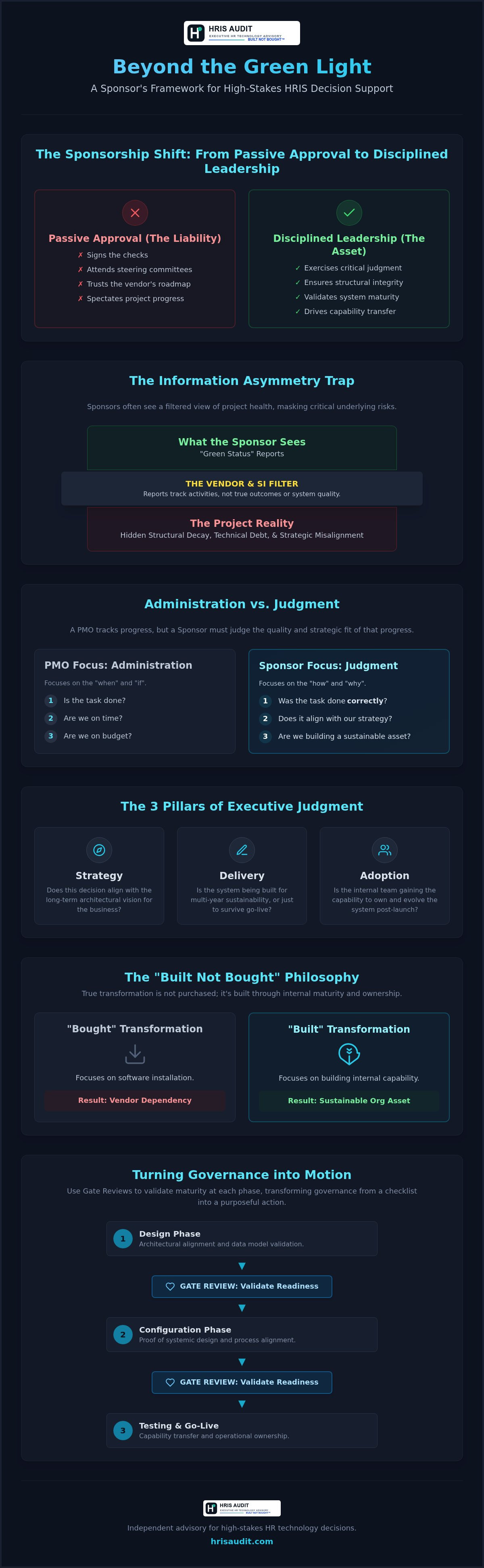
Vendors and System Integrators (SIs) possess a natural information advantage. They understand the software's limitations and the project's technical debt far better than the internal executive team. This creates a dangerous imbalance. Sponsors often receive "Green Status" reports that mask underlying structural rot. These reports track activities, not outcomes. They celebrate the completion of a configuration phase while ignoring the fact that the configuration doesn't align with the business's long-term needs. Effective decision support levels this playing field. It provides the sponsor with the independent diagnostics necessary to challenge the vendor's narrative and uncover the risks hidden beneath the surface of a slide deck.
Judgment vs. Administration
Your Project Management Office (PMO) is not equipped to provide sponsor-level support. PMOs are administrative engines. They track timelines, budgets, and resource allocations. They are excellent at telling you if a task is done, but they cannot tell you if the task was done correctly for the organization's future. Executive judgment requires a different set of motions. A robust Decision Support System (DSS) for HR technology focuses on evaluating the quality of the work rather than the speed of the delivery. It moves past the "when" to focus on the "how."
High-stakes decision support relies on three core pillars of judgment:
- Strategy: Does this specific configuration decision align with the long-term architectural vision?
- Delivery: Is the system being built for multi-year sustainability or just to survive the go-live date?
- Adoption: Is the internal team gaining the actual capability to own and evolve the system post-launch?
The ultimate goal of this support is the "Built Not Bought" philosophy. You cannot simply buy a transformation. You must build the internal maturity to sustain it. High-stakes HR technology sponsor decision support ensures that every choice made during the implementation serves this goal of capability transfer. It moves the sponsor from a position of passive approval to one of active, informed ownership. It transforms the project from a software installation into a foundational organizational asset.
The Architecture of Decision Support: Frameworks for High-Stakes Choices
An HRIS is not a standalone software event. It is an integrated system. When you treat an implementation as a series of isolated tasks, you ignore the mechanical dependencies that dictate long-term performance. Effective HR technology sponsor decision support requires a shift from tracking "Feature Completion" to evaluating "Systemic Design." Does the data flow logically? Do the modules talk to each other without friction? If the architecture is flawed, no amount of user training will save the project.
The Field Library Approach
Decisions shouldn't rest on gut feel. They require evidence. A disciplined sponsor utilizes standardized diagnostics to validate project health. This is where a Field Library License becomes essential. By using editable workbooks and structured facilitation guides, you move away from the vendor’s subjective progress reports. You gain a neutral set of benchmarks. These tools allow you to interrogate the machinery of the project. They force the team to prove that the system is maturing, not just moving toward a date on a calendar.
Evidence-based leadership changes the conversation. You no longer ask "Are we on time?" Instead, you ask "Are we ready?" This transition requires three specific motions:
- Validation: Using standardized workbooks to check configuration against requirements.
- Diagnostics: Identifying where the logic of the platform conflicts with business processes.
- Standardization: Ensuring every decision follows a repeatable, disciplined framework.
Evaluating Structural Integrity
Technical debt is the silent killer of HRIS sustainability. It accumulates when teams take shortcuts to meet a deadline. As a sponsor, you must identify these cracks before they are buried under layers of configuration. Design reviews are your primary tool for this. Don't let these meetings become passive presentations. Turn them into structural audits. Ask if the system logic reflects your organization’s unique DNA or if you're just bending your business to fit the software's defaults.
Identify the "why" behind every customization. If a configuration choice creates a manual workaround, it's a structural flaw. True HR technology sponsor decision support empowers you to reject these compromises early. It aligns your executive vision with the practical machinery of the HCM platform. You are the architect. The vendor is the builder. If the blueprints are wrong, the building will fail. Maintain your discipline. Demand integrity in the design. Ensure the system is built for the decade, not just the quarter.
Strategic Advisory vs. System Integration: Navigating the Information Gap
Do not confuse the builder with the architect. In most HRIS implementations, the System Integrator (SI) acts as the builder. They focus on the machinery of configuration. They align the software to the requirements you provided. But who ensures those requirements align with your long-term organizational health? This is the critical distinction between System Integration and Client-Side advisory. For an executive, effective HR technology sponsor decision support must come from a source that is independent of the implementation's billable hours.
The SI Conflict of Interest
The SI has an inherent conflict of interest. Their success metric is a "Go-Live" on a specific date. Your success metric is an "Operate-Forever" capability. These are not the same thing. SIs are incentivized to prioritize speed and feature completion over capability transfer. If they make the system too simple for your team to manage, or if they fail to document the underlying logic, they secure their own future support revenue. This bias is rarely malicious; it is simply structural. An independent advisor acts as the guardian of your interests. They ensure the system is built for your autonomy, not for the vendor's convenience. They mitigate bias by demanding transparency where the SI prefers complexity.
The Role of the Independent Advisor
An independent advisor provides the "Pattern Recognition" that an internal team lacks. Most HR teams go through a major implementation once a decade. A seasoned advisor sees them every year. They know exactly where "Green Status" reports hide technical debt. They act as the Sponsor’s Advocate, bridging the gap between high-level vision and technical execution. This role is about providing the friction necessary to ensure quality. By conducting objective Gate Reviews, the advisor forces the project to prove its maturity before moving to the next phase.
This advisory presence changes the project dynamic in three ways:
- Objectivity: Decisions are based on organizational outcomes, not vendor roadmaps.
- Clarity: Technical jargon is translated into the language of executive risk and reward.
- Ownership: The focus remains on transferring knowledge to your internal team, ensuring you are "Built Not Bought."
Relying solely on the SI for HR technology sponsor decision support is like asking the contractor to inspect their own foundation work. You need an independent eye to verify the structural integrity of the build. This independence is the only way to ensure that the final system is an asset you own, rather than a liability you merely rent.
Establishing the Decision Motion: Gate Reviews and Governance
Governance is often reduced to a bureaucratic ritual. Executives gather in steering committees to review traffic light reports that are frequently disconnected from the project's actual health. This is not governance. It is theater. Real HR technology sponsor decision support transforms these meetings into a series of disciplined motions. It moves the sponsor from the role of a spectator to that of a structural inspector. You are not there to witness progress. You are there to validate integrity.
The Anatomy of a Gate Review
A Gate Review is a mechanical checkpoint. It is a barrier that prevents the project from moving to the next phase until specific, non-negotiable criteria are met. Success at a gate is not defined by the completion of a document. It is defined by the maturity of the system logic. When moving from Design to Configuration, the sponsor must ask: Is this design sustainable? Or are we building technical debt into the foundation?
The review requires a "Stop, Pivot, or Proceed" framework. If the criteria are not met, the motion is to stop. Proceeding with a flawed design only compounds the risk. These reviews must include independent voices who are not incentivized by the project's timeline. This objectivity is the only way to ensure that the "Green" status on a slide reflects the reality of the build. Without this friction, governance is merely a rubber stamp for future failure.
Pulse Scans and Risk Detection
Waiting for the monthly steering committee to identify issues is a strategic error. By the time a risk reaches the committee, it has often already compromised the project's timeline or budget. You need a method for real-time risk detection. This is the role of the Transformation Pulse Scan. It acts as a stress test for the implementation. It identifies "silent" project killers like stakeholder misalignment or a lack of internal capability before they manifest as crises.
Pulse scans turn subjective anxieties into actionable data. They allow the sponsor to make decisions based on the current state of the organization's readiness rather than the vendor's optimistic projections. High-stakes decision support relies on this steady stream of intelligence. It provides the clarity needed to intervene early and decisively.
A robust governance framework must outlast the implementation project. The motions you establish during the build phase become the foundation for how you manage the system post-go-live. You are building organizational muscle. You are teaching your team how to evaluate, challenge, and own their technology. This disciplined approach to HR technology sponsor decision support ensures that the system remains an asset rather than a legacy burden. It is the difference between a project that ends and a capability that evolves.
Transforming Decision-Making into Capability: The HRIS Audit Method
Every decision you make as a sponsor either builds internal muscle or creates a new dependency. Most organizations finish an implementation only to realize they are tethered to high-priced consultants for basic maintenance. This is a failure of leadership. True HR technology sponsor decision support ensures that the knowledge required to run the system stays inside your walls. It moves the focus from the software itself to the people who must operate it long after the vendors have departed.
The Built Not Bought Philosophy
The "Built Not Bought" approach is the antidote to perpetual consultant reliance. It shifts your status from a passive customer of software to an active owner of a system. When you prioritize internal capability, you secure the long-term ROI of the platform. Your team must understand the "why" behind the configuration, not just the "how" of the user interface. Without this transfer of knowledge, your HRIS is a static monument to a project that ended years ago. It becomes a legacy burden rather than a strategic asset.
Built Not Bought is a strategy for organizational maturity that prioritizes the development of internal expertise over the passive consumption of vendor roadmaps.
Next Steps for the Enterprise Sponsor
Sustainability is the only metric that matters for a sponsor. A successful "Go-Live" is a tactical milestone; a sustainable system is a strategic victory. To achieve this, you must close the gap between your executive vision and the practical, people-centric outcomes of the technology. This requires a shift in how you exercise authority. It requires a commitment to structural integrity over superficial progress. It requires a disciplined method for evaluating every design choice against the standard of future self-sufficiency.
How do you begin this transition? Start by assessing the current state of your implementation machinery. You can initiate a Transformation Pulse Scan to detect hidden risks in your project governance. If you find your steering committee is merely a rubber stamp, consider engaging in a Transformation Studio to reset your decision motions. For a deeper dive into the architectural mindset required for this journey, the Built Not Bought Book provides the foundational framework for high-stakes leadership. The machinery of your organization requires more than a software subscription. It requires a steward. Secure your transformation with disciplined sponsor decision support.
Securing Your Organizational Legacy: From Project to Permanent Capability
Passive sponsorship is a risk your organization cannot afford. True leadership in the digital age requires more than a signature on a vendor contract. It demands a shift toward disciplined judgment. By moving from simple project administration to a rigorous framework of HR technology sponsor decision support, you ensure that your system is built for the long term. You must prioritize structural integrity over superficial speed. You must value internal capability transfer over perpetual consultant reliance. This is the core of the Built Not Bought™ methodology.
You have the tools to change the trajectory of your transformation. Utilize independent client-side leadership to bridge the information gap. Leverage the Field Library of licensed frameworks to validate every design choice. Don't settle for a system you merely rent; build one you truly own. The path to a sustainable HRIS begins with a single motion of disciplined governance. You can take that step today. Request a Transformation Pulse Scan for your HRIS project and ensure your technology serves your strategic vision. Your legacy depends on the integrity of the foundation you build now.
Frequently Asked Questions
What is the primary role of an HR technology sponsor?
The primary role of an HR technology sponsor is to act as the guardian of the system's structural integrity. You are not a passive observer signing checks. You are the lead architect responsible for active leadership and high-stakes judgment. This role requires you to bridge the gap between executive vision and the practical machinery of implementation; ensuring that the final build aligns with the organization's long-term strategic needs rather than a vendor's roadmap.
How does sponsor decision support differ from project management?
Project management is administrative; while HR technology sponsor decision support is architectural. A PMO tracks timelines, budgets, and resource allocations. Decision support evaluates the quality, maturity, and sustainability of the work. It provides the independent diagnostics necessary for an executive to challenge vendor claims. While project management tells you if a task is finished, decision support tells you if the task was completed with the integrity required for multi-year success.
Why do enterprise HRIS projects fail even with a Big 4 integrator?
Enterprise projects often fail because System Integrators (SIs) prioritize billable hours and go-live dates over organizational self-sufficiency. SIs have a structural conflict of interest. They are incentivized to build complexity that requires ongoing support. Even a Big 4 integrator might deliver a system that meets technical specs but lacks the internal capability transfer necessary for your team to own it. Failure occurs when the system logic is disconnected from the business's unique DNA.
What are the most critical "gates" in an HR technology transformation?
The most critical gates are the transitions between Design, Configuration, and Testing. These are not mere calendar dates. They are mechanical barriers where the sponsor must exercise the "Stop, Pivot, or Proceed" framework. Moving from Design to Configuration without a validated architectural blueprint is a strategic error. Each gate must serve as a rigorous audit of system maturity; ensuring that technical debt is identified and resolved before it is buried in the platform.
How can a sponsor detect if a project is at risk of failure?
A sponsor can detect risk by looking past "Green Status" reports to find "silent killers" like stakeholder misalignment or stagnant internal capability. If your steering committee feels like a rubber stamp, the project is already in danger. Utilizing a Transformation Pulse Scan provides the objective diagnostics needed to identify structural decay in real-time. Early detection allows you to intervene before a design compromise turns into a post-go-live crisis that drains your budget.
What is "capability transfer" and why does it matter for the sponsor?
Capability transfer is the process of ensuring your internal team possesses the architectural knowledge to own the system post-go-live. It is the core of the Built Not Bought philosophy. Without it, you are a perpetual customer of consultants. For a sponsor, capability transfer matters because it dictates the long-term ROI of the project. A successful transformation is measured by your team's ability to evolve the system without external intervention, turning the HRIS into a permanent organizational asset.
Is an independent advisor necessary if we have a strong internal IT team?
An independent advisor is essential because they provide the "pattern recognition" and objectivity that an internal team lacks. Your IT team may be strong, but they are often too close to the daily friction of implementation to see broader structural risks. An advisor acts as your advocate, providing a platform-agnostic perspective that prioritizes your interests over vendor roadmaps. They provide the necessary friction to ensure that the build meets rigorous standards of systemic design and organizational maturity.
How does the "Built Not Bought" method impact long-term HRIS costs?
The "Built Not Bought" method significantly reduces long-term costs by eliminating perpetual consultant reliance and minimizing technical debt. By investing in HR technology sponsor decision support early, you build internal expertise that handles maintenance and evolution in-house. This prevents the common cycle of expensive post-go-live remediations. While it requires more discipline during the implementation, it ensures the system is an efficient machine that delivers value for a decade rather than a liability requiring constant repair.


