

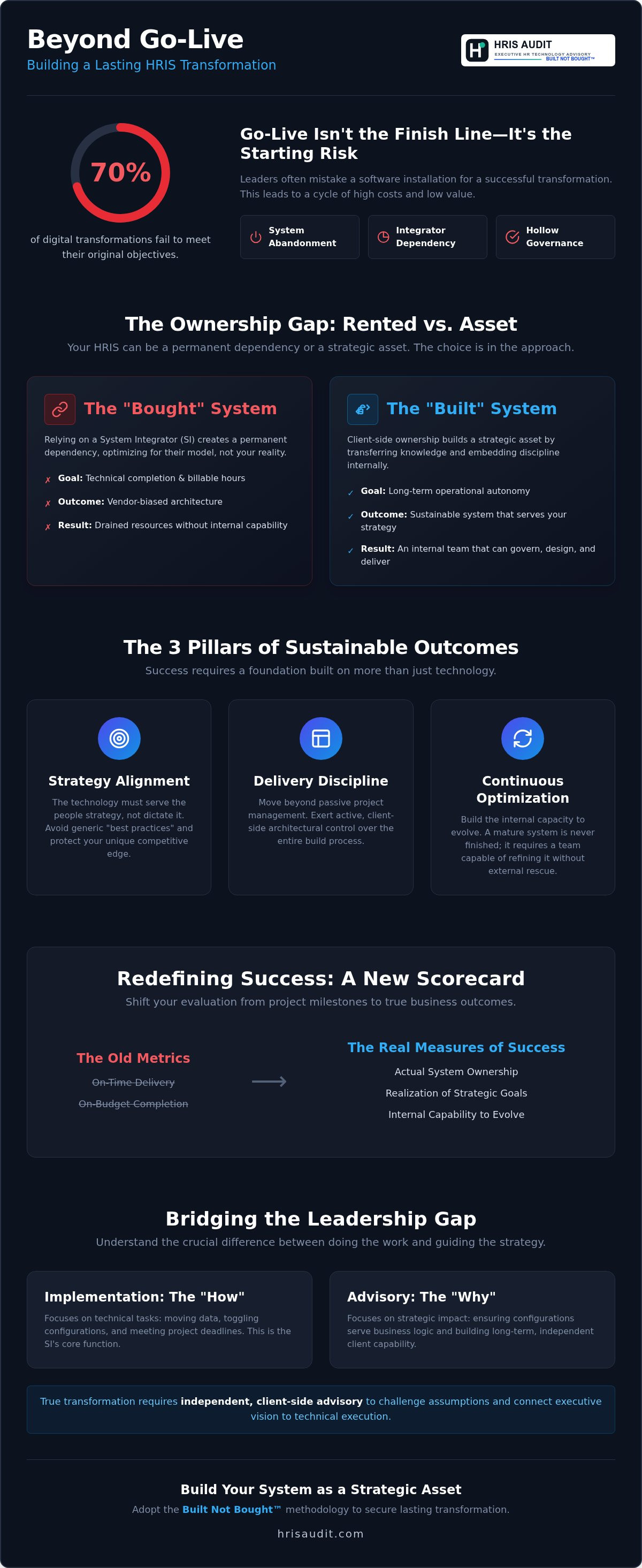
Go-live is the beginning of the risk. It's not the end of the journey. Most organizations treat their new HRIS like a leased vehicle they don't know how to maintain. Industry research suggests nearly 70% of digital transformations fail to meet their original objectives. This happens because leaders often mistake a software installation for meaningful HR transformation advisory outcomes. You've likely experienced the fallout: system abandonment, a heavy reliance on high-priced integrators, and governance that feels like a hollow checkbox exercise.
It's a cycle that drains resources without building internal capability. You deserve a system that functions as a strategic asset, not a technical burden. This article shows you how to secure outcomes that last by shifting from passive consumption to disciplined, client-side architectural ownership. We'll examine the specific motions required to build internal mastery and establish decision-support frameworks that ensure your technology serves your people-centric goals. It's time to stop buying software and start building a system that lasts.
Key Takeaways
- Understand why "Go-Live" is a deceptive milestone that often masks a lack of genuine organizational adoption and system maturity.
- Identify the structural limitations of the System Integrator model that prioritize technical delivery over your team's internal capability to lead.
- Learn how to secure sustainable HR transformation advisory outcomes by treating HRIS architecture as a core internal competency rather than an outsourced service.
- Shift your evaluation criteria from "on-time and on-budget" to metrics that measure actual system ownership and the realization of strategic goals.
- Discover the Built Not Bought™ methodology for transferring deep strategic and technical knowledge from consultants to your permanent staff.
Defining Meaningful HR Transformation Advisory Outcomes
Go-live is a milestone. It is not an outcome. In the high-stakes environment of enterprise HCM, many leaders mistake a successful technical launch for a successful transformation. This is a strategic error. A "live" system is merely a machine that has been plugged in. True HR transformation advisory outcomes are measured by the system's structural integrity three, five, and ten years after the consultants have left the building. If your organization cannot manage the technology without an umbilical cord attached to a system integrator, the transformation has failed. It's that simple.
The distinction between technical installation and organizational adoption is where most projects lose their ROI. Installation is a binary state. Adoption is a cultural and operational shift. Meaningful outcomes require a focus on Strategic human resource planning that treats technology as an integrated component of business logic rather than a standalone tool. When advisory services focus only on the "project," they leave behind a capability vacuum. The organization is left holding the keys to a vehicle they don't know how to drive, much less repair. You can diagnose your current risk level by using a Transformation Pulse Scan to see where the gaps in your internal machinery actually sit.
The Three Pillars of Sustainable Outcomes
Sustainable success rests on three specific structural foundations. First, Strategy Alignment. The technology must serve the people strategy, not the other way around. If the software dictates your processes, you've lost your competitive edge. Second, Delivery Discipline. This requires moving beyond passive project management. You must exert active architectural control over the build. Third, Optimization. This is the internal capacity to evolve. A mature system is never "finished." It requires a team capable of refining the engine without calling for an external rescue team every time a business process changes.
Why 'World-Class' Performance Requires Internal Ownership
External benchmarking is a sedative. It tells you what everyone else is doing, but it ignores your specific organizational DNA. Relying on "best practices" from a vendor often leads to a generic configuration that solves no one's problems. Client-side leadership is the only mechanism that protects the long-term ROI of HCM platforms. Without it, you're merely renting someone else's workflow at an enterprise price point. Sustainable HR transformation is the ability for an organization to govern, design, and deliver its own technology future. This level of maturity is "built, not bought." It requires a deliberate transfer of knowledge from the advisor to the internal team, ensuring that governance is a living discipline rather than a checkbox exercise.
The Client-Side Leadership Gap: Why Strategy Often Fails Execution
The System Integrator (SI) paradox is the silent killer of enterprise HCM value. These firms are incentivized to build systems, not to teach your organization how to own them. Their success is measured by technical completion and billable efficiency. Your success is measured by long-term operational autonomy. These two goals are rarely aligned. When you rely solely on an SI for direction, you aren't just buying a system; you're buying a permanent dependency. This is why many HR transformation advisory outcomes end in frustration. The architecture becomes vendor-biased, optimized for the integrator's delivery model rather than your organization's unique operational reality.
The "Sponsor Decision Support" vacuum is another critical failure point in large-scale transformations. Executives often find themselves approving major architectural shifts based on data provided by the very people building the system. It's a closed loop. Without independent oversight, sponsors lack the objective friction necessary to challenge assumptions. They end up "buying" a solution that looks good on a slide deck but fails the stress test of real-world use. This gap between executive vision and tactical delivery is where ROI goes to die. It's the difference between installing a tool and building a capability.
Advisory vs. Implementation: Knowing the Difference
Implementation is about the "How." Advisory is about the "Why." SIs focus on moving data and toggling configurations. An advisor focuses on how those configurations impact your Strategic Advisory vs. System Integration balance. Without this distinction, organizations often face expensive program resets. They realize too late that the technical build doesn't support the business vision. If you find your project drifting into technical minutiae at the expense of strategy, it's time to evaluate your internal capability. You can start this process by reviewing the principles in the Built Not Bought book to understand the shift toward ownership.
The Role of the Independent HR Technology Advisor
The independent advisor acts as the guardian of the client's long-term interests. They provide the pattern recognition that internal teams often lack. They see the traps before you fall into them. This role is not about passive observation; it is about active governance. It requires a "battle-tested" perspective that values structural integrity over mere project speed. The advisor's value is found in the questions they ask that the SI won't. This includes:
- Conducting gate reviews that look past technical "green lights" to assess genuine organizational readiness.
- Bridging the gap between high-level executive ambition and the practical machinery of implementation.
- Providing the objective friction required to keep SIs accountable to the original business case.
True success isn't just about finishing the project. It's about ensuring your team has the muscle memory to manage the system on day two. This is the difference between a software installation and a genuine transformation.
Built Not Bought™: A Framework for Sustainable System Ownership
Ownership is the only hedge against technical obsolescence. Most organizations treat an HRIS implementation as a transaction. They buy a solution and hope the outcomes follow. This approach is flawed. True HR transformation advisory outcomes are built through the deliberate cultivation of internal expertise. Architecture must be treated as a core competency, not an outsourced service. If your internal team cannot explain the logic behind your system configuration, you don't own the system. You are merely renting a workflow from your integrator.
The shift from "Project Mode" to "Product Ownership" is the most critical transition in the Built Not Bought™ method. Projects have end dates. Products have lifecycles. When you operate in project mode, you prioritize speed and budget over structural integrity. When you pivot to product ownership, you prioritize the long-term health of the platform. This requires a "Studio" approach to design. In our Transformation Studio, we don't just solve immediate technical hurdles. We tackle the deeper governance challenges that determine whether a system thrives or withers after go-live.
The 5 Motions of the Built Not Bought Method
Sustainability is achieved through five specific, disciplined motions. First, you must Design for Ownership. This means crafting configurations that your internal team can actually maintain without external help. Second, you must Govern for Integrity. This involves establishing rigorous gate reviews that prevent the accumulation of technical debt. Third, you must Deliver for Adoption. The "people" element of the transformation cannot be a late-stage afterthought. Finally, the process must culminate in Capability Transfer. This is the explicit training of your internal staff to replace the consultants. The goal is a clean break where the organization retains the knowledge, not just the software.
Using Field Library Workbooks for System Design
Efficiency in transformation doesn't come from reinventing the wheel. It comes from applying proven frameworks to unique challenges. We use a proprietary Field Library of tools to facilitate rapid capability transfer. These aren't generic templates. They are battle-tested workbooks and facilitation guides that move your team from a blank-slate design to a standardized, high-integrity architecture. You can explore our Field Library and Frameworks to see how these licensed tools reduce project risk. By using these standardized motions, you ensure that your HR transformation advisory outcomes are consistent, predictable, and, most importantly, repeatable by your own people. Discipline replaces guesswork. Knowledge replaces dependency.
Measuring Success: Metrics That Matter Post-Implementation
Success is not a date on a calendar. Most organizations celebrate go-live as the ultimate victory, yet this is often the moment of maximum vulnerability. If you judge your HR transformation advisory outcomes solely by "on-time and on-budget" delivery, you're looking at the wrong dashboard. These are project management metrics. They tell you nothing about the structural health of your system or your team's ability to operate it. A project can be perfectly on budget while leaving behind a fragmented architecture and a workforce that resents the new technology. True success is measured in the months and years following the launch.
We must distinguish between usage and adoption. Usage is often a result of coercion. Employees use the system because they have no other choice. Adoption is different. It occurs when the technology simplifies work and provides clear value to the user. If your help desk is flooded with basic navigation queries six months post-launch, you don't have adoption. You have a failure of design. Similarly, you must measure the "Capability Gap." Calculate how much external support is required to maintain the system. If you're still paying high-priced integrators for routine configuration changes, your transformation has not achieved its intended state of ownership.
Get a Transformation Pulse Scan
Maturity Metrics vs. Tactical KPIs
Move beyond surface-level stats to evaluate systemic maturity. This requires looking at three specific indicators. First, Governance Maturity. Is there a disciplined process for evaluating and deploying updates, or is the system drifting into technical debt? Second, Data Integrity. Does the HRIS act as a single, trusted source of truth, or is the organization still relying on "shadow" spreadsheets? Third, User Sentiment. This isn't about happiness; it's about friction. Does the system enable or hinder the primary work of the business? These metrics provide a sober view of the HR transformation advisory outcomes that actually drive long-term value.
The Long-Term ROI of Client-Side Leadership
The financial impact of client-side leadership is felt most clearly in the reduction of post-go-live "rescue" fees. When an organization builds its own architectural muscle, it eliminates the need for perpetual external intervention. This creates a faster time-to-value for new features. Instead of waiting for a consultant's availability, your internal team can optimize the engine in real-time. This level of self-sufficiency is the ultimate ROI. It ensures that the millions invested in enterprise HCM platforms result in a resilient, evolving asset rather than a depreciating technical liability. Detecting these latent risks early is essential to protecting your investment.
Securing Your Future State: The HRIS Audit Approach
Pattern recognition is the ultimate defense against project failure. After 30 years in the industry, the wreckage of failed HRIS implementations begins to look remarkably similar. The same gaps in leadership. The same lack of internal capability. The same over-reliance on external vendors. At HRIS Audit, we don't just facilitate software installation. We engineer HR transformation advisory outcomes that prioritize capability transfer over mere technical delivery. Expertise isn't something you rent. It is something you build.
The shift from implementation to ownership is a deliberate motion. It requires a move away from the "hands-off" approach favored by traditional consultancies. Instead, we focus on the structural integrity of your internal team. By integrating the Built Not Bought book into your leadership strategy, you move from being a passive consumer of software to an active architect of your organizational future. This isn't about learning how to click buttons. It's about learning how to govern a complex human system. It is about leadership readiness in an era where AI and agentic technologies are rapidly redesigning the workforce.
The Path to System Independence
Independence is achieved through a structured progression of motions. It begins with the Transformation Pulse Scan. This diagnostic tool identifies the hidden risks that threaten your project's long-term viability. It provides the sober, objective data required to reset your trajectory before technical debt becomes insurmountable. Once the risks are mapped, we move into Studio sessions. These are not standard meetings. They are intensive workshops designed to reset your governance and design logic. Finally, we leverage the Field Library. These licensed frameworks accelerate your team's development by providing the battle-tested workbooks needed to manage the system internally. No more reinventing the wheel. No more dependency.
Final Call to Action for HR Leaders
You face a fundamental choice. You can remain a passive consumer of vendor-led roadmaps, or you can become an active architect of your own technology future. The most successful transformations are never purchased off a shelf. They are "Built Not Bought." This philosophy demands discipline, but it rewards you with a system that actually supports your people-centric goals. Don't settle for a go-live that marks the beginning of a slow decline. Secure HR transformation advisory outcomes that empower your organization to lead, evolve, and thrive independently.
Order the 'Built Not Bought' Book
Take Command of Your HRIS Future
Sustainable HR transformation advisory outcomes are the result of architectural discipline, not software selection. You've seen why go-live is a deceptive finish line. True success is found in the months that follow, when your internal team either thrives or founders. By bridging the leadership gap and applying the Built Not Bought™ framework, you move from a state of vendor dependency to strategic independence. This shift requires a move from tactical KPIs to maturity metrics that measure your actual capacity to lead.
We bring 30 years of battle-tested experience to this challenge. Our proprietary Field Library frameworks provide the specific blueprints for this transition. We act as independent, client-side advocates, ensuring your interests remain the priority throughout the entire lifecycle of the system. It's time to stop renting workflows and start owning your machinery.
Secure your transformation outcomes with a Pulse Scan
You have the tools to build a system that lasts. Take the first step toward genuine ownership today.
Frequently Asked Questions
What are the primary outcomes of HR transformation advisory?
The primary HR transformation advisory outcomes include established internal ownership, a resilient governance framework, and the transfer of architectural knowledge. It moves the organization from a state of technical dependency to strategic autonomy. Success is defined by a system that evolves with the business without requiring perpetual external intervention. It is the shift from a software installation to a permanent organizational capability.
How does client-side leadership differ from a system integrator?
A system integrator is incentivized to deliver a technical build within a billable window. Client-side leadership is incentivized to protect the organization's long-term interests. While the SI manages the software configuration, the leader manages the business logic and organizational readiness. One installs the engine; the other ensures the organization can maintain and repair it. They are separate disciplines with often conflicting goals.
What is the 'Built Not Bought' method for HR technology?
The 'Built Not Bought' method is a strategic framework that treats HRIS architecture as a core internal competency. It rejects the idea that a "world-class" system can be purchased off a shelf. Instead, it focuses on building the internal muscle memory required to design, govern, and optimize technology. It is about ownership over consumption. It requires a disciplined approach to knowledge transfer from the very start of the project.
Why do most HRIS transformations fail after go-live?
Failure often stems from the capability vacuum created when consultants depart. Organizations frequently mistake a technical launch for a successful transformation. Without internal mastery, the system becomes a static burden that cannot adapt to changing business needs. This leads to user abandonment and the eventual return to manual workarounds. Go-live is just the beginning of the risk, not the end of the journey.
What should be included in an HR system gate review?
A gate review must look past technical "green lights" to evaluate structural integrity. It should include assessments of data quality, process alignment, and, most importantly, internal team readiness. If the team cannot explain the logic of the current configuration, the project should not pass the gate. Discipline outweighs momentum. You must verify that the people part of the transformation is moving at the same pace as the software build.
How can we measure the success of an HR transformation advisor?
Success is measured by the organization's ability to operate independently six months post-launch. High-quality HR transformation advisory outcomes result in a significant reduction in "rescue" consulting fees. You should also see a faster time-to-value for new feature releases and a measurable improvement in user adoption across the enterprise. The advisor's ultimate goal is to make themselves unnecessary through effective capability transfer.
What is an HR transformation pulse scan?
An HR transformation pulse scan is a diagnostic tool used to detect latent risks in large-scale projects. It provides a sober, objective view of governance maturity and architectural health. It acts as an early-warning system for sponsors, identifying where the project is drifting away from the original business case. It is a necessary reality check for any executive overseeing a complex HCM implementation.
How do we ensure internal capability transfer during an HCM implementation?
Capability transfer requires a deliberate shift from project participation to product ownership. We facilitate this through Studio sessions and licensed Field Library workbooks. These tools move your team from a blank-slate design to a standardized, high-integrity architecture. It's a methodical process of knowledge hand-off that ensures your staff replaces the consultants. You don't just want a live system; you want a team that knows how to run it.


