

What if your HRIS implementation is a house of cards designed to collapse the moment your system integrator walks out the door? Most organizations mistake a vendor's "go-live" checklist for a successful transformation. It isn't. This HRIS audit checklist for executives is designed to strip away the hyperbole and reveal the underlying structural integrity of your technology stack. With the 2026 expansion of FMLA definitions and the tightening of state data privacy laws in Oregon and Connecticut, your system's configuration must be precise. Logic dictates that you verify the foundation now.
You likely suspect that project status reports are hiding the true complexity of your system's misalignment with business strategy. It's a valid concern. This framework shifts your perspective from simple compliance to true ownership. We provide a rigorous structure to evaluate project health and generate objective data for sponsor-level decisions. You'll gain a clear path to a system that is Built Not Bought. This ensures long-term sustainability. This ensures strategic discipline.
Key Takeaways
- Shift your focus from superficial "go-live" dates to the structural integrity of your technology governance.
- Identify the "SI Paradox" by auditing whether your integrator is building for their exit or your long-term success.
- Utilize this HRIS audit checklist for executives to verify if your internal team has the mechanical knowledge to maintain the system.
- Implement a Pulse Scan to detect hidden risks in your governance charter and resolve accountability gaps.
- Ensure every configuration choice passes the Built Not Bought™ test to guarantee the system remains a strategic asset.
Beyond Compliance: Why Executives Must Audit for Structural Integrity
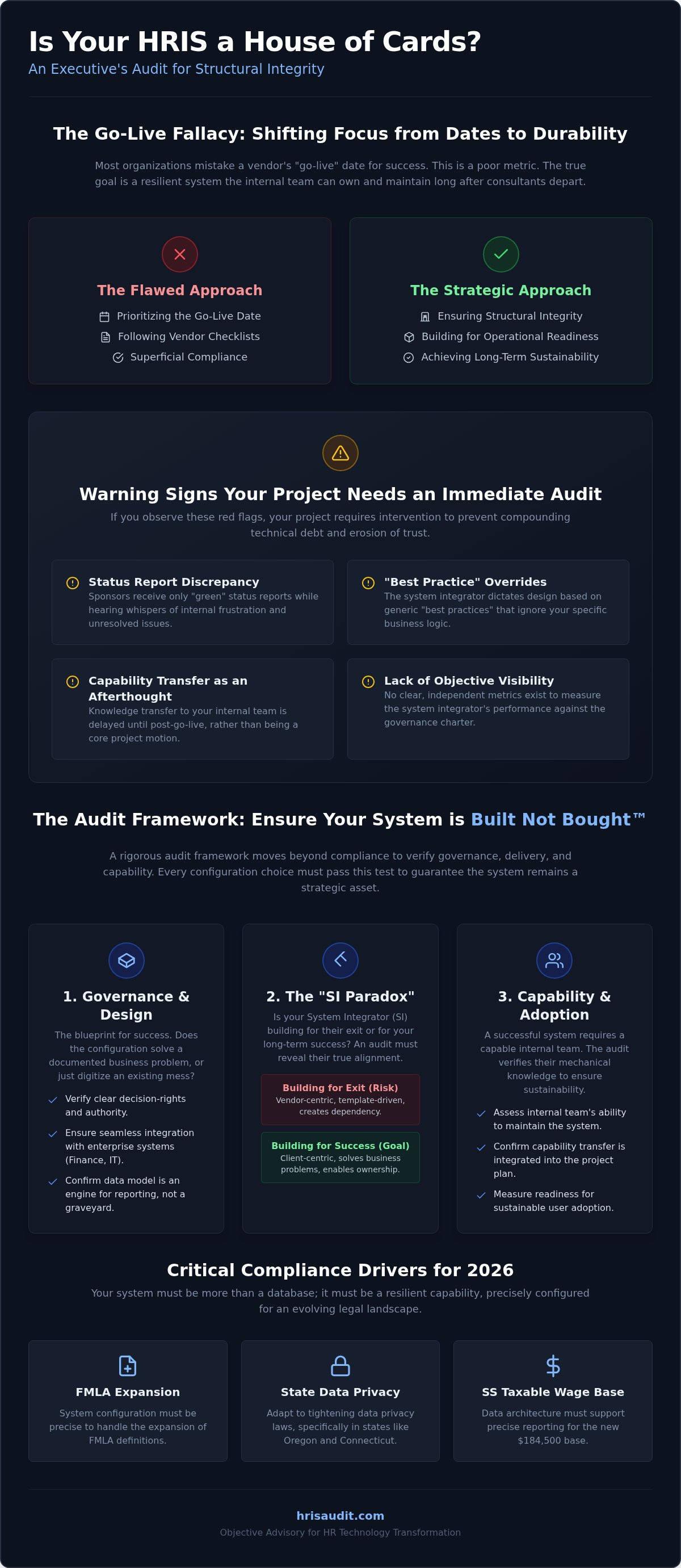
An executive HRIS audit is not a routine compliance exercise. It is a strategic review of technology governance and mechanical delivery. While the HR department might focus on litigation risk, the executive sponsor must focus on the structural integrity of the Human Resource Management System (HRMS) as a core enterprise asset. Most transformations fail because they prioritize the "Go-Live" date over operational readiness. This is the Go-Live Fallacy. Hitting a calendar date is a poor metric for success if the internal team cannot maintain the system once the consultants depart.
The true cost of a flawed implementation isn't just the initial invoice. It is the compounding technical debt, the erosion of employee trust through low adoption, and the inevitable project reset two years later. For 2026, the landscape is shifting. With new FMLA definitions and complex state privacy laws in Oregon and Connecticut, your system must be more than a database. It must be a resilient capability. You aren't just buying a system; you are building an organizational engine. An effective HRIS audit checklist for executives identifies whether that engine is built to last or destined to stall.
The ROI of Objective Advisory
Internal teams often suffer from proximity bias. Vendors are incentivized by milestone payments. Both have blind spots. Independent, client-side leadership provides a sober perspective on project health that status reports often obscure. By utilizing a Transformation Pulse Scan, executives can detect drift before it becomes a catastrophic failure. This objective advisory ensures that the system design solves documented business problems rather than simply following a vendor's standard template. Ownership is the only hedge against failure.
Signs Your Transformation Needs an Immediate Audit
Recognition is the first step toward recovery. If you observe these red flags, your project requires an intervention:
- Sponsors receive only "green" status reports while hearing whispers of internal frustration.
- The system integrator dictates design decisions based on "best practices" that ignore your specific business logic.
- Capability transfer is treated as a post-go-live afterthought rather than a core project motion.
- There is a lack of objective visibility into the system integrator's actual performance against the governance charter.
A rigorous HRIS audit checklist for executives forces these issues into the light. It demands accountability. It prioritizes long-term ownership over mere participation. The date is a vanity metric. Sustainability is the goal.
The Structural Integrity Checklist: Auditing Governance and Design
Structural integrity begins with the blueprint. You can't audit for ownership if the initial design was never aligned with business strategy. An effective HRIS audit checklist for executives starts by asking a provocative question: Does this configuration solve a documented business problem, or are we just digitizing an existing mess? The role of HR audits has evolved. It is no longer just about legality; it's about systemic design. Consider the 2026 Social Security taxable wage base of $184,500. If your system's data architecture isn't built for precise reporting and payroll integration, you're inheriting a manual workload from day one. Your data model must be an engine for reporting, not a graveyard for entries.
Systemic design requires that your HRIS integrates seamlessly with the broader enterprise architecture. It shouldn't exist in a vacuum. If the technology doesn't talk to your finance or IT systems, the structural foundation is fractured. You'll face high project failure rates when these silos clash. Executives must demand a system that is built for the post-go-live reality, where data flows effortlessly across the organization. This isn't a technical preference. It's a business necessity.
Auditing the Governance Framework
Governance is the project's nervous system. Without it, configuration changes become arbitrary and expensive. Use a structured HR technology governance framework to audit decision-rights. Who has the authority to deviate from the global template? If gate reviews are merely rubber stamps, your transformation is drifting toward chaos. You need a single source of truth for people data that is protected by rigorous accountability. Auditing this framework reveals whether your project is governed by discipline or by vendor convenience.
Design for Post-Go-Live Reality
Implementation teams often design for the "happy path." They ignore the messy, real-world employee journeys that define actual usage. Auditing for structural integrity means testing the system against complex scenarios, like the expanded FMLA definitions effective July 1, 2026. If the configuration requires heavy customization to meet these regulatory shifts, you're creating future maintenance hurdles your internal team can't clear. Every design document should reflect the "Built Not Bought" philosophy. It's the difference between a system you rent from your integrator and a capability you own. For a deeper dive into this methodology, consider the Built Not Bought book as a guide for your internal team. A thorough HRIS audit checklist for executives identifies these design flaws before they become permanent liabilities.
Mechanical Delivery: Auditing the System Integrator (SI) Gap
The system integrator is not your partner in long-term sustainability. They are incentivized by the milestone, not the decade. This is the SI Paradox. Their profit margins depend on a swift exit, while your ROI depends on a resilient, internal capability. An effective HRIS audit checklist for executives must bridge this gap by identifying the "Shadow Project." This is the massive volume of work the SI won't touch, such as data cleansing, internal process alignment, and the heavy lifting of change management. If your internal team isn't leading these motions, they are merely spectators in their own transformation.
Deliverables are not outcomes. An SI can provide a hundred completed workbooks and still leave you with a dysfunctional organization. You must audit the "Capability Transfer" throughout the implementation. Is your team actually learning to run the system, or are they just watching a vendor click through a sandbox? By the time you hit the 2026 Social Security taxable wage base update, your team must be capable of independent configuration. If they still rely on a support ticket to the vendor for basic logic changes, the delivery has failed. Ownership is a mechanical requirement, not an optional benefit.
Sponsor Decision Support Metrics
Executive sponsors often suffer from the "Watermelon Project" phenomenon. On the outside, status reports are green. On the inside, the structural foundation is red with risk. You need objective metrics to validate SI claims. Ask your project lead: Can our team explain exactly why this specific configuration was chosen over the standard template? If the answer is "because the vendor recommended it," you have a governance gap. To cut through the noise, many organizations utilize an independent advisor to provide a sober, unvarnished view of the project's mechanical health. This is sponsor-level decision support.
The Field Library Approach to Delivery
Reclaiming control requires standardized tools that force the "Client-Side" to lead. You shouldn't be using the vendor's templates exclusively. Audit the quality of the facilitation guides and workbooks used during your design sessions. Are they driving toward your specific business outcomes or the vendor's standard "best practices"? Using a disciplined Field Library approach ensures that your team owns the logic behind every configuration choice. This prevents the system from becoming a black box. It ensures that when the SI leaves, the knowledge stays. You don't just want a system that works; you want a team that knows how it works.
The Capability Audit: Ensuring Sustainable System Adoption
Adoption is often treated as a psychological problem. It isn't. It is a design outcome. If your end-users find the system cumbersome, the architecture has failed. A robust HRIS audit checklist for executives must evaluate usability through the lens of structural simplicity. We must look past the "Go-Live" finish line toward Day 2. Who owns the configuration when the vendor is gone? If your internal team cannot pass the Built Not Bought™ Test, you have merely rented a system. They must be able to explain the logic behind every decision, not just point to a vendor workbook. Ownership is the only path to sustainability.
Measuring readiness requires moving past vanity metrics like training completion percentages. High participation rates do not guarantee operational competence. A team that "participated" in workshops is not necessarily a team that can "operate" a complex enterprise asset. True readiness is the ability to manage the next regulatory shift without external help. Consider the Oregon Privacy Act's enforcement beginning on July 1, 2026. Can your team reconfigure data processing and consumer rights workflows independently? If they require a change order for every legislative update, you have a dependency, not a capability.
Capability vs. Participation
There is a sharp distinction between showing up and taking ownership. Auditing the internal HR Ops team’s ability to manage future releases is critical for long-term health. They must understand the system's mechanics to handle new global requirements, such as the EU Pay Transparency Directive taking effect in June 2026. Shifting the team mindset from "users" to "architects" is the core goal. This requires a transition from passive consumption to active governance. The Built Not Bought book provides the specific framework for this psychological and operational transition.
Transformation Pulse Scans
Change fatigue is a silent project killer. By the time you notice it, adoption has already stalled. Using a Transformation Pulse Scan allows you to detect these structural risks months before the system goes live. It validates that the design actually delivers the promised employee experience rather than just adding administrative burden. This is not a "vibe check." It is a technical and functional audit of your organization's capacity to absorb change. If the system doesn't facilitate a better user journey, the investment is wasted.
Audit your transformation health with a Pulse Scan
Executing the Audit: Frameworks for Resolution and Recovery
Executing the audit is the final motion in reclaiming ownership. It requires a methodical approach to identifying and repairing structural fractures before they become permanent liabilities. This HRIS audit checklist for executives provides the necessary framework to move from passive observation to active resolution. You cannot fix a foundation while the house is still being built on a flawed blueprint. Logic dictates a sequence of disciplined steps to ensure the system serves the business, not the vendor's timeline.
- Step 1: Conduct an independent Transformation Pulse Scan to identify immediate structural risks that standard status reports often gloss over.
- Step 2: Review the Governance Charter and Decision Logs. These documents are the forensic evidence of accountability gaps. If configuration choices lack documented business logic, your foundation is fractured.
- Step 3: Evaluate the Capability Transfer plan against the "Built Not Bought" standard. If your team cannot explain the *why* behind the system's setup, the transfer has failed.
- Step 4: Execute a Program Reset if the audit reveals foundational misalignment. A pause is a strategic choice, not a failure.
- Step 5: Transition to permanent Client-Side Leadership. The vendor's influence must diminish as your internal governance matures.
The Program Reset Motion
Pausing a transformation is a high-stakes decision. However, it is often the only way to prevent a total system collapse post-go-live. A reset allows you to realign the system design with your core business strategy. Communicating this to the board requires a sober focus on risk mitigation and long-term ROI. You aren't stopping the project; you are reinforcing its structural integrity. This findings-to-action transition is best handled in a disciplined workshop environment, where stakeholders can confront the mechanical reality of the project's health.
Securing Your Investment for 2026
By 2026, the complexity of HR technology will only intensify. With the Social Security wage base rising to $184,500 and the EU Pay Transparency Directive in effect, your system must be a high-performance engine. You must move from "Project Mode" to "Continuous Optimization." This requires establishing a permanent HR technology governance body. This body ensures that every future configuration change preserves the system's structural integrity. Ownership is not a one-time event; it is a continuous discipline. An HRIS audit checklist for executives is merely the first step in a long-term commitment to organizational maturity.
Protect your transformation with an Executive Pulse Scan
Reclaiming the Foundation of Your Transformation
Your HRIS is either a strategic asset you own or a technical liability you rent. True ownership requires looking past vendor-led status reports to evaluate the structural integrity of your governance and delivery mechanics. By applying a rigorous HRIS audit checklist for executives, you shift the focus from a vanity "go-live" date to long-term organizational capability. This process isn't about simple compliance. It is about ensuring your internal team can operate the system with precision once the system integrator departs.
We bring 30+ years of industry experience to every engagement. Our Built Not Bought™ methodology provides the independent, client-side leadership required to detect project drift and enforce accountability. You now possess the strategic frameworks to turn a misaligned implementation into a resilient enterprise engine. Logic dictates that you protect your investment before the foundation settles.
Secure your HR transformation with an objective Pulse Scan
The path to a stable, high-performance HR technology stack is clear. Take the first step toward disciplined ownership and long-term sustainability today.
Frequently Asked Questions
What is the difference between a system audit and a transformation audit?
A system audit focuses on technical features and software configuration. A transformation audit evaluates the structural integrity of your governance, delivery model, and internal capability. It identifies whether you are building a sustainable organizational asset or simply checking off vendor milestones. One checks the tools; the other checks the foundation.
How often should an executive sponsor request an HRIS audit?
Logic dictates that you request an audit at every major gate review or at least once per quarter during active implementation. Regular verification prevents technical debt from compounding. Waiting until go-live to audit is a high-risk strategy that often leads to expensive post-production resets. Discipline in the short term protects the long-term investment.
Why shouldn’t our System Integrator (SI) perform the project audit?
Your System Integrator has a structural conflict of interest. They are incentivized by milestone payments and a swift exit, while you are incentivized by long-term ownership. An SI-led audit rarely identifies the "Capability Transfer" gaps that leave your internal team dependent on future change orders. You need an independent, platform-agnostic viewpoint to ensure objectivity.
What are the top red flags that indicate an HRIS project is failing?
Red flags include "watermelon" status reports that appear green but hide functional risks. If your vendor is dictating design without clear business logic, or if your team cannot explain specific configuration choices, the project is drifting. Utilizing an HRIS audit checklist for executives helps expose these foundational fractures before they become permanent liabilities.
How much time does a comprehensive HRIS audit take for the executive team?
A comprehensive audit requires minimal direct time from the executive team but provides maximum decision support. While advisors handle the deep technical and functional review, sponsors typically spend two to four hours reviewing the Pulse Scan results and aligning on resolution frameworks. It is a high-leverage motion for risk mitigation.
Can an HRIS audit help us recover a project that is already past go-live?
Yes. An audit is essential for post-go-live recovery to stop the bleeding of technical debt. It identifies which configurations require remediation to meet 2026 regulatory standards, such as the Oregon Privacy Act enforcement beginning July 1, 2026. Recovery focuses on transitioning from vendor dependency to internal client-side leadership.
What is the "Built Not Bought" approach to HR technology?
The Built Not Bought™ approach prioritizes internal ownership over passive participation. It ensures the system is designed for your specific business logic rather than a vendor's generic template. This methodology focuses on building the internal capability to maintain and evolve the system without perpetual reliance on external integrators. It treats technology as a permanent organizational capability.
What metrics should executives look for in an HRIS audit report?
Executives should look for metrics on governance maturity, capability transfer, and strategy alignment. A quality HRIS audit checklist for executives tracks whether the internal team is gaining the mechanical knowledge to run the system independently. Avoid reports that focus solely on training completion or technical "up-time" percentages. Those are vanity metrics that ignore structural health.


