

Is your HR technology a strategic asset or a structural liability? Most organizations treat system reviews as a superficial checkbox exercise. They are wrong. In a regulatory environment defined by the 2026 EEOC AI bias mandates and expanding pay transparency laws, a simple glance at your dashboard is a recipe for failure. This Complete guide to HRIS Audit moves past the surface. It forces you to evaluate the deeper foundations of your technology stack to ensure it can actually support the weight of your organization.
You likely feel the friction of data fragmentation across your global entities. You have seen adoption rates stall after the initial go-live hype faded. You understand that a system without a disciplined governance framework is merely an expensive, unorganized database. We will provide the frameworks required to master compliance, data integrity, and strategic transformation success. From navigating the new $2,000 reporting thresholds for 1099 forms to aligning system delivery with executive vision, this guide outlines the specific motions needed for a clean bill of health. It is time to stop participating in your technology and start owning it.
Key Takeaways
- Stop using checklists as a crutch. Evaluate the functional, operational, and strategic layers of your organizational architecture to ensure structural integrity.
- Recognize that independent client-side leadership is the only way to bypass internal confirmation bias and secure objective validation of your system.
- This Complete guide to HRIS Audit outlines the five strategic motions necessary to align technical delivery with executive vision and 2026 compliance standards.
- Apply the "Built Not Bought" philosophy to ensure your internal team moves beyond passive software participation toward true system ownership.
- Treat the audit as a strategic "Program Reset" to stabilize failing implementations and establish a disciplined, sustainable governance framework.
What is an HRIS Audit? Defining the 2026 Standards
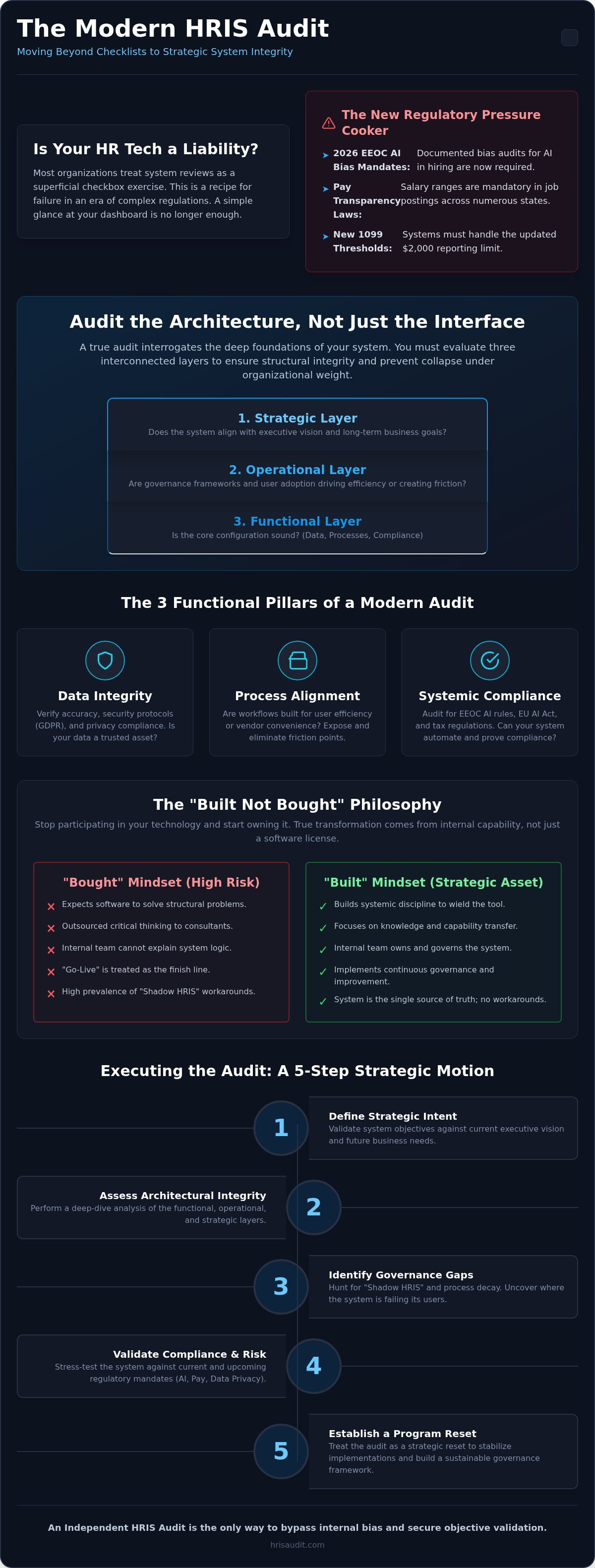
An HRIS Audit is the systematic verification of a platform's architectural integrity against its strategic intent. It is not a cursory glance at a vendor's feature list. It is a rigorous interrogation of how your Human Resource Management System (HRMS) functions as a core component of your corporate machinery. To execute a Complete guide to HRIS Audit, you must look past the interface. You must examine the layers of your system: the functional, the operational, and the strategic. If these layers do not align, the system will eventually fracture under the weight of organizational complexity.
The standards have shifted. In 2026, the baseline for "functioning" technology has been rewritten by regulatory pressure and technical advancement. We are no longer just auditing for payroll accuracy. We are auditing for AI governance. As of July 1, 2026, federal guidelines from the EEOC and DOJ require documented bias audits for AI used in hiring and promotions. Simultaneously, global pay transparency mandates now require salary ranges in all job postings across more than a dozen states. If your system cannot automate these compliance demands, it is a liability, not an asset.
The Functional Pillars of a Modern Audit
A disciplined audit focuses on three critical foundations. First, data integrity. This involves verifying accuracy, security, and privacy protocols like GDPR and the latest state-level employee data privacy laws. Second, process alignment. We ask: are workflows built for the user or for the convenience of the software vendor? Third, systemic compliance. This includes auditing for the EU AI Act and ensuring your system can handle the new $2,000 reporting threshold for 1099-MISC forms. A failure in any pillar compromises the entire structure.
Why Point-in-Time Audits Fail
Most organizations fall into the "Go-Live" trap. they treat the initial implementation as the finish line. This is a mistake. Systems decay. Data fragments. Users find workarounds that bypass your intended governance. This Complete guide to HRIS Audit advocates for a shift from reactive checking to continuous governance. Many businesses purchase a "Bought" system, expecting the software to solve their problems. They fail because they didn't develop "Built" capabilities. They lack the internal ownership to maintain the system's health. A Transformation Pulse Scan can reveal these hidden points of decay before they become catastrophic failures. Stop looking for a software solution to a structural problem. Build the capability to lead your own technology.
Auditing Strategic Integrity: Beyond the Checklist
A checklist is a comfort blanket for the unprepared. True strategic integrity requires a deeper interrogation of your organizational architecture. You must evaluate the "Built Not Bought" philosophy within your system design. Did your organization merely purchase a software license, or did you build the systemic discipline required to wield it? Most organizations outsource their critical thinking to a System Integrator (SI). They mistake a signed contract for a successful transformation. This Complete guide to HRIS Audit demands you look at the capability transfer. If your internal team cannot explain the configuration logic without calling an external consultant, your foundation is porous.
Decision support is the next pillar of structural validation. Audit the history of your system's configuration. Were choices made to support a long-term strategy, or were they shortcuts taken to meet a "Go-Live" date? Speed often masks technical debt. You can detect these failures by hunting for "Shadow HRIS." These are the manual spreadsheets, offline trackers, and "temporary" workarounds your team uses because the primary system is too rigid or complex. Every workaround is a signal of structural decay. If your people are working outside the system, the system has already failed.
Auditing Automated Decision Systems (AI)
The 2026 regulatory landscape has turned AI from a marketing feature into a legal lightning rod. You must test for algorithmic bias in recruitment and performance modules. The EEOC now requires documented proof of fairness and transparency. Verifying these requirements is no longer optional; it is a mandate. You must document human-in-the-loop controls for every high-risk HR tech application. If your system makes a decision about a human being, a human must be able to explain the logic behind it. This Complete guide to HRIS Audit prioritizes this transparency to mitigate the risk of litigation.
The Governance Gap Analysis
Governance is the glue of structural integrity. Review your HR system gate review process. Is it a rigorous barrier or a rubber stamp? You must distinguish between the roles of a strategic Advisor and a System Integrator. One protects your interests; the other protects their billable hours. Assessing the "Transformation Pulse" allows you to identify hidden project risks before they manifest as compliance failures. For those seeking a deeper diagnostic of their current trajectory, a Transformation Pulse Scan provides the objective data needed to reset a drifting program. Ownership is earned through discipline, not purchased through software.
HRIS Audit vs. HR Self-Assessment: The Independence Factor
Self-assessment is a trap. It is an exercise in confirmation bias where internal teams, consciously or not, seek to validate their own past decisions. When you lead a transformation, you are too close to the machinery to see the cracks in the foundation. An internal review often misses the subtle decay of data integrity or the slow creep of manual workarounds. This Complete guide to HRIS Audit emphasizes one non-negotiable requirement: objectivity. Without an independent lens, you aren't auditing; you're just proofreading your own mistakes.
Comparison is necessary. Internal audits often lack specialized industry pattern recognition. Big 4 advisory firms often arrive with generic templates and high-level checklists that fail to interrogate the specific structural foundations of your HR technology. Independent client-side leadership provides a different value. It offers a platform-agnostic perspective that prioritizes organizational maturity over software features. It asks the uncomfortable questions that internal teams are often too polite, or too fearful, to raise. Is the system actually delivering ROI, or are we just maintaining an expensive status quo?
The Conflict of Interest in SI-Led Audits
"Our System Integrator already audits our progress." This is the most dangerous sentence in HR technology. A System Integrator (SI) is incentivized by project velocity and milestone payments. They are naturally predisposed to ignore long-term adoption gaps that might delay a "Go-Live" date. Their focus is technical configuration. Does the field exist? Does the integration fire? They rarely audit for organizational readiness. They do not care if your managers are confused or if your data strategy is incoherent. Protecting the sponsor's interests requires an advisor who is not financially tied to the software implementation timeline.
Capability Evaluation Framework
True readiness is not about the software. It is about your team. Are you "Transformation Ready" or merely "Software Ready"? Many organizations have the tool but lack the discipline to use it. You must benchmark internal team maturity against a proven standard. Using the HRIS Audit Frameworks and Field Library workbooks allows you to move past subjective opinions. These tools provide the mechanical rigor needed to evaluate if your team can actually own the system once the consultants leave. If the capability transfer hasn't happened, your audit will reveal a system that is functionally operational but strategically hollow. Discipline is the only bridge between implementation and ownership.
Executing the Audit: A 5-Step Strategic Motion
Executing an audit is not a random act of inspection. It is a methodical progression through five distinct phases of organizational validation. This Complete guide to HRIS Audit treats your technology as a structural entity that must be stress-tested at every level. If you skip a step, you leave a gap in your foundation that will eventually lead to systemic collapse.
- Phase 1: Define Scope and Stakeholder Alignment. We start with the Sponsor's View. If the executive vision isn't mirrored in the system's blueprints, the project is already drifting. We establish the boundaries of the interrogation.
- Phase 2: Data and Compliance Deep Dive. We interrogate the technical foundation. This is where we verify the new $2,000 reporting thresholds for 1099 forms and ensure your AI modules meet the 2026 EEOC bias audit standards. We also validate that your data privacy protocols match the July 1, 2026 state-level mandates for employee data deletion rights.
- Phase 3: Process and Adoption Stress-Test. We move to the User Experience. We hunt for the "Shadow HRIS" workarounds that signal a failure in capability transfer. If the workflows don't fit the human reality, the data will always be flawed.
- Phase 4: Governance and Security Review. We inspect the structural guardrails. This involves a sober review of your gate review process and security permissions. Are your controls rigorous or merely performative?
- Phase 5: The Program Reset or Optimization Roadmap. We define the path forward. An audit without a remedy is just a list of complaints. This phase translates findings into a prioritized sequence of architectural corrections.
The Transformation Pulse Scan
Speed is a strategic advantage. You can use a Transformation Pulse Scan to detect critical risks in your transformation lifecycle within 48 hours. It identifies the red flags that lead to post-go-live adoption failure before they become permanent fixtures of your environment. This allows you to move from diagnostic to remedy without the catastrophic cost of restarting the entire project. It is a high-velocity entry point for organizations that suspect their implementation is drifting but lack the objective data to prove it.
Leveraging the Field Library
Discipline requires the right tools. The Field Library provides editable workbooks for rapid system design verification. These aren't generic templates found in a standard consulting deck. They are battle-tested frameworks designed for high-stakes stakeholder interviews and gate reviews. They standardize the verification process across global entities. By using these facilitation guides, you can prevent future failures by forcing a sober assessment of your internal maturity. You stop guessing and start measuring against a proven architectural standard.
Request a Transformation Pulse Scan
From Audit to Ownership: The Built Not Bought™ Conclusion
Ownership is the only sustainable end state for your HR technology. If you remain tethered to an external implementation partner for basic structural decisions, you have not transformed; you have merely rented a solution. This Complete guide to HRIS Audit has outlined the path from technical validation to organizational maturity. An audit serves as a critical Program Reset for failing implementations. It strips away the layers of technical debt and manual workarounds to reveal the core logic of your system. This Complete guide to HRIS Audit serves as the blueprint for that transition. The ultimate objective is Client-Side HR Technology Leadership. Your system must remain effective and compliant long after the consultants have exited the building.
Building for Sustainability
The industry often mistakes "Go-Live" for the finish line. It is actually the beginning of the decay cycle. Without a permanent governance framework, your data integrity will erode. You must move from a project mindset to a product mindset. The Built Not Bought book provides the philosophical foundation for this shift. It challenges executives to stop buying software and start building internal capability. Ownership is a discipline that requires continuous structural validation. It requires grit. It requires a refusal to accept "standard" as "sufficient."
Next Steps for Executives
Securing the budget for an independent audit is a defensive play for your reputation. When communicating findings to a Board or Steering Committee, focus on risk mitigation and structural ROI. Do not bury the truth in corporate jargon. Highlight the specific gaps in AI bias documentation or the risks posed by the expanded FMLA definitions effective July 1, 2026. These are not just HR issues; they are board-level liabilities. For those ready to move from suspicion to certainty, contact HRIS Audit for a confidential program review. A clean bill of health is earned through discipline, not assumed through hope.
Secure Your Architectural Future
Your HRIS is the central engine of your organizational architecture. If the foundation is porous, the system will eventually fail under the weight of regulatory pressure and technical debt. This Complete guide to HRIS Audit has provided the frameworks required to move beyond superficial checklists toward true structural validation. You now understand that independent, client-side advocacy is the only objective way to verify that your technology aligns with your strategic intent. Without this independence, you are simply proofreading the mistakes of your implementation partner.
True transformation isn't bought; it's built through rigorous discipline and internal ownership. We leverage over 30 years of transformation leadership and our proprietary Built Not Bought™ methodology to help you navigate these complexities. Stop guessing about your system's health or waiting for a post-go-live failure to reveal the cracks. It's time to interrogate your current trajectory and reclaim control of your technology stack. A clean bill of health isn't a gift; it's a structural requirement for 2026 and beyond.
Request a Transformation Pulse Scan to identify your project risks
Take the first step toward a system that actually serves your vision. Secure your foundation today.
Frequently Asked Questions
What is the difference between an HR audit and an HRIS audit?
An HR audit focuses on people policies, labor law compliance, and cultural health. An HRIS audit interrogates the technical architecture, data integrity, and system governance of your technology stack. One reviews the rulebook; the other inspects the machinery. An HRIS audit ensures the platform actually enforces those rules accurately across global entities without structural decay.
How often should an enterprise conduct an HRIS audit?
Strategic audits should occur annually or whenever a significant structural change occurs. Waiting for a three-year cycle is a mistake. Rapid regulatory shifts, such as the 2026 AI bias mandates, require more frequent validation. This Complete guide to HRIS Audit advocates for continuous governance to prevent the slow erosion of data integrity and user adoption after the consultants leave.
Can our internal IT team perform a strategic HRIS audit?
Internal IT teams excel at technical uptime and security but often lack the HCM pattern recognition to evaluate strategic alignment. They see the code; they don't see the process friction. A strategic audit requires an independent lens to challenge the underlying business logic. Without objectivity, internal reviews usually become exercises in confirming existing biases rather than identifying structural flaws.
What are the biggest red flags in an HRIS implementation audit?
Shadow HRIS is the most critical warning sign. If your team uses offline spreadsheets to manage data the system should handle, the implementation has failed. Other red flags include stalled adoption rates, excessive custom code, and a lack of documented gate reviews. These signals indicate that the system's architecture is disconnected from the human reality of the business and its strategic goals.
How does the EU AI Act affect HRIS auditing in 2026?
The EU AI Act classifies many HR systems as high-risk, necessitating rigorous transparency and bias auditing. By 2026, organizations must document human-in-the-loop controls for algorithmic decision-making. Your audit must now verify that your vendor's AI modules comply with these specific European standards. Failure to provide this documentation creates a massive legal and financial liability for global enterprises operating in the region.
What is a Transformation Pulse Scan and how does it work?
A Transformation Pulse Scan is a high-velocity diagnostic tool designed to detect hidden project risks in 48 hours. It bypasses the noise of standard status reports to interrogate the actual health of your transformation lifecycle. By measuring against proven architectural benchmarks, it identifies where your implementation is drifting. This allows leadership to execute a program reset before a catastrophic failure or compliance breach occurs.
Why is capability transfer a critical part of the audit process?
Systems only remain effective if the internal team actually owns the logic. Most implementations fail because the System Integrator leaves without transferring the knowledge required to maintain the architecture. An audit evaluates whether your team is merely participating in the software or actively leading the technology. Without true capability transfer, you are perpetually dependent on expensive external advisors to fix basic structural issues.
How much does a professional HRIS audit cost for a global enterprise?
Professional audit costs vary based on the number of entities, system complexity, and the depth of the technical deep dive required. Enterprises should view the audit as a structural insurance policy rather than a simple expense. The cost of a failed implementation or a major compliance breach far outweighs the investment in an independent architectural review. Use this Complete guide to HRIS Audit to scope your requirements before engaging an advisor.


