

Why does your HCM look like a high-performance engine in the demo but stall the moment it hits production? Most enterprise leaders have felt the sting of a "successful" go-live that fails to gain actual traction. You've checked the boxes. You've followed the vendor's roadmap. Yet, the business case remains unfulfilled. A rigorous HR system capability evaluation is the only way to bridge the gap between software features and organizational performance. It's about structural integrity, not just user interfaces.
You deserve a system that functions as a strategic asset rather than a technical burden. We're moving past the glossy brochures to examine the underlying machinery of your HR technology. This article provides a disciplined framework to audit your current state and reduce your reliance on expensive external consultants. We'll explore the diagnostic steps necessary to ensure your architecture supports your long-term vision. We'll move from passive record-keeping to a mature, high-output engine that delivers on its promise. It's time to stop participating in the vendor's narrative and start owning your own infrastructure.
Key Takeaways
- Shift your perspective from superficial software features to architectural integrity to ensure your technology mirrors your actual business strategy.
- Implement a rigorous HR system capability evaluation that prioritizes structural maturity and mechanical reliability over the vendor's marketing narrative.
- Utilize diagnostic pulse scans to uncover hidden project risks and verify that your system is built for long-term operational health.
- Distinguish between simple user adoption and true system ownership to build internal expertise and eliminate permanent dependency on external consultants.
- Adopt the Built Not Bought™ framework to transform your HRIS from a one-time transaction into a sustainable, high-output strategic asset.
Beyond the Feature List: Redefining HR System Capability
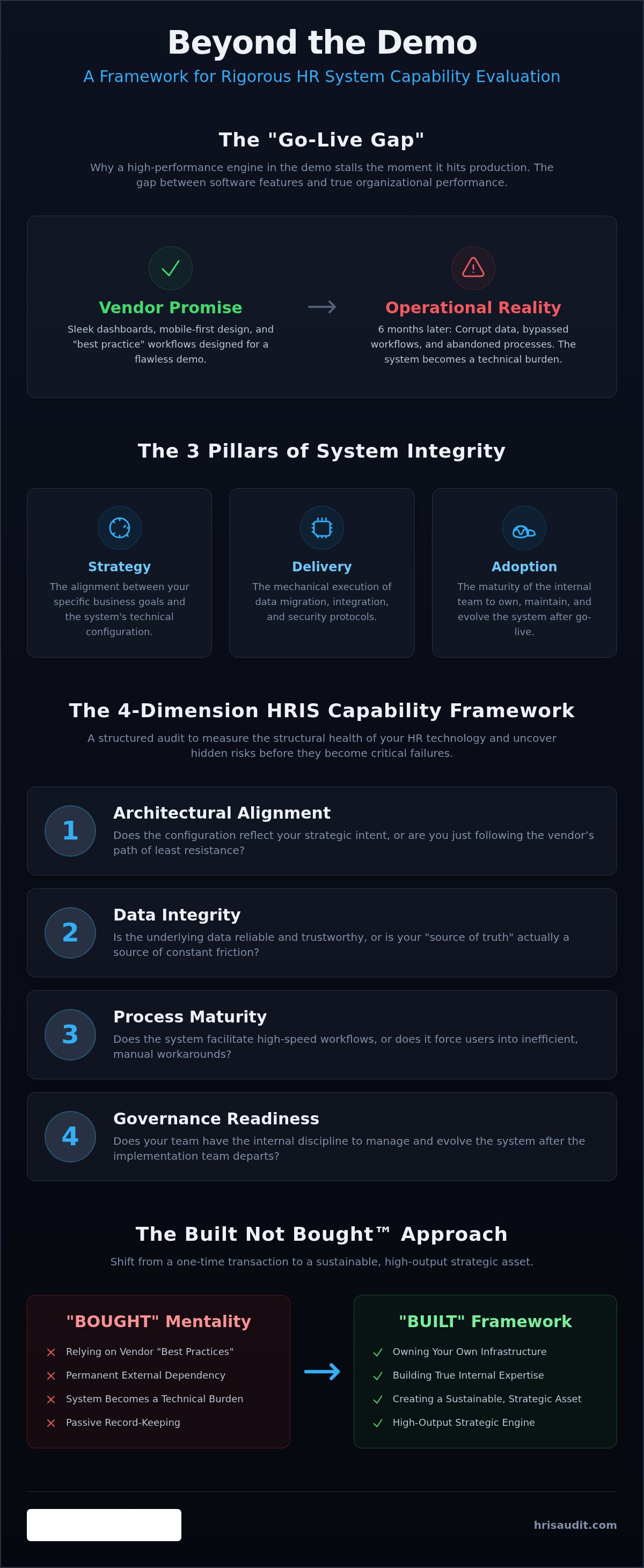
Software vendors sell promises. They demonstrate features. They offer "best practices" that are often just pre-configured templates designed for rapid implementation, not organizational fit. This is the fundamental trap of modern HCM procurement. A true HR system capability evaluation must look past the interface. It must interrogate the structural integrity of the platform. Just because a Human Resource Management System (HRMS) includes a module doesn't mean your organization has the capability to extract value from it.
Capability isn't what the software can do. It's what your organization actually does with it. We see it repeatedly. A system looks flawless at go-live. Six months later, the data is corrupt, the workflows are bypassed, and the "best practices" have been abandoned. This is the Go-Live Gap. It happens when the machinery is built by outsiders who don't understand the long-term operational load. They build for their own exit, not for your endurance.
To move beyond a simple feature checklist, we evaluate three specific pillars of system integrity:
- Strategy: The alignment between your specific business goals and the technical configuration.
- Delivery: The mechanical execution of data migration, integration, and security protocols.
- Adoption: The maturity of the internal team to own, maintain, and evolve the system.
The Illusion of Software Parity
Every demo follows the same script. Sleek dashboards. Mobile-first design. Automated workflows. They create an illusion of parity. Beneath the UI, however, the architectural logic varies wildly. Out-of-the-box solutions often lack the flexibility to handle complex, real-world governance. If you don't define the architecture, the vendor will. Their definition of "Best Practice" is usually whatever makes their implementation faster. It is rarely what makes your business better. You need an HR system capability evaluation that identifies where the software's logic ends and your business reality begins.
Capability as a Structural Motion
Think of your HRIS as a piece of heavy machinery. It requires maintenance, calibration, and skilled operators. Capability is a motion, not a state. It's the disciplined application of governance to ensure the data remains clean and the processes remain relevant. Without internal ownership, you aren't running a system; you're just renting a mess. Real capability transfer happens when your team stops asking the vendor "how" and starts deciding "why." Governance is the steering mechanism. Without it, the machine is useless, regardless of how many features you purchased.
The 4-Dimension Framework for HRIS Capability Evaluation
A superficial audit checks for the presence of features. A rigorous HR system capability evaluation measures the structural health of the entire ecosystem. We analyze technology through four specific dimensions to ensure it can withstand the pressures of real-world operations. If any dimension fails, the system becomes a liability rather than an asset. It ceases to be a tool and starts to be a burden.
- Dimension 1: Architectural Alignment. Does the configuration reflect your strategic intent, or are you just following the vendor’s path of least resistance?
- Dimension 2: Data Integrity. Is the underlying data reliable, or is the "source of truth" actually a source of friction?
- Dimension 3: Process Maturity. Does the system facilitate high-speed workflows, or does it force users into inefficient workarounds?
- Dimension 4: Governance Readiness. Do you have the internal discipline to manage the system after the implementation team departs?
Auditing Architectural Alignment
Alignment isn't accidental. It's engineered. You must conduct a formal gate review of your system design documents before they become code. Look for "hard-coded" limitations. These are the technical shortcuts that seem convenient now but will prevent scaling later. Ensure the architecture supports a Systemic HR Operating Model, where data flows across functions rather than staying trapped in silos. If the foundation is misaligned, no amount of training will fix the resulting friction. It’s better to correct the blueprint now than to rebuild the structure later. This is the core of a disciplined HR system capability evaluation.
Evaluating Data and Process Integrity
Data integrity is the mechanical reliability of your people data. We use a Transformation Pulse Scan to detect risks in data flow before they lead to system failure. This diagnostic approach identifies where the machine is grinding. When processes are cumbersome, managers won't use them. They'll revert to spreadsheets. This creates a data vacuum that starves executive decision-making. You can follow a standard capability assessment guide to map these gaps, but the focus must remain on friction. High-integrity systems produce high-quality outcomes. If the data is broken, the business case is dead. Real capability means the system works as intended, every time, without manual intervention.
How to Execute a System Capability Audit: A Step-by-Step Guide
A disciplined HR system capability evaluation is not a series of casual observations. It is a rigorous, technical audit of your organizational machinery. You aren't looking for minor glitches. You are looking for structural failures that threaten your business case. Execution requires a methodical sequence that moves from strategic intent to mechanical reality. If you skip a step, you risk missing the very friction points that will eventually stall your transformation.
Define the "Future State" requirements before you look at your current configuration. Most leaders make the mistake of auditing the system in a vacuum. You must establish the strategic target first. If you don't know what the machine is supposed to produce, you cannot measure its current efficiency. This target acts as the blueprint for every subsequent diagnostic motion.
Deploying a Transformation Pulse Scan is the next critical move. This diagnostic layer identifies hidden project risks that surface-level reviews frequently miss. It functions as an x-ray for your implementation, exposing cracks in the foundation that the vendor might have ignored. These scans provide the objective data needed to challenge the "green" status reports often presented by implementation teams.
Stakeholder interviews must focus on friction, not wish lists. Wish lists are distractions. They are collections of "nice-to-have" features that often complicate the architecture. Instead, ask where the system fails the user. Where do they revert to spreadsheets? Where do they create manual workarounds? These friction points are the true indicators of a capability gap. Identifying them allows you to prioritize structural fixes over cosmetic changes.
Benchmarking involves comparing your current configuration against the proprietary Field Library standards. This is where you move from "it feels broken" to "here is the evidence." Finally, synthesize these findings into a Capability Roadmap. This is a sober, data-driven report for the project sponsor. It outlines exactly what must be fixed to secure the long-term ROI of the investment.
Utilizing Field Library Workbooks
Objective data is the only currency that matters in a system audit. By using a Field Library License, your team gains access to structured workbooks that strip away subjective opinions. These tools facilitate design sessions that prioritize long-term system health over short-term convenience. They turn diagnostic results into executable action items. You stop debating "best practices" and start enforcing architectural standards that actually work for your specific enterprise.
The Role of Independent Advisory
Your System Integrator cannot objectively audit their own work. They are incentivized to meet deadlines, not necessarily to ensure your long-term ownership. A true HR system capability evaluation requires a platform-agnostic viewpoint. It requires "tough love." Independent Advisory Services provide the necessary distance to deliver a sober report to the executive steering committee. This ensures the leadership team sees the mechanical reality of the system, not just the vendor's polished narrative.
Capability Transfer: Evaluating Your Team's Readiness to Own
Go-live is a milestone. It isn't the finish line. Most organizations confuse user adoption with system ownership. They celebrate because managers can submit a leave request while the actual engine is smoking under the hood. A thorough HR system capability evaluation must assess the team left standing when the consultants vanish. If your internal staff only knows how to use the system rather than how to own the architecture, you've inherited a ticking clock. Ownership is the difference between evolving a platform and merely managing its decline.
The final 10% of a project is the danger zone. This is when fatigue sets in. Documentation is rushed. Knowledge transfer sessions become passive lectures. This is where capability transfer fails. Identifying the skills gap is a matter of survival. Most HR teams are comfortable with data entry. They are rarely prepared for strategic system optimization. This requires a shift from passive participation to active governance. You need three specific elements to survive the hand-off:
- Technical literacy across functional leads.
- A documented governance framework.
- A clear support model for strategic optimization.
The Internal Capability Audit
Assess the technical literacy of your functional leads now. Don't wait for a system failure to find the gaps. You need to know if you have a System Architect or just a System Administrator. An administrator follows a manual. An architect understands the design. We apply the "Built Not Bought" test: Can your team replicate a complex configuration change without external help? If they can't, the capability hasn't been transferred. It has been leased. True HR system capability evaluation requires this level of sober honesty about your internal talent. You can't fix a structural skill gap with a software patch.
Designing for Sustainability
Sustainability requires a governance framework that outlasts the implementation team. It's about building an internal Transformation Studio to facilitate continuous training and evolution. You aren't just maintaining a tool. You are managing a strategic asset. This requires a disciplined approach to Capability Transfer: Ensuring Your Team Can Own the System. Without this structural foundation, the system will eventually drift away from the business strategy. You can secure this transition by engaging Advisory Services to bridge the gap between project delivery and long-term operational health. Don't leave your ROI to chance.
The Built Not Bought™ Approach: Securing Your HR Technology Investment
Buying a system is a transaction. Building one is a strategy. Most enterprise leaders fall into the trap of treating their HCM implementation as a procurement exercise. They sign the contract. They hand over the keys to a System Integrator. They wait for the ribbon-cutting ceremony. This passive approach is why ROI remains elusive. True value is found in client-side leadership. It requires a fundamental shift from a "Go-Live" mindset to a "Sustainable Outcome" mindset. You aren't just installing software. You're re-engineering your organization's central nervous system.
The Built Not Bought™ methodology emphasizes that software is only the raw material. The actual capability of the system is a result of your own organizational discipline. A rigorous HR system capability evaluation reveals if you've built a high-performance engine or just bought a shiny, stationary object. We look for the mechanical reliability of your data. We measure the maturity of your governance. If the system cannot run without a consultant on speed-dial, you haven't built anything. You've simply leased a problem. Real ROI is earned through ownership, not just participation.
To secure your investment, you must move beyond the implementation timeline. You must focus on the structural foundations. This starts with a Transformation Pulse Scan. It's the fastest way to detect immediate capability gaps before they become permanent failures. It provides the sober reality check that vendor status reports often obscure.
Strategic Advisory vs. Implementation
You need an architect to oversee the builder. The System Integrator is the builder. Their goal is speed. Their metric is the go-live date. They want to finish the job and move to the next client. An independent architect, providing client-side Advisory Services, has a different objective. We focus on the structural integrity of the design. We conduct independent gate reviews to prevent program failure. We bridge the gap between your executive vision and the practical machinery of the system. We ensure the builder doesn't cut corners that will haunt your operations for years. This is about protecting your interests, not the vendor's timeline.
Next Steps for Executive Sponsors
Ownership requires the right tools. You can't audit a complex architecture with spreadsheets and gut feelings. You need a disciplined framework. Start by requesting a Pulse Scan to evaluate your current project's health. It provides the data needed for executive decision-making. Equip your team with a Field Library License. This provides the diagnostic workbooks and standards necessary to take control of the transformation. Stop being a passenger in your own project. It's time to Secure your transformation with HRIS Audit.
Transitioning from Software Installation to Strategic Ownership
Your HR technology shouldn't be a black box that only your vendor understands. Real enterprise value is built on architectural integrity and internal governance. We've established that capability isn't a list of features; it's the disciplined motion of your organization. It requires moving beyond the go-live milestone to ensure your team possesses the structural literacy to own the system long-term. This transition is where most transformations fail. It's also where the business case is won or lost.
A rigorous HR system capability evaluation is the first step toward reclaiming control of your technology roadmap. By applying the Built Not Bought™ methodology, you shift from being a passive consumer to a strategic architect. Our independent, client-side leadership experts provide the platform-agnostic "tough love" needed to audit your configuration against our proprietary Field Library of diagnostic workbooks. You don't have to settle for a system that barely functions. You can build an engine that drives your business forward.
Take the first step toward a mature, sustainable HCM ecosystem. Request a Transformation Pulse Scan to evaluate your system's integrity and identify the friction points stalling your progress. It's time to stop renting your results and start owning your infrastructure. Your future state depends on the structural decisions you make today.
Frequently Asked Questions
What is the difference between an HR audit and an HR system capability evaluation?
An HR audit focuses on compliance, policy adherence, and regulatory risk. An HR system capability evaluation interrogates the structural integrity and mechanical output of your technology architecture. While an audit checks if you're following the rules, an evaluation determines if your machinery is actually capable of supporting your business strategy. It’s the difference between checking a driver's license and inspecting the engine's horsepower.
How often should an enterprise evaluate its HRIS capability?
Enterprises should conduct a formal evaluation annually or whenever a significant strategic pivot occurs. Your HRIS is a living system. It drifts. Business requirements evolve, and internal expertise often erodes through turnover. Regular calibration ensures the technology remains aligned with your operational reality rather than becoming a legacy burden that hinders growth. Don't wait for a system crash to measure your health.
Can our System Integrator perform a capability evaluation for us?
A System Integrator cannot objectively audit their own configuration. They are incentivized to prove the success of their implementation, not to expose its structural flaws. True objectivity requires an independent, platform-agnostic advisor who isn't protecting a project timeline. You need "tough love" from someone whose only interest is your long-term system health, not their own billable hours or future software sales.
What are the most common signs that an HR system is losing capability?
The most common sign is the proliferation of shadow systems. When your managers revert to spreadsheets and manual workarounds, your HRIS has failed them. You'll also see accelerating data decay and a growing reliance on external consultants for basic configuration changes. If the system feels like a barrier rather than a conduit for decision-making, you have a capability crisis that requires immediate intervention.
How long does a typical HR system capability evaluation take?
A thorough HR system capability evaluation typically requires four to six weeks of disciplined analysis. This isn't a surface-level survey. It involves deep architectural gate reviews, stakeholder friction interviews, and data flow diagnostics. The timeline depends on the complexity of your HCM ecosystem and the maturity of your existing documentation. Precision takes time; shortcuts lead back to the structural problems you're trying to solve.
What role does data integrity play in system capability?
Data integrity is the mechanical reliability of your entire people operation. It’s the fuel for your strategic engine. If the data is corrupt, every automated workflow and executive dashboard becomes a liability. High system capability is impossible without clean, governed data. You aren't just storing records; you're building a foundation for executive decision support. Without integrity, the most expensive software is just an empty shell.
How do we measure 'adoption' as a metric of system capability?
Adoption isn't measured by login counts or vanity metrics. True adoption is measured by ownership and the absence of workarounds. We evaluate how many strategic processes are completed entirely within the system without manual intervention. We also measure the team's ability to evolve the configuration independently. If they can't own the change, they haven't truly adopted the system; they're just tolerating it.
What is a Transformation Pulse Scan and how does it help?
A Transformation Pulse Scan is a high-speed diagnostic tool designed to detect immediate risks in your system's health. It functions as an x-ray for your implementation or BAU environment. By identifying where the machinery is grinding, it allows leaders to intervene before structural cracks become permanent failures. It’s the first step in moving from a passive go-live mindset to a sustainable, high-output ownership model.


