

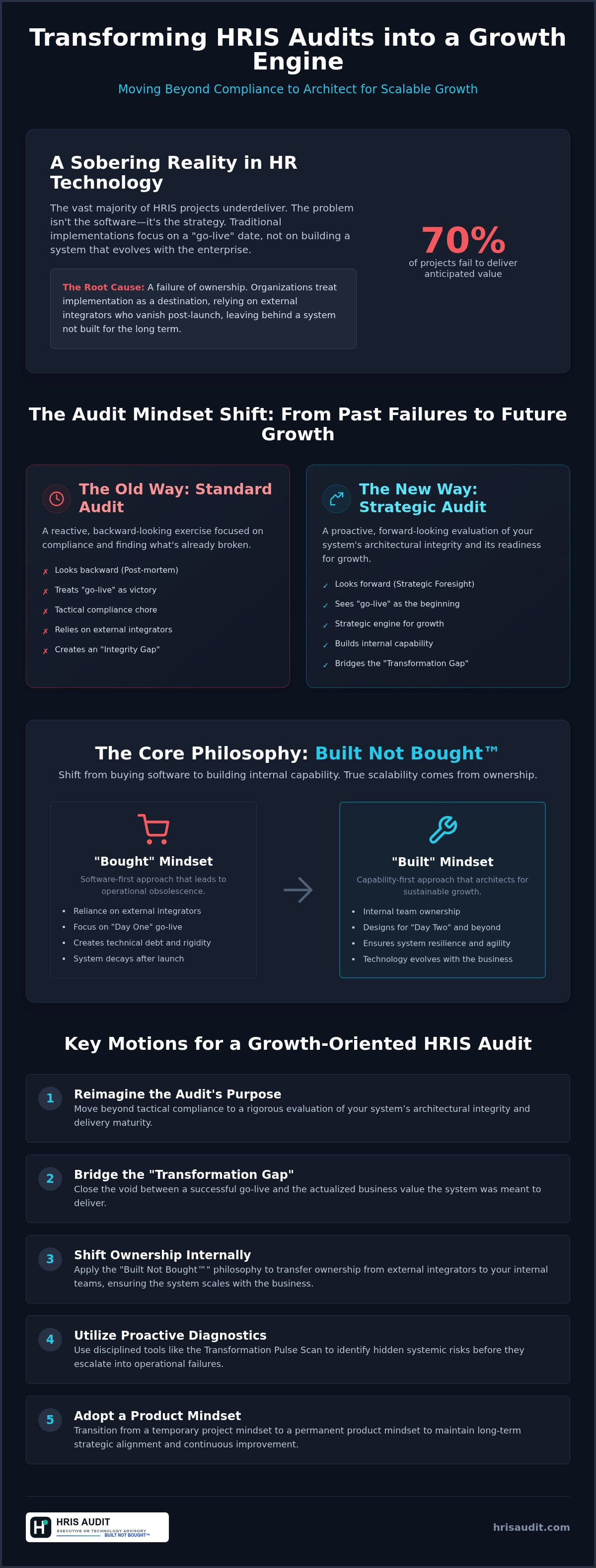
Seventy percent of HR technology projects fail to deliver their anticipated value. It is a sobering reality. The cause is rarely a lack of features; it is a failure of ownership. Most organizations treat implementation as a destination. They rely on external integrators who vanish once the system is live. To break this cycle, you must shift your perspective. Implementing robust HRIS Audit strategies for growth is not about checking boxes. It is about architecting a system that evolves with your enterprise. It is about structural integrity.
You have likely felt the constraints of a system that doesn't scale. You have seen the Integrity Gap between vendor promises and operational reality. We agree that a go-live is not a victory; it is merely the beginning. This guide will show you how to transform your audit from a tactical compliance chore into a strategic engine for sustainable growth. You will discover how to move beyond being a passive consumer to becoming a battle-tested architect. We will examine the transition from buying software to building internal capability, ensuring your technology remains aligned with your expansion.
Key Takeaways
- Move beyond tactical compliance by reimagining the audit as a rigorous evaluation of your system’s architectural integrity and delivery maturity.
- Execute HRIS Audit strategies for growth that bridge the "Transformation Gap" between a successful go-live and actualized business value.
- Apply the "Built Not Bought™" philosophy to shift ownership from external integrators to internal teams, ensuring the system scales with the business.
- Utilize disciplined motions like the Transformation Pulse Scan to identify hidden systemic risks before they manifest as operational failures.
- Transition from a temporary project mindset to a permanent product mindset to maintain strategic alignment during enterprise expansion.
Beyond Compliance: Reimagining the HRIS Audit as a Growth Engine
A standard audit is a post-mortem. It looks backward to ensure you haven't broken the law. A strategic HRIS audit looks forward. It is a rigorous evaluation of architectural integrity and delivery maturity. Does the machinery work? Can it sustain the load of a global workforce? Most leaders confuse a successful software launch with organizational readiness. They shouldn't. True HRIS Audit strategies for growth prioritize the structural foundation over the superficial interface. This isn't about checking boxes. It's about ensuring your system can survive the friction of rapid expansion.
The growth paradox is real. Organizations spend millions "buying" a top-tier Human Resource Management System (HRMS), yet they find themselves in operational stagnation months later. The reason is simple. You cannot purchase maturity. You cannot outsource ownership. When you rely solely on vendor promises, you inherit their limitations. Shifting from checking boxes to evaluating foundations is the only way to prepare for global expansion. Implementing HRIS Audit strategies for growth requires client-side leadership to bridge the gap between what the software can do and what the business actually needs. It's the difference between being a passenger and being the pilot.
The Architecture of Scalability
Growth requires a platform-agnostic view. Your technology stack is an ecosystem, not a series of silos. If you focus only on the specific tool, you miss the systemic flaws. Technical debt in your HRIS acts like rust in a machine. It slows down rapid organizational changes. It prevents agility. The 2026 digital economy demands a system that is resilient, not just functional. Misalignment isn't just a technical glitch. It's a strategic liability. It creates friction where there should be flow. It forces your people to work for the system rather than the system working for the business. You must identify where the system is rigid and where it is built to bend.
Audit as Strategic Foresight
Diagnostics should predict implementation bottlenecks before they stall your momentum. Moving from reactive fixes to proactive systemic design is the mark of a mature organization. A strategic audit is a diagnostic for organizational health, not just legal safety. It reveals if your team has the capability to own the technology long-term. To begin this evaluation, a Transformation Pulse Scan can detect hidden systemic risks that standard reviews ignore. This tool allows you to see around corners. It exposes the "Integrity Gap" before it becomes a financial drain. Stop fixing symptoms. Start designing for the future. Does your current audit process provide a roadmap for the next three years, or just a report on the last twelve months?
The 'Built Not Bought' Philosophy: Architecting for Scalable Ownership
Buying a license is not a strategy. It's a transaction. The "Software-First" mindset is the fastest route to operational obsolescence. Software is a tool, not an architect. Effective HRIS Audit strategies for growth demand that you build your internal capability alongside your technical configuration. This is the core of the "Built Not Bought™" philosophy. It rejects the dangerous idea that an external integrator can hand you a finished, sustainable solution. If your team didn't build the underlying logic, they don't own the result. Without ownership, scalability is impossible.
Designing for "Day Two" is the real architectural challenge. Day One is the go-live; it's the celebratory milestone. Day Two is when the integrator leaves and the reality of enterprise complexity sets in. Without a structural foundation, the system begins to decay immediately. You need a Human Resources System Audit framework that prioritizes long-term ownership over short-term implementation speed. Strategic governance is the ultimate growth lever. It ensures that your technology serves the business expansion, rather than the business serving the software's limitations. Leaders who want to master this shift should consult the Built Not Bought book for a deeper breakdown of these mechanics.
Governance as a Growth Multiplier
Governance is not about restriction. It is about direction. A framework that survives leadership transitions is essential for global scalability. We focus on three pillars: Strategy, Delivery, and Adoption. Strategy defines the "why." Delivery manages the "how." Adoption measures the "impact." If one pillar is weak, the entire structure eventually collapses under its own weight. You must establish these protocols before the first line of code is configured. Explore our frameworks for sustainable system design to see how these pillars integrate into a cohesive, high-performance operating model.
The Field Library: Tools for Structural Integrity
Standardization is the enemy of organizational chaos. The Field Library provides the workbooks and facilitation guides necessary to enforce discipline across your implementation lifecycle. These aren't just generic templates. They are precision instruments for executive decision support. They force clarity where there is usually ambiguity. They demand consensus where there is usually conflict. By using these standardized tools, you ensure that every architectural decision is documented, defensible, and repeatable. This process is the engine of capability transfer. It systematically moves your organization from being vendor-dependent to being internally-driven. You stop asking the integrator what the system can do. You start telling the system what the business requires. This is the only way to ensure your technology remains a strategic asset as you scale. HRIS Audit strategies for growth must include these tactical tools to ensure the high-level vision is actually executed on the ground.
Diagnosing the Transformation Gap: Why Standard Audits Stifle Growth
Standard audits are compliance anchors. They keep you safe but static. Strategic HRIS Audit strategies for growth identify the "Transformation Gap." This is the canyon between a successful technical launch and the delivery of long-term business value. Most Big 4 models fail here. They audit for legal safety. They ignore architectural maturity. They count the bolts but forget to check if the engine is connected to the wheels. Big 4 auditors are trained to find missing signatures; they aren't trained to find missing logic in your organizational design. If your audit doesn't evaluate your team's ability to maintain the system, it's incomplete. It's a false sense of security that stifles agility. You don't need a checklist. You need a blueprint for maturity.
Identifying red flags before they become catastrophic is the primary function of a strategic review. Is your workforce data still being corrected in manual spreadsheets? Are your managers bypassing the system because the interface is too rigid? These are not "user errors." They are symptoms of structural failure. When you ignore these signals, you build your enterprise on a foundation of sand. A growth-oriented audit treats these inefficiencies as systemic risks that must be engineered out of the process.
The Mirage of 'Go-Live' Success
Go-live is not a victory. It is an entry point. Approximately 70% of HR technology projects do not deliver their anticipated value. This is a failure of ownership. Launching software is a technical exercise. Transforming a business is a leadership discipline. If your post-launch reality involves manual workarounds and shadow systems, you haven't succeeded; you've merely digitized your dysfunction. Understand that Go-Live is just the beginning of the leadership journey. You must bridge the gap between "it works" and "it creates value."
Vendor Bias vs. Objective Advisory
Never let the implementation partner audit the system. It is a fundamental conflict of interest. Objective due diligence requires independent, client-side leadership. You need battle-tested advisors who have seen these patterns before. They recognize the "Integrity Gap" between what was promised in the sales cycle and what was actually delivered in the tenant. Utilizing Five Effective Strategies for Conducting an HR Audit can provide a baseline for compliance, but true expansion requires a platform-agnostic perspective. This is where HRIS Audit strategies for growth become both defensive and offensive. They protect your investment while clearing the path for organizational expansion. Don't ask the barber if you need a haircut. Seek independent pattern recognition to ensure your architecture is actually built for the long haul.
Five Strategic Audit Motions to Fuel Organizational Expansion
Discipline is the bedrock of scalability. To move beyond the limitations of a standard compliance check, you must adopt a series of deliberate motions. These HRIS Audit strategies for growth are designed to stress-test your system's structural integrity. They force you to confront the reality of your implementation before the market does. If your audit doesn't challenge your underlying assumptions, it's not an audit. It's a rubber stamp. Success requires a methodical approach to identifying friction and building resilience.
- Motion 1: Execute a Transformation Pulse Scan to detect hidden systemic risks.
- Motion 2: Conduct a Gate Review to validate architectural decisions before commitment.
- Motion 3: Perform a Capability Transfer assessment to ensure internal ownership.
- Motion 4: Align HR technology strategy with the 3-year business growth map.
- Motion 5: Reset the program focus from 'technical delivery' to 'people-centric outcomes'.
Most organizations fail because they treat these motions as optional. They aren't. They are the essential machinery of a high-performance HR function. Without them, you are simply hoping for the best. Hope is not a strategy. You must engineer your outcomes through rigorous, repetitive, and disciplined evaluation. This is how you move from a reactive posture to a proactive engine for enterprise expansion.
The Pulse Scan: Rapid Risk Detection
Complexity breeds blindness. A project can look "green" on a status report while being fundamentally broken beneath the surface. A 15-minute diagnostic can save a multi-million dollar implementation by exposing the truth. It identifies misalignment between sponsors, delivery teams, and end-users. It reveals the friction points that stall momentum. By detecting these risks early, you can course-correct before the cost of change becomes prohibitive. Detect your project risks with a Pulse Scan. Stop guessing. Start measuring the structural health of your transformation.
Capability Transfer: The Ultimate Exit Strategy
Reliance on external advisors is a tax on your future growth. You must measure your team's ability to govern and evolve the HRIS independently. This is not about basic training. It's about architectural maturity. Are you building a Transformation Studio environment for continuous learning? Or are you just paying for perpetual support? True HRIS Audit strategies for growth prioritize the transfer of knowledge over the delivery of features. You need an exit strategy for your consultants. You need a team that can pilot the ship, not just follow a manual. If you can't run the system without the integrator, you don't own the system. You are merely renting it. Capability transfer is the bridge from vendor dependence to strategic autonomy.
Start your Transformation Pulse Scan today
Securing the Future: Moving from Go-Live to Sustained Performance
The project mindset is a trap. It suggests a finish line. In reality, the most successful enterprises view their HR infrastructure as a product, not a project. A project has an end date; a product has a lifecycle. Sustained performance requires a fundamental shift in how your organization perceives its technology. You must move from the frantic energy of implementation to the disciplined rhythm of product management. Implementing HRIS Audit strategies for growth means ensuring your system evolves at the same pace as your business strategy. If your technology remains static while your company expands, you are building on a fault line.
Executive engagement often evaporates after the initial go-live. This is a failure of leadership communication. Sponsors need ongoing decision support to maintain the system's strategic alignment. They don't need technical updates. They need to know how the HRIS is fueling organizational expansion and where the structural risks reside. By treating the audit as a permanent governance motion, you provide the C-suite with the clarity they need to protect their investment. Success is not found in the software itself. It's found in the maturity of the people who own it.
The Leader's Library for Transformation
A common language is the foundation of structural discipline. Without it, HR, IT, and Finance operate in silos, creating friction and technical debt. Every HR tech sponsor needs a methodology that transcends the specific software being used. This is why the "Built Not Bought" philosophy is critical. It provides the architectural framework for long-term ownership. Leveraging licensed field libraries ensures that your team maintains the same level of rigor years after the integrator has departed. It's about preserving the original intent of the system while allowing it to bend under the weight of new requirements. Get the blueprint for sustainable HR systems and establish the common language your leadership team lacks.
Next Steps: From Audit to Action
An audit without action is a wasted exercise. To maximize impact, you must socialize your findings with the C-suite in a way that translates technical risk into business consequence. Don't present a list of bugs. Present a roadmap for maturity. Prioritize remediation efforts based on their potential to unlock growth or mitigate catastrophic failure. The goal is to move from reactive patching to proactive systemic design. This transition is what separates market leaders from those who are perpetually stalled by implementation failures. HRIS Audit strategies for growth are only effective when they lead to a disciplined execution of remediations. The most resilient companies understand that the audit is the first motion in a continuous cycle of improvement. If you are ready to evaluate your current trajectory, the time for an objective perspective is now. Contact HRIS Audit for a strategic program review and begin architecting a system that truly scales.
Mastering the Machinery of Enterprise Expansion
Scalability is not a software feature. It is the result of disciplined governance and internal ownership. You must move beyond the "go-live" mirage to focus on the long-term structural health of your enterprise. True HRIS Audit strategies for growth ensure your technology serves your expansion rather than restricting it. We've identified these patterns through 30 years of client-side leadership. The "Built Not Bought™" methodology and our battle-tested frameworks for HCM governance provide the stability you need to lead with confidence. Stop relying on external integrators to define your future. It's time to take the pilot's seat and own the machinery of your transformation.
Success requires a shift from a temporary project mindset to a permanent product mindset. It demands that you bridge the Integrity Gap with objective, platform-agnostic diagnostics. You have the tools and the framework to architect a system that scales. Now, you must execute the motions required to secure that future. Your growth doesn't have to be limited by your systems. Build a foundation that lasts and transforms your HR function into a strategic engine for the entire business.
Secure your enterprise transformation with a Strategic Pulse Scan
Your journey toward sustainable ownership starts with a single diagnostic step. We're here to ensure you never have to buy your maturity again. Build it instead.
Frequently Asked Questions
What is the difference between a compliance audit and a strategic HRIS audit?
Compliance audits look backward at legal safety and administrative handbooks. Strategic HRIS audits look forward at architectural integrity and delivery maturity. They evaluate if the system can sustain the load of a global workforce. While a compliance check ensures you aren't breaking the law, a strategic review ensures your technology isn't breaking your business.
How do HRIS audit strategies directly support company growth?
These strategies remove the friction of technical debt and ensure the system scales with the business. Implementing HRIS Audit strategies for growth allows leaders to identify systemic risks before they manifest as operational failures. By architecting for ownership, you ensure the internal team can adapt the technology to new market demands without waiting for an external integrator.
When is the best time to conduct an HRIS audit during a transformation?
The best time is before significant commitments are made, typically through a Gate Review or a Transformation Pulse Scan. However, auditing is a continuous motion that should occur at every major milestone. Don't wait for a total system failure; use diagnostics early to predict bottlenecks and ensure the foundation remains structurally sound throughout the implementation lifecycle.
Can an HRIS audit help fix a failing Workday or SAP implementation?
Yes, by exposing the "Integrity Gap" between vendor promises and operational reality. An audit identifies where the logic of the configuration has diverged from the needs of the business. It provides a blueprint for remediation, focusing on structural integrity rather than superficial fixes. This process moves the project from a state of "technical delivery" to one of "business value."
What are the common red flags that indicate an HRIS needs a strategic reset?
High reliance on external integrators and the persistence of manual workarounds are the primary indicators of failure. If your managers are using shadow spreadsheets to correct system data, your architecture is broken. Other red flags include a lack of internal governance and a "Software-First" mindset that prioritizes features over functional capability. These are symptoms of a system that is built to fail, not to scale.
How does the 'Built Not Bought' method impact long-term ROI?
The Built Not Bought™ method drastically reduces long-term operational costs by eliminating perpetual consulting spend. It focuses on capability transfer, ensuring your internal team possesses the specific knowledge to pilot the technology. This ownership translates to higher ROI because the system remains agile and effective long after the implementation partners have left the building.
Is an independent advisor better than a Big 4 firm for HRIS auditing?
Independent advisors provide an objective perspective that is free from the conflicts of interest found in integrator-led audits. Big 4 firms often focus on administrative compliance rather than strategic architecture. A battle-tested independent advisor brings "pattern recognition" from decades of industry experience, acting as a guardian of the client’s interests rather than a vendor’s bottom line.
How much internal effort is required for a Transformation Pulse Scan?
A Transformation Pulse Scan requires approximately 15 minutes of input from key stakeholders. It is a rapid diagnostic designed to detect hidden systemic risks without disrupting the daily flow of work. Despite its speed, it provides high-level executive clarity on whether the project is on a path to success or heading toward a catastrophic failure.


